Therapy 02 / 04
Sermorelin
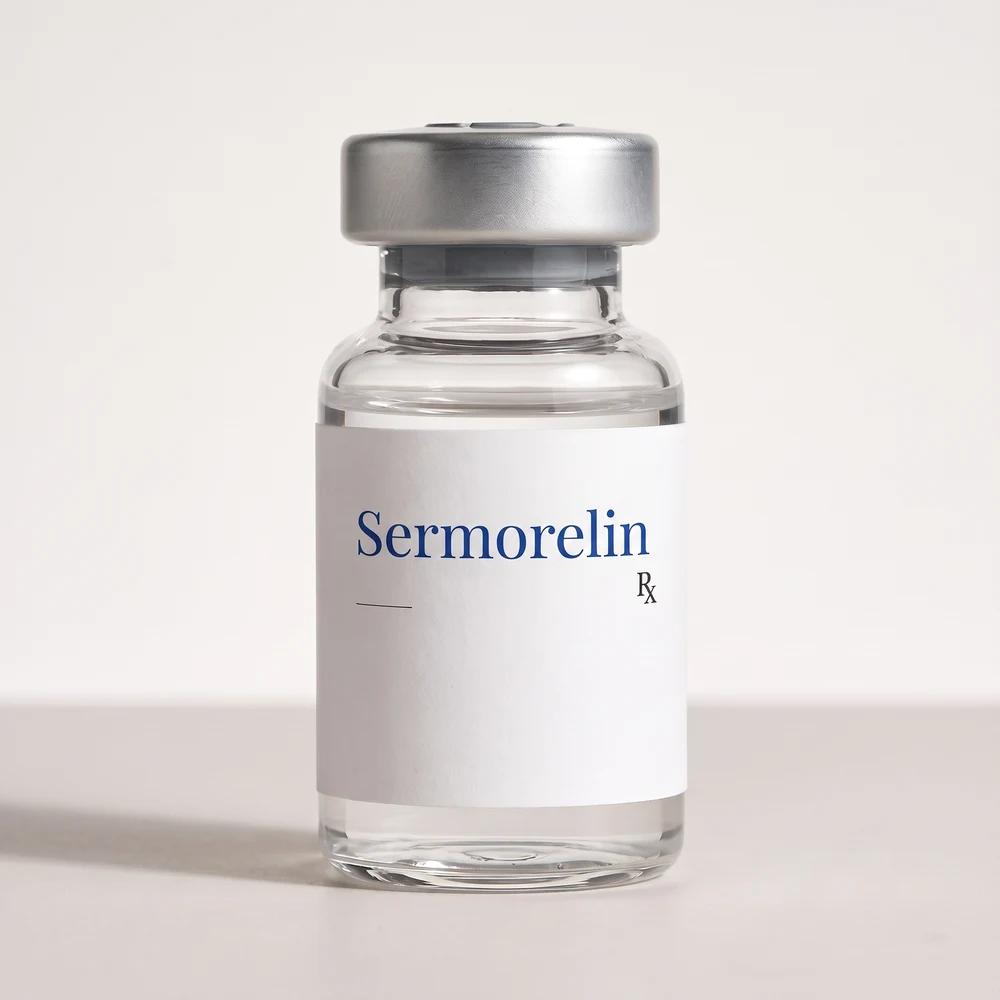
Sermorelin 9 mg injection. Understand the option before considering care.
- Injectable
- 9 mg
- Supply: 9 mL
- Prescription required
Compound references (not image sources): Sermorelin · PubChem CID 16132413
01
What it is
Sermorelin is a peptide based on part of growth hormone–releasing hormone, a signal involved in regulating growth hormone. The listed prescription product is a 9 mg injection.
It is different from taking growth hormone itself. That distinction does not establish that it is safer or appropriate for any particular person.
02
How it works
Sermorelin stimulates growth hormone release from the pituitary rather than supplying growth hormone directly.
A biological mechanism is not proof of a clinical outcome. Ask what evidence applies to the proposed formulation and why a clinician would consider it in your circumstances.
03
Questions about benefits
Useful questions for your clinician include:
- What evidence supports the proposed use?
- Are other explanations worth assessing?
- What are the risks and alternatives?
- Would evaluation or testing be needed?
- How would follow-up be planned?
Better sleep, muscle gain, fat loss, recovery or skin changes are not assured.
04
Who it's for
Suitability starts with a discussion of:
- Your health history and concerns
- Current medicines and supplements
- Previous treatments and evaluations
- Expectations and alternatives
05
How you use it
Your prescriber and dispensing pharmacy provide the specific administration instructions if treatment is prescribed. Do not infer a dose or schedule from general descriptions of sermorelin.
06
What to expect
Before treatment
Discuss your history, goals and the evidence with a clinician.
If prescribed
Review directions and follow-up with your prescriber and pharmacy.
At follow-up
Discuss your experience and whether continuing is appropriate.
There is no promised outcome or timetable. A clinician should review whether treatment remains appropriate rather than assuming a longer supply guarantees a benefit.
Plans
Pricing
Sermorelin
1 Month
$219/mo
$219 total
- Save $30
3 Months
$209/mo
$627 total for 3 months
- Best ValueSave $120
6 Months
$199/mo
$1,194 total for 6 months
Listed medication supply prices include the initial clinical review and standard shipping. A licensed provider must approve treatment before anything is prescribed. Eligibility and availability vary.
07
Safety
Side effects
Possible side effects may include:
- Redness, swelling, or itching where you inject
- Flushing
- Headache
- Dizziness
Sermorelin is not right for everyone. Tell your provider if you have or have had cancer, a thyroid condition, or are pregnant or breastfeeding. Your provider may order labs before you start.
Evidence
The Research
Sermorelin has been studied since the 1980s. It was once FDA-approved (sold as Geref) to test for and treat growth hormone deficiency in children. The drugmaker stopped selling it in 2008 for business reasons, not safety reasons. Research on Sermorelin for healthy aging in adults is more limited, and larger studies are still needed.
- Sermorelin: a better approach to management of adult-onset growth hormone insufficiency?(opens in a new tab)
Clinical Interventions in Aging, 2006 · via NIH PubMed Central
A review explaining how Sermorelin helps the body make its own growth hormone. It also explains why this may be a gentler approach than taking growth hormone directly.
- Sermorelin: a review of its use in the diagnosis and treatment of children with idiopathic growth hormone deficiency(opens in a new tab)
BioDrugs, 1999 · via PubMed
A detailed review of how Sermorelin works, how well it worked in clinical studies, and how well patients tolerated it.
How it works in the body
Growth hormone release starts in the brain. A region called the hypothalamus sends a signal, GHRH, to the pituitary gland, which then releases growth hormone in pulses. Sermorelin is a copy of the active part of that GHRH signal. The body's own feedback systems still control how much growth hormone gets released.
- Physiology, Growth Hormone(opens in a new tab)
StatPearls · NIH National Library of Medicine Bookshelf
A medical reference explaining how the brain signals the pituitary to release growth hormone, and what growth hormone does in the body.
- The gatekeepers of growth: the neural roles and regulation of growth hormone-releasing hormone neurons(opens in a new tab)
via NIH PubMed Central
A recent review of the brain cells that make GHRH, the natural signal Sermorelin is based on.
Studies are shared for education. Many were done in labs, in animals, or with forms and doses different from our prescriptions. They are not a promise of results. Talk to your provider about what the research means for you.
08