How Can I Describe Patchy Hair Loss Before a Clinician Review: What to Record
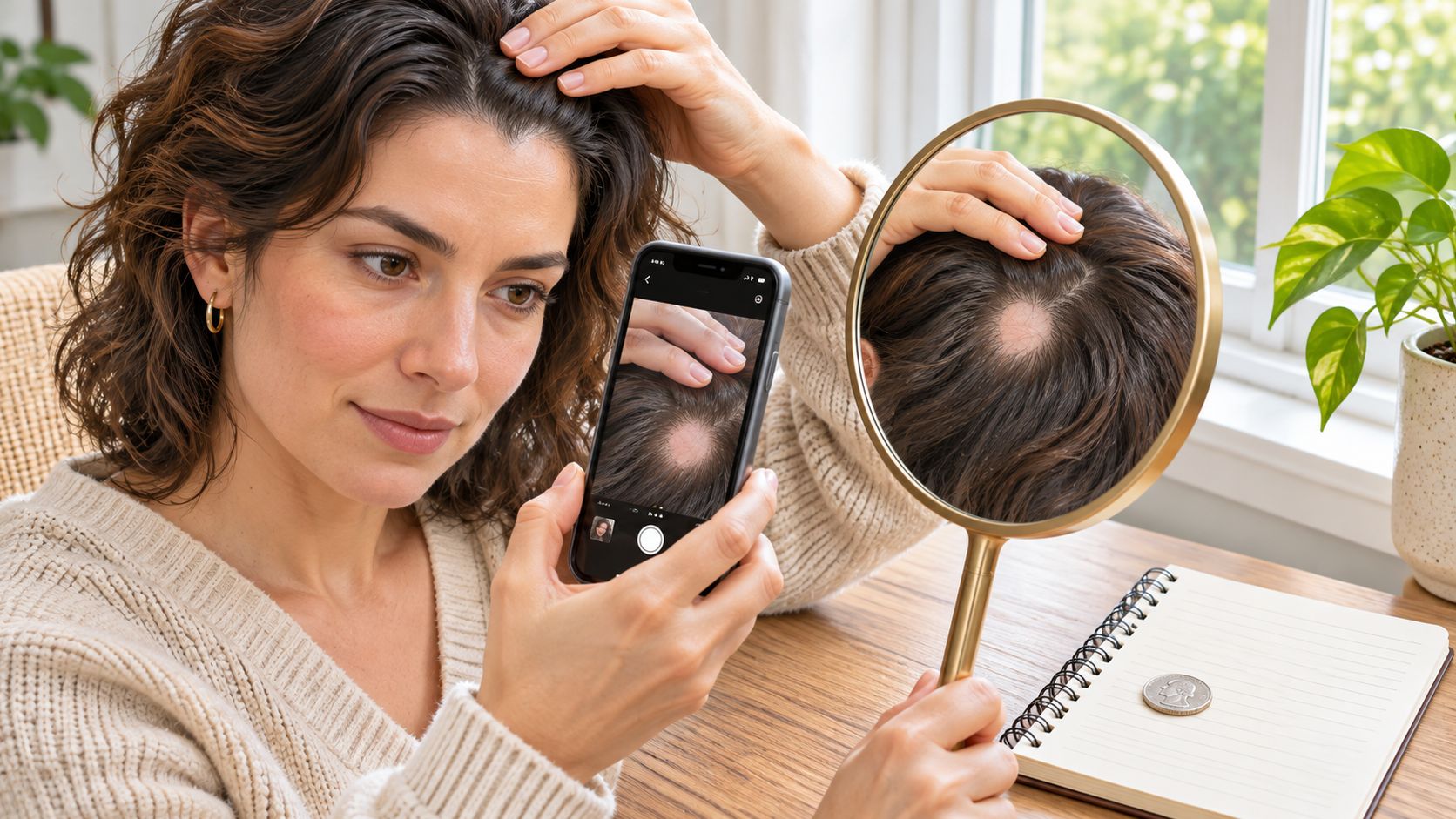
How can I describe patchy hair loss before a clinician review? Learn what to note about location, timing and skin, plus evidence limits and when to seek care.
A useful description names the spot, when it was first noticed, roughly how wide it is and what the skin looks like, such as a smooth round patch on the left side of the scalp about 2 cm wide, first noticed three weeks ago, and that description isn't a diagnosis. Most notes about a bald spot stop at a single word, thinning, and then ask the reader to guess the cause. What happens if the guess is dropped and the date, the width and the skin surface are written down instead?
The same patch reads very differently in those two versions. "Thinning on top" leaves a clinician starting from zero. "A coin-shaped bare patch above the right ear, first seen on the 4th, about 2 cm across, skin smooth and pale, no itch" gives a timeline that can be checked against an examination. Readers searching for how can I describe patchy hair loss before a clinician review usually want a label, and the more useful answer is a record.
Table of Contents
- Write One Sentence That Describes the Patch
- Record Location, Timing and Skin Appearance
- Note Symptoms, Other Hair Areas and Past Episodes
- Describe a Patch That Has Faded or Regrown
- How to Photograph and Track a Patch Over Time
- Take Your Description to an Independent Clinician
Write One Sentence That Describes the Patch
One neutral sentence, written per patch, does most of the work. It answers the first four questions a clinician is likely to ask, in the order they're usually asked.
A smooth, round patch on the left side of the scalp, about 2 cm wide, first noticed three weeks ago, not painful or itchy, with no change in the past week.
That wording is an illustration of the format, not a real case and not a description of any particular condition. Each clause carries one job:
- Where: the body area and the side, so the clinician knows which region to inspect first.
- When: a date or an approximate interval, which turns a complaint into a timeline.
- How big: an approximate width, since size is easier to compare later than a vague adjective.
- What the skin looks and feels like: smooth or scaly, comfortable or itchy, which is often the detail that redirects the examination.
- What's changed: stable, wider, or filling in, because direction of change matters as much as appearance.
Notice what the sentence leaves out on purpose. There's no guessed condition, no medicine name offered as an explanation, and no bare word like "thinning" unless specifics follow it. A reader who writes "probably stress" has added a theory the clinician must then unwind, which costs time and can anchor the conversation in the wrong place.
Write the sentence first, then fill in the finer detail in the worksheet below it. Date the note itself separately from the date the patch was noticed, so a note written from memory two months later doesn't become a note written at the time.
Draft one sentence for each patch noticed, keep them somewhere readable during the review, and expect follow-up questions. A short note is a starting point for a history, not a finished one.
Record Location, Timing and Skin Appearance
Patchy hair loss describes a visible pattern, not a diagnosis, and alopecia areata is one important cause clinicians consider: an autoimmune condition that typically produces non-scarring, round or oval areas of hair loss on the scalp, beard, eyebrows, eyelashes or other body sites, according to a systematic review of alopecia areata published in PubMed Central. The same review reports that first onset is most common during the third and fourth decades, although it can begin at any age. That's background for understanding why a clinician asks about timing, not a reason to assign a cause to a patch at home.
Why location and timing carry the most weight
Location tells the clinician whether one region is involved or several, and those two situations prompt different questions. The American Academy of Dermatology's overview of alopecia areata symptoms describes sudden, sharply defined round or oval areas of smooth hair loss on the scalp or beard, with skin that often looks normal, and notes that some people notice itching, tingling, burning, mild redness or scaling before or during the loss. Additional patches can develop, and eyebrows or eyelashes may be affected too. So a note that says "scalp only, one patch" and a note that says "scalp plus a thinner left eyebrow" send the examination down different paths, even when the scalp looks similar in both.
Turning shape and skin into everyday words
Technical vocabulary isn't needed. A round patch can be described as coin-shaped, an oval one as egg-shaped. A sharp border looks like a line drawn with a ruler, while a blurred border fades gradually into the surrounding hair. Smooth skin with ordinary color and visible pores is the pattern commonly described in non-scarring hair loss; skin that looks scaly, red, shiny, crusted or swollen changes what a clinician checks next.
For size, use a reference anyone can find: a pencil eraser, a dime, a quarter. Measurements are approximate, and saying so is more honest than a false-precise number. Skip labels such as "bald spot" or "dandruff" as shorthand for the cause, because both smuggle in an explanation.
| Detail | What to write | Why it helps |
|---|---|---|
| Location | Scalp, beard, eyebrows, eyelashes or other body hair; name the side | Shows whether one area or several are involved |
| First noticed | Date or approximate time, such as about three weeks ago | Sets the timeline for the clinician |
| Speed of onset | Sudden or gradual | Separates rapid from slow change |
| Number and size | Count the patches; give approximate width in centimeters or compare with a coin | Shows whether patches are solitary or multiplying |
| Shape and border | Round or oval, coin-shaped or irregular; sharp or blurred edge | Describes the pattern at the edge |
| Skin surface | Smooth, scaly, red, crusted, scarred or shiny | Separates smooth patches from inflamed skin |
| Broken or short hairs | Present or absent at the edge of the patch | Relevant to hair-shaft examination |
| Change since onset | Stable, enlarging, merging or regrowing | Documents progression or recovery |
Fill one line per row for each patch, and flag any blank field as something to check in a mirror before the review rather than guess at during it.
Note Symptoms, Other Hair Areas and Past Episodes
The second half of a good description is history, and it's used alongside the examination rather than instead of it. Three short lists cover most of what a reader can observe without interpreting.
Symptoms and when they showed up
Record whether the patch itches, hurts, burns or tingles, and whether the sensation started before, during or after the hair loss appeared. Timing is the useful part. The nuance worth knowing is that symptoms alone don't sort causes: Medscape's clinical review of alopecia areata explains that classic patches are sharply defined and smooth with little or no inflammation, while scaling or marked inflammation should prompt consideration of alternatives such as tinea capitis, especially in children, yet mild itch, burning or tingling can occur with alopecia areata itself. So "itchy" isn't evidence of infection, and "not itchy" isn't evidence against one.
Other hair-bearing areas and nails
Check the beard, eyebrows, eyelashes and body hair, and write down anything that has changed, even slightly. Look at fingernails and toenails for small pits, ridges or roughness, and describe them plainly rather than naming a condition. Distribution and nail findings can materially shape a clinical assessment, which is why a scalp-only note may be incomplete. Readers who've also noticed more hair coming out at the root may find the plain-language explanation of hair falling out with a white bulb useful background for what they're seeing in the brush.
History the reader can observe, not explain
- Earlier episodes: whether patches appeared before, roughly how long they lasted, and whether hair returned without treatment.
- Recent events: illness, surgery or a major life stress, with approximate dates rather than a causal claim.
- Hair practices: tight ponytails, braids, extensions, or frequent pulling or twisting, described as habits and frequencies.
- New products and medicines: names exactly as printed on the label, including supplements, plus the start date.
- Family history: thyroid disease, vitiligo, eczema or other autoimmune conditions, noting who and how it was diagnosed if known.
Keep observation and explanation in separate columns. "Started a new supplement in March" is an observation. "The supplement caused this" is a theory, and it belongs to the clinician to test.
A normal-looking patch can still need examination, and a worrying-looking one may turn out to be straightforward. Bring the three lists as lists.
Describe a Patch That Has Faded or Regrown
A patch that's already filling in is harder to describe than a fresh one, and it's the situation where a written timeline earns its keep. A prior episode that regrew is strongly suggestive of alopecia areata in a clinician's reasoning, but diffuse or partially regrown disease can be difficult to recognize, and active disease may be identified through examination and trichoscopy rather than appearance alone, as outlined in a PubMed Central review of alopecia areata assessment. A scalp that looks normal today doesn't establish that nothing is happening.
Rebuilding the timeline works best as a sequence:
- Search dated photos, calendar entries or messages from the months before the patch was noticed. A haircut photo or a holiday snapshot often shows the area more clearly than memory does.
- Write the first date a gap was visible, its approximate width at the largest point, and roughly when it began to fill in.
- Note whether regrowth is even or patchy, whether new hairs are fine or light-colored at first, and whether any hairs are short or broken.
- List prior episodes and how long each lasted, including small or unclear ones that were never mentioned to anyone.
- Record whether a patch has returned in the same place, since recurrence at one site is a different detail from a new site.
These notes are more useful than a general label such as "stress hair loss," which assigns a cause the reader can't verify and may close off other questions.
Mark memory-based estimates as estimates. Writing "about 2 cm, from memory, not measured" tells the clinician exactly how much weight to give the number, and it's more valuable than a confident figure that can't be traced. The clinician decides what the reconstructed timeline means.
How to Photograph and Track a Patch Over Time
Change over time often says more than any single image, and a simple routine makes images comparable. Guidance from DermNet's alopecia areata topic page recommends photographs taken in consistent lighting and from the same angles, with a ruler or familiar object for scale, and advises against applying hair fibers or styling products immediately beforehand when images are intended for review.
- Use daylight near a window. Soft, even light shows the skin surface and the patch edge. Skip flash, which flattens texture and washes out redness or scale.
- Take a wide view first. Show the whole scalp, beard or area so the patch's position is obvious. Without context, a close-up could be from anywhere.
- Then a straight-on close-up with a scale object. Place a ruler or a coin beside the patch, not on top of it. A familiar object turns "looks bigger" into a comparison someone else can repeat.
- Keep angle and distance fixed. Same spot, same parting, same head position each time. Otherwise a change in lighting or tilt masquerades as a change in hair.
- Photograph before products go on. Fibers, tinted sprays and heavy oils can conceal a patch or fill in its border, which defeats the purpose of the record.
- Name each file with the date and the area. Something like "2024-05-04 left scalp" sorts itself and prevents mixing up sides months later.
- Repeat at a steady interval and add a note. Every few weeks is workable for many people. Alongside each set, write one line about size, number of patches and any symptoms.
Readers tracking a patch near the top of the head may also want the plain description of thinning at the crown of the head, since that area is notoriously hard to photograph consistently without a mirror or a second person.
Photos support the written description; they don't replace an examination, and comparing images online can't establish a cause.
Take Your Description to an Independent Clinician
Population figures explain how common a condition is, not what a particular patch is. Alopecia areata carries an estimated lifetime risk of about 2% in the general population and an approximate prevalence of 1 in 1,000, and a diagnosis can't be confirmed from a photograph or symptom description alone, because infections, inflammatory disorders, traction and other forms of alopecia produce overlapping appearances, per the StatPearls reference on alopecia areata. A clinician generally relies first on history and physical examination, including the scalp, beard, nails and individual hairs.
Examination can add clues a mirror can't. The American Academy of Dermatology's alopecia areata treatment page notes that dermoscopy or trichoscopy may show yellow dots, black dots, short tapered hairs, broken hairs or fine vellus hairs, and that uncertain cases may lead to a fungal culture, selected blood tests or a scalp biopsy, often at the edge of an active patch. Routine screening for every autoimmune disease isn't supported for everyone; testing follows the history and examination.
Matching symptoms to the right level of urgency
| Symptom now | Appropriate action |
|---|---|
| Patch with no other symptoms and stable for weeks | Routine clinician review with your written description |
| Fever, spreading redness, pus, crusting or severe pain | Seek prompt medical care rather than waiting for a routine review |
| Trouble breathing, chest pain or fainting | Call 911 or seek emergency care immediately |
A remote history of a past patch, a diagnosed condition and symptoms happening right now are three different things, and the note should say which is which.
What to bring and what to ask
- The one-sentence description for each patch, dated.
- The completed worksheet, with blanks flagged.
- Photo sets with the scale object and file dates intact.
- Symptom, other-site and history lists, plus current medicines and supplements by label name.
Useful questions include which patterns the clinician is checking for, what would change the differential, and how to track change between reviews. For readers who want a structured starting point, Vials + Vitals facilitates access to an online medical intake covering health history, symptoms and treatment goals, which an independent licensed healthcare provider reviews against the patient's chart. A doctor reviews the answers and may request more information before deciding whether care is appropriate. Identifying medical details don't belong on Vials + Vitals marketing pages. The hair health intake page is the place to begin when the notes are ready, and readers weighing where to seek an in-person examination can review the guidance on choosing a hair loss treatment clinic.
This article is educational and isn't medical advice, a diagnosis or a treatment plan. Only an independent licensed clinician who examines the scalp can determine the cause of a patch.
Vials + Vitals provides marketing, management and access to intake, connecting adults with private online medical intake for independent licensed clinician review, and licensed pharmacy partners fill valid prescriptions when a clinician prescribes. A dated patch description, a size reference and a few consistent photos are exactly the kind of detail that makes an intake submission clearer for the reviewing clinician. When the notes are written and the questions are ready, visit Vials + Vitals to find the hair health intake and start the review process.
Optional journal measurement
May we count eligible search visits and whether the session reaches a care page or a confirmed new email signup? These first-party counts do not record page addresses, searches or contact details. A random session code prevents repeat counting for up to 30 minutes. This choice lasts for this tab; marketing email consent is separate. You can withdraw here.
Nothing is counted before you choose Allow.