Hair Falling Out with White Bulb: Normal or a Warning?
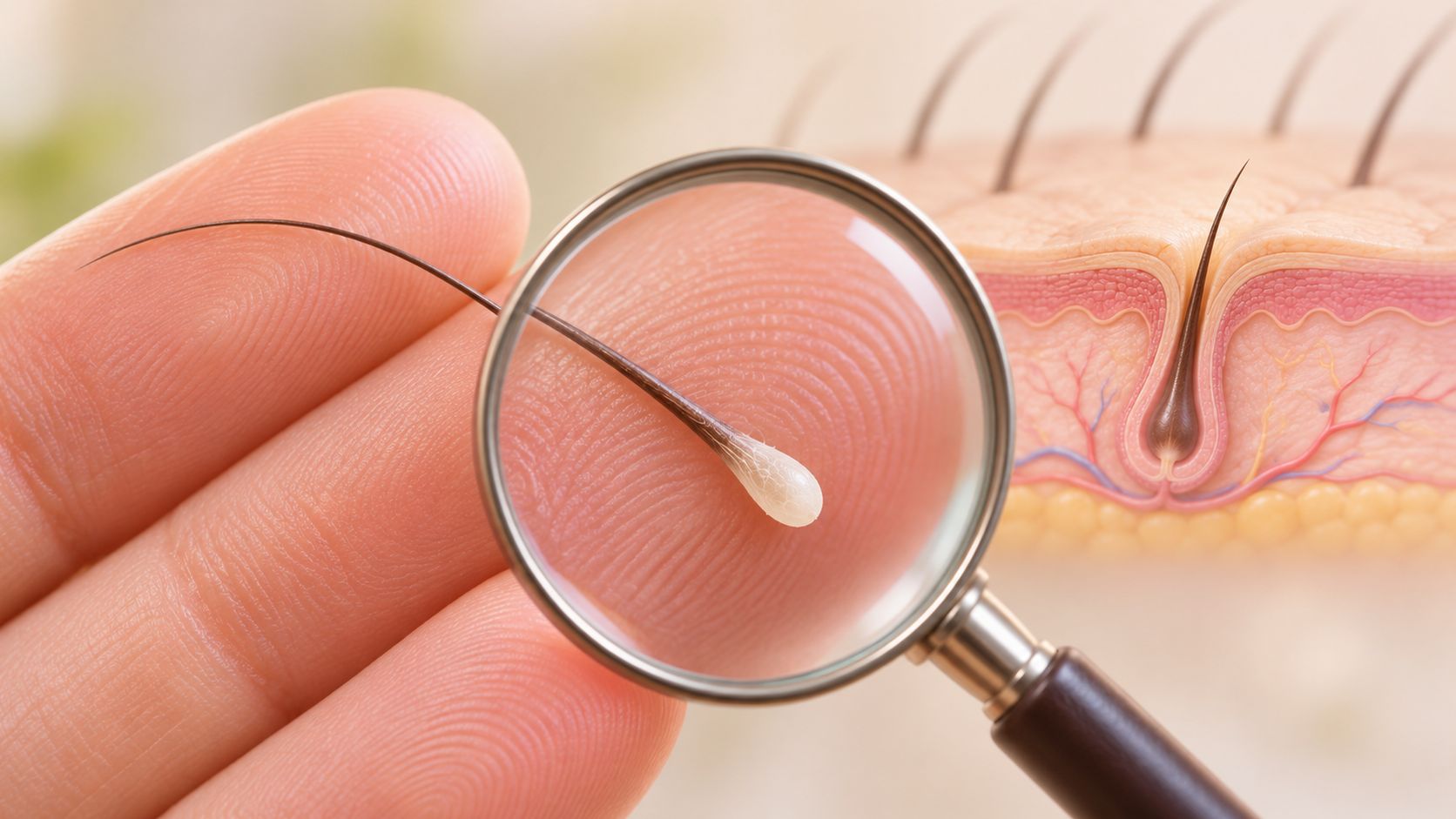
Hair falling out with white bulb? Learn what a telogen hair root means, normal shedding ranges, common triggers, and when to consult a clinician.
You finish a shower, open your hand, and find hair falling out with white bulb still on the tip. The pale end looks as if the follicle tore free. It usually did not.
That bulb is the club-shaped root of a telogen hair, a strand that finished its resting phase and released on schedule. The follicle stays in the scalp and can grow a new shaft. Shedding about 50 to 100 hairs a day is a normal baseline, the range the American Academy of Dermatology describes (AAD on normal shedding).
The bulb works like a tag on a bag that already left the carousel. It tells you which cycle that one strand was in. It cannot tell you whether too many bags are leaving, how long the rush has gone on, or whether the carousel itself looks injured.
Use the bulb for hair type only. Volume against that daily baseline, the pattern of loss, how long the shedding has lasted, and what the scalp looks like decide when self-monitoring should end and a clinical exam should begin.
Table of Contents
- What a White Bulb Means and Why It Forms
- Telogen Effluvium and Its Common Triggers
- How Clinicians Tell Shedding Causes Apart
- How to Track Shedding Without Feeding Anxiety
- Red Flags That Warrant a Clinical Exam
- What to Do Next About White-Bulb Shedding
What a White Bulb Means and Why It Forms
After a shower, a pale tip on a shed strand can look like a tiny root. It is usually the club-shaped, keratinized end of a telogen hair, a strand released after its growth cycle (StatPearls on hair follicle anatomy and physiology). The follicle remains in the scalp and can produce another shaft.
That tip is made of keratin, the same protein found in hair, skin and nails. A finished club hair has little or no pigment at its end, which can make the bulb appear white or pale. Its appearance identifies the hair type, but cannot diagnose the reason for increased shedding.
A normal scalp sheds about 50 to 100 hairs a day, according to the American Academy of Dermatology. Washing, brushing, hair length and individual cycle patterns affect how much shedding is visible (AAD on normal shedding). Compare what you see with your usual pattern, rather than judging a single strand.
The follicle as a factory and the shaft as its product
Each follicle works like a small production site beneath the skin. It grows a shaft, pauses between cycles, then releases the finished strand as another cycle begins. A white club at the end is the shed hair's keratinized root, not the follicle itself.
Growing hairs look different at the base. A strand pulled during growth may have a less-developed root, sometimes with a gelatinous sheath. Its appearance can help distinguish it from a finished club hair, though the root alone cannot explain why shedding is happening.
Why the root looks white
As a hair reaches the end of its cycle, the root loses pigment, leaving a pale, rounded club. The contrast is easier to see on dark hair; on light or gray hair, the same structure may blend in. Color alone does not indicate a different follicle condition.
Identify the strand in seconds
Shed-hair root identification guide
| What you see on the root | Hair type or cause | What it suggests | Follicle and regrowth outlook |
|---|---|---|---|
| White or pale, club-shaped bulb | Telogen (club) hair | Hair completed its resting phase and was released | Follicle remains in the scalp and can produce another shaft |
| Tapered, less-developed root, sometimes with a gelatinous sheath | Anagen hair | Growing hair was pulled out or injured during growth | Follicle usually remains intact; repeated traction can damage it |
| No bulb, clean broken shaft | Hair breakage | Damage from heat, chemicals, tension or fragile hair | The shaft broke; the follicle is unaffected |
| Black dots at the scalp surface | Broken stubble | Can occur with alopecia areata, tinea capitis or trichotillomania | A clinician can assess the cause |
A close phone photo in daylight can make a small root easier to inspect. A magnifier may help distinguish a rounded club from a blunt break, especially on fine hair.
A broken shaft has no bulb because it snapped rather than shed from the root. Black dots at the scalp surface are also broken hairs, and a clinician can assess them alongside other scalp signs.
The bulb identifies the hair type. Shedding volume, pattern, duration and scalp signs determine whether clinical evaluation is warranted.
Telogen Effluvium and Its Common Triggers
A physical or physiological stressor pushes follicles out of growth and into rest before their time, and the resulting shedding has a name: telogen effluvium. Childbirth, fever and severe illness, major surgery, significant blood loss, marked psychological stress, restrictive dieting and some medications are the recurring culprits.
The timing is the part that misleads people. Onset typically falls about 2 to 6 months after the triggering event, with many patients noticing it around three months later, and in a substantial episode up to 50% of scalp hairs may enter the resting phase at once; DermNet reports that hair fall commonly tapers toward baseline over 6 to 9 months, while visible regrowth takes longer because follicles must restart growth and produce shafts that become cosmetically noticeable (DermNet on hair loss).
A flu in January shows up in the drain in April. That gap explains why so many people blame the wrong thing: a new shampoo, a stressful week at work or the change of season takes the blame, while the illness, surgery or diet that shifted the follicles sits two or three months back, outside the window of what still feels relevant.
The sequence runs in four predictable stages.
Two triggers deserve naming because they're easy to miss. Hair problems showed up in 61.4% of 307 women with COVID-19 in one published series, and telogen effluvium accounted for 60.8% of those hair problems (Irish Journal of Medical Science study). Weight loss is the other: a 2024 Annals of Dermatology analysis of 140 patients with weight-loss-associated telogen effluvium recorded a mean weight loss of 15.21%, at an average rate of 3.54 kg per month (Annals of Dermatology).
For anyone using appetite-suppressing medication, the overlap between reduced intake, rapid weight change and shedding is worth reading on its own in semaglutide and hair loss.
Mapping a trigger to a timeline
Common triggers of telogen effluvium and expected course
| Trigger | Typical shedding onset | Usual course |
|---|---|---|
| Childbirth (postpartum) | 2 to 4 months after delivery | Peaks around months 3 to 4, tapers toward baseline over 6 to 9 months |
| Fever or severe illness, including COVID-19 | About 2 to 6 months after the trigger | Tapers toward baseline over 6 to 9 months |
| Major surgery or significant blood loss | 2 to 4 months | Gradual return to baseline over 6 to 9 months |
| Crash dieting or rapid weight loss | 2 to 4 months | Improves once nutrition and weight stabilize |
| Marked psychological stress | 2 to 6 months | Tracks resolution of the stressor; longer if stress persists |
| New medication or dose change | 2 to 6 months | Often improves after prescriber review and adjustment |
Persistent or recurrent shedding warrants medical assessment rather than patience, because nutritional deficiency, thyroid disease, medication effects, inflammatory scalp disorders and androgenetic alopecia can coexist with telogen effluvium or mimic it closely. The pattern that improves and resolves looks very different from the one that plateaus and then slowly thins.
How Clinicians Tell Shedding Causes Apart
Two people can hold up identical white-bulb hairs and need completely different care. The strand looks the same because the strand isn't the variable; the pattern around it is.
Reading patterns rather than single strands
Telogen effluvium produces full-length club hairs spread evenly across the scalp, and the scalp skin itself looks undisturbed, with no redness, scaling or loss of follicular openings. Diffuse shedding with preserved scalp skin supports that picture, whereas sharply demarcated patches, scarring, inflammation, pain or broken hairs call for a different diagnostic evaluation (DermNet on examining hair and scalp).
How shedding conditions differ at the root and on the scalp
| Condition | Shed-hair and root clues | Loss pattern | Typical course |
|---|---|---|---|
| Telogen effluvium | Full-length hairs with white club bulbs; scalp skin looks normal | Diffuse across the scalp | Usually reversible over 6 to 9 months once the trigger resolves |
| Androgenetic alopecia | Short, thin, miniaturized hairs; fewer club bulbs | Patterned at the part, crown or temples | Progressive without treatment; follicles miniaturize |
| Alopecia areata | Exclamation-mark hairs, black dots, broken stubble | Smooth, round, sudden patches | Unpredictable; patches may regrow or spread |
| Scarring alopecia | Hairs shed from red, scaled or scarred scalp | Patchy with loss of follicular openings | Progressive and permanent without prompt treatment |
| Thyroid disease or iron deficiency | Diffuse shedding, often dry or brittle hair | Diffuse | Improves when the underlying condition is treated |
What the examination adds
A standardized hair-pull test, a scalp examination and, where available, trichoscopy separate these conditions quickly. Trichoscopy is the deciding tool for pattern loss: hairs that are progressively shorter and thinner, miniaturized rather than shed, indicate androgenetic alopecia, in which follicles shrink over successive cycles instead of shedding normally. Exclamation-mark hairs, black dots and broken stubble in a smooth round patch point toward alopecia areata.
Scarring alopecia is the pattern that punishes delay. Redness, scale, pustules and a disappearance of follicular openings mean the follicle is being destroyed rather than rested, and openings that close do not reopen.
Laboratory testing follows the history rather than leading it. Broad panels ordered without a hypothesis mostly generate noise, while targeted tests chosen from the timeline and the examination findings are what surface a coexisting thyroid disorder or iron deficiency. That is why the trigger timeline matters as much as any single number on a lab report.
A structured evaluation of this kind, from intake through examination and treatment selection, is outlined in the hair loss treatment clinic pathway for readers who want to see how the pieces fit together.
How to Track Shedding Without Feeding Anxiety
Someone skips two washes, then stares at a clogged drain and decides the loss is speeding up. The follicle did not change overnight. Loose telogen hairs sit in the scalp the way mail sits in a closed box: they leave together the moment the routine resumes.
In a 2026 single-center study of 110 patients with primary telogen effluvium, 51.8% delayed washing because they feared the shedding, 35.5% collected their shed hair, and 65.5% feared going bald; 86.4% had already tried at least one intervention before seeing a dermatologist, and 57.3% took their guidance from social media or the internet. Delaying washing was associated with a higher positive hair-pull test, 80.7% versus 52.8%, and collecting hair was independently associated with greater economic burden, with an adjusted odds ratio of 6.40 (Springer study on patient behaviors in telogen effluvium). Avoiding washing distorts the picture a clinician needs.
Wash-day reality: more hair in the drain after a wash doesn't mean washing caused the loss. Telogen hairs that released days earlier collect in the scalp and come out together.
A five-step tracking protocol
Use the count as a triage file, not a daily verdict. A usual shed sits around 50 to 100 hairs a day. The white bulb only labels the hair as a telogen shaft. Volume against that baseline, the pattern, how many months it lasts, and scalp signs are what decide when self-monitoring should stop and a clinician should look.
- Wash and brush normally. Keep the routine steady so the shedding you count reflects biology rather than a backlog of trapped hairs.
- Photograph the part and crown monthly. Same room, same light, same angle, same distance. Weeks of identical frames show whether loss is diffuse or the part is widening. A mirror impression from one morning cannot.
- Build a trigger timeline. List illness, fever, surgery, childbirth, diet changes, new medications and major stress across the preceding 3 to 6 months, with approximate dates.
- Judge trends, never single days. A heavy wash day is noise. Set the month beside the 50 to 100 range. A heavier month across three months is signal. Write duration and any scalp change next to the count so the record holds pattern, time, and skin, not only a pile of strands.
- Bring the file to the appointment. Photos plus a timeline give a clinician more usable information than a bag of saved strands.
That file replaces counting strands on a tile floor with a monthly task of about five minutes.
Red Flags That Warrant a Clinical Exam
A white bulb identifies a shed hair as a club hair, but it cannot tell you whether the amount, pattern or duration of shedding needs evaluation. Use the signs below to decide when self-monitoring should end.
The checklist that ends self-monitoring
- Shedding well above your usual amount. Losing about 50 to 100 hairs a day is typical. If shedding is consistently above that range, arrange an evaluation. A clinician can assess the pattern and, when appropriate, examine the proportion of hairs in the resting phase.
- Patchy or focal bald spots. Smooth round patches can point to alopecia areata, while thinning along the part or crown may fit a patterned process.
- Scalp redness, scale, pain, pustules or visible scarring. These signs can indicate inflammation or damage around follicles. Scarring may be permanent, so seek prompt assessment.
- Broken hairs or black dots instead of full-length club hairs. Breakage and stubble suggest a different problem from shedding at the root.
- Eyebrow or body-hair loss. Hair loss beyond the scalp can change what a clinician considers as possible causes.
- A widening part or receding hairline that keeps progressing. A change that continues over time deserves assessment.
- Systemic symptoms such as fatigue, cold intolerance or unexplained weight change. These symptoms can help a clinician decide whether a broader health issue may be contributing.
What the visit includes
A clinician will ask when the shedding began, what changed in the preceding months, and about medications, diet and family history. The examination may include the scalp, follicular openings and hair density, along with a hair-pull test or trichoscopy when available.
Testing should follow the history and examination. It may include a blood count, ferritin or iron studies when deficiency is plausible, and thyroid testing. While the cause is being assessed, avoid crash dieting and unverified high-dose supplements, which can add nutritional strain.
What to Do Next About White-Bulb Shedding
A white bulb on a shed hair answers only one question: this strand was a telogen club hair that finished its cycle and let go. It does not name the cause. Volume against the usual 50 to 100 hairs a day, whether the loss is diffuse or patterned, how long it has lasted, and whether the scalp looks irritated are what decide if home monitoring is enough or a clinician should take over.
If a clear trigger is already known, correcting that trigger is the first treatment. Restore adequate protein and iron, follow through on a diagnosed thyroid problem, stop crash dieting, and ask the prescriber who started a new medicine whether it could be involved. Telogen effluvium usually settles once the stressor settles. The hairs that return come from the same follicles and are ordinary club hairs.
Pattern thinning, or shedding that continues after the trigger is gone, is a narrower decision than the product market implies. Clinicians often discuss topical minoxidil for that picture. For pattern loss tied to androgen sensitivity, they may add an oral DHT inhibitor such as finasteride or dutasteride, sometimes with a topical agent rather than instead of one. Supplements, devices, and products sold as root strengtheners often promise more than the evidence behind them can support. Treat those claims with skepticism.
Oral minoxidil needs the same plain account. Oral minoxidil is not FDA-approved for hair loss and is prescribed off-label at a clinician's discretion. Minoxidil-related swelling, palpitations, dizziness or unwanted body hair can occur with Re-Grow. Chest pain, shortness of breath, fainting or rapid unexplained weight gain require prompt medical attention when taking oral minoxidil.
Vials + Vitals pairs a confidential online intake with review by U.S.-licensed providers, who decide eligibility and formulation. Compounded preparations are dispensed by state-licensed partner pharmacies and shipped discreetly. A prescription is not automatic. If the clinical picture does not support treatment, the visit can end without one.
The next step is small. Track calmly for about a month and write down the timeline: onset, possible triggers, daily volume against that 50 to 100 baseline, and whether the loss is even or patterned. Use the checklist above if shedding keeps going, the scalp is symptomatic, or the pattern is not a diffuse spread. The guide to slowing hair loss covers what tends to follow that decision.
Informational purposes only. Compounded medications are evaluated by a licensed provider for individual suitability and are fulfilled by state-licensed partner compounding pharmacies.
Those notes, the pattern, and the scalp findings can be read against a full history rather than one strand in the drain. Hair health protocols are prescribed only when the clinical picture supports them. Start with the assessment at Vials + Vitals and let a licensed provider tell you which category your shedding falls into.
Optional journal measurement
May we count eligible search visits and whether the session reaches a care page or a confirmed new email signup? These first-party counts do not record page addresses, searches or contact details. A random session code prevents repeat counting for up to 30 minutes. This choice lasts for this tab; marketing email consent is separate. You can withdraw here.
Nothing is counted before you choose Allow.