What Is Compounded Tirzepatide? a 2026 Explainer Guide

What is compounded tirzepatide? Learn how it works, the FDA shortage timeline, safety rules, and how it differs from branded Mounjaro and Zepbound in 2026.
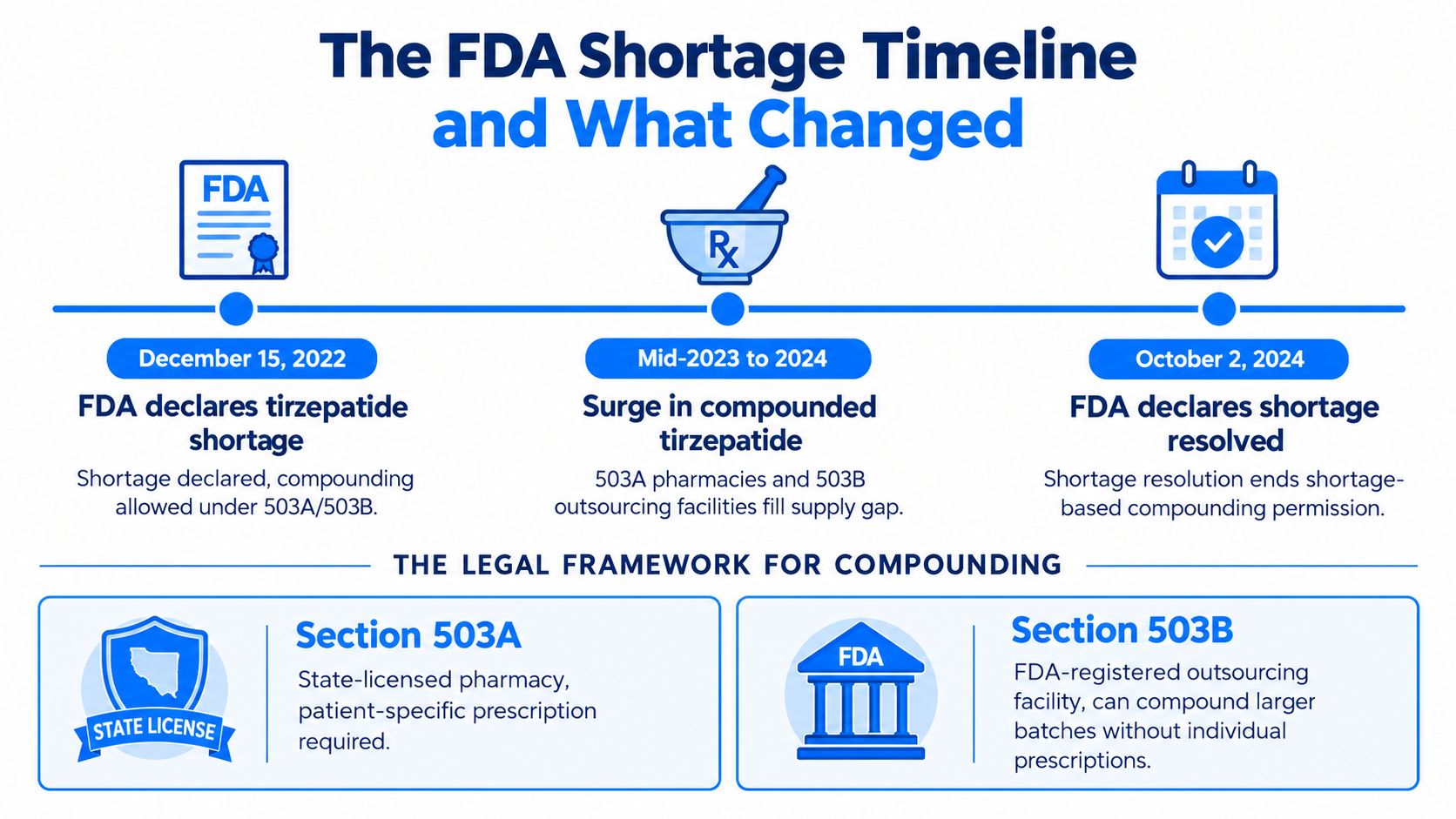
Compounded tirzepatide is a pharmacy-prepared version of the dual GIP/GLP-1 agonist tirzepatide that became widely accessible after the FDA added tirzepatide injection products to the shortage list on December 15, 2022. The shortage was resolved on October 2, 2024, changing which pharmacies could compound it and under what circumstances.
The important question isn't only whether compounded tirzepatide contains the same active molecule as branded treatment. The harder question is whether a pharmacy can lawfully prepare it today, whether the prescription documents a genuine patient-specific difference, and how the product's potency, sterility, concentration, and dispensing instructions are controlled.
Table of Contents
- A Clear Definition of Compounded Tirzepatide
- How Tirzepatide Works in the Body
- How Pharmacies Compound Tirzepatide
- The FDA Shortage Timeline and What Changed
- Compounded Versus Branded Tirzepatide
- Safety, Quality, and Impurity Risks
- Evaluating a Compounded Tirzepatide Source
- Frequently Asked Questions for Patients and Clinicians
- Can compounded tirzepatide still be dispensed in 2026?
- What should medical necessity documentation include?
- Can a pharmacy substitute compounded tirzepatide for Mounjaro or Zepbound?
- Does insurance cover it?
- What should a patient do if an online clinic offers it today?
- How should a patient transition back to a branded pen?
A Clear Definition of Compounded Tirzepatide
What is compounded tirzepatide, and why does its legal status matter as much as its active ingredient?
It is a pharmacy-prepared formulation containing tirzepatide, the molecule used in FDA-approved medicines. A licensed 503A pharmacy generally compounds for an identified patient after receiving a prescription. A 503B outsourcing facility may produce larger batches for healthcare settings under a different federal framework. These pharmacy types are not interchangeable, and state law can add requirements.
The intended pharmacologic effect comes from tirzepatide itself. The preparation is not a new drug class. Its concentration, inactive ingredients, container, and delivery method may differ from an approved finished product, however, so the prescription and dispensing instructions deserve careful review.
An approved branded product has undergone FDA review as a finished drug, with a standardized formulation, labeled indications, manufacturing controls, and a specified delivery device. A compounded preparation is made under compounding rules rather than approved through that finished-drug pathway. The FDA explains that compounded drugs are not reviewed in advance for safety, effectiveness, or quality in the same way as approved medicines in its policy clarification for compounders.
Why the shortage created the category
The market expanded during the 2022 to 2024 shortage period detailed in the timeline below. Shortage status created a federal basis for certain compounding activity, but it did not grant permanent permission to copy a commercially available medicine.
After that period, the legal question became more specific: which pharmacy prepared the medication, under which pathway, and for what patient or clinical setting? A prescription alone does not answer those questions.
A patient-specific difference may matter. Examples can include an ingredient or dosage form that a prescriber documents as clinically unsuitable in the approved product. A patient's preference for lower cost, online availability, or a pharmacy's willingness to dispense does not by itself establish lawful compounding.
Practical rule: Check the pharmacy type, state law, prescription details, and documented clinical difference before treating access as proof that compounded tirzepatide may legally be dispensed.
How Tirzepatide Works in the Body
What happens after tirzepatide enters the body, and why does the compounded form raise a separate quality question? Tirzepatide is a dual incretin agonist, meaning it activates receptors for two meal-related hormones: glucose-dependent insulinotropic polypeptide, or GIP, and glucagon-like peptide-1, or GLP-1. Together, these pathways help coordinate blood glucose, digestion, appetite, and energy balance.
GLP-1 receptor activity produces several effects. It increases insulin secretion when glucose is high, reduces glucagon release in that setting, slows gastric emptying, and strengthens signals of fullness. For some patients, these changes make meals more satisfying and reduce hunger.
GIP activates a second incretin pathway. It also supports glucose-dependent insulin secretion and contributes to metabolic signaling involving adipose tissue and energy use. Individual responses vary, but the pharmacologic distinction is straightforward: tirzepatide activates both GIP and GLP-1 receptors, whereas a single-agonist GLP-1 medicine primarily activates one incretin pathway.
What the clinical evidence shows
Clinical weight-loss evidence for tirzepatide comes from trials of the FDA-approved finished product, not independent trials of pharmacy-compounded formulations. In SURMOUNT-1, adults with obesity or overweight without diabetes lost a mean 15.0% to 20.9% of baseline body weight over 72 weeks, depending on dose, compared with 3.1% with placebo, as reported in the peer-reviewed endocrine analysis.
These findings show what tirzepatide can achieve as a studied molecule. They do not establish that every compounded vial has the same concentration, stability, sterility, or clinical performance as the trial product.
Why preparation still matters
A compounded preparation containing correctly identified and accurately measured tirzepatide is intended to produce the same dual GIP and GLP-1 receptor activity. Preparation and quality controls determine whether the patient receives the labeled dose in a safe, reliable formulation.
Pharmacology explains what tirzepatide is designed to do. Quality assurance determines whether a particular vial reliably contains what its label states. That distinction is especially important when evaluating compounded medication after the shortage period, because lawful access and product quality depend on more than the molecule's intended mechanism.
How Pharmacies Compound Tirzepatide
Compounding follows two main federal tracks, and the difference affects both production and legal access.
A 503A pharmacy generally prepares a medication after receiving a prescription for an identified patient. The pharmacist compounds for that patient's documented needs, subject to federal requirements, state pharmacy law, and applicable professional standards. This pathway is centered on the individual prescription rather than routine mass production.
A 503B outsourcing facility can compound larger batches for healthcare facilities under a different federal framework. These facilities register with the FDA and operate under manufacturing controls associated with current good manufacturing practice. Their ability to prepare a particular bulk drug, however, depends on the applicable federal rules, including shortage status and the 503B bulks list.
What happens to the material
The active pharmaceutical ingredient must come from an appropriate source, and an injectable preparation requires controlled handling and sterile processing. The compounder must establish the formulation, concentration, container system, labeling, storage requirements, and beyond-use date. Patients should receive clear instructions because a vial may require drawing a dose with a syringe rather than using a prefilled pen.
A prescription-specific preparation may be designed around a documented clinical difference, such as an excipient issue or a dosage-form problem. The FDA has explained that a prescriber must identify a meaningful patient-specific difference, and the analysis of the FDA policy describes why reproducing the commercial route and strength may not satisfy that standard.
| Attribute | 503A Pharmacy | 503B Outsourcing Facility |
|---|---|---|
| Primary model | Patient-specific compounding after a prescription | Batch compounding for healthcare facilities |
| Regulatory registration | State-licensed pharmacy | FDA-registered outsourcing facility |
| Prescription relationship | Generally tied to an identified patient | May prepare office stock under the applicable framework |
| Production scale | Individualized or smaller prescription-based preparation | Larger-batch production |
| Tirzepatide basis | Patient-specific clinical difference may be required after shortage resolution | Bulk compounding depends on federal shortage and bulks-list rules |
| Main patient question | What documented need makes this preparation appropriate? | Is the facility authorized to compound this bulk drug now? |
After the shortage ended, the two pathways couldn't be treated as interchangeable. A pharmacy's label, website, or telehealth relationship doesn't answer which legal track applies.
The FDA Shortage Timeline and What Changed
What changed after tirzepatide left the shortage framework, and why does the answer depend on the pharmacy type?
The legal pivot came from the end of the shortage-based pathway. The FDA's official notice established the regulatory change, after which a compounder could no longer rely on shortage status alone to make a preparation that matched an FDA-approved product.
The transition period functioned like a closing window, not a new authorization. 503A pharmacies received 60 calendar days, ending February 18, 2025. 503B outsourcing facilities received 90 days, ending March 19, 2025, according to the FDA transition document. These dates gave affected compounders time to adjust their practices after the shortage determination. They did not make compounded tirzepatide an FDA-approved product.
The post-shortage legal test
After the transition windows closed, the relevant question became, “Which legal pathway applies, and what facts support it?” For a 503A pharmacy, the prescription generally must be tied to an identified patient. The prescriber may also need to document a meaningful clinical difference that makes the compounded preparation appropriate for that patient. Cost, convenience, or a short-term local supply problem does not by itself establish that difference.
A 503B outsourcing facility follows a separate analysis. Its ability to compound in batches depends on its FDA registration, the applicable federal rules, and whether the bulk ingredient can be used under the relevant framework. A 503B facility is therefore not a larger 503A pharmacy.
The FDA's policy clarification explains why shortage status and bulk-drug rules must be assessed separately.
Clinical takeaway: As of 2026, lawful access generally depends on documented patient-specific need for 503A compounding or a separate federal basis for 503B production. A prescriber and pharmacist should verify the current federal and state requirements before dispensing.
Compounded Versus Branded Tirzepatide
What makes compounded tirzepatide different from a branded product if both are intended to contain tirzepatide? The answer is that the active molecule may be the same, while the finished product is not.
Mounjaro and Zepbound are FDA-approved finished products. The FDA reviewed each product as a complete system, including its formulation, manufacturing process, labeling, delivery device, and clinical evidence. Compounded tirzepatide has not received that same product-specific approval. Results from branded-product trials therefore cannot automatically be applied to every compounded formulation.
Differences patients encounter
A branded product usually comes in a standardized prefilled pen with manufacturer instructions. A compounded preparation may arrive in a multidose vial and require a syringe. Its concentration and directions can vary by pharmacy and prescription.
That difference turns a milligram dose into a measurement task. The patient must match the prescribed amount to the correct volume or syringe marking. A change in pharmacy can also mean a change in concentration, even when the intended weekly dose stays the same. The dispensing label and pharmacist's explanation should be checked before each new formulation is used.
| Attribute | Compounded Tirzepatide | Branded Tirzepatide |
|---|---|---|
| FDA status | Not FDA-approved as a finished product | FDA-approved finished product |
| Active ingredient | Intended to be tirzepatide | Tirzepatide |
| Clinical evidence | Evidence is not automatically identical for every formulation | Evidence applies to the approved product |
| Delivery | May use a vial and syringe with a pharmacy-specific concentration | Standardized prefilled pen |
| Labeling | Patient-specific or facility-specific instructions | Manufacturer labeling |
| Quality system | Depends on the compounder's controls and oversight | Product-specific manufacturing and release controls |
| Substitution | Cannot be treated as an automatic pharmacy substitution | Dispensed under the approved prescription |
The regulatory question is separate from the product comparison. A 503A pharmacy generally compounds for an identified patient, while a 503B outsourcing facility operates under a different federal framework. Even when a compounded formulation could address a documented patient-specific difference, it does not become an interchangeable version of the branded product. The prescriber and pharmacist must determine whether compounding is lawful and appropriate under the applicable rules.
Safety, Quality, and Impurity Risks
Could a compounded tirzepatide dose be unsafe even when the active ingredient is intended to be the same? Yes. The main concern is uncertain patient exposure when formulation, concentration, sterility, or impurity controls vary. A vial can turn a pharmacologic question into a measurement question: the patient must draw the correct volume, from a product that remains sterile and contains the stated amount.
A multidose vial requires careful handling. If the concentration is unfamiliar, or the instructions give syringe units without the corresponding milligram amount, the wrong volume may be injected. Clear packaging and labeling also matter when the product is stored at home or used near children.
Sterility and potency
Injectable products must be sterile. The compounder's procedures, environmental controls, staff training, testing program, storage conditions, and beyond-use date all contribute to that assurance. Oversight and pharmacy practices can differ, and tracing an adverse event may be harder without the standardized manufacturer identification and distribution system associated with an approved pen.
A statement that a batch was tested is not the same as a record showing what the testing measured. Ask for documentation identifying the product and lot, along with identity testing, the assay method used to measure potency, sterility results, applicable endotoxin limits and results, storage requirements, and the rationale for the beyond-use date. A pharmacist should be able to explain these records and the injection instructions.
The tirzepatide-B12 issue
Some compounded preparations combine tirzepatide with vitamin B12 or another additive. A recent peer-reviewed study identified an impurity formed by a chemical reaction between tirzepatide and certain vitamin B12 analogs. The investigators reported finding it in mass-compounded products, supporting analytical potency and impurity testing before dispensing, as described in the peer-reviewed impurity study.
The finding does not prove that every tirzepatide-B12 preparation is unsafe. It does show why an additive should not be assumed harmless or clinically necessary. Patients and clinicians can ask whether the certificate of analysis covers the specific batch, names the assay method, reports an impurity profile, and states the applicable endotoxin limit.
A certificate of analysis is useful only when it identifies the tested product, batch, methods, and results clearly enough for a clinician or pharmacist to interpret.
Evaluating a Compounded Tirzepatide Source
How can you tell whether a compounded tirzepatide source is operating within the rules and handling the medication responsibly? Start with the pharmacy's legal pathway, because after shortage-based flexibility ends, a patient's preference alone may not make compounding lawful. A 503A pharmacy generally compounds for an identified patient with a prescription and a documented clinical difference. An FDA-registered 503B outsourcing facility follows a different pathway and must meet the requirements that apply to its registration and production.
A practical screening process
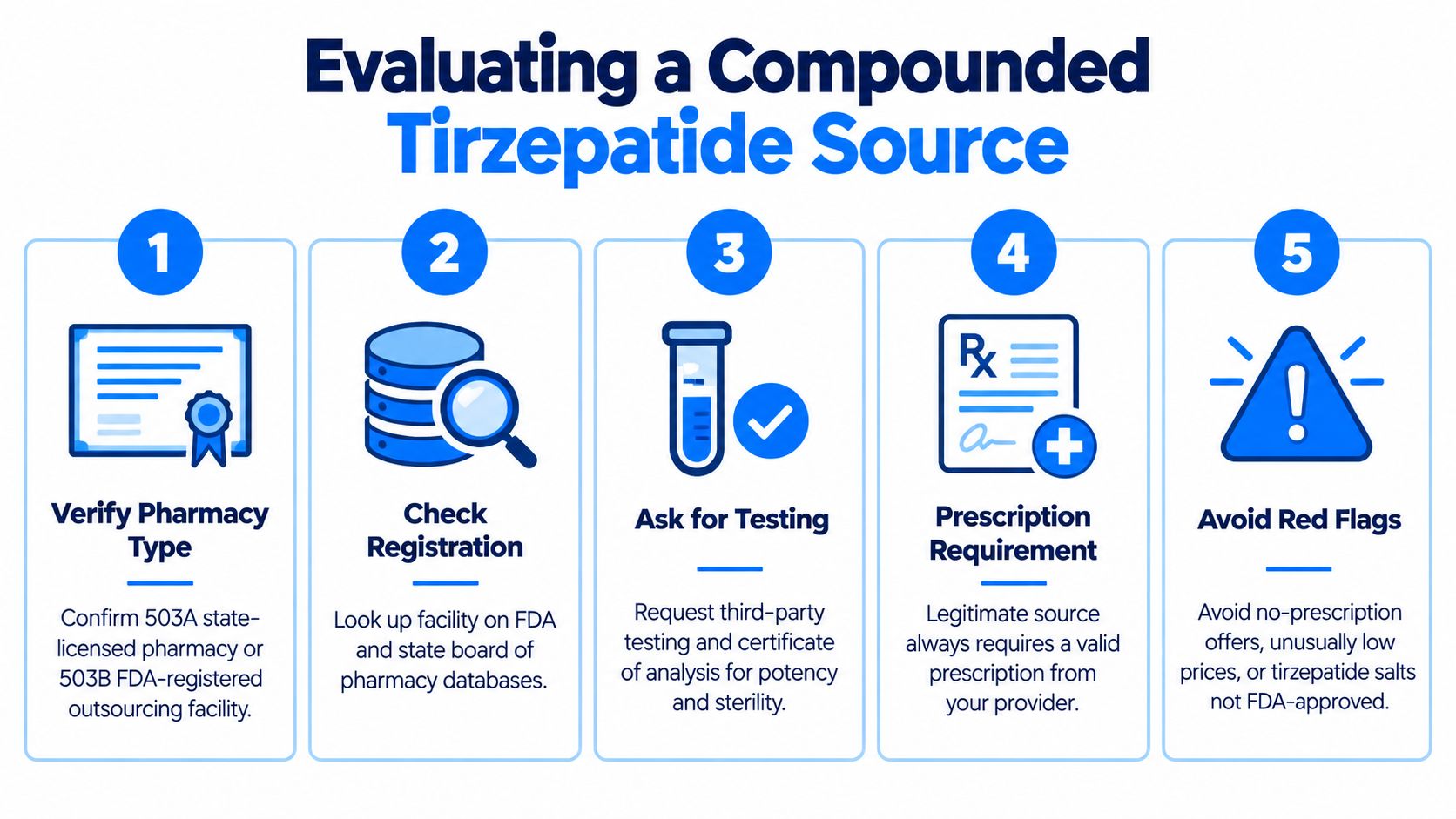
Identify the pharmacy. The prescribing platform should name the pharmacy that prepares and dispenses the medication. “Partner pharmacy” is too vague to verify.
Confirm the pharmacy type. Ask whether it is a state-licensed 503A pharmacy or an FDA-registered 503B outsourcing facility. This distinction affects the applicable compounding rules.
Ask why this patient needs a compounded preparation. For a 503A prescription after shortage resolution, the prescriber should document a patient-specific clinical difference that makes the approved product unsuitable. Lower cost, convenience, or a request for the same injectable product does not establish that difference.
Request quality records. Ask whether the pharmacy can identify the product and lot, provide potency and identity testing, report sterility and endotoxin results, state storage requirements, and explain the beyond-use date. A pharmacist should be available to discuss the formulation, dose, and injection process.
Check the injection instructions. The label should state the concentration, dose in milligrams, volume to inject, syringe instructions, storage conditions, and what to do if a dose is missed or the vial looks abnormal. Concentration is the bridge between the prescribed dose and the volume in the syringe.
Red flags that deserve a pause
- No named pharmacy: The platform will not disclose who prepares or ships the medication.
- No valid prescription: The seller offers treatment without a licensed provider's evaluation and prescription.
- Unclear concentration: Instructions use syringe units without explaining the corresponding medication amount.
- Unverified shipping: The vendor ships across state lines without explaining prescriber licensure, pharmacy licensure, and state restrictions.
- Unusual formulation claims: The seller promotes oral, powder, or additive-containing products without clear evidence, labeling, or pharmacist support.
- Pressure to purchase: The patient must pay before receiving basic information about the pharmacy and product.
Vials + Vitals describes online clinical assessment, licensed provider review, individualized titration, and fulfillment through a licensed compounding-pharmacy workflow. Patients should still confirm the current legal basis, pharmacy identity, formulation, and testing documentation with the prescribing team.
Frequently Asked Questions for Patients and Clinicians
Can compounded tirzepatide still be dispensed in 2026?
It may be dispensed only when the pharmacy and prescription fit an applicable federal and state pathway. The end of shortage-based permission means a 503A pharmacy generally needs a documented patient-specific clinical difference rather than relying on shortage status, convenience, or price. A 503B facility requires separate confirmation that its registration, bulk ingredient authority, and production activity comply with current rules.
The legal answer can vary with enforcement developments and state pharmacy law. A clinic's continued advertising isn't proof that a specific order is lawful.
What should medical necessity documentation include?
The prescriber should record the patient's relevant clinical circumstances and explain why the approved finished product doesn't meet that patient's needs. A qualifying difference may involve an inactive ingredient that creates a documented problem or a dosage form that the patient can't use appropriately. Requesting the same injectable product at the same strength doesn't necessarily qualify, as described in the FDA compounding policy analysis.
The record should also support the treatment decision clinically, including the patient's medical history, current medications, treatment goals, monitoring plan, and follow-up arrangements.
Can a pharmacy substitute compounded tirzepatide for Mounjaro or Zepbound?
A pharmacy shouldn't make an automatic substitution. The prescriber must determine whether compounded treatment is appropriate, issue the proper prescription, and provide instructions suited to the product's concentration and delivery format.
Does insurance cover it?
Coverage depends on the plan and the product's status. Compounded medications are often handled differently from FDA-approved products, so patients should ask both the insurer and the dispensing pharmacy rather than assume that a branded authorization applies to a compounded vial.
What should a patient do if an online clinic offers it today?
The patient should pause before payment and ask for the pharmacy's legal name, license information, pharmacy type, prescription requirements, formulation details, testing documentation, and the reason compounding is clinically appropriate. The prescriber should confirm that the offering fits a recognized exception and that telehealth prescribing and interstate dispensing comply with the relevant state rules.
How should a patient transition back to a branded pen?
The prescriber should determine the transition dose and timing. The patient should bring the compounded vial, label, concentration, dosing history, treatment response, and any adverse-event record to the appointment. That information helps the clinician avoid a dosing assumption based on syringe units.
Suspected adverse events should be discussed promptly with the prescriber and reported through the FDA MedWatch program when appropriate. Clinicians and patients should document the product name, pharmacy, lot number, dose, timing, symptoms, and treatment provided.
Vials + Vitals provides physician-directed telehealth assessments and individualized GLP-1 and dual-incretin treatment protocols, including tirzepatide options when clinically appropriate. Patients seeking a structured review of eligibility, formulation, titration, and pharmacy fulfillment can visit Vials + Vitals to begin the clinical assessment.
Ready to see if this protocol fits your biology?
A licensed provider reviews every request before anything is prescribed.
Calibrate your metabolic protocol →