What Does NAD Stand for in Longevity Research? a Guide
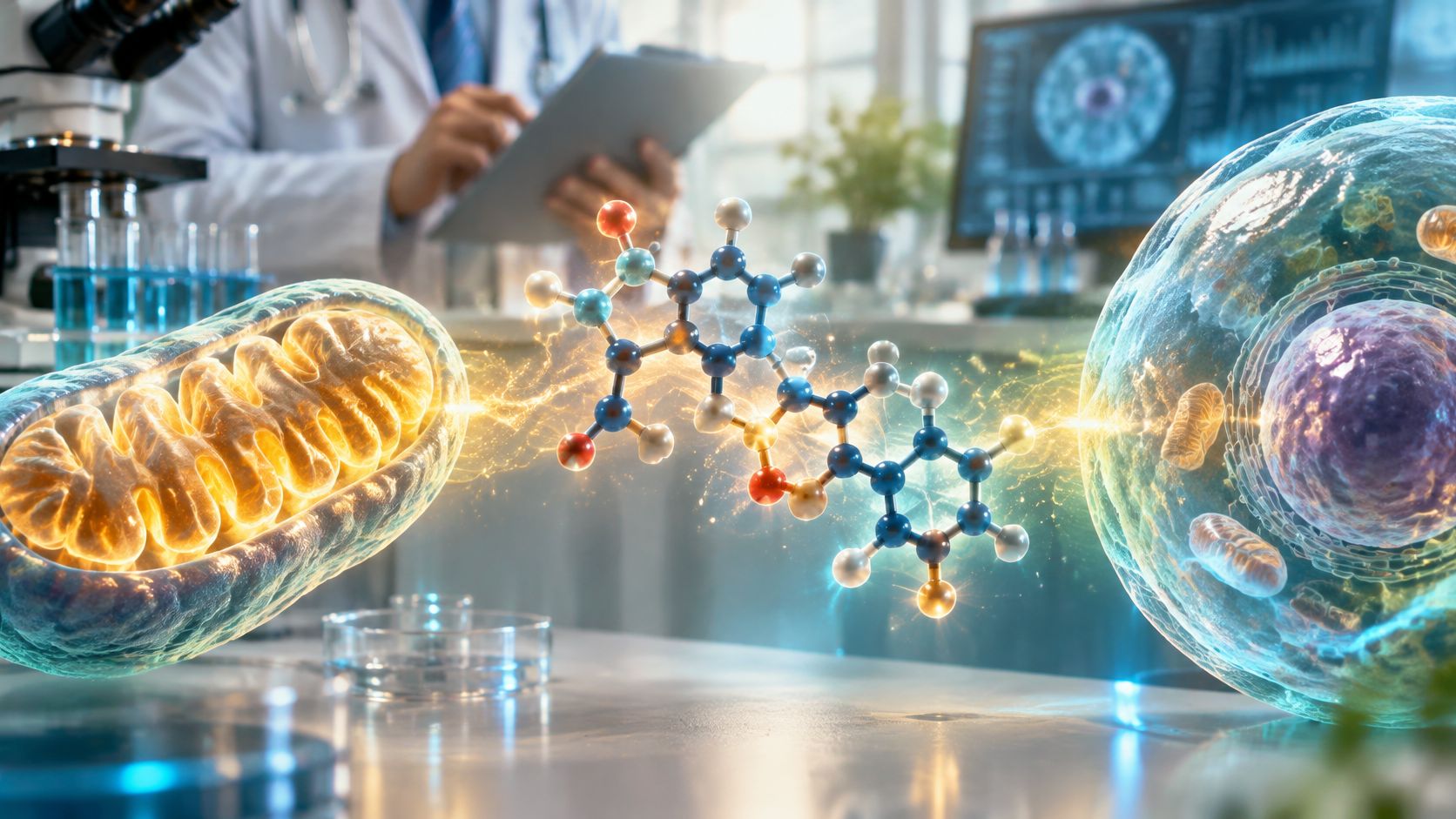
What does NAD stand for in longevity research? Learn the term, its role in cells, and what human studies do and do not show.
NAD stands for nicotinamide adenine dinucleotide, a coenzyme found in living cells. In longevity research, NAD+ refers to its oxidized form, which helps cells carry out energy-producing reactions and other essential processes.
But does a molecule's importance inside cells mean that increasing it helps people live longer? That's the gap between established biochemistry and an unproven health claim. Understanding the name is useful, but understanding what human studies measure matters just as much.
Table of Contents
- NAD Stands for Nicotinamide Adenine Dinucleotide
- NAD, NAD+, NADH and Precursors Compared
- What NAD Does Inside Living Cells
- Biomarker Changes Are Not Proof of a Longer Life
- What Human Studies Show and Where They Stop
- Take Specific NAD Questions to an Independent Clinician
NAD Stands for Nicotinamide Adenine Dinucleotide
The name works like a small map of the molecule. NAD stands for nicotinamide adenine dinucleotide. A coenzyme is a helper molecule that lets enzymes carry out chemical reactions. The label tells the reader what is built into the molecule, and why chemists gave it that name.
The long name describes the molecule's structure:
- Nicotinamide is a form of vitamin B3 and part of the molecule's chemical structure.
- Adenine is a nitrogen-containing building block.
- Dinucleotide means that the molecule contains two nucleotide units joined together.
Those parts describe composition. They also help separate the molecule's identity from the way it is discussed in longevity research. A name can explain structure while leaving health outcomes as a separate question.
A metabolic molecule before a wellness term
Research history starts with basic chemistry. NAD research began in 1906, when Arthur Harden and William John Young identified a heat-stable factor that accelerated sugar fermentation in yeast, as described in this review of NAD metabolism and aging. Hans von Euler-Chelpin later characterized it as a nucleotide sugar phosphate, and in 1936 Otto Warburg demonstrated its role in hydride-transfer reactions.
That order matters. Scientists first studied NAD to understand how cells handle chemical reactions. Its role in metabolism gives aging researchers a reason to study it. A reason to study a molecule, however, leaves open what human outcomes will show.
When readers ask, “What does NAD stand for in longevity research?” the answer has separate layers. The abbreviation identifies a molecule with a defined structure. The longevity context identifies a field of investigation, including questions about cellular maintenance and age-associated changes.
NAD is a naturally occurring molecule central to metabolism. Calling it a longevity molecule describes a research interest, not a proven outcome.
NAD, NAD+, NADH and Precursors Compared
NAD-related terms and what each one means
| Term | What It Is | Why Readers Confuse It |
|---|---|---|
| NAD | Nicotinamide adenine dinucleotide, the general coenzyme name | Used loosely for both oxidized and reduced forms |
| NAD+ | Oxidized form that accepts electrons | Most longevity discussions emphasize this form |
| NADH | Reduced form that carries electrons onward | It's another chemical state of NAD, not an unrelated molecule |
| Nicotinamide riboside | NAD precursor studied in human trials | Results don't automatically transfer to NAD+ itself |
| Nicotinamide mononucleotide | NAD precursor studied in human trials | Its evidence is separate from NAD+ and from nicotinamide riboside |
The most important distinction is between a form of NAD and a precursor used to make NAD. NAD+ and NADH describe different electron-carrying states. Nicotinamide riboside and nicotinamide mononucleotide describe different compounds that cells can use in NAD production.
Headlines may shorten all of these to NAD. That shortcut can hide what investigators tested. A study of a precursor isn't automatically a study of NAD+ itself, and an observed effect from one compound doesn't establish the same effect for another.
Why the exact compound matters
A clinical review of NAD-related interventions explains why biochemical target engagement, meaning evidence that an intervention affected its intended pathway, must be distinguished from broader clinical benefit. The compound, study population, and measured outcome all affect how a result should be interpreted.
For example, a headline might describe a NAD-boosting intervention while the underlying study tested nicotinamide riboside. Without that detail, readers could mistakenly apply its findings to a different substance or route.
The related comparison of NAD and NMN addresses this terminology distinction. Neither a familiar abbreviation nor a similar name makes compounds interchangeable.
Reading rule: Identify the exact molecule, the people studied, and the outcome measured before interpreting a longevity claim.
What NAD Does Inside Living Cells
After a meal, cells begin breaking glucose into smaller parts. At several steps in that breakdown, enzymes pass electrons to NAD+. Accepting those electrons converts NAD+ into NADH, which then carries them to the reactions that produce ATP, the molecule cells spend as energy.
NAD+ works like a rechargeable battery in this process: it picks up a charge in one place, releases it in another, and returns ready to repeat the cycle. The battery comparison is a teaching aid, not a complete description of the chemistry.
How NAD+ carries electrons
NAD+ and NADH participate in glycolysis, the citric-acid cycle, and oxidative phosphorylation, while NAD+ also supports signaling enzymes involved in cellular maintenance, according to this review in Aging and Mechanisms of Disease.
In plain language, these pathways move energy out of food and into a form cells can use. Redox reactions are reactions involving electron transfer. NAD's ability to switch between its oxidized form (NAD+) and its reduced form (NADH) is what makes it useful in that work.
The following diagram shows this carrier cycle.
Cellular signaling and maintenance
Carrying electrons is only part of NAD's work. Some enzymes consume NAD+ outright while performing their jobs.
- Sirtuins use NAD+ when removing acetyl or other acyl groups from proteins. These activities connect cellular energy status with mitochondrial regulation, stress responses, and gene expression.
- PARP enzymes consume NAD+ during DNA-damage signaling and repair. Sustained DNA damage can increase the cell's demand for NAD+.
If cells make less NAD+, consume more of it, or both, the processes above could be affected. That possibility is one reason researchers study NAD in relation to aging.
Describing this pathway answers a biochemistry question. Showing that raising NAD+ improves health requires a different kind of evidence: clinical outcomes in people.
Biomarker Changes Are Not Proof of a Longer Life
What does a higher NAD+ measurement tell you about aging? Its meaning depends on what was measured, where it was measured, and whether the change accompanies better health.
NAD availability may change with chronological age, potentially affecting mitochondrial function, metabolism, and NAD-dependent enzymes. A review of NAD biology in aging describes this rationale while emphasizing tissue, age, and health status. These connections leave an important clinical question open: whether an older adult has a meaningful NAD deficit that treatment could improve.
Blood measurements don't describe every tissue
Blood is accessible for testing. NAD-dependent enzymes also operate inside muscle, brain, liver, and other tissues, where NAD availability may differ from a whole-blood measurement.
The distinction resembles a gauge and an engine. A gauge records a particular quantity. To determine whether the engine performs better or lasts longer, you also need measurements of performance and durability.
A biomarker helps track a biological change. Connecting a higher blood NAD+ value to slower aging or longer survival requires evidence from those outcomes.
The substance being tested matters, too. NAD+ measurements, NAD-related metabolites, and responses to an NAD precursor answer related but distinct questions. A precursor's effect on a laboratory value cannot establish the health effects of NAD+ delivered by another route.
What the common claims mean
The table separates accepted cellular functions from biomarker findings and clinical outcomes. Each category answers a different question.
Common claims compared with the published evidence
| Claim | What the Evidence Shows | Status |
|---|---|---|
| NAD+ takes part in cellular energy production | Its role is well established in biochemistry and metabolism. | Established |
| Blood NAD+ falls steadily with age | A Nature Metabolism report on whole-blood NAD+ found stable levels across age and lifestyle interventions, with changes after nicotinamide-riboside supplementation. This limits its interpretation as a universal blood-aging marker. | Unsettled |
| Oral NAD precursors raise NAD-related metabolites | A 2025 review, the Nature Metabolism review, found increases in NAD-related biomarkers alongside heterogeneous and often absent effects on functional, metabolic, vascular, and other healthspan outcomes. | Supported for biomarkers |
| Raising NAD+ slows aging or extends lifespan | Clinical effectiveness remains inconclusive. The same review identified no eligible outcomes trials testing intravenous or intramuscular NAD+ itself for anti-aging or wellness. | Not shown |
| NAD precursors improve physical function or frailty | The review found insufficient evidence to determine benefit for physical function or physical-frailty measures. | Not established |
Established describes accepted biochemistry. Supported for biomarkers identifies an observed biochemical response; the clinical significance still needs assessment.
Not shown leaves the possibility of benefit open while indicating that available evidence has yet to demonstrate it. Unsettled describes findings that do not support a consistent general conclusion.
Healthspan also needs a concrete definition. Mobility, cognition, disease outcomes, and quality of life concern how people function and feel. Laboratory values can support investigations of these outcomes when researchers measure both.
For care decisions, NAD+ measurements need a clinically established interpretation. The useful question is how a result relates to a person's health and whether acting on it improves a meaningful outcome.
What Human Studies Show and Where They Stop
A concrete example helps clarify the limits. A randomized, double-blind, placebo-controlled crossover study enrolled 24 healthy adults aged 55–79 and examined nicotinamide riboside over six weeks, focusing on safety, tolerability, and NAD-related metabolites. The study is summarized in a review of human NAD-related trials.
That design can help investigators see whether the tested compound reaches its biochemical target. Randomization and placebo comparison help separate the intervention's effects from changes that might have occurred anyway. Think of it as checking whether the key turns in the lock, not whether the whole house is safer.
Strong design features still have boundaries. A small, short study can't establish whether an intervention changes lifespan, prevents major disease, or reduces long-term frailty. Its findings apply to the tested population and measured outcomes, not automatically to all adults.
Review totals need their own context
At the review level, the picture stays cautious. A separate systematic review of NAD and NADH interventions covered 10 studies and 489 participants across different clinical conditions.
That total belongs to the review, not to the individual precursor trial. Different compounds, populations, and outcomes cannot be combined into a broad promise. The earlier evidence table already shows why physical function and frailty remain unsettled at review level.
The word longevity in a headline deserves close inspection. A clinical discussion of peptides and longevity should be read with attention to what was studied, rather than treating a category label as evidence of benefit. The same caution applies to NAD-related products. A term can be scientifically real while the advertised outcome remains unproven.
A practical study-reading checklist asks:
- Which molecule was tested? NAD+, NADH, and individual precursors require separate evaluation.
- How long did the study run? Duration limits which outcomes investigators can assess.
- How many people participated? Sample size affects how much confidence a finding can support.
- Which outcome was measured? A metabolite change and improved daily function answer different questions.
The 24-person trial can support a narrow conclusion about short-term biochemical activity and tolerability in that tested group. It cannot show longer life, disease prevention, or better daily function. Human research can establish one piece while leaving the larger health question open.
Take Specific NAD Questions to an Independent Clinician
Trouble breathing, swelling of the face or throat, chest pain, fainting, or a severe reaction after any injection calls for emergency care. Call 911 or seek help immediately.
Injectable preparations raise safety questions beyond the biological role of NAD. Manufacturing and sourcing matter here. Sourcing for injection is a separate question from whether a molecule occurs in the body.
The FDA's warning about ingredients used in sterile compounding describes food-grade NAD+ sold by repackagers being used for injectable products. The concern is microbial or endotoxin contamination without appropriate processing. The agency also received reports of severe chills, shaking, vomiting, and fatigue after NAD+ injections, with some patients requiring medical treatment.
Questions that make a care discussion more useful
Those reports don't establish the risk of every preparation. They do support precise questions about evidence, sourcing, and clinical suitability. An injectable wellness service still needs careful review.
- Evidence for the goal: What published findings apply to the intended health outcome?
- Product sourcing: How are ingredients sourced, and what sterile-compounding standards apply?
- Relevant health information: Which diagnosed conditions, medications, and supplements affect suitability?
- Monitoring and follow-up: What outcomes and adverse effects would need assessment?
The checklist below keeps emergency symptoms separate from routine questions. It works like a set of labels on the same folder: one label for urgent warning signs, the rest for preparing a calm discussion.
For nonurgent reading, the discussion of NAD therapy side effects offers a related topic. It doesn't replace assessment of symptoms happening now.
How independent intake works
Vials + Vitals facilitates access to online intake for review by independent licensed clinicians. The online intake asks customers to complete information that clinicians review independently. Those clinicians determine suitability and prescribe when appropriate. Licensed pharmacy partners fill valid prescriptions, and every pharmacy in the network is licensed in the states where it dispenses, accredited by the National Association of Boards of Pharmacy, board-certified, and LegitScript-approved. Those credentials concern sourcing and service standards, not proof of a longevity benefit.
Educational disclaimer: This content explains terminology and published evidence. It isn't personal medical advice, a diagnosis, or a recommendation to use NAD-related products.
Readers considering a nonurgent wellness care question can complete an online intake for independent licensed-clinician review. Suitability and any prescribing decisions remain with the clinician.
Optional journal measurement
May we count eligible search visits and whether the session reaches a care page or a confirmed new email signup? These first-party counts do not record page addresses, searches or contact details. A random session code prevents repeat counting for up to 30 minutes. This choice lasts for this tab; marketing email consent is separate. You can withdraw here.
Nothing is counted before you choose Allow.