Weight Loss Medication Guide to GLP-1 Options
Explore weight loss medication classes, how GLP-1s work, efficacy, risks, and how to choose safely under medical supervision.
A patient can feel this decision before any prescription is written. The scale has stalled, food noise is louder than expected, and the next step looks crowded with headlines about GLP-1s, injections, pills, titration, side effects, and hair shedding. Under physician supervision, weight loss medication becomes less about picking a brand and more about choosing a protocol that matches biology, tolerance, and follow-up needs.
That approach matters because these medicines are not interchangeable. Semaglutide and tirzepatide sit in the same broad metabolic category, but they act through different receptor pathways and can produce different outcomes over time. A careful clinician looks at the whole picture, including weight history, current medications, needle preference, and the pace at which response is changing.
Vials + Vitals uses a protocol-driven model for this kind of decision-making. That means the conversation starts with eligibility and safety, then moves to formulation, titration, and monitoring instead of rushing straight to a prescription.
Table of Contents
- Introduction to Weight Loss Medication Today
- How Weight Loss Medication Works in the Body
- Main Classes of Prescription Weight Loss Medication
- Efficacy and What Clinical Trials Show
- Risks Side Effects and Hair Retention Considerations
- How to Choose Weight Loss Medication With Your Physician
- Key Takeaways for Safe and Effective Use
Introduction to Weight Loss Medication Today
A common first visit sounds simple on the surface. A person says they've tried eating less, walking more, and tracking meals, but their weight keeps drifting back up after each brief success. The question isn't whether effort has been made, it's whether the treatment plan has finally matched the underlying metabolic problem.
Modern prescription weight loss medication is designed for chronic weight management, not a quick reset. The important shift is that these medicines are now used as part of a physician-directed plan, with dose changes, adverse-effect monitoring, and response checkpoints built in. That is where many readers get confused, because headlines often present GLP-1 drugs as if they were a single category with one outcome.
Practical rule: a prescription should fit the patient's history, not the other way around.
This guide stays focused on the clinical side of the conversation. It does not treat every medication as interchangeable, and it doesn't assume that the strongest drug is always the right first step. In real practice, the right choice may depend on how much weight loss is needed, how fast the body is responding, and whether a person can tolerate an injectable or needs a different route.
A physician also has to think beyond the scale. History of thyroid disease, pancreatitis, pregnancy, rapid weight loss, or medication sensitivity can change the plan quickly. For that reason, supervised care is not a formality, it's part of the treatment itself.
How Weight Loss Medication Works in the Body
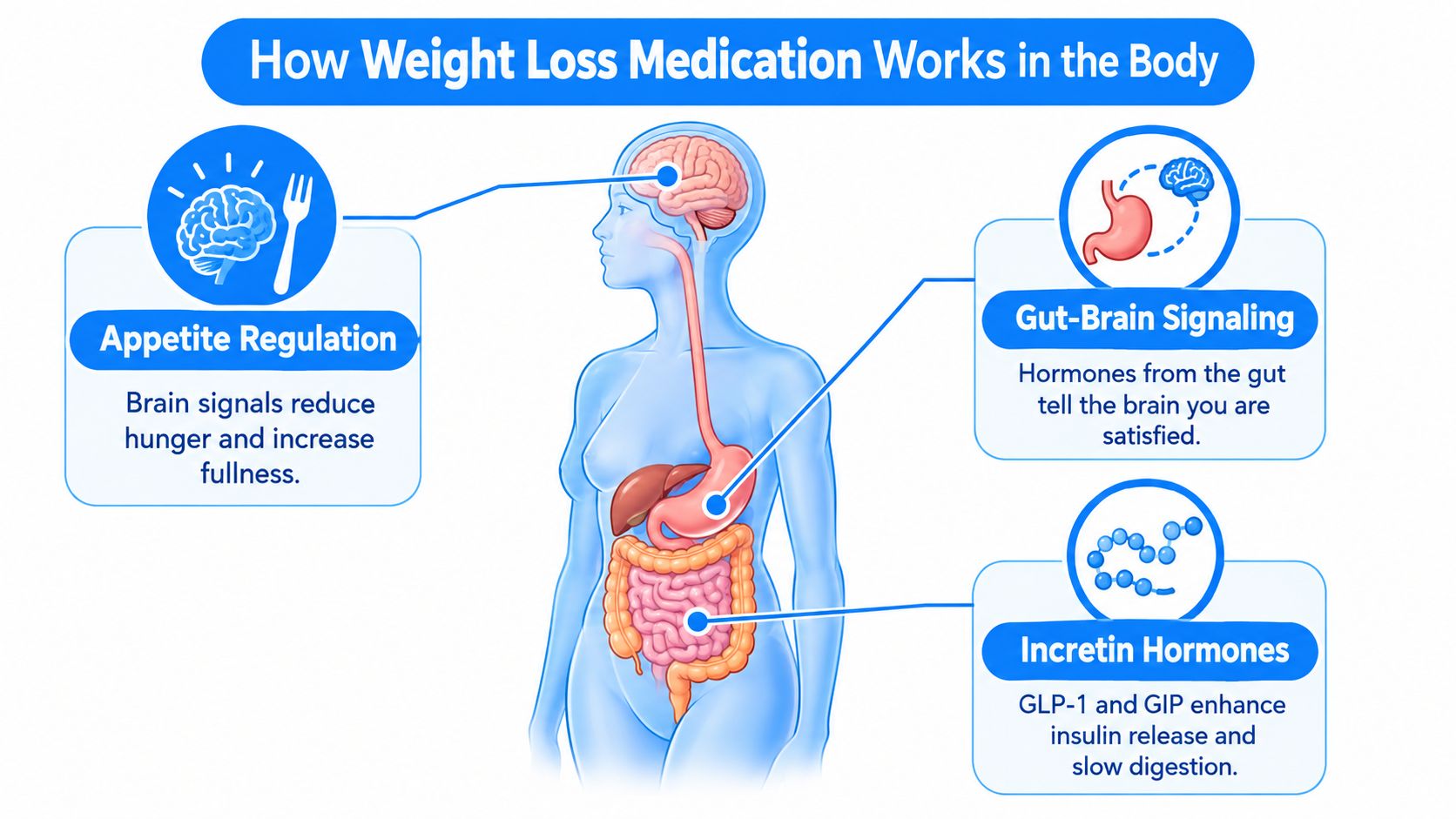
The simplest way to understand GLP-1 therapy is to think of the body as having a fuel gauge and a thermostat. Hunger, fullness, digestion speed, and blood sugar all send signals to the brain, and those signals affect how much food feels satisfying at a given meal. Incretin hormones help shape those signals, which is why modern metabolic treatment can reduce appetite rather than relying only on willpower.
The gut and brain keep talking
After eating, the gut releases signals that tell the brain the body has received fuel. GLP-1 receptor agonists amplify that messaging, so meals can feel more complete and snacks can feel less urgent. Dual GIP/GLP-1 therapies broaden that signal set, which is one reason they can produce a stronger metabolic effect in some patients.
That does not mean the body drops weight instantly. The process tends to unfold over months because appetite patterns, meal size, satiety, and treatment dose all change gradually. Titration exists for a reason, and clinicians use it to give the body time to adapt while reducing the chance of side effects.
Why dose escalation matters
A starting dose is not the final answer. It's the opening step in a controlled adjustment process that helps the clinician see how the patient responds before moving higher. If a dose rises too quickly, nausea or other gastrointestinal effects can interfere with adherence, which can blur the difference between a medication that isn't working and one that needs better pacing.
The best protocol is the one a patient can actually stay on long enough to evaluate.
That is also why response is watched over time, not judged after a few days. Weight loss medication works by changing the body's regulatory set points, and those changes are more visible at steady dosing than in early use.
Main Classes of Prescription Weight Loss Medication
Prescription choices can be organized by mechanism and practical use. The main distinction is between GLP-1 receptor agonists, dual incretin therapies, and older non-incretin options that may still fit selected patients. The route of administration matters too, because some patients are comfortable with injections while others need a different format.
| Medication Class | Mechanism | Example Agents | Administration Notes |
|---|---|---|---|
| GLP-1 receptor agonists | Increase satiety signaling and reduce hunger | Semaglutide, liraglutide | Often used as weekly or daily injections, depending on agent |
| Dual incretin therapies | Act on both GIP and GLP-1 pathways | Tirzepatide | Typically used as a weekly injection |
| Appetite and reward pathway agents | Influence cravings and appetite through central signaling | Naltrexone-bupropion | Oral option for selected patients |
| Fat absorption inhibitor | Reduces dietary fat absorption in the gut | Orlistat | Oral capsule taken with meals |
| Sympathomimetic-based options | Reduce appetite through central stimulation | Phentermine, phentermine-topiramate | Route and schedule vary by formulation |
Where GLP-1s fit
Semaglutide is the best-known GLP-1 option because its obesity indication marked a major turning point in modern treatment. Tirzepatide extends that logic by engaging a second incretin pathway, which is why it is often discussed when a patient needs stronger response or a different titration strategy. These agents are not interchangeable just because they share a broad category label.
Why route of administration matters
Injection anxiety is real, and it can shape adherence as much as side effects do. Some patients do better with a weekly injection because it simplifies routine, while others prefer oral options because they want to avoid needles altogether. The right route is part of the prescription decision, not an afterthought.
A clinic that takes protocol seriously also looks at formulation quality and handling. That matters especially for injectable vial formats and any temperature-sensitive medication that must be stored and shipped correctly.
Efficacy and What Clinical Trials Show
A physician and patient often reach this section after the same question: if two medications both reduce appetite, how do you decide which one is doing enough? The answer comes from trial-based response, dose by dose, and from whether the result holds as treatment continues. In the STEP 1 trial, semaglutide 2.4 mg produced a mean body-weight change of −14.9% at 68 weeks versus −2.4% with placebo, with an estimated treatment difference of −12.4 percentage points (trial summary). That gives a realistic benchmark for what controlled treatment can look like over time.
Response is not all or nothing
A peer-reviewed review of semaglutide obesity trials reported mean weight loss ranging from 14.9% to 17.4% at week 68, and noted that ≥5% weight loss is widely accepted as a clinically meaningful response (review). The same review reported that 86% to 89% of participants on semaglutide 2.4 mg achieved at least 5% weight loss, compared with 29% to 48% of placebo recipients (review).
Clinical takeaway: the goal is not just losing some weight, it is reaching a threshold that changes health risk in a meaningful way.
Tirzepatide has shown a stronger response in head-to-head testing. In the SURMOUNT-5 phase 3b trial, tirzepatide produced a least-squares mean body-weight reduction of 20.2% at 72 weeks versus 13.7% with semaglutide in adults with obesity without diabetes, a 6.5 percentage point gap (ACC trial scan). That difference matters because it explains why clinicians may change the incretin pathway or adjust titration when progress stalls.
How to think about the time horizon
The long horizon is part of the treatment, not a sign that the medication is slow. Semaglutide data are usually assessed at 68 weeks, and tirzepatide comparison data are usually assessed at 72 weeks. Short snapshots can miss the full effect, especially while titration is still underway or before a steady dose is reached.
A 2026 systematic review and meta-analysis found weight reduction in 79.90% of semaglutide trial participants versus 30.30% with placebo, and 79.38% of tirzepatide trial participants versus 24.72% with placebo (systematic review). The pattern supports a simple clinical reality. Most patients respond, but not all respond equally, so monitoring needs to stay objective.
Risks Side Effects and Hair Retention Considerations
Safety conversations should happen before the first dose, not after a problem starts. The most common issues with incretin-based therapy are gastrointestinal, and that's why gradual dose escalation is built into protocols. Physician oversight also matters because a history of medullary thyroid cancer, pancreatitis, or pregnancy changes the risk-benefit equation and may rule out certain therapies.
What patients usually notice first
Nausea, constipation, diarrhea, and early fullness are the common tolerability issues that can interrupt treatment if they're not anticipated. In many cases, those symptoms are part of the body adjusting to altered appetite signaling and slower gastric emptying. A slower titration schedule can make the difference between a patient staying on therapy and dropping off too early.
Hair retention deserves separate attention. Rapid weight change can trigger telogen effluvium, a form of shedding that often follows a physiological stressor rather than a direct medication injury. With tirzepatide, a secondary summary of SURMOUNT-1 reported alopecia rates of 5.2% at 5 mg, 5.0% at 10 mg, and 5.9% at 15 mg, versus 1.1% with placebo over 72 weeks, and the shedding pattern was described as predominantly in female participants and usually transient.
Guardrails that help reduce avoidable harm
A few practical rules can keep the course safer:
- Report persistent vomiting or dehydration early. Fluid loss can escalate fast and should not be managed by guessing.
- Tell the clinician about thyroid and pancreatic history. Those histories change prescribing decisions.
- Do not improvise dose jumps. Titration is meant to reduce side effects, not just chase faster loss.
- Watch for hair shedding after rapid change in body weight. That pattern often points to nutritional or physiologic stress that needs review.
If hair starts shedding during active weight loss, the issue may be the speed of change, not just the medication name.
Protein intake, zinc status, and overall nutrition deserve attention during treatment because the body needs building blocks while it's losing fat. That doesn't replace medical evaluation, but it does explain why hair retention and weight loss planning belong in the same conversation.
How to Choose Weight Loss Medication With Your Physician
Choice starts with the person, not the drug. A patient with injection fatigue, a history of plateauing on one incretin pathway, and a stable medical profile may need a different plan from someone who is just beginning treatment and wants the most conservative entry point. The physician's job is to match the medicine to the medical history, then confirm that the patient can tolerate the pace of change.
The consultation should cover more than weight
A solid visit includes current diagnoses, family history, other medicines, previous attempts at weight reduction, and any pattern of adverse reactions. The clinician should also ask about pregnancy plans, pancreatitis history, thyroid history, and whether the patient has already noticed a plateau on a prior protocol. Those details can change formulation choice or titration speed.
Monitoring should be explicit. A practical check-in window is around 12 to 24 weeks, when early response, plateau, and side effects can be assessed together instead of in isolation. If the body is not responding, the next move may be dose adjustment, a different formulation, or a switch in class.
A protocol is only as good as the follow-up
Some patients need a slower ramp. Others need a more assertive pathway because the clinical gap between current weight and target weight is too large to wait endlessly on a low dose. A supervised plan also helps catch the less obvious problem, when a person is losing weight but losing muscle, hydration, or hair health along the way.
Vials + Vitals offers physician-directed assessments, protocol-based titration, and formulation options that can include injectable vial formats and needle-free oral tablet approaches for selected patients. That kind of structure is useful when the issue is not access to information, but access to a careful prescribing workflow.
A good decision leaves the patient with a plan for what happens next, not just a medication name.
Key Takeaways for Safe and Effective Use
Weight loss medication works best as a chronic, supervised metabolic treatment. The strongest results come from matching the drug class to the patient's physiology, then adjusting dose based on response and tolerability rather than chasing quick change. Semaglutide and tirzepatide both have strong evidence, but they are not the same medicine, and they shouldn't be treated that way.
The main safety lessons are straightforward. Side effects are manageable when titration is deliberate, red flags are reviewed up front, and follow-up is scheduled before problems arise. Hair shedding can happen during rapid loss, so nutritional status and the pace of change deserve the same attention as the number on the scale.
The practical goal is simple. Use the medicine long enough, and carefully enough, to learn whether it's helping without letting preventable adverse effects derail the plan. That is the difference between a prescription and a protocol.
Vials + Vitals provides physician-directed weight management care built around GLP-1 and dual incretin protocols, with eligibility review, titration planning, and monitored follow-up. For readers who want a medically supervised path that accounts for response, side effects, and formulation preference, start with a confidential assessment at Vials + Vitals.
Ready to see if this protocol fits your biology?
A licensed provider reviews every request before anything is prescribed.
Calibrate your metabolic protocol →