Weight Loss Injections Online Safe Legal Guide

Learn how to get weight loss injections online safely and legally — evaluation, provider checks, pharmacy fulfillment and shipping explained.
The reader is probably in the same position as many patients right now. Ads promise convenience, social feeds flatten complex medical care into a checkout button, and a weekly injection starts to look like something that should be simple to order online. It isn't that simple, and that's exactly why caution matters.
A legitimate online pathway for weight management isn't a shortcut around medical care. It is medical care, delivered through telehealth. That means a licensed U.S. clinician reviews health history, checks whether treatment is appropriate, rules out obvious contraindications, determines whether semaglutide or tirzepatide fits the patient's goals and risk profile, and sends any approved prescription to a licensed U.S. pharmacy for dispensing. Anything less than that is not a clinical pathway. It is a product sale dressed up as healthcare.
The Vials + Vitals Medical Board views weight loss injections online as a clinical pathway audit. Before a patient pays, there should be proof of provider licensure, clarity on pharmacy accreditation, defined titration guardrails, and a reliable fulfillment process for temperature-sensitive medication. Those checkpoints matter more than branding, speed, or marketing language.
Online care can work well when it is structured. A large real-world telehealth cohort of 655 adults treated with semaglutide reported mean body-weight reduction of 16.6% over 68 weeks, with women losing 18.1% versus 13.4% in men, in a defined model that included screening, titration, and monitoring through telehealth in this PubMed-indexed cohort report. That is the right frame for patients to use. The question isn't “Where can injections be bought online?” The better question is “Which online program behaves like real medicine from intake through follow-up?”
Online prescribing is only as safe as the screening, pharmacy controls, and follow-up behind it.
Table of Contents
- Introduction to Getting Weight Loss Injections Online Safely
- How Online Evaluation and Prescription Determination Work
- Verifying Providers Pharmacies and Safe Fulfillment
- Choosing Between Tirzepatide and Semaglutide Protocols
- Receiving Storing and Staying on Track With Treatment
- Your Safe Next Steps for Weight Loss Injections Online
Introduction to Getting Weight Loss Injections Online Safely
A typical patient scenario looks like this. An adult has struggled with appetite control, weight regain, or a long plateau. In-person appointments are hard to schedule, online options seem faster, and the patient starts searching for weight loss injections online late at night with a credit card in hand.
That moment is where mistakes happen.
Some websites make treatment look frictionless. Real prescribing should never be frictionless. It should be efficient, private, and clear, but there should still be clinical review. Patients should expect questions about current medications, prior pancreatitis concerns, digestive symptoms, metabolic history, pregnancy-related considerations when relevant, prior GLP-1 exposure, and whether needle aversion changes formulation choices.
What legitimate online access actually requires
At minimum, a compliant pathway includes three essentials:
- Licensed medical review: A U.S.-licensed clinician must determine whether treatment is indicated.
- Pharmacy-grade fulfillment: Medication should come from a licensed U.S. pharmacy, not an informal seller or anonymous importer.
- Ongoing monitoring: The prescription decision is the start of care, not the end.
Patients should also expect to see a real policy for people who aren't appropriate candidates. If a service prescribes nearly everyone, that is a warning sign. A proper program excludes some patients because exclusion is part of safe care.
What this guide treats as a safety audit
This article uses a stricter standard than “Was a prescription issued?” It looks at the full chain:
- Intake and eligibility review.
- Provider licensure and consultation standards.
- Pharmacy accreditation and compounding controls when applicable.
- Shipping integrity for temperature-sensitive medication.
- Titration oversight, refill continuity, and adverse-effect follow-up.
That full-chain review matters even more after the semaglutide shortage era shifted online access patterns. The FDA placed semaglutide injection products on its shortage list in March 2022 for Wegovy and August 2022 for Ozempic, then removed semaglutide from the shortage list on February 21, 2025, with limited transition periods for compounded products through April 22, 2025 for 503A pharmacies and May 22, 2025 for 503B outsourcing facilities as summarized in this shortage timeline review. That sequence explains why many patients got used to online compounding pathways, then suddenly had to reassess what legal and legitimate access looked like once supply normalized.
Clinical takeaway: Patients should judge online weight management services by medical process quality, not checkout speed.
How Online Evaluation and Prescription Determination Work
You fill out an online form, enter your payment details, and see a prescription approval minutes later. That should make you pause, not feel relieved. Weight loss injections online should begin with a clinical review that can withstand audit, because the prescription decision sets the risk profile for everything that follows.
A safe process starts with enough information to justify treatment. Height and weight alone do not support a prescribing decision for GLP-1 or GIP/GLP-1 therapy. The intake should collect medical history, current medications, prior response to weight-loss treatment, adverse effects, and practical adherence issues such as needle tolerance and the ability to follow a dose-escalation plan.
What the workflow should look like
A legitimate online program usually follows a clear sequence:
- Confidential digital intake. The patient submits health history, current medications, prior GLP-1 use, relevant diagnoses, and treatment goals.
- Clinical screening. The intake is reviewed for contraindications, medication conflicts, and reasons that treatment may need more review or should be declined.
- Provider evaluation. A U.S.-licensed clinician reviews the case, either asynchronously or during a live visit, based on state requirements and clinical judgment.
- Prescription determination. The clinician approves treatment, requests clarification, or declines treatment based on medical appropriateness.
- Titration plan. If approved, the patient receives a structured dosing schedule with follow-up expectations and criteria for holding, delaying, or adjusting dose increases.
That sequence matters because online prescribing fails in predictable ways. Some services ask too little. Others move patients up in dose too fast. Both create avoidable risk.
What a good intake asks before any prescription
A credible intake should gather enough detail to support a real chart review and a defensible prescribing decision.
- Medication history: Current prescriptions, prior GLP-1 or related use, and whether side effects or poor tolerance limited adherence.
- Risk review: Gastrointestinal history, endocrine conditions, prior intolerance, and other factors that change the risk-benefit assessment.
- Treatment objective: Appetite reduction, satiety support, glycemic considerations, or help after a weight-loss plateau.
- Practical fit: Comfort with injections, ability to store medication correctly, and readiness to follow titration instructions.
This is the point where patients should audit the pathway, not the price. If a service cannot explain who reviews the intake, what exclusion criteria are used, and how dose escalation is controlled, the process is weak before the prescription is even written.
A physician-directed telehealth model such as Vials + Vitals uses confidential online assessment, U.S.-licensed provider review, individualized titration schedules, and refund protection when treatment is not clinically appropriate. Patients should treat that as the standard for online prescribing, not an extra.
Why denial is part of proper medical review
A refusal can be the right outcome.
Safe prescribing means some patients will be told no, told to wait, or told they need a different level of care first. Programs that approve nearly everyone are advertising a conversion funnel, not demonstrating clinical discipline. The same standard applies to refunds. If treatment is declined, the policy should be plain and fair, because the service provided was medical evaluation and judgment.
Patients should also expect a written rationale or a clear verbal explanation. Approval should come with a dosing plan. Declines should come with a reason. Requests for more information should be specific.
A legitimate program should be able to explain why a patient was approved, why a patient was declined, and what the follow-up plan is after the first prescription.
Questions worth asking before submitting intake
Ask direct questions before you pay:
- Who reviews the intake? A U.S.-licensed clinician, or software alone?
- What could disqualify me? A serious program should name exclusion criteria.
- How is titration handled? There should be a defined dose-escalation schedule and a plan for side effects.
- How are records protected? HIPAA-compliant handling should be standard.
- What happens if treatment is inappropriate? The decline and refund policy should be clear.
- How are refills approved? Ongoing treatment should require clinical review, not automatic renewal.
Good online access is not fast by default. It is defensible, documented, and medically controlled.
Verifying Providers Pharmacies and Safe Fulfillment
A common failure point looks like this. A patient completes an online intake, gets approved quickly, pays, and assumes the safety questions are settled. They are not. Before payment, audit the clinical pathway from prescriber to pharmacy to shipment.
Start with licensure, then verify who controls the protocol
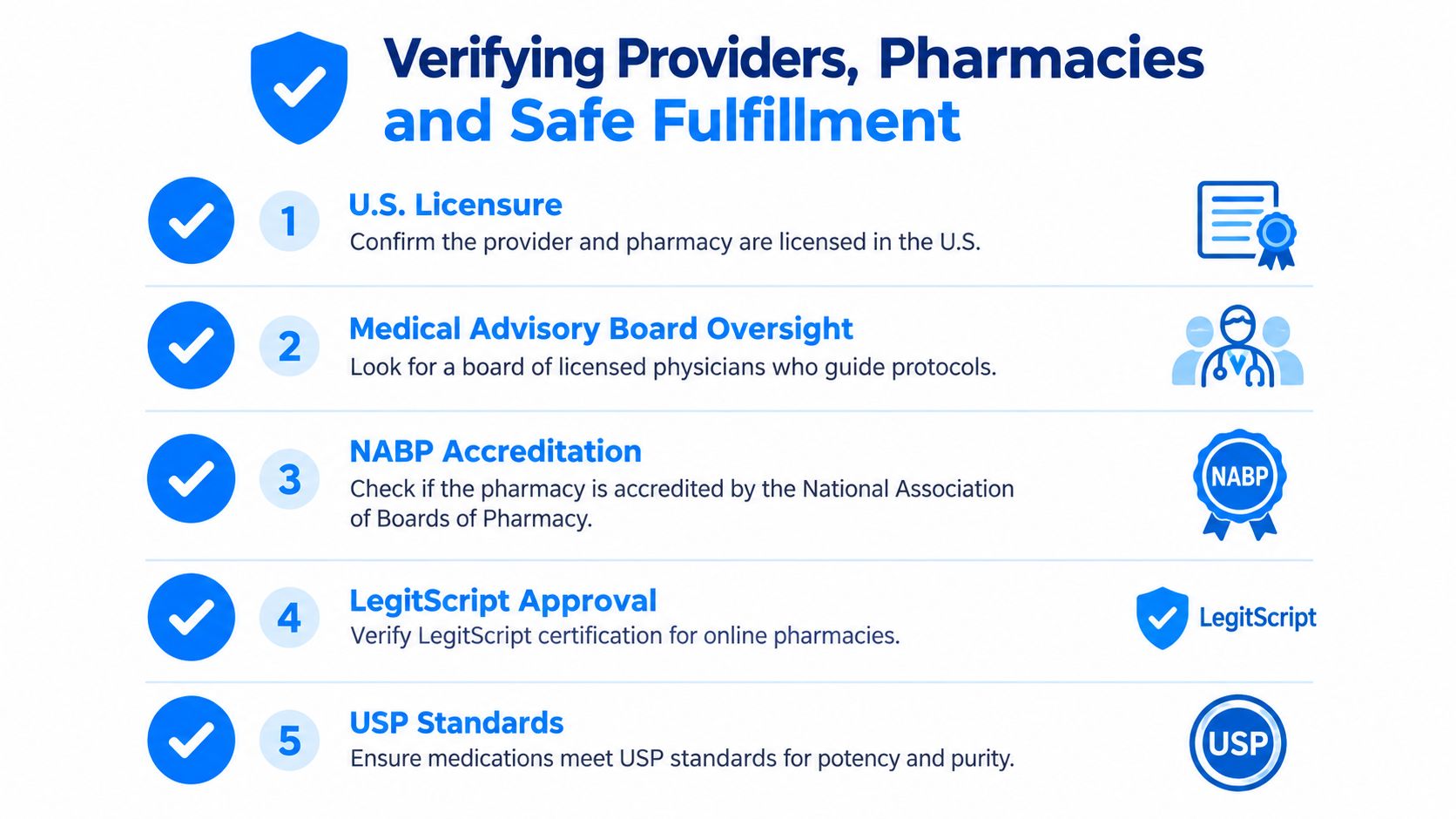
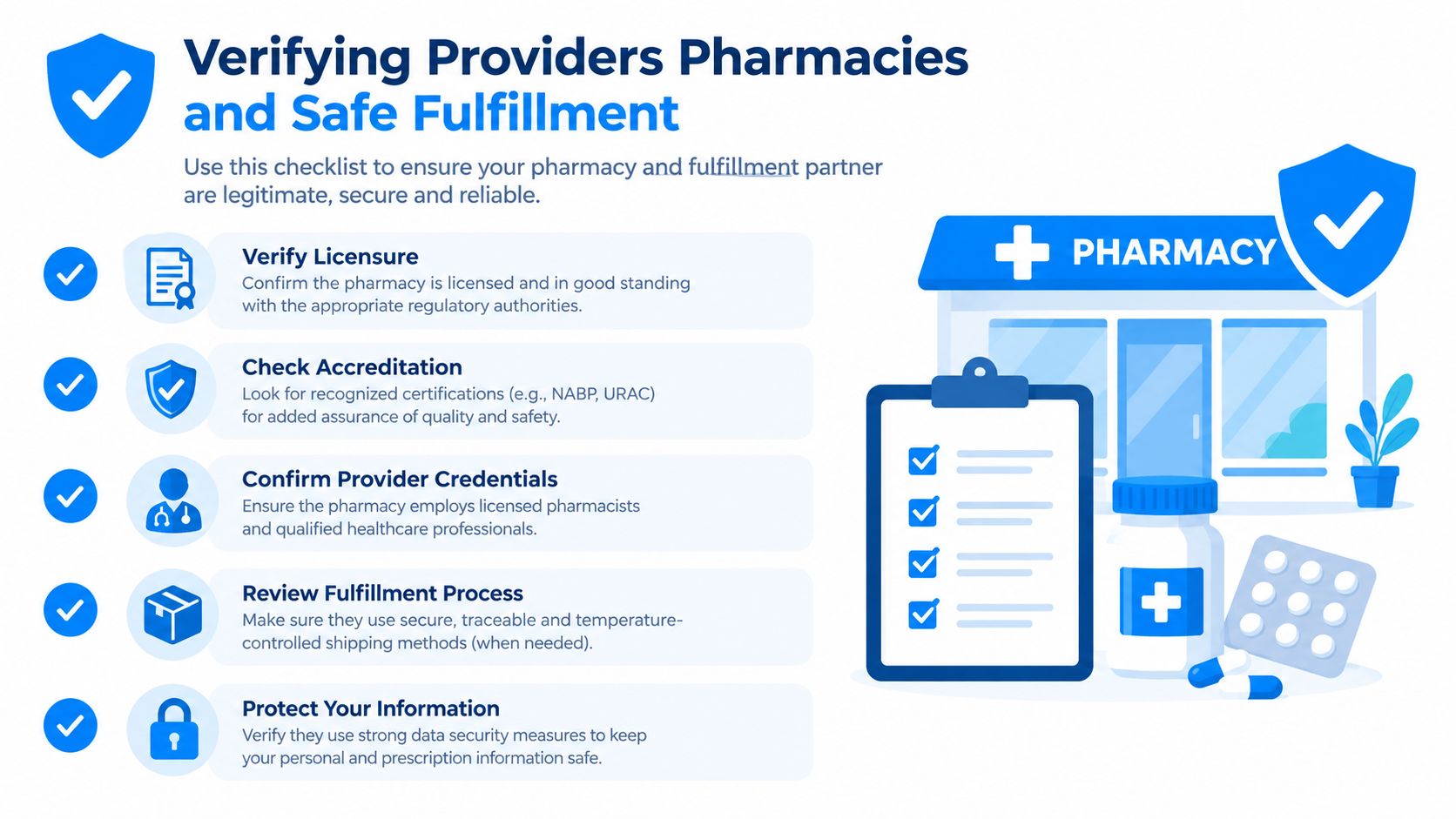
Check the prescriber first. The clinician's name, credentials, and active state license should be easy to find and easy to verify through the appropriate state board. If that information is hidden, stop there.
Then check who sets the treatment rules. A legitimate program has physician oversight, written prescribing standards, exclusion criteria, and a defined titration process. Those controls protect patients from improvised dosing and refill decisions.
The pharmacy deserves the same scrutiny. Patients should look for NABP accreditation, LegitScript approval, and, if compounded medication is involved, clear disclosure that preparation follows USP standards with sterility and potency controls. Vague quality claims are not enough.
Shortage-era assumptions can mislead patients
Many patients are still shopping with shortage-era habits. That creates risk.
The FDA has updated shortage information for GLP-1 medications on its drug shortage pages, and patients should verify current status directly with the agency rather than relying on outdated articles or sales copy. That matters because the distinction between FDA-approved branded medication and compounded medication affects legality, product source, refill continuity, and what happens if supply conditions change.
If a provider cannot explain, in plain language, why a compounded product is being used, whether that use is still appropriate, and what the backup plan is, do not proceed.
Safe fulfillment should be specific and documented
Good fulfillment is not a marketing feature. It is a chain of custody.
A trustworthy service should state who dispenses the medication, how temperature-sensitive products are packed, how long they can remain in transit, what labeling arrives with the shipment, and how patients report damage or temperature concerns. Patients should receive tracking, readable storage instructions, lot information, and expiration or beyond-use dating when applicable.
Cold-chain handling is a patient safety issue, not a minor shipping detail. If the package arrives warm, damaged, or missing materials, do not inject first and ask questions later. Photograph the package, keep the contents as received, contact the pharmacy or prescribing service immediately, and wait for instructions.
Practical rule: If the service cannot explain who dispenses the medication, how it ships temperature-sensitive doses, and what happens if the package is compromised, the patient should not pay.
A pre-payment audit checklist
Before paying for weight loss injections online, confirm each of these points:
- Prescriber identity is verifiable: Full name, credentials, and active state licensure are visible.
- Dispensing pharmacy is named: Patients should know exactly which pharmacy fills the prescription.
- Accreditation is stated clearly: Quality claims should be backed by recognized accreditation or inspection standards.
- Compounding is explained: The service should state when compounded medication is used and why.
- Shipping protocol is disclosed: Refrigeration needs, packaging method, and damage-reporting steps should be clear.
- Refill controls are defined: Ongoing prescribing should depend on clinical review, not automatic renewal.
- Problem resolution is real: There should be a direct contact path for damaged, delayed, or temperature-compromised shipments.
Online access can be safe. Only if the safety chain is visible before the charge goes through.
Choosing Between Tirzepatide and Semaglutide Protocols
A patient completes an online intake, pays, and gets approved within hours. The question comes after that. Was the protocol chosen because it fit the patient's history, tolerance, and follow-up plan, or because it was the easiest option to sell online?
That distinction matters. Protocol choice is part of the same safety audit as licensure, pharmacy oversight, and cold-chain handling. Patients should expect a prescriber to explain why one medication was selected, how dose escalation will work, what side effects would trigger a pause, and what markers will be reviewed before each increase.
What head-to-head data suggest
In the SURMOUNT-5 head-to-head trial in adults with obesity but without diabetes, tirzepatide produced -20.2% least-squares mean weight change at 72 weeks versus -13.7% with semaglutide in the published trial report. That gap is large enough to shape protocol decisions. If a patient is a strong candidate for either option and wants the greater average weight-loss effect, tirzepatide usually leads the discussion.
That does not mean semaglutide is the wrong choice. It means the prescriber should document a reason for the recommendation, then build a titration plan the patient can follow.
Tirzepatide vs Semaglutide Weight Loss Outcomes
| Outcome Measure | Tirzepatide | Semaglutide |
|---|---|---|
| Least-squares mean weight change at 72 weeks in SURMOUNT-5 | -20.2% | -13.7% |
What should drive protocol selection online
A safe online program does not treat these medications as interchangeable checkout options. It uses a clinical decision process.
Look for these signs that the protocol choice was made correctly:
- The starting dose is conservative: The plan should begin at the appropriate introductory dose, not jump ahead to chase faster results.
- Escalation is scheduled and conditional: Dose increases should depend on tolerance, symptoms, and clinician review.
- Prior response is reviewed: A patient who previously did well on one agent may not need a switch just because another drug shows stronger average results.
- Plateaus are evaluated properly: Stalled weight loss should prompt a review of adherence, dosing, side effects, nutrition, and activity before changing the medication.
- Side-effect guardrails are clear: Patients should know when nausea, vomiting, constipation, or reduced intake require clinician contact or dose delay.
- Follow-up is built in before refill approval: Continued prescribing should depend on progress and safety review, not automatic renewal.
The practical recommendation
Choose the protocol that a licensed clinician can justify in writing and monitor over time.
For patients seeking the strongest average weight-loss effect, tirzepatide often deserves first review. For patients who have tolerated semaglutide well and are progressing, staying with semaglutide can be the better clinical decision. Switching for marketing reasons is poor care.
Online access works best when protocol selection is disciplined. Before paying, patients should confirm that the service has real titration guardrails, real follow-up, and a clear rationale for choosing one medication over the other.
Receiving Storing and Staying on Track With Treatment
A shipment arrives late in the day. The box feels warm, the label is hard to read, and the dosing instructions do not match what the clinician discussed. That is the moment to pause. Online treatment stays safe only if the handoff from prescriber to pharmacy to patient holds up under inspection.
Receiving the medication is part of the clinical pathway, not a delivery detail. Patients should confirm that the product arrived intact, that storage instructions are specific, and that the first dose is clear before anything is used.
What to inspect when the package arrives
Start with the basics. The package should be sealed, the prescription label should identify the patient and medication clearly, and the enclosed directions should match the prescribed plan.
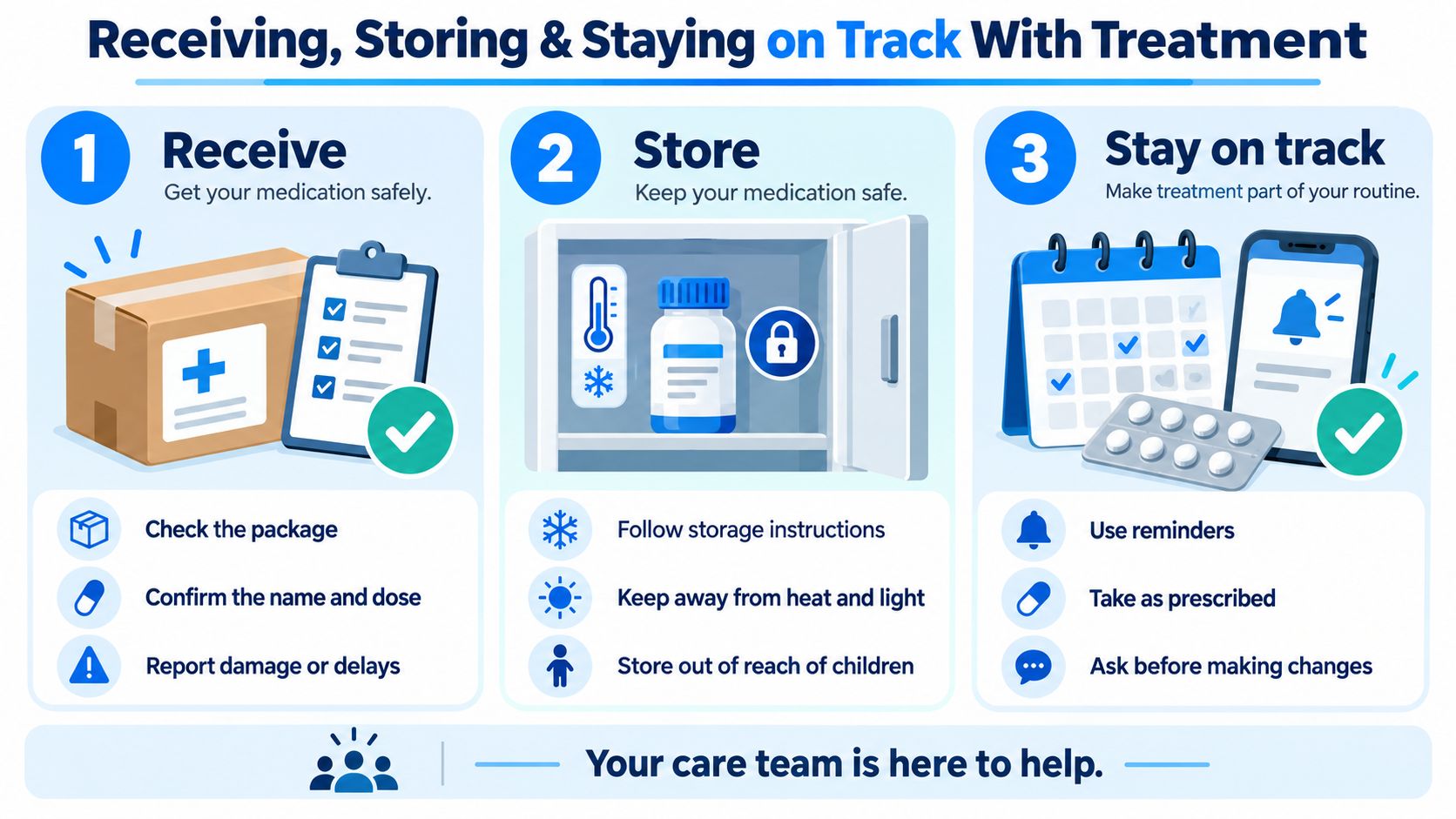
Check these points before the first dose:
- Packaging integrity: No leaks, cracked caps, broken seals, or signs of tampering.
- Correct supplies: Include any syringes, alcohol swabs, or measuring tools needed for the prescribed form.
- Readable instructions: Storage temperature, beyond-use guidance, and injection steps should be stated plainly.
- Dose accuracy: The starting dose, schedule, and any later increase plan should match the clinician's written instructions.
If any part of the shipment is unclear, hold the medication and contact the dispensing pharmacy or prescribing team before use.
Storage and administration require discipline
Poor storage and dosing confusion cause preventable problems. A pen or vial is only as safe as the patient's handling.
Refrigerated medications should be stored exactly as directed and kept away from freezing conditions, heat, or direct light if the labeling warns against them. Do not guess about room-temperature limits. Do not use medication that looks discolored, cloudy when it should be clear, or otherwise different from prior fills unless the pharmacy confirms it is expected.
Administration should be routine and boring. That is good care. Use the same day each week if the prescription is weekly. Keep the medication, supplies, and written instructions in one place. If the format requires drawing up a dose from a vial, patients should know the exact volume to measure, not just the drug name.
Staying on track between refills
The main adherence failures are predictable. Patients run out because they request refills too late. They drift off schedule after travel or illness. They push through side effects without telling the clinician, then stop entirely.
A simple system works better than good intentions:
- Mark each dose date: Use a calendar, app, or written log.
- Request refills early: Build in enough time for review, dispensing, and shipping.
- Track side effects: Note nausea, vomiting, constipation, reduced intake, dizziness, or missed doses.
- Follow the written plan: Do not increase, repeat, or delay doses on your own unless the prescribing team instructed it.
- Keep follow-up active: Ongoing prescribing should depend on symptom review, progress, and tolerability.
The FDA's drug safety reporting system exists because adverse events do happen, and reporting quality matters when problems arise. Patients should keep the carton, prescription label, and lot information until the fill is finished in case the pharmacy or clinician needs to review the product history.
When patients should stop and ask for help
Contact the prescribing team promptly if the package arrives damaged, the temperature handling seems questionable, the instructions do not match the prescription, or side effects interfere with hydration or normal intake.
Do not improvise around uncertainty. Good online obesity care has guardrails after checkout, not just before payment.
Arrival rule: Inspect first, store correctly, then dose. Reversing that order creates avoidable risk.
Your Safe Next Steps for Weight Loss Injections Online
The safest way to approach weight loss injections online is to stop thinking like a shopper and start thinking like an auditor. Online treatment can be appropriate and effective, but only when the care model holds together from intake through refill.
A good decision process is straightforward. Confirm that a U.S.-licensed clinician reviews the case. Confirm that a licensed U.S. pharmacy dispenses the medication. Confirm that the service can explain storage, shipping, and follow-up without vague language. If any of those answers are unclear, the patient should keep looking.
A practical decision checklist
Before moving forward, patients should be able to answer yes to each of these questions:
- Was there real medical review? The service should screen history, medications, and exclusion criteria before prescribing.
- Is the dispensing pathway transparent? The patient should know which U.S. pharmacy is involved and what quality standards apply.
- Are titration guardrails defined? Dose escalation should be planned, not improvised.
- Is fulfillment reliable? Storage instructions, temperature handling, and package escalation steps should be obvious.
- Is continuity addressed beyond the initial 12 weeks? A refill path without follow-up is not continuity of care.
When to pause and ask for help
Patients should pause treatment and contact the prescribing team if shipment quality is uncertain, instructions don't match the prescription plan, side effects become difficult to manage, or the patient isn't sure how to continue titration safely. Fast access matters less than correct use.
Hair health also deserves mention because metabolic treatment goals and hair retention can overlap. If a patient is already concerned about shedding or thinning, a structured tracking tool such as a Follicular Retention Index can help frame that discussion alongside weight-management follow-up. The right response is not to abandon treatment reflexively. It is to monitor, document, and review with a clinician.
The bottom line
The strongest online programs don't just prescribe. They screen carefully, dispense through accredited channels, protect cold-chain integrity, and keep patients engaged long enough to make the treatment meaningful. Clinical structure is what turns online convenience into legitimate care.
Patients don't need the fastest option. They need the clearest one.
Vials + Vitals provides physician-directed telehealth evaluation for GLP-1 and dual-incretin weight-management protocols, with U.S.-licensed provider review, individualized titration planning, and fulfillment through accredited U.S. pharmacy partners when treatment is appropriate. Patients who want a structured, safety-first pathway for weight loss injections online can review the clinical process and next steps at Vials + Vitals.
Ready to see if this protocol fits your biology?
A licensed provider reviews every request before anything is prescribed.
Calibrate your metabolic protocol →