USP Compounding Standards: What Every Patient Should Know
A clinical guide to USP compounding standards covering chapters 795, 797, and 800, sterility testing, BUD dating, and what compliant pharmacies look like
USP <795>, USP <797>, and USP <800> are the three compounding chapters patients should care about today, and the revised <795> and <797> became official on November 1, 2023 while <800> became official on December 1, 2019. That means a pharmacy dispensing a compounded GLP-1 in current practice shouldn't hide behind a vague “USP compliant” label. It should be able to state which chapter governs the preparation, which version it follows, and how that maps to the state where the prescription is filled.
Most patient advice on USP compounding standards is too soft. It treats compliance like a badge. It isn't. A compounded oral suspension, a sterile semaglutide vial, and a hazardous drug workflow don't sit under one generic seal of approval. They sit under different chapters, different operational rules, and sometimes different state enforcement timelines.
For GLP-1 prescribing, that distinction matters. Semaglutide and tirzepatide injectables are sterile products. They don't belong in the same mental category as a nonsterile capsule or cream. Any patient, prescriber, or telehealth platform reviewing a compounding partner should start there.
Table of Contents
- Why USP Compounding Standards Are Not a Single Badge
- A Timeline of USP Compounding Chapters 795, 797, and 800
- Nonsterile vs Sterile Compounding Requirements Compared
- Beyond-Use Dating and How Long a Compounded Preparation Is Actually Safe
- Sterility Testing Triggers Batch Limits and What Testing Can and Cannot Prove
- Why State Enforcement Shapes What USP Compliant Really Means in 2026
- Labeling Requirements and What Your Vial Should Actually Show
- A Patient Checklist for Vetting a Compounding Pharmacy
- How USP Standards Apply to Telehealth and GLP-1 Therapies
- Quick Reference Glossary and Cross References
Why USP Compounding Standards Are Not a Single Badge
A pharmacy doesn't earn one universal USP badge. That idea is marketing shorthand, not an operational reality.
USP compounding standards are split across separate chapters with separate scopes. USP <795> addresses nonsterile compounding. USP <797> governs sterile compounding. USP <800> addresses hazardous drug handling. These aren't interchangeable labels. They apply based on what the pharmacy prepares.
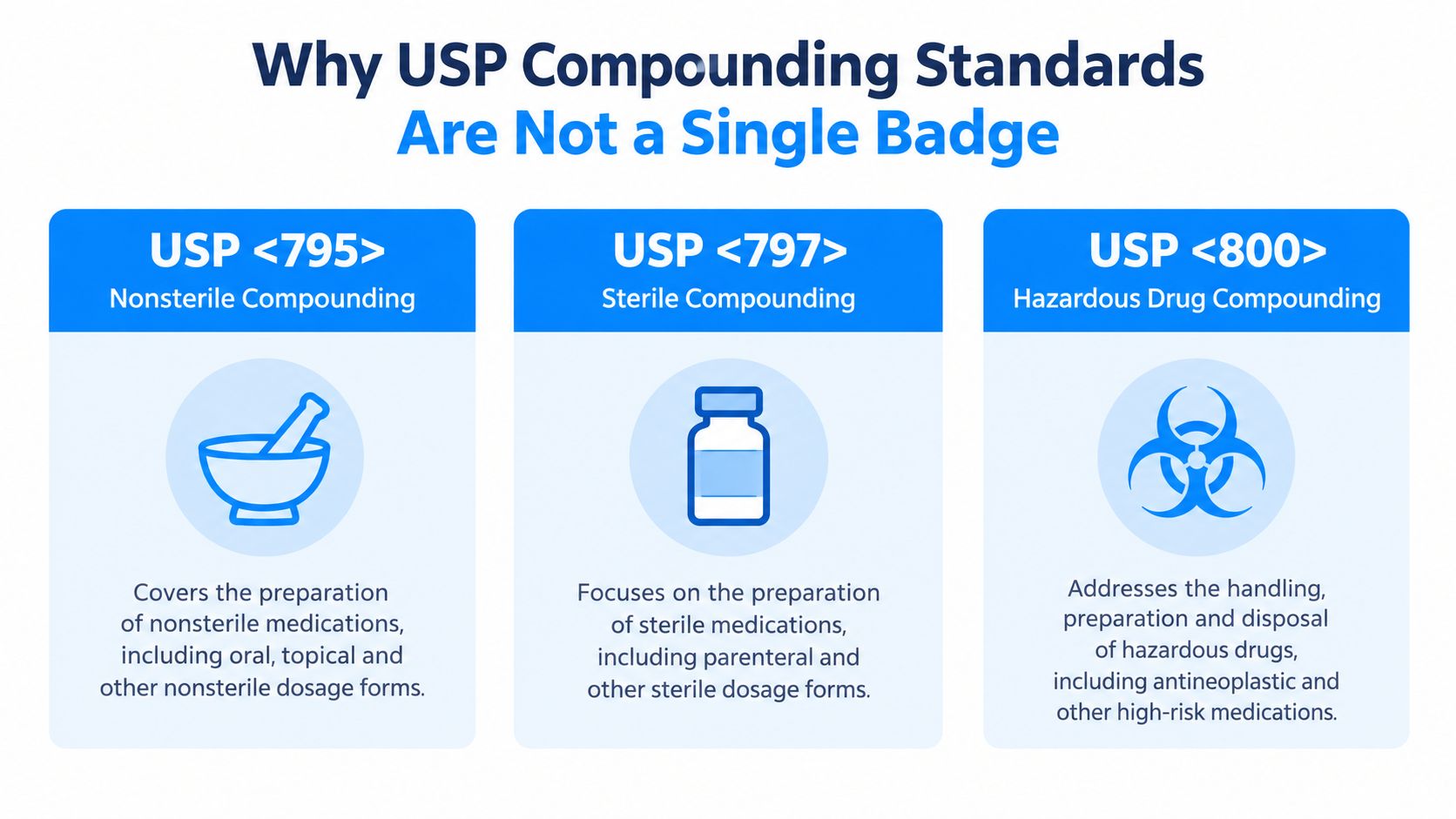
Which chapter applies depends on the dosage form
A compounded oral liquid usually points first to USP <795>. A compounded injectable points to USP <797>. If the preparation involves hazardous drug handling, USP <800> layers on top of the relevant workflow.
That layered logic matters more than the slogan on a website. A pharmacy can be competent in nonsterile compounding and still not be an appropriate sterile compounding partner for injectable metabolic therapies.
Practical rule: If a pharmacy can't clearly say whether a prescription falls under USP <795>, <797>, or <800>, it hasn't earned the patient's trust.
What patients should stop accepting
Patients and prescribers should stop accepting phrases like:
- “USP compliant” without a chapter number
- “Meets USP standards” without saying whether the product is sterile or nonsterile
- “Follows current guidelines” without naming the current chapter version in use
- “Tested and safe” without explaining what testing was required for that dosage form
A task is simpler and stricter. A patient should identify the preparation type first, then ask whether the pharmacy's facility, procedures, and labeling match the chapter that governs that prescription.
For GLP-1 care, that means one blunt question at the start: Is this preparation compounded under a sterile workflow governed by USP <797>? If the answer drifts into generic talking points, that's a warning sign.
A Timeline of USP Compounding Chapters 795, 797, and 800
USP compounding didn't appear all at once. It emerged in stages over more than two decades, which is exactly why lazy references to “the USP rule” are misleading. The framework changed over time and still changes.
The historical record matters because some pharmacies still cite old milestones as if they prove current compliance. They don't.
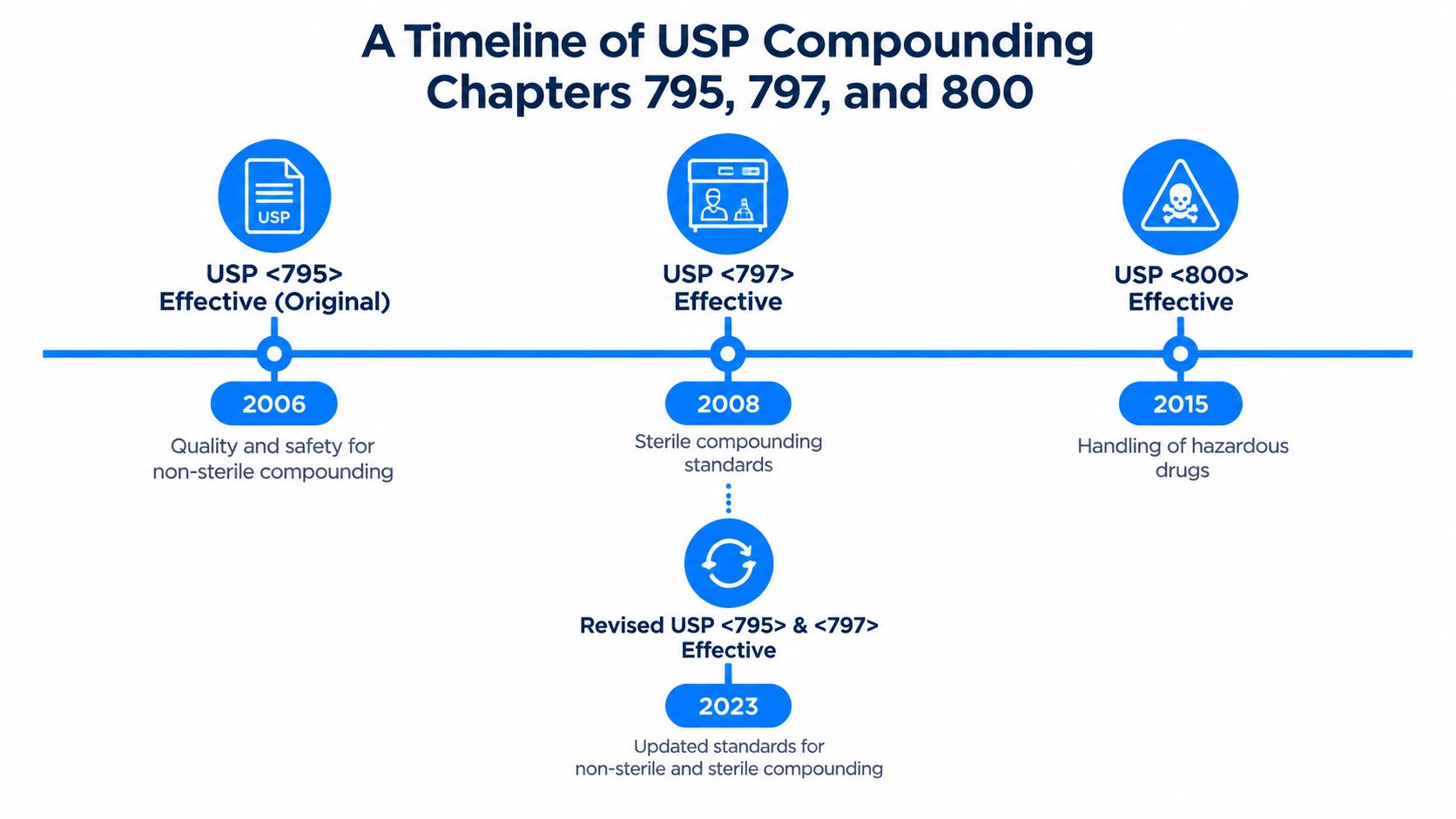
The chapter history that actually matters
According to the NCPA presentation on the history of USP <795>, <797>, and <800>, the first nonsterile compounding standard was USP <1161> Pharmacy Compounding Practices in 1996. USP <795> was first published in 2000 and later revised in 2004 and 2011. USP <797> first appeared in 2004 as the first sterile compounding standard. USP <800> became official on December 1, 2019. Revised USP <795> and USP <797> became official on November 1, 2023.
That timeline makes one point unmistakable. USP compounding standards are a modern regulatory framework that evolves. They aren't a frozen checklist from a prior decade.
Why sterile compounding history is different
Sterile compounding deserves special scrutiny because the consequences of failure are immediate and sometimes catastrophic. A timeline of sterile compounding events and actions summarized by Wolters Kluwer notes that USP <797> became the first enforceable national sterile compounding standard on January 1, 2004, was revised on June 1, 2008, and after years of revision and stakeholder comment, final revisions were published on November 1, 2022 and became enforceable on November 1, 2023. That same summary also notes that serious patient harm from poor-quality compounded sterile preparations and the 2012 meningitis outbreak linked to improper sterile compounding drove stronger state adoption of USP <797>.
Sterile compounding rules weren't tightened for paperwork. They were tightened because poor sterile practice can injure patients.
For any patient checking a pharmacy in current practice, the useful question isn't whether the pharmacy knows what USP <797> was years ago. The useful question is whether it follows the version that became enforceable in 2023 and whether the state where it dispenses has adopted that version for inspection and enforcement.
Nonsterile vs Sterile Compounding Requirements Compared
Patients often confuse dosage form with seriousness. That's backwards. The more useful distinction is nonsterile versus sterile.
A compounded capsule, suspension, or topical may fall under USP <795>. A compounded injectable vial falls under USP <797>. Those aren't cosmetic differences in paperwork. They reflect different contamination risks, environmental controls, staff qualification expectations, and release decisions.
What changes when the product is injectable
Sterile compounding requires a cleaner environment, tighter process discipline, and more rigorous quality oversight because the preparation bypasses normal external barriers when administered.
Nonsterile compounding still requires controlled practice, but it doesn't carry the same sterile assurance burden as an injectable product intended for subcutaneous use.
| Requirement | USP <795> Nonsterile | USP <797> Sterile |
|---|---|---|
| Typical dosage forms | Oral suspensions, capsules, creams, other nonsterile preparations | Injectable vials and other compounded sterile preparations |
| Primary risk focus | Formulation accuracy, cleanliness, appropriate storage, and assigned BUD | Microbial contamination control, sterile technique, environmental control, and assigned BUD |
| Compounding environment | Designated clean area appropriate for nonsterile work | Controlled sterile compounding environment with much stricter cleanroom expectations |
| Personnel demands | Scaled to nonsterile workflow and formulation risk | Personnel qualification is much more intensive because aseptic technique directly affects patient safety |
| Testing burden | Driven by formulation and stability support | Sterility support becomes central, especially when longer dating is pursued |
| Patient relevance | Most useful for oral and topical customization | Essential for compounded semaglutide, tirzepatide, and other injectables |
The pharmacy description should match the product
If a pharmacy markets compounded semaglutide or tirzepatide, the patient should hear a sterile workflow description. That means sterile handling language, sterile preparation controls, and product-specific release logic. Generic discussion of compounding experience isn't enough.
A safe review process is simple:
- Match the dosage form: Oral and topical products are not judged by the same chapter as injectables.
- Listen for sterile specifics: A pharmacy handling injectables should speak concretely about sterile compounding operations.
- Reject chapter confusion: If staff mix together nonsterile and sterile requirements, the review should stop there.
A pharmacy that compounds injectables should sound different from a pharmacy discussing flavored suspensions. If it doesn't, the patient is hearing marketing, not process.
Beyond-Use Dating and How Long a Compounded Preparation Is Actually Safe
The label date patients care about isn't the manufacturer's expiration date on an ingredient bottle. It's the beyond-use date, or BUD, assigned to the compounded preparation itself.
USP guidance distinguishes the two clearly. A state pharmacy board BUD fact sheet summarizing USP concepts explains that a BUD is the date or hour-and-date after which a compounded sterile preparation or compounded nonsterile preparation must not be used, stored, or transported, and it is assigned from the date and time the preparation is compounded. In practice, the compounded product's BUD is usually shorter than the original drug's expiration date because compounding changes the packaging and introduces additional uncertainty.
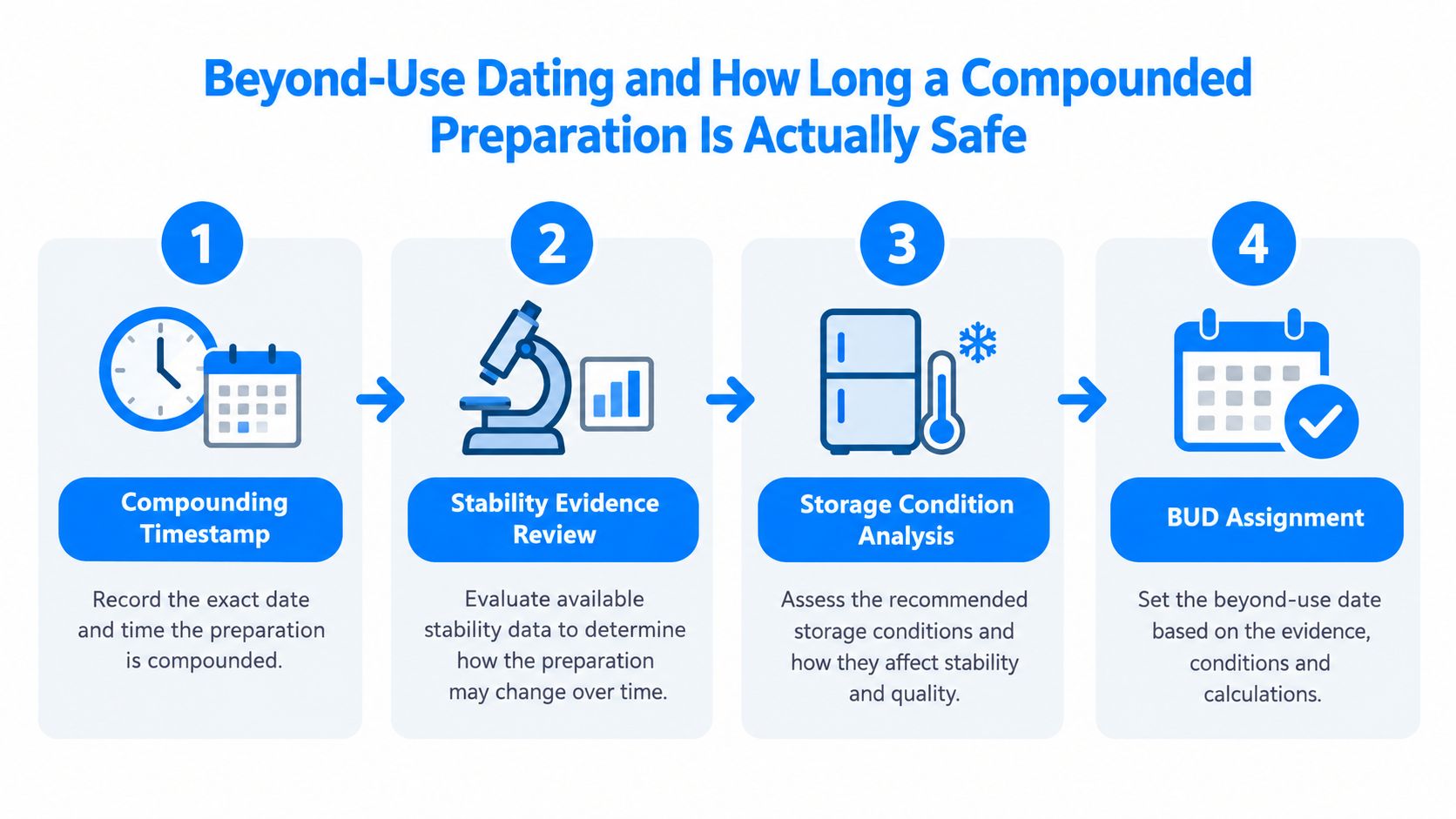
How BUD assignment should be understood
A pharmacy assigns the BUD from the compounding timestamp forward, not from the date a patient happens to receive the package. That matters for shipped medications. If transit consumes part of the use window, the usable life at delivery is shorter.
For sterile products, BUD assignment is not just a chemistry question. The ASHP guidance on assigning beyond-use dates states that USP <797> uses a framework based on sterility risk rather than chemical or therapeutic stability, and if a pharmacist wants to extend a sterile product's BUD beyond default limits, both stability testing and sterility testing are needed. The final legal BUD must be the shorter of the stability-based date and the sterility-based date.
What this means for a compounded semaglutide vial
A multidose compounded semaglutide vial may remain chemically intact longer than the default sterile BUD would allow. That doesn't mean the vial automatically qualifies for longer use. If sterility support is missing, the chemically stable product still can't be used beyond the sterility-supported limit.
For nonsterile preparations, a pharmacy standards summary discussing USP <795> BUD conventions notes that default nonsterile aqueous preparations receive 14 days refrigerated and other nonsterile dosage forms receive 90 days absent stability data. That's useful as a reminder that BUDs are dosage-form specific and shouldn't be generalized across all compounded products.
Patients should verify three things on receipt:
- Compounding timing: The BUD should make sense in relation to the dispense date.
- Storage conditions: Refrigerated products should be labeled as such when required.
- Use instructions: The counseling should match the assigned BUD, not a generic “good until empty” assumption.
Sterility Testing Triggers Batch Limits and What Testing Can and Cannot Prove
Sterility testing gets oversold. A passing test result matters, but it doesn't prove that every vial in a batch is sterile. It proves only what sample-based testing can support.
That distinction becomes critical when pharmacies market longer-dated sterile products.
When sterility testing is triggered
A review of USP <797> sterility testing triggers in sterile compounding practice identifies several situations where sterility testing is required in high-risk sterile preparations, including batches of more than 25 identical preparations, multiple-dose vials intended for administration to multiple patients, preparations exposed to 2°C to 8°C for more than 12 hours before sterilization, and preparations exposed to temperatures above 8°C for more than 6 hours before sterilization. The same review states that sterility testing is also required when a BUD longer than the USP <797> limit is desired, regardless of risk level.
That means testing is not a premium add-on. It is part of the gatekeeping logic for certain higher-risk sterile workflows and for extending usable life.
What testing can support, and what it can't
A sterility testing overview discussing USP <797>, USP <71>, and extended-dated sterile preparations notes that USP <797> requires sterility testing for certain Category 2 and Category 3 compounded sterile preparations, that all Category 3 CSPs must use USP <71> or a validated noninferior alternative, and that sources also note a maximum batch size of 250 final yield units for CSPs requiring sterility testing. That same discussion highlights the key limitation. Sterility testing is sample-based and cannot guarantee every unit is sterile.
| CSP Category | Batch-Size Testing Trigger | Method | What a Pass Confirms |
|---|---|---|---|
| Category 2 | Required in certain workflows under USP <797>, including when longer dating is pursued | USP <71> or other required validated approach where applicable | That the tested sample didn't show evidence of contamination under the method used |
| Category 3 | Sterility support is required, and all Category 3 CSPs must use USP <71> or a validated noninferior alternative | USP <71> or validated noninferior alternative | That the tested sample met the sterility test criteria. Not that every unit in the batch is sterile |
Passing sterility testing lowers uncertainty. It doesn't erase it.
Patients reviewing a sterile compounding partner should ask one pointed question: Was this product's assigned BUD supported by both the required testing and the cleanroom controls needed for that dating claim? If the answer focuses only on a single test report, it's incomplete.
Why State Enforcement Shapes What USP Compliant Really Means in 2026
National effective dates don't create uniform real-world enforcement. State boards do.
That's the gap most patient-facing content skips, and it's one of the most important operational realities for telehealth-linked compounding. A pharmacy can advertise that it follows current USP compounding standards while still operating under a state inspection and adoption timeline that lags the national effective date.
The enforcement gap is real
A state-by-state summary of compounding regulation adoption notes that USP <795>, <797>, and <800> became officially enforceable on November 1, 2023, but state adoption and inspection timelines still vary. The same summary gives a concrete example: Kentucky's board moved to enforce the 2022 revisions on January 1, 2026.
That example matters because it shows why “current USP compliant” can be a slippery phrase. The operational question isn't only what the chapter says. It's which version the destination state has adopted, how the board inspects against it, and what transitional discretion applies.
What patients and prescribers should ask instead
A better verification script is blunt:
- Which USP chapter governs this preparation?
- Which version is the pharmacy using in practice?
- Has the destination state adopted that version for enforcement and inspection?
- If state adoption lags, what standard is the pharmacy using voluntarily right now?
For telehealth dispensing across state lines, this isn't a technicality. It determines whether a pharmacy's quality claims line up with the state where the patient receives the product.
Labeling Requirements and What Your Vial Should Actually Show
A compounded vial label is not just a shipping tag. It's a condensed quality record. If critical fields are missing, the patient loses the easiest front-end check available.
For GLP-1 injectables and other compounded prescriptions, the label should allow a patient to verify what was dispensed, how long it may be used, and how it should be stored. If those basics are vague, the compounding record deserves closer scrutiny.
Turn each label field into a safety check
Patients don't need to inspect a cleanroom to catch obvious quality failures. They can inspect the vial and the paperwork handed over with it.
| Required Label Element | Patient Verification Step |
|---|---|
| Patient name | Confirm the medication is assigned to the correct person before leaving the counter or accepting shipment |
| Prescriber | Verify that the listed prescriber matches the clinician who authorized the therapy |
| Active ingredients | Confirm the ingredients match the prescribed compounded formulation |
| Route of administration | Check that the product is clearly labeled for its intended route, especially for injectables |
| Beyond-use date | Compare the BUD to the dispense date and ask how much usable time remained at shipment |
| Storage conditions | Verify the instructions match the formulation's handling needs, especially refrigeration when applicable |
| Lot number or batch identifier | Ask whether the pharmacy can trace that lot to the compounding record and any release testing documentation |
| Pharmacy contact information | Confirm there is a direct way to report storage excursions, appearance changes, or administration questions |
What absence usually means
Some omissions are more concerning than others. Missing storage instructions create practical misuse risk. Missing a lot number weakens traceability. A vague BUD makes it impossible for the patient to know when use must stop.
The useful patient response is simple. Don't accept verbal reassurance as a substitute for labeling discipline. Ask for corrected documentation before use.
A sterile injectable should arrive with enough label clarity that a patient can identify the product, the route, the storage requirement, and the stop-use date without guessing.
A Patient Checklist for Vetting a Compounding Pharmacy
Patients don't need deep pharmacy training to screen a compounding partner well. They need a script and the willingness to use it.
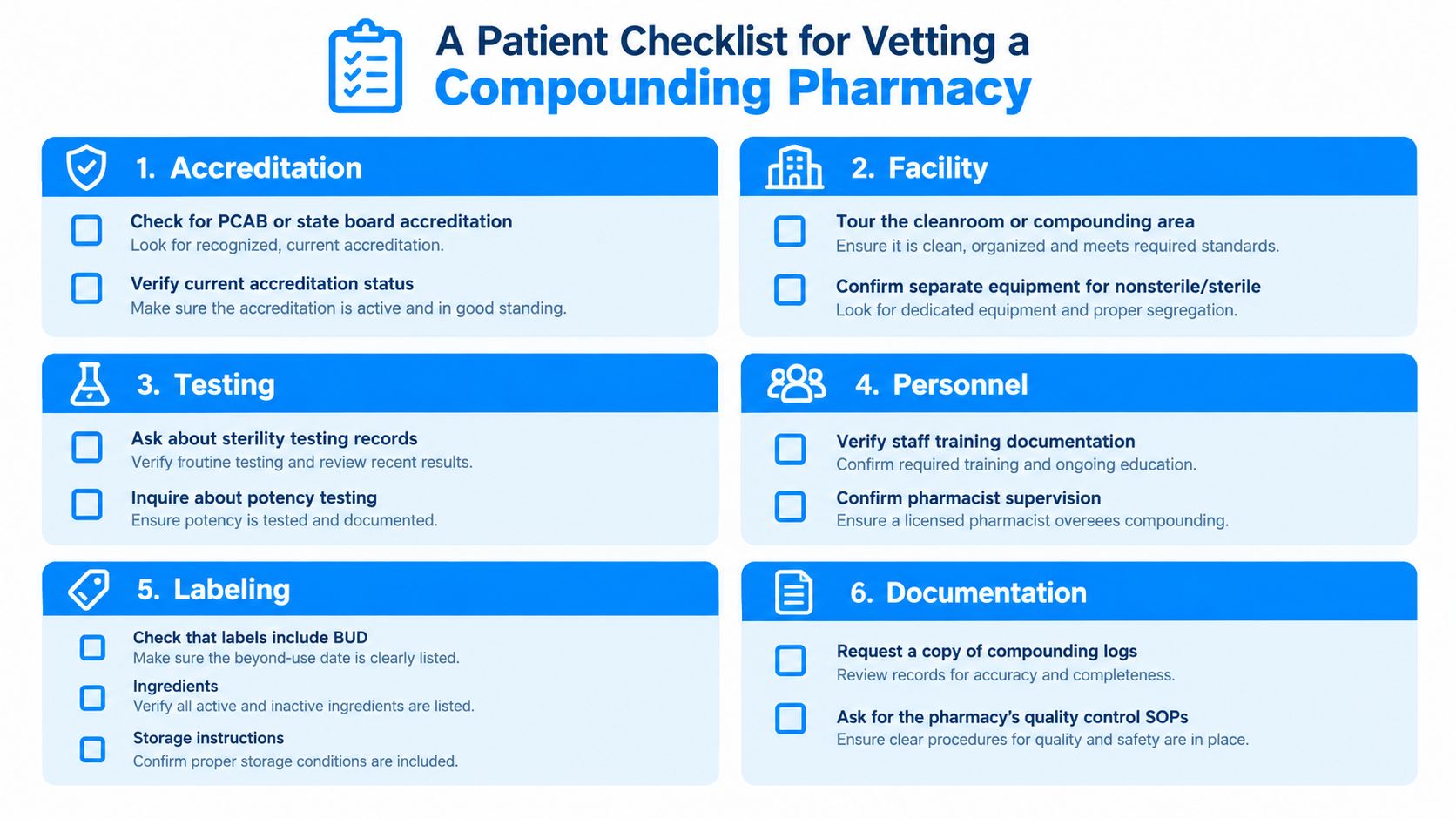
The strongest vetting process checks accreditation claims, sterile workflow controls, product testing support, personnel oversight, label quality, and traceable documentation. That's especially relevant for injectable metabolic therapies shipped after a telehealth visit.
The questions worth asking before transfer or fill
- Chapter fit: Ask which USP chapter governs the exact preparation being dispensed.
- Sterile workflow: For injectables, ask whether the product is compounded under USP <797> sterile procedures.
- Hazard handling: If hazardous handling is relevant, ask how USP <800> is incorporated into workflow.
- BUD support: Ask what evidence supports the assigned beyond-use date.
- Sterility support: Ask whether the product required sterility testing under the workflow used.
- Traceability: Ask whether the lot number on the label maps to a compounding record and release review.
The operational checks that separate strong from weak answers
The best answers are specific and document-based. Weak answers stay broad.
A practical checklist should include:
- Accreditation status: Verify whether the pharmacy holds the accreditations or state authorizations it claims.
- Facility description: Ask for a plain explanation of where sterile and nonsterile work occur and how they are separated.
- Testing records: For injectables, ask whether sterility and related release documentation can be discussed at a high level.
- Personnel oversight: Ask who the designated responsible person is for compounding quality oversight.
- Failure response: Ask what happens if a batch, environmental sample, or final review fails.
- Shipping controls: Ask how storage requirements are preserved during delivery.
Vials + Vitals states that care is fulfilled through licensed U.S. pharmacy partners for protocol-driven therapies, which is the right type of operating model to audit closely when the product is a compounded injectable rather than a commercially manufactured pen.
How USP Standards Apply to Telehealth and GLP-1 Therapies
Telehealth makes the logistics easier for patients. It doesn't relax sterile compounding expectations.
A compounded semaglutide or tirzepatide injection belongs in the sterile compounding lane. That means the questions should center on USP <797>, assigned BUD, sterility support when required, storage during shipping, and state-specific enforcement at the destination. A nonsterile framework doesn't answer the risk profile of an injectable vial.
The practical review standard for GLP-1 care
For telehealth-dispensed metabolic therapy, the patient or prescriber should verify:
- Sterile chapter fit: Injectable GLP-1 products should be reviewed as sterile compounded preparations.
- Destination-state reality: Cross-state shipment should align with the enforcement posture of the receiving state.
- Hazard workflow if relevant: If hazardous handling is part of the process, USP <800> should be addressed rather than assumed.
- Counseling match: The vial label, storage instructions, and stop-use date should agree with the pharmacy's compounding logic.
FDA-approved branded GLP-1 products and compounded versions are not interchangeable from a regulatory workflow standpoint. That is exactly why sterile compounding discipline matters more, not less, when treatment is arranged remotely.
Quick Reference Glossary and Cross References
The terms below are the ones patients and prescribers should recognize when reviewing USP compounding standards and a GLP-1 compounding workflow.
| Term | Definition | See Section |
|---|---|---|
| USP <795> | The USP chapter governing nonsterile compounding practice | Why USP Compounding Standards Are Not a Single Badge |
| USP <797> | The USP chapter governing sterile compounding practice | Nonsterile vs Sterile Compounding Requirements Compared |
| USP <800> | The USP chapter addressing hazardous drug handling | Why USP Compounding Standards Are Not a Single Badge |
| BUD | Beyond-use date. The date or hour-and-date after which a compounded preparation must not be used, stored, or transported | Beyond-Use Dating and How Long a Compounded Preparation Is Actually Safe |
| CSP | Compounded sterile preparation | Sterility Testing Triggers Batch Limits and What Testing Can and Cannot Prove |
| Stability | Evidence that a compounded preparation retains appropriate chemical and physical integrity over time | Beyond-Use Dating and How Long a Compounded Preparation Is Actually Safe |
| Sterility | The absence of viable contaminating microorganisms as supported by process controls and, when required, testing | Sterility Testing Triggers Batch Limits and What Testing Can and Cannot Prove |
| Primary engineering control | The controlled device or area used to support compounding operations appropriate to the workflow | Nonsterile vs Sterile Compounding Requirements Compared |
| ISO classification | Cleanliness classification used in sterile compounding environments | Nonsterile vs Sterile Compounding Requirements Compared |
| Media-fill testing | A personnel qualification approach used in sterile compounding to assess aseptic process performance | Nonsterile vs Sterile Compounding Requirements Compared |
| Lot number | The traceable batch identifier linking the dispensed preparation to its compounding record | Labeling Requirements and What Your Vial Should Actually Show |
| State adoption | The process by which a state board incorporates or enforces a USP chapter version in practice | Why State Enforcement Shapes What USP Compliant Really Means in 2026 |
Vials + Vitals provides physician-directed telehealth care for metabolic health and related therapies, with fulfillment through licensed U.S. pharmacy partners that patients should vet using the same sterile compounding questions outlined here. Patients comparing GLP-1 options, compounded injectables, or shipped temperature-sensitive therapies can use this framework to review labeling, BUD logic, and state enforcement issues before treatment begins. Learn more at Vials + Vitals.
Ready to see if this protocol fits your biology?
A licensed provider reviews every request before anything is prescribed.
Calibrate your metabolic protocol →