Tirzepatide vs Semaglutide Dosage for Weight Loss
Clinical comparison of tirzepatide vs semaglutide dosage for weight loss. Analyze titration schedules, outcomes, and side effects to find the right path.
Is the clinically important question really whether tirzepatide or semaglutide produces more weight loss, or is it whether a patient can reach and remain on an effective dose without losing treatment tolerance? The final milligram count attracts attention, but starting dose, escalation speed, maintenance ceiling, gastrointestinal response, and adherence often determine what happens in practice.
For the tirzepatide vs semaglutide dosage for weight loss decision, milligrams can't be compared as though they were interchangeable units. These medications follow different titration pathways, engage different receptors, and were evaluated at different therapeutic ceilings. A higher theoretical dose isn't automatically the better clinical dose if nausea, vomiting, poor intake, cost, access, or treatment discontinuation prevents sustained use.
| Clinical consideration | Tirzepatide | Semaglutide |
|---|---|---|
| Receptor activity | GIP and GLP-1 agonism | GLP-1 agonism |
| Studied obesity-treatment range | 2.5 mg to 15 mg weekly | 0.25 mg to 2.4 mg weekly |
| Starting dose | 2.5 mg weekly | 0.25 mg weekly |
| Obesity trial maintenance ceiling | 10 mg or 15 mg weekly in SURMOUNT-5 | 2.4 mg weekly |
| Direct dose conversion | No standardized equivalent | No standardized equivalent |
| Main practical issue | Finding the highest tolerated dose without forcing escalation | Completing gradual escalation while preserving tolerability |
Dose ranges and trial ceilings are summarized from the verified comparative evidence in SURMOUNT-5 and the dose-equivalence review in Clinical Obesity.
Table of Contents
- Head-to-Head Weight Loss Outcomes
- Titration Schedules and Dosing Progression
- Mechanism Differences and Side Effect Profiles
- The Equivalence Dilemma and Switching Protocols
- Patient Selection and Clinical Indicators
- Strategic Recommendation for Optimal Dosing
Head-to-Head Weight Loss Outcomes
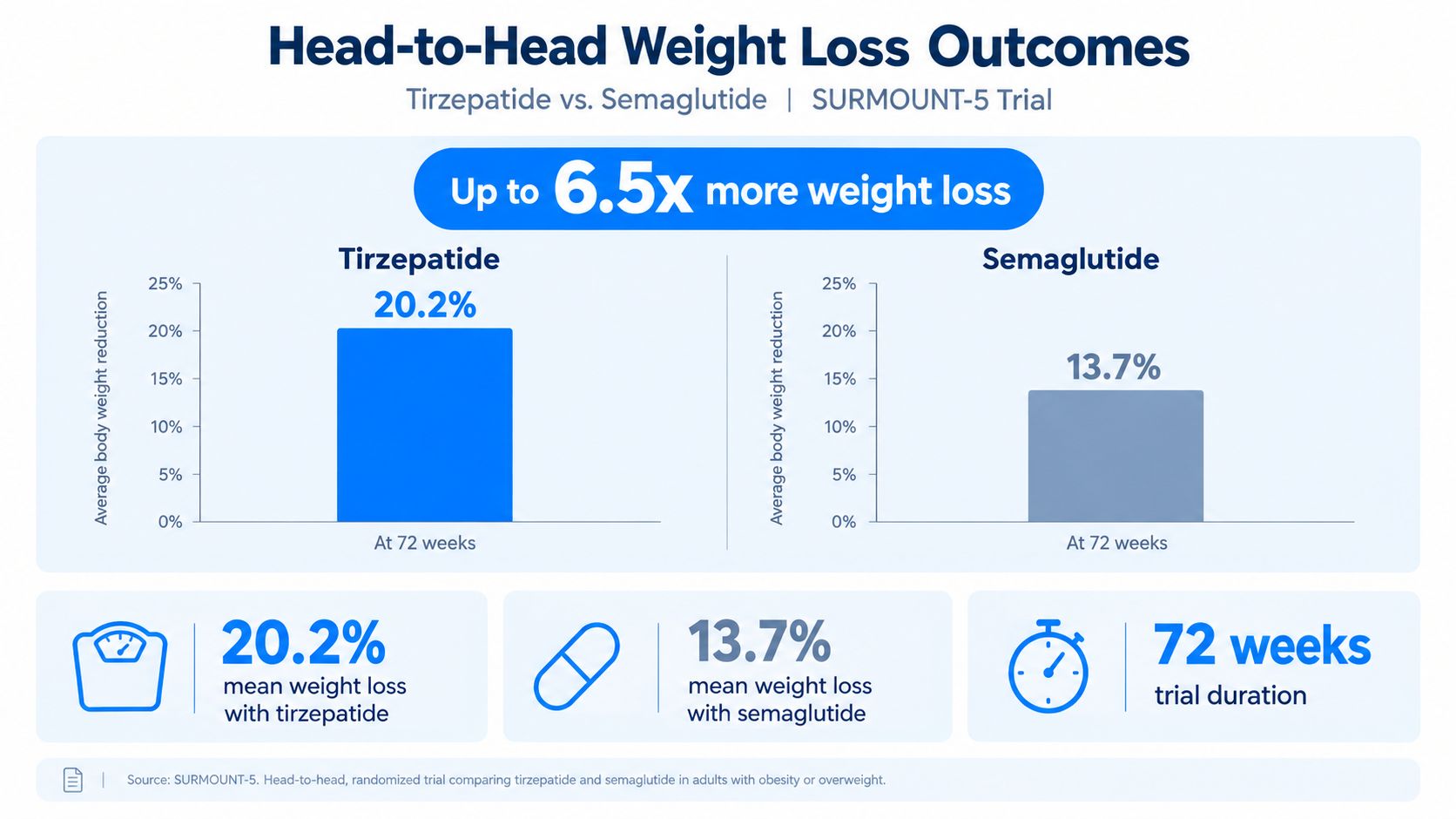
How much does the difference in average weight loss matter when the doses are not milligram-for-milligram equivalents? The strongest direct comparison comes from the 2025 SURMOUNT-5 obesity trial. Adults without diabetes received maximum tolerated doses of tirzepatide or semaglutide, with follow-up continuing to 72 weeks across 32 sites in the United States and Puerto Rico. The trial enrolled 751 patients and found mean body-weight changes of 20.2% with tirzepatide and 13.7% with semaglutide, equal to average losses of 22.8 kg and 15.0 kg, respectively. The between-group result was highly significant, p<0.001. These outcomes are reported in the New England Journal of Medicine SURMOUNT-5 publication.
What the comparison does and doesn't prove
The difference is clinically meaningful, yet it does not mean one injection is universally stronger for every patient. Because SURMOUNT-5 titrated each drug to its own maximum tolerated dose, the 20.2% versus 13.7% gap reflects two complete dosing programs, not a milligram-for-milligram contest. The practical question is which program a given patient can complete and maintain.
An earlier head-to-head diabetes trial, SURPASS-2, provides a different but useful benchmark. In that 2021 study, tirzepatide was evaluated at 5 mg, 10 mg, and 15 mg once weekly, while semaglutide was given at 1 mg once weekly to adults with type 2 diabetes. At 40 weeks, mean weight loss was 7.6 kg, 9.3 kg, and 11.2 kg with tirzepatide, compared with 5.7 kg with semaglutide. The between-group differences were 1.9 kg, 3.6 kg, and 5.5 kg, respectively, with each comparison statistically significant at P<0.001, according to the New England Journal of Medicine SURPASS-2 publication.
Clinical takeaway: Head-to-head evidence supports greater average weight reduction with tirzepatide at the studied therapeutic doses. It does not establish that every patient should pursue the highest available dose.
Population averages still need clinical context. A patient who remains on semaglutide because symptoms are manageable may achieve a more durable result than someone who reaches a higher tirzepatide dose but stops treatment when adverse effects become unacceptable. Titration completion, tolerability, and continued use often matter more than the final milligram count.
Titration Schedules and Dosing Progression
Titration isn't a formality. Each medication begins below its maintenance range so the body can adapt to gastrointestinal and appetite-related effects before the dose rises. The schedule also creates a period in which clinicians can assess hydration, bowel function, food intake, glycemic response when relevant, and whether symptoms settle before another increase.
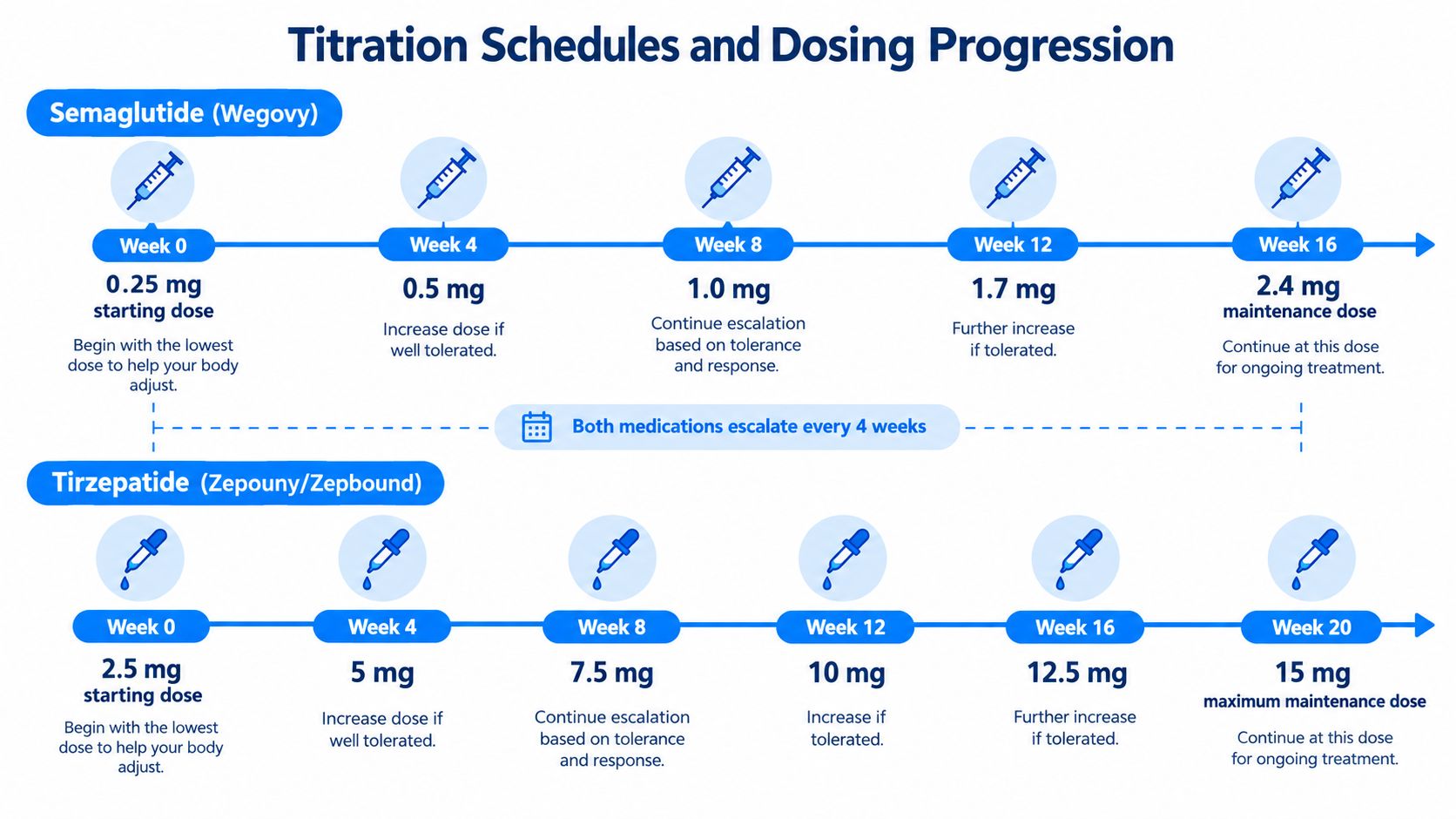
Semaglutide obesity trials used a fixed escalation schedule beginning at 0.25 mg once weekly for 4 weeks. The dose then increased every 4 weeks, progressing through 0.5 mg, 1.0 mg, and 1.7 mg, with a maintenance dose of 2.4 mg weekly by week 16. Lower maintenance doses were permitted when 2.4 mg wasn't tolerated, according to the semaglutide obesity trial protocol.
Why the pathways cannot be matched by milligrams
Tirzepatide follows a different numerical pathway, beginning at 2.5 mg weekly and progressing through 5 mg, 7.5 mg, 10 mg, 12.5 mg, and 15 mg weekly as tolerated. The verified comparative evidence describes the overall tirzepatide range as 2.5 mg to 15 mg weekly, compared with 0.25 mg to 2.4 mg weekly for semaglutide. Those numbers look dramatically different because the molecules have different pharmacology and potency. A larger number doesn't represent a proportionally larger biological effect.
A cautious clinician may hold a dose longer when symptoms are active rather than treating the calendar as a mandate. Escalation should pause when persistent nausea limits nutrition, vomiting threatens hydration, constipation becomes clinically significant, or a patient can't maintain ordinary daily function. The next increase should be based on tolerance and treatment response, not on the fact that another week has passed.
The STEP 1 obesity trial enrolled 1,306 participants receiving semaglutide 2.4 mg and 655 receiving placebo for 68 weeks, establishing the dose and duration that anchor many semaglutide weight-management discussions, as summarized by the American College of Cardiology STEP 1 trial review. That duration also illustrates why early titration shouldn't be judged by short-term scale changes alone.
Mechanism Differences and Side Effect Profiles
Semaglutide activates the GLP-1 receptor. Tirzepatide activates both the GIP and GLP-1 receptors. Both medications influence appetite and glucose-dependent insulin signaling, and both can slow gastrointestinal movement. Tirzepatide's dual receptor activity helps explain why it can produce greater average weight loss in direct comparisons, but greater efficacy doesn't eliminate the need for careful dose management.
The adverse-effect experience is shaped by the dose reached, the speed of escalation, baseline gastrointestinal sensitivity, food intake, hydration, and other medications. Nausea, vomiting, diarrhea, constipation, and reduced appetite can occur with either treatment. Symptoms may intensify around an increase and then improve, but persistent or severe symptoms require clinical review rather than automatic continuation.
Tolerability changes the meaning of efficacy
A systematic review found that tirzepatide at 15 mg or the maximum tolerated dose produced the largest reductions in body weight and waist circumference, while also being associated with increased gastrointestinal side effects and higher discontinuation rates. The review also raised the possibility of more serious adverse events, creating a trade-off between maximal average reduction and the ability to remain on treatment. The findings are available in the systematic review of comparative incretin therapies.
This distinction matters because the most effective dose in a trial isn't always the most effective dose for a particular patient. A lower dose that supports regular eating, fluid intake, sleep, work, and consistent administration may outperform a higher dose that repeatedly forces interruptions.
Safety principle: Dose escalation should stop when tolerability stops supporting treatment. A maintenance dose is successful only when the patient can take it consistently and safely.
Clinicians should also review contraindications, relevant endocrine history, pregnancy-related considerations, pancreatitis concerns, gallbladder symptoms, kidney function when dehydration is possible, and concurrent glucose-lowering therapy. New severe abdominal pain, repeated vomiting, inability to keep fluids down, or symptoms suggesting a serious complication warrant prompt medical assessment.
The Equivalence Dilemma and Switching Protocols
Patients commonly ask whether 5 mg of tirzepatide equals 1 mg or 2.4 mg of semaglutide. The evidence doesn't provide a validated conversion table. These drugs were studied through different titration paths, with different receptor activity and different maximum tolerated doses, so a direct mathematical equivalence would create false precision.
The clinical evidence still offers useful direction. SURMOUNT-5 showed greater average weight loss with tirzepatide at 72 weeks, and real-world evidence summarized in the dose-equivalence review describes larger reductions with tirzepatide at 6 months. Neither finding proves that a specific dose of one medication should be replaced with a particular dose of the other. The review specifically identifies the lack of a simple conversion rule as a practical gap in switching and plateau management.
A safer approach to transition
A patient changing therapy shouldn't assume that prior exposure permits skipping the new medication's introductory phase. The receiving clinician needs to review the last dose, timing of the last injection, treatment response, side effects, current medical conditions, and the reason for switching. The new medication generally requires its own cautious starting strategy, with subsequent increases guided by response.
A switch may be reasonable when weight loss has plateaued, adverse effects limit continuation, access changes, or a patient has a clinical reason to favor a different receptor profile. Semaglutide can be the better choice when a patient values a more familiar GLP-1-only approach or tolerates it more reliably, even if average weight loss is lower in comparative studies.
The opposite is also true. Tirzepatide may be considered when greater average weight reduction is a priority and the patient can be monitored through gradual escalation. Neither option should be selected through milligram arithmetic alone.
Patient Selection and Clinical Indicators
The right dose depends on the patient's therapeutic target and physiological margin for side effects. A person with substantial obesity and weight-related disease may reasonably discuss a path toward a higher tolerated dose, while another patient may need a slower approach because nausea, constipation, reflux, medication interactions, or previous treatment intolerance threatens adherence.
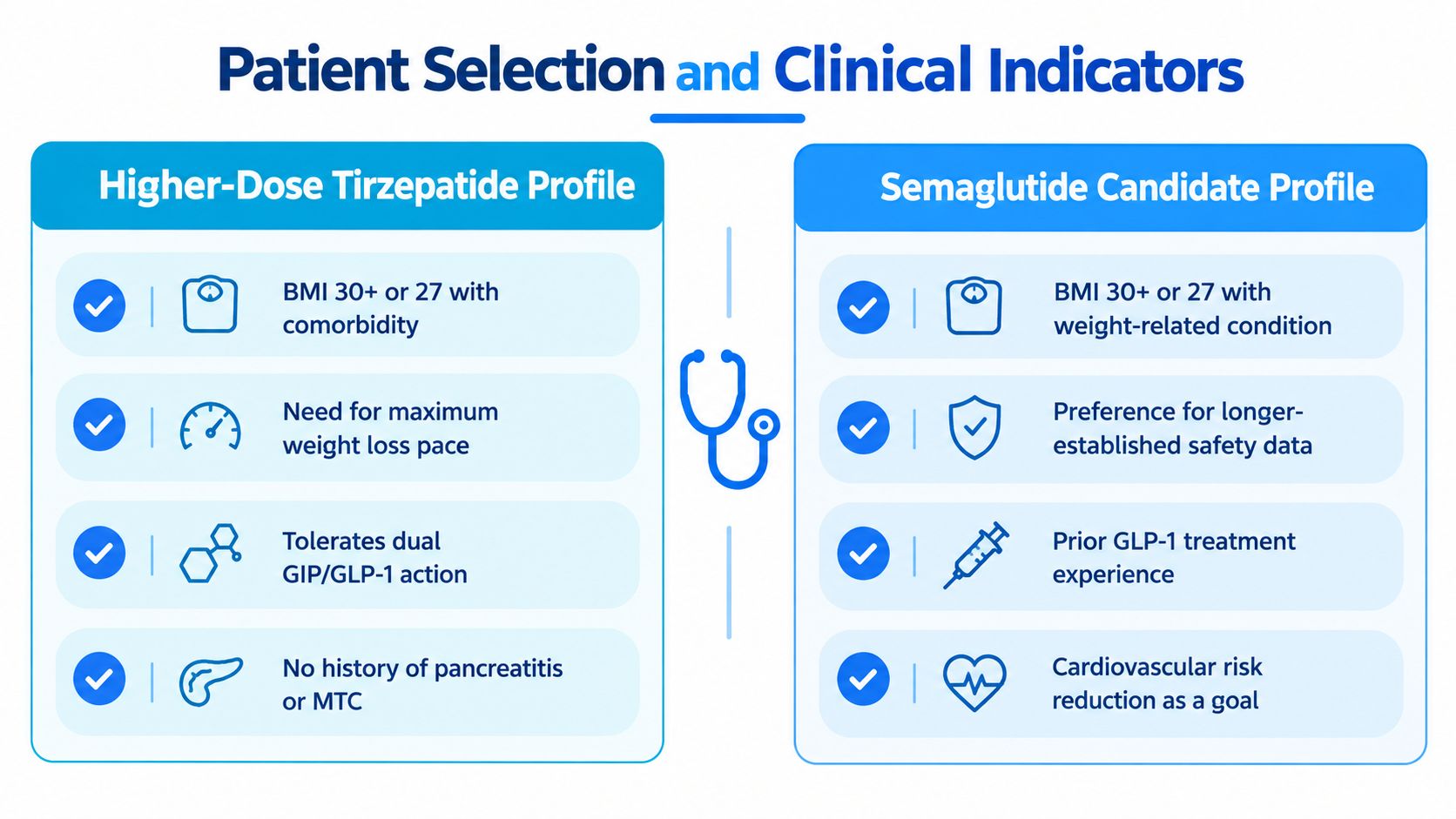
The eligibility framework for obesity treatment includes BMI 30 or higher, or BMI 27 or higher with a weight-related condition, but dose selection requires more than an eligibility threshold. The clinician must consider the severity and pattern of obesity, metabolic risk, cardiovascular history, glycemic status, eating behavior, current medications, nutritional adequacy, and the patient's ability to attend follow-up.
Who may benefit from a more assertive titration path
A patient may be a reasonable candidate for continued tirzepatide escalation when the clinical goal requires substantial weight reduction, early doses are tolerated, nutrition remains adequate, and the patient understands that higher doses can increase gastrointestinal burden. The decision still requires screening for contraindications and a plan for responding to symptoms.
A patient may favor semaglutide or a lower maintenance dose when treatment continuity matters more than maximizing average trial weight loss. Prior GLP-1 experience, preference for a single receptor pathway, concern about gastrointestinal effects, or a strong need for a familiar titration structure can all influence the choice.
| If the priority is... | The discussion should focus on... |
|---|---|
| Greater average weight reduction | Whether tirzepatide escalation is tolerated and clinically justified |
| Sustained adherence | The dose that controls appetite without disrupting daily function |
| A cautious restart or switch | Reassessing the new medication rather than applying a conversion formula |
| Cardiometabolic risk management | The medication's approved indication, comorbidities, and overall treatment plan |
Maximum tolerated beats maximum theoretical
The maximum tolerated dose is the dose that produces an acceptable balance of benefit and adverse effects for that patient. It may be the labeled ceiling, but it may also be lower. Forcing escalation after a patient has reached a stable, useful response can reduce adherence without guaranteeing a proportionate benefit.
Decision rule: The best long-term dose is the lowest dose that produces meaningful control and remains acceptable to the patient and clinician.
That rule doesn't mean under-treating obesity or stopping at the first mild symptom. It means separating manageable, transient effects from symptoms that compromise hydration, nutrition, function, or safety. Dose selection should remain individualized rather than treating a higher number as a universal clinical achievement.
Strategic Recommendation for Optimal Dosing
A practical dosing strategy starts with the treatment objective, not the advertised maximum. The clinician and patient should define what success means, whether that involves weight reduction, appetite control, improved glycemic management, better mobility, reduced metabolic risk, or a combination of goals. The target determines how much escalation is worth pursuing.
A structured clinical process
Establish a baseline. Review weight trajectory, waist-related concerns, comorbidities, current medications, gastrointestinal history, nutritional intake, and contraindications. Document the reason for choosing tirzepatide or semaglutide before the first dose.
Start at the designated introductory dose. Semaglutide begins at 0.25 mg weekly, while tirzepatide begins at 2.5 mg weekly. These doses aren't conversion equivalents. They're entry points for the respective titration programs.
Increase only after tolerance is clear. Both pathways use four-week escalation milestones in the verified dosing evidence. A patient with ongoing clinically important symptoms shouldn't be advanced merely to stay on schedule.
Assess the whole response. Scale weight is only one measure. Review appetite, eating quality, hydration, bowel function, adverse effects, physical activity, sleep, glycemic measures when relevant, and treatment consistency.
Hold or reduce when necessary. A lower dose is appropriate when it preserves treatment continuity and provides useful benefit. Persistent vomiting, severe abdominal symptoms, dehydration, allergic symptoms, or other concerning changes require prompt medical evaluation.
Reassess plateaus before escalating. A plateau may reflect inconsistent dosing, inadequate protein or fluid intake, constipation, sleep disruption, medication effects, or an unrealistic timeframe. Escalation isn't the only response, and it isn't always the safest one.
The comparison data support tirzepatide's greater average weight reduction at studied therapeutic doses, but the tolerability review supports a more nuanced conclusion. The optimal choice is the regimen a patient can continue while receiving meaningful benefit, with monitoring strong enough to detect problems early.
Vials + Vitals offers physician-reviewed metabolic care, including individualized titration oversight and a GLP-1 Titration Calculator for semaglutide and tirzepatide. Any such tool should support, not replace, a licensed clinician's assessment of eligibility, formulation, dose progression, adverse effects, and follow-up needs.
Treatment shouldn't be adjusted from online conversion charts or by comparing milligram numbers across medications. Patients should bring their current dose, injection date, symptoms, weight trend, medication list, and treatment goals to a qualified prescriber before starting, switching, holding, or increasing either therapy.
Vials + Vitals provides physician-directed telehealth evaluation and individualized GLP-1 treatment planning for patients considering tirzepatide or semaglutide. Visit Vials + Vitals to complete a confidential clinical assessment and discuss a monitored dosing plan with a licensed provider.
Ready to see if this protocol fits your biology?
A licensed provider reviews every request before anything is prescribed.
Calibrate your metabolic protocol →