Tirzepatide Telehealth: How Online Prescribing Works

Learn how tirzepatide telehealth works in 2026, from intake and titration oversight to state limits and pharmacy fulfillment. A clinical, evidence-based guide.
Maya has already done the hard part. She found a telehealth slot on a Sunday evening, filled out a form after months on a primary care waitlist, and now she wants to know something more useful than “can tirzepatide be prescribed online?” She wants to know what happens next, who reviews her chart, how the dose is adjusted, what happens if nausea hits, and whether the medication will still be available when the next refill is due.
That's the right question. Tirzepatide telehealth works best as a structured chronic-care program, not a fast checkout page, because the clinical work starts after the first intake. In a 24-week virtual obesity-management program, adults using semaglutide or tirzepatide with behavioral support lost 7.2% of baseline weight by 12 weeks and 12.3% by 24 weeks, and 67.22% reached at least 10% weight loss by week 24, with blood pressure improving as well (Medscape summary of the virtual care study, PubMed record). Those outcomes don't happen by accident. They happen when intake, titration, pharmacy, and follow-up are treated as one protocol.
Table of Contents
- Starting a Tirzepatide Telehealth Journey
- The Intake Assessment and Physician Review
- How Tirzepatide Works and Why It Matters for Telehealth
- Titration Oversight, Monitoring, and Side-Effect Management
- Pharmacy Pathways from Brand to Compounded Supply
- State Rules and Licensure That Shape Online Prescribing
- Long-Term Maintenance and Relapse Prevention After Telehealth Titration
- Choosing a Telehealth Program and What Comes Next
Starting a Tirzepatide Telehealth Journey
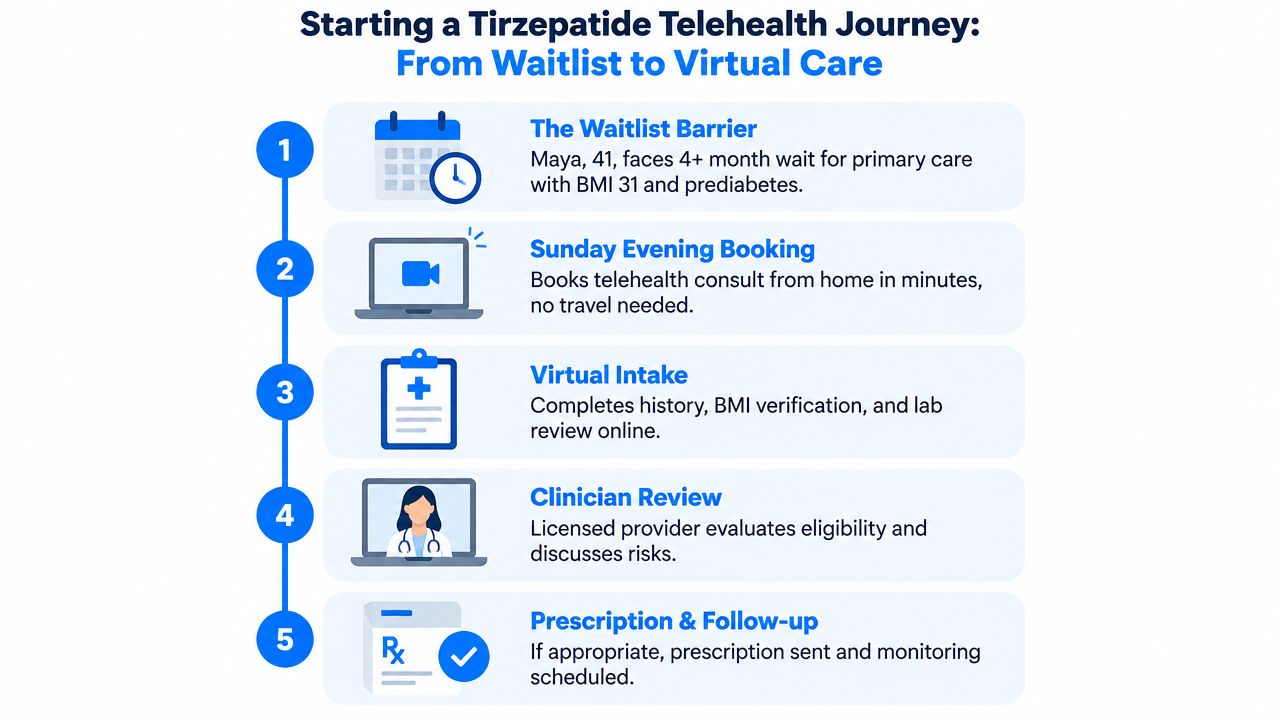
A patient often starts with a waitlist, then moves into a digital intake, clinician review, dose titration, maintenance, and refills. Each step answers a different clinical question. If one is skipped, problems usually show up later in the process.
Why the structure matters
A defensible telehealth program starts with a licensed clinician who can verify identity, review the medical record, and prescribe within the patient's state rules. Tirzepatide is not a one-time purchase. It works more like ongoing metabolic care, with follow-up, symptom tracking, and dose decisions that need to be revisited as treatment continues.
Evidence supports that kind of structure. Virtual obesity-care programs that paired medication with behavioral support have shown meaningful weight loss and better blood pressure outcomes, as summarized in the Medscape summary. That result depends on a program that treats intake, titration, pharmacy access, and follow-up as one linked pathway.
Practical rule: if a program cannot explain who owns your chart, who changes your dose, and how refills are handled, it is not running a real treatment pathway.
The difference shows up quickly between a protocol-driven telehealth model and a simple checkout page. A clinical program asks for history, medications, labs when needed, and a prescriber decision. A weaker setup asks a few checkbox questions and sends medication with little visible oversight. They may look similar on a screen, but they are not similar in safety, continuity, or accountability.
What the patient should expect
The patient should expect longitudinal care, not a single transaction. The clinician who reviews the intake should also be responsible for follow-up, especially if side effects, plateaus, or refill problems appear.
A useful way to judge the service is by its process, not its promise. If it behaves like a pharmacy transaction, it probably is one. If it explains how the plan changes over time, it is closer to a real clinical program.
The Intake Assessment and Physician Review
A high-quality intake asks for more than weight and a credit card. It should verify identity, document basic body metrics, reconcile the medication list, and screen for conditions that make tirzepatide unsafe or poorly matched. That's the first place where a real telehealth program separates itself from a loose screening form.
What a rigorous intake should capture
The intake should confirm who the patient is, what medications and supplements they use, and whether there's any history that changes risk. That includes a personal or family history of medullary thyroid carcinoma, a history of pancreatitis, gastroparesis, pregnancy intent, and recent bariatric surgery. A good program also records self-reported height and weight, with home scale data or uploads when appropriate, because starting dose and eligibility depend on the clinical picture, not on marketing copy.
The physician review is where the intake becomes a prescription decision. A licensed prescriber in the patient's state should reconcile the questionnaire, decide whether the indication is obesity or a weight-related comorbidity, and order baseline labs when appropriate, such as HbA1c, lipids, eGFR, and TSH. Some programs can do this asynchronously, some need a live video visit, and the better choice depends on the complexity of the history.
Clinical takeaway: a short questionnaire can screen interest, but it can't replace a prescriber who documents the reason for treatment and the reason it's safe.
Intake components at a glance
| Domain | Minimum Acceptable | Comprehensive Standard |
|---|---|---|
| Identity | Basic account verification | Photo ID plus selfie match |
| Body metrics | Self-reported weight and height | Verified BMI documentation with optional home scale upload |
| Medication review | Current prescription list | Full medication and supplement reconciliation |
| Risk screening | General health questions | Screening for thyroid cancer history, pancreatitis, gastroparesis, pregnancy intent, and recent bariatric surgery |
| Prescriber review | Automated approval workflow | Licensed clinician review in the patient's state with documented risk-benefit rationale |
| Baseline data | Optional or deferred testing | Labs when appropriate, including HbA1c, lipid panel, eGFR, and TSH |
The depth of the review changes with the visit model. Asynchronous intake is efficient, but it works best when the chart is straightforward and the service still supports live follow-up when needed. A synchronous visit gives the clinician more room to ask about symptoms, eating patterns, prior medication responses, and the patient's actual ability to handle injections and side effects. High-quality telehealth doesn't have to be slow, but it does have to be complete.
How Tirzepatide Works and Why It Matters for Telehealth
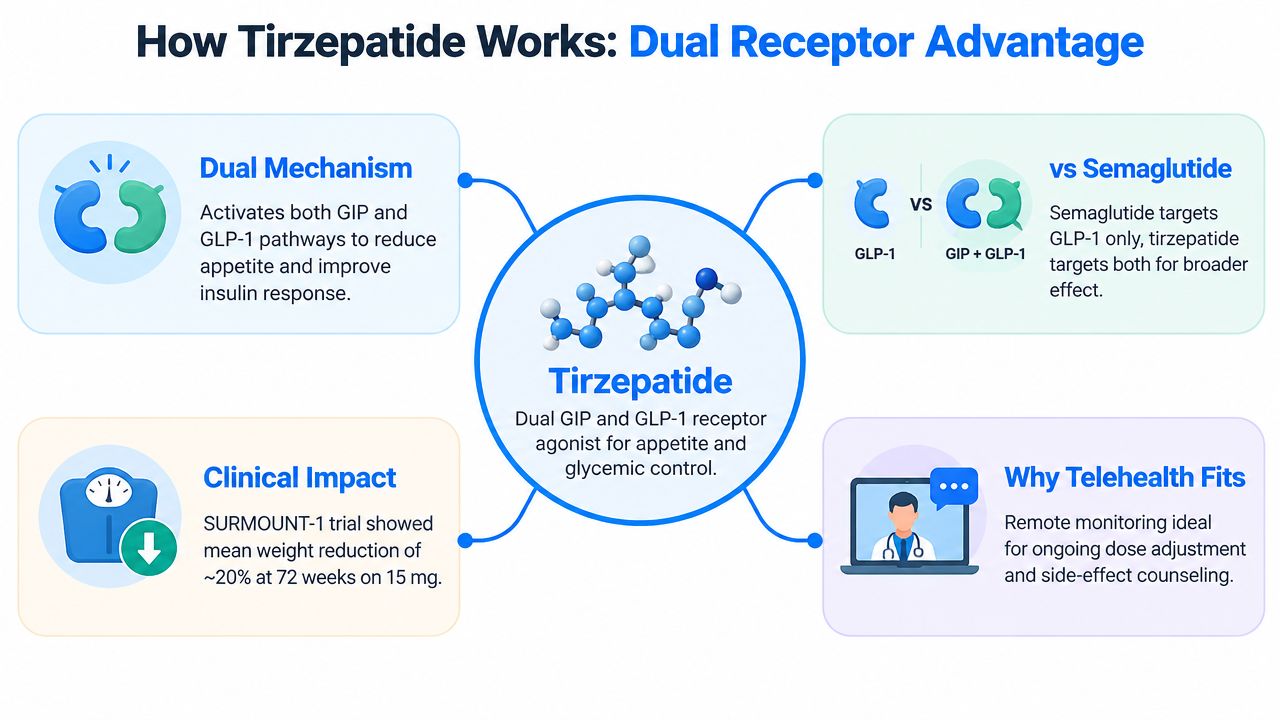
Tirzepatide is a dual incretin agonist, which means it acts on both GIP and GLP-1 pathways. A mechanistic analysis showed stronger engagement at the GIP receptor than the GLP-1 receptor and also found GLP-1 signaling bias toward cAMP generation over β-arrestin recruitment, which helps explain why its metabolic profile isn't identical to semaglutide's (mechanistic analysis). That difference matters in telehealth because the dose plan can't be treated as a generic refill ladder.
Mechanism shapes the protocol
The practical point is simple. Tirzepatide affects appetite and glycemic regulation through more than one receptor pathway, so clinicians need to watch both response and tolerance rather than assuming every patient will progress the same way. In the 72-week SURMOUNT-1 trial, once-weekly tirzepatide produced substantial and sustained weight loss, and long-term follow-up in obesity with prediabetes reported mean weight changes at 176 weeks of −12.3% with 5 mg, −18.7% with 10 mg, and −19.7% with 15 mg versus −1.3% with placebo (NEJM trial report). That kind of efficacy is exactly why the remote protocol needs discipline.
Telehealth fits this medication well because the work is iterative. Appetite changes, fullness cues, glucose trends, and side effects all evolve after the prescription is written. If the patient is plateauing, the clinician has to decide whether the dose is too low, the timing is too fast, or the problem is adherence rather than pharmacology. Automatic escalation doesn't solve those questions.
Why clinicians should pace reassessment
A patient may think the next dose should always come as soon as the previous pen is finished. That isn't how responsible titration works. The prescriber should move on schedule when tolerance is good and the goals justify it, but should pause when symptoms or labs say otherwise. That's also why telehealth programs need structured check-ins, not just a shipment label and a refill reminder.
Titration is a clinical decision, not a customer preference.
The same logic applies to maintenance. A strong early response doesn't mean the medication can be handled casually later. The program has to keep evaluating weight trend, gastrointestinal tolerance, and glycemic risk, especially if the patient is moving from symptom control into long-term metabolic management.
Titration Oversight, Monitoring, and Side-Effect Management
A telehealth tirzepatide program should treat titration like a guided climb, not an automatic refill cycle. The usual start is 2.5 mg, then increases in 2.5 mg steps at roughly four-week intervals, up to a 15 mg ceiling when tolerated. That schedule gives the prescriber a framework, but it does not mean every patient should move at the same speed.
What good monitoring looks like
Good follow-up goes beyond body weight. It asks about nausea, vomiting, appetite suppression, injection-site reactions, constipation, hydration, and whether the patient can keep up with meals and fluids. It also tracks blood pressure and, when relevant, glucose data, because the goal is metabolic improvement, not just a smaller number on the scale.
Telehealth teams do better when they collect information between visits through secure messaging, brief check-ins, and scheduled video follow-ups. Weight logs and waist-circumference trends help show whether the patient is responding or stalling. Home blood pressure readings can also show whether the cardiovascular side of the weight-loss response is moving in the right direction, as described in the virtual care cohort where systolic pressure fell from 131.2 mm Hg to 120.0 mm Hg and diastolic pressure from 83.8 mm Hg to 78.2 mm Hg.
A patient who is plateauing may need more than a higher dose. The clinician may need to ask whether the dose is too low, the pace is too fast, or adherence is the issue. That is why the program has to review the pattern over time, not just the latest shipment.
Safety guardrails patients should look for
A reputable program has clear hold criteria for troublesome nausea, vomiting, dehydration, or hypoglycemia, and it knows when to stop escalating. It should also review labs before moving higher when the clinical picture calls for it. If red-flag symptoms appear, the patient should be directed to in-person care rather than told to wait for the next portal message.
- Dose timing: the schedule should be written in advance, not decided case by case.
- Symptom tracking: nausea, vomiting, and injection-site reactions should be documented, not mentioned casually.
- Vitals review: weight and blood pressure should be reviewed regularly, not only at refill time.
- Escalation pathway: there should be a clear route to in-person evaluation if symptoms become concerning.
Protocol check: if a service only asks whether the box arrived and never asks how the patient feels on the dose, it is dispensing medication, not managing therapy.
The most useful question a patient can ask is direct. What triggers a dose increase, what triggers a hold, and what triggers a visit? If the team can answer those three questions without hesitation, the monitoring system is probably real.
Pharmacy Pathways from Brand to Compounded Supply
Telehealth tirzepatide can move through more than one pharmacy pathway, and the pathway matters as much as the prescription itself. Some patients receive brand medication, some receive a licensed pharmacy supply where available, and some programs have used compounded tirzepatide when legally permitted. The right pathway depends on regulation, access, and how transparent the program is about what it is dispensing.
What changed after the shortage era
In December 2024, the FDA said tirzepatide was no longer in shortage, and 2025 reporting described manufacturer litigation against telehealth companies over alleged illegal copies, which turned access, pricing, and compounding into a moving target rather than a stable FAQ topic (NPR report). That shift matters because patients need continuity planning, not just a first shipment. It also means any program that still talks about compounded supply has to explain the legal and pharmacy basis for doing so.
Patients should verify three things with any pharmacy pathway. First, what exactly is being dispensed. Second, which licensed pharmacy is fulfilling it. Third, what happens if the supply source changes, the refill is delayed, or a dose is unavailable. The same program can feel smooth on day one and still be fragile at refill time if those questions were never addressed.
How to compare pathways
Brand medication usually comes with the clearest regulatory footing, but it may also come with more price sensitivity. Compounded supply may appear more flexible, but it depends on legal status, pharmacy oversight, and product transparency. What matters clinically is whether the patient gets a verified formulation, proper storage, and a refill path that doesn't collapse when policy changes.
| Pharmacy Type | Typical Monthly Cost | Regulatory Status | Telehealth Access Considerations |
|---|---|---|---|
| Brand tirzepatide | Often higher cash-pay pricing | FDA-approved product | Clearer sourcing, but cost and coverage can limit access |
| Licensed pharmacy supply | Varies by channel and availability | Depends on dispensing pathway | Useful when the program discloses the exact source and refill process |
| Compounded tirzepatide | Historically lower in some cash-pay programs | Contingent on current FDA shortage status and state rules | Requires careful verification of pharmacy licensing, labeling, and continuity risk |
A useful self-check is simple. If the program won't name the pharmacy type, won't say whether the product is brand or compounded, or won't explain what happens when the formulation changes, the patient should slow down. The medication path is part of the treatment plan, not an afterthought.
State Rules and Licensure That Shape Online Prescribing
Telehealth prescribing for tirzepatide isn't governed by one national rulebook. State law decides how the visit must happen, whether a clinician can prescribe after an asynchronous intake, and where that clinician must be licensed. That's why the same program can look available on a website yet still be unavailable for a specific ZIP code.
What varies by state
Some states allow an asynchronous intake plus a brief live video check. Others require a synchronous audiovisual visit before the prescription can be issued. The licensure side matters too, because the prescriber generally has to be authorized in the patient's state, even when the consultation itself happens online. The Interstate Medical Licensure Compact expands reach for some clinicians, but it doesn't erase state boundaries.
Pharmacy rules add another layer. State boards can regulate dispensing and shipment separately from the clinical visit, and some states place extra limits on injectable peptide therapies shipped from out-of-state compounding pharmacies. That means a telehealth program may be operationally sound in one state and blocked in another, even if the medical protocol is identical.
What patients should check before enrolling
A patient should never assume national availability just because a webpage says “telehealth.” The safer move is to confirm that the clinician can prescribe in the patient's state, that the pharmacy can legally ship there, and that the visit model matches state law. A program may also require an initial lab panel or a live follow-up before any dose is sent, depending on the state.
| State Category | Visit Requirement | Licensure Approach | Implication for Patients |
|---|---|---|---|
| More flexible telehealth states | Asynchronous intake may be allowed with limited live follow-up | Prescriber still needs valid state authority | Faster onboarding may be possible |
| More restrictive prescribing states | Synchronous audiovisual visit may be required | State-specific licensure often needed | Enrollment may require a live appointment |
| Pharmacy-restricted states | Clinical visit alone isn't enough | Dispensing and shipment rules add limits | The medication can be legal in one state and blocked in another |
The practical lesson is straightforward. The program website should match the patient's geography, not the other way around. If a service can't explain its state-by-state rules in plain language, it probably isn't ready for careful prescribing.
Long-Term Maintenance and Relapse Prevention After Telehealth Titration
The endpoint isn't the end of the first twelve weeks. It's whether the patient can keep the weight off, keep tolerating the medication, and keep the metabolic gains after the early dose climb is over. Tirzepatide is a long-term therapy for many patients, and the maintenance phase has to be treated like medicine, not like a victory lap.
Why follow-up has to continue
The withdrawal data make the case clearly. In SURMOUNT-4, participants who switched to placebo after initial loss experienced a 14.0% weight regain from week 36 to 88, while those who continued tirzepatide had an additional 5.5% weight reduction (SURMOUNT-4 summary). That pattern shows why a telehealth program needs a maintenance plan before the patient ever reaches the higher doses.
Maintenance should include continued check-ins, dose holds or dose reductions when needed, and metabolic monitoring such as A1c, lipids, blood pressure, and body composition when clinically relevant. It should also watch for relapse early by tracking home weight trends and appetite rebound, rather than waiting for a large regain to show up at the next refill.
How clinicians should think about plateaus
A plateau doesn't automatically mean the dose must go up. It can also mean the patient is at a good maintenance dose, the eating pattern has drifted, or side effects are interfering with adherence. A good clinician will look at trends, not just one weigh-in, and will decide whether to continue, hold, reduce, or reassess.
Maintenance rule: if the program only talks about escalation and never talks about stable dosing, it's not set up for long-term obesity care.
That matters because ongoing treatment is where the medication's benefits are preserved. The patient should know in advance how refill timing works, how relapse is detected, and what the next step is if the medication has to be adjusted down instead of up. Durable outcomes depend on those guardrails.
| Outcome Measure | Continued Tirzepatide (Week 88) | Switched to Placebo (Week 88) |
|---|---|---|
| Weight trend | Additional 5.5% reduction | 14.0% regain from week 36 to 88 |
Choosing a Telehealth Program and What Comes Next
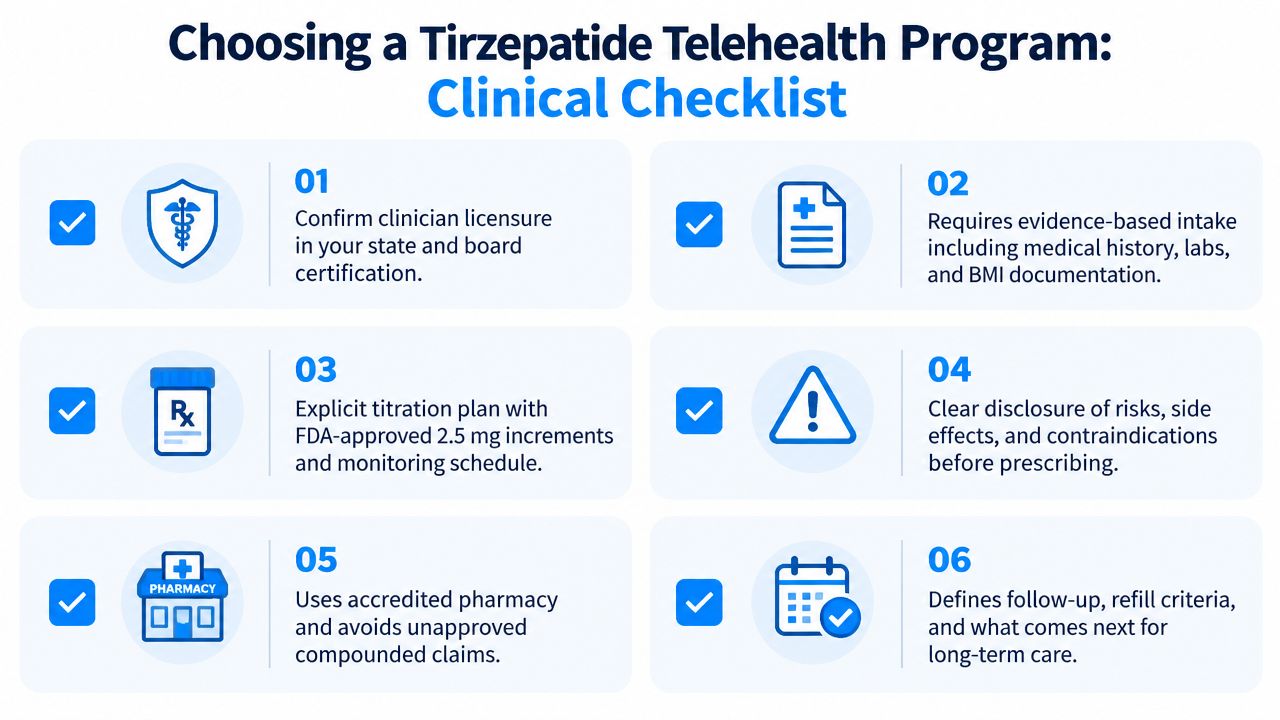
A patient choosing a program should look for five things before enrolling, a licensed clinician in the correct state, an evidence-based intake, a written titration plan, transparent pharmacy labeling, and a maintenance policy that doesn't disappear after week 12. If any of those are missing, the service may still be convenient, but it isn't well built for safe metabolic care.
What to verify before signing up
A serious program should show how it handles labs, follow-up, adverse events, and refills. It should clearly say whether the medication is brand or compounded, disclose the pharmacy pathway, and explain what happens if the state rules change or the supply source changes. It should also avoid same-day approvals that don't involve clinician contact, especially when the chart has risk factors or incomplete history.
One practical option in this space is Vials + Vitals, which uses an online clinical assessment, U.S.-licensed provider review, individualized titration schedules, and fulfillment through accredited U.S. pharmacies. That model aligns with the protocol layer patients should be asking about, not just the convenience layer.
The next phase of the market will likely be shaped by state-level compounder crackdowns, FDA enforcement after the shortage resolution, and tighter integration with primary care records. Through 2026 and into 2027, the more durable programs will probably be the ones that can document continuity, explain pharmacy sourcing, and build maintenance into the price structure rather than treating it as an afterthought.
If a patient wants tirzepatide telehealth handled as real medical care, not a refill chase, Vials + Vitals is a reasonable place to start. The team can review eligibility, prescribe only when clinically appropriate, and build a titration plan that matches state rules and pharmacy pathways. For anyone comparing programs, the safest next step is to choose the one that can explain its intake, follow-up, and maintenance policy in plain English before the first charge ever posts.
Ready to see if this protocol fits your biology?
A licensed provider reviews every request before anything is prescribed.
Calibrate your metabolic protocol →