Tirzepatide Online: Safe Access Through Telehealth

Learn how to access tirzepatide online through legitimate telehealth and compounding pathways, with safety checks, eligibility, and fulfillment guidance.
Maria types “tirzepatide online” into a search bar, then gets hit with ads, telehealth intake forms, and pharmacy offers that all look similar at first glance. For a reader with prediabetes, obesity, or both, the hard part isn't finding a result. It's telling whether the path is legitimate, patient-specific, and clinically appropriate.
That distinction changed after the FDA approved Zepbound for chronic weight management on November 8, 2023, following the earlier approval of Mounjaro for type 2 diabetes on May 13, 2022 (Lilly FDA approval announcement). It changed again when the FDA declared the tirzepatide shortage resolved on December 19, 2024, which narrowed the legal space for mass compounding and pushed online access into a more regulated, more scrutinized environment.
Table of Contents
- The Search for Tirzepatide Online Has Changed
- How Tirzepatide Works in the Body
- Three Legal Pathways to Obtain Tirzepatide Online
- How Telehealth Evaluation and Titration Actually Work
- Safety Checks for Online Tirzepatide Sources
- Comparing Vial, Injectable, and Sublingual Formats
- Rethinking Price, Convenience, and the Shortage Era
- A Practical Checklist for Patients
The Search for Tirzepatide Online Has Changed
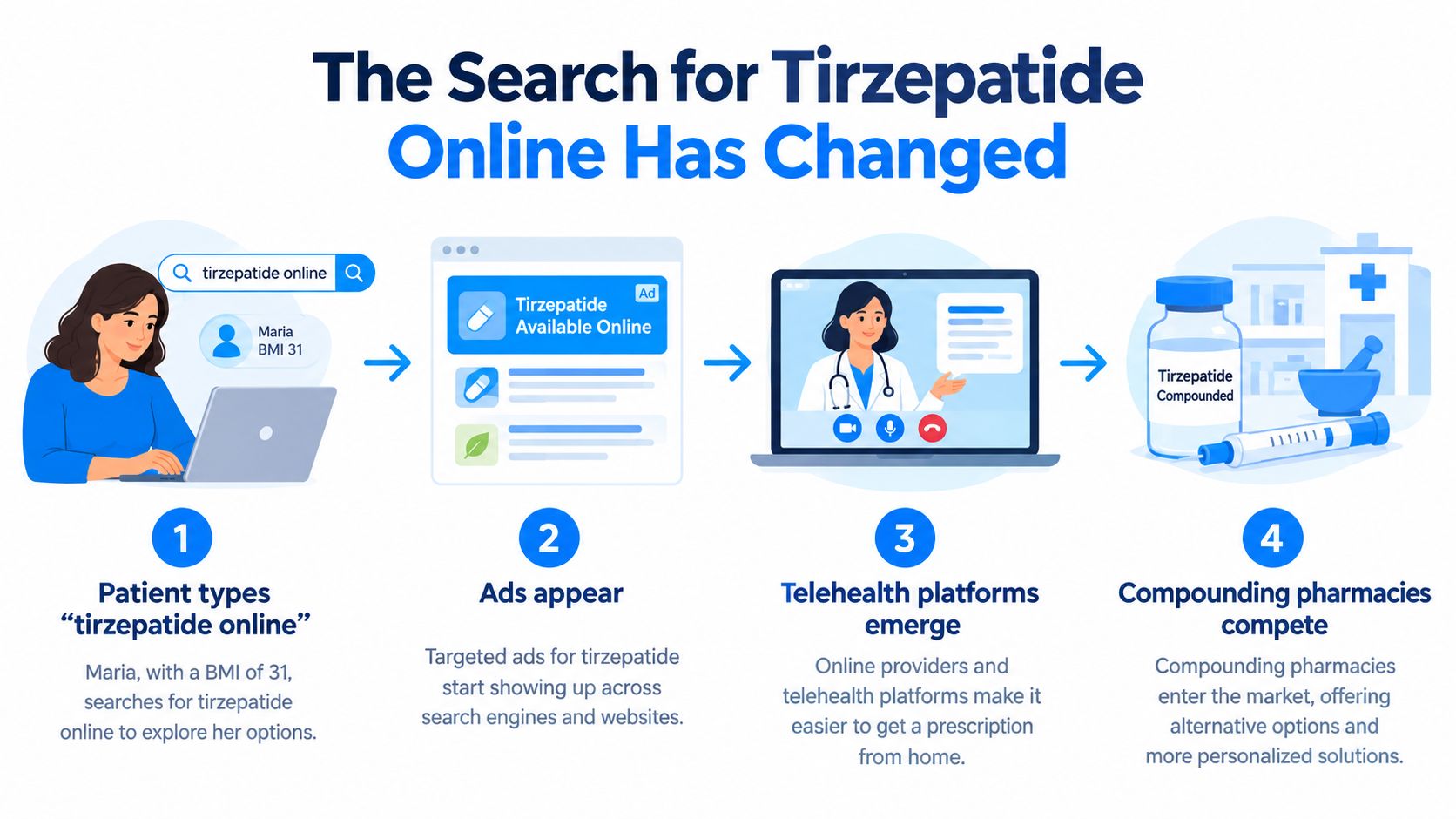
Maria's search results would have looked different in 2023 than they do now. Back then, shortage-era compounding was easier to find, and many sites blurred the line between brand-name tirzepatide, patient-specific compounding, and bulk-made copies. After the shortage ended, the legal question became sharper, because access now depends on whether a site is working through a valid prescription pathway, a lawful compounding exception, or an offer that should raise concern.
What changed after the shortage
The key shift is operational, not just legal. A telehealth ad that once signaled convenience may now be only the first step in a workflow that still has to prove prescriber involvement, pharmacy licensure, and formulation transparency. That matters because the same search result can point to very different realities, including FDA-approved brand dispensing, patient-specific compounded medication, or an unapproved copy being marketed too broadly.
Practical rule: if a site cannot explain who prescribed the medication, who compounded or dispensed it, and why that exact pathway is lawful for the individual patient, the pathway is incomplete.
Readers should also expect more friction than before. Legitimate online access can include an intake, a clinician review, a prescription decision, and then pharmacy fulfillment. That process is slower than a one-click storefront, but it is also what separates a clinical pathway from a sales funnel.
A useful way to read the modern market is to sort every offer into three buckets, brand-name dispensing, patient-specific compounding, or an unapproved copy. That framework makes the search easier to evaluate and helps patients ask better questions before they hand over payment or medical history.
How Tirzepatide Works in the Body
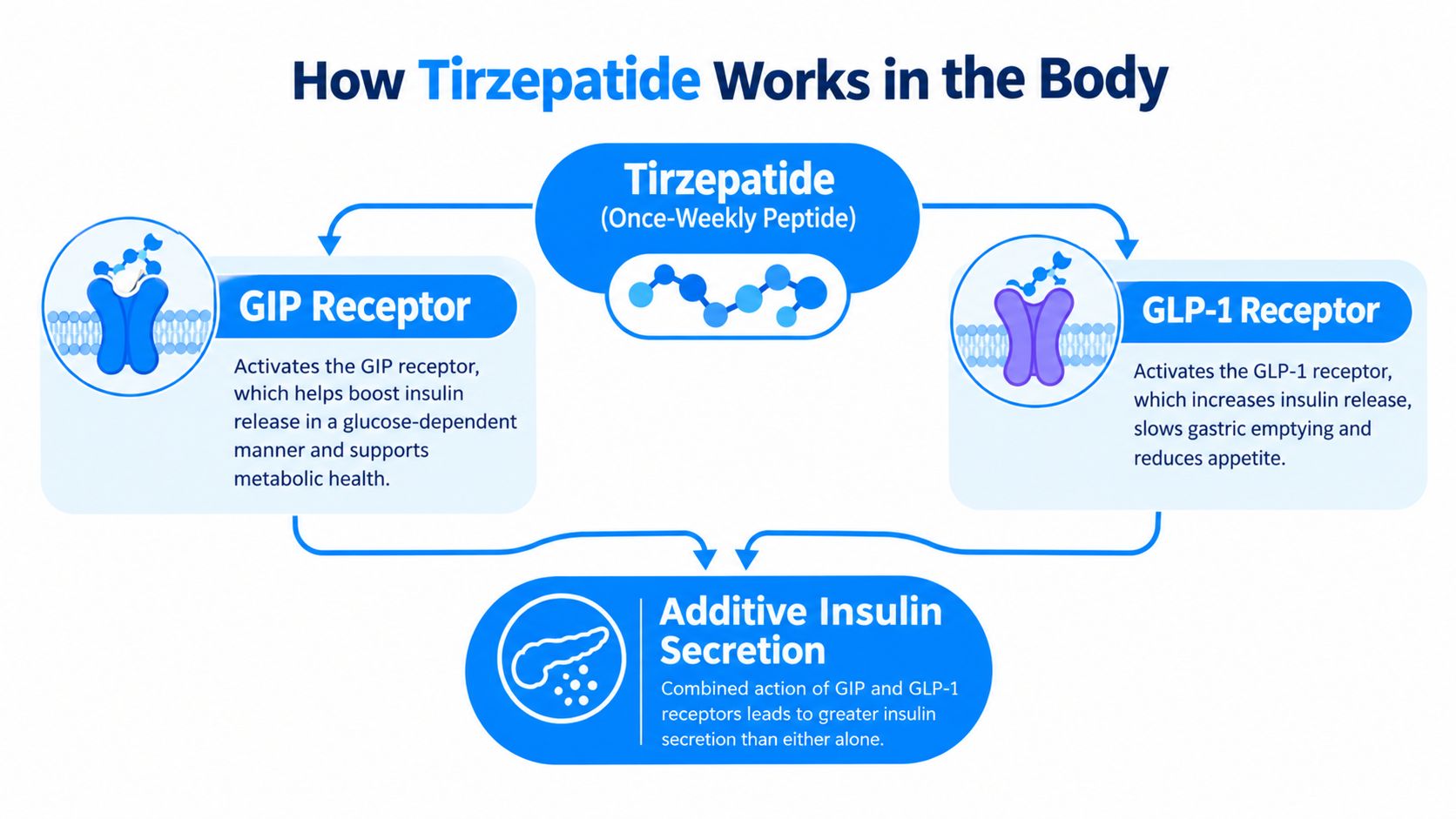
A patient looking for tirzepatide online may see the medicine described as a weight-loss injection, but the biology is broader than that. Tirzepatide is a once-weekly subcutaneous peptide that activates both GIP and GLP-1 receptors. Those two signals work together, like a two-part control system, to influence appetite and glucose regulation at the same time.
Why the dual-incretin design matters
The clinical effects make more sense once the mechanism is broken into pieces. Tirzepatide supports insulin secretion when glucose is present, reduces glucagon output, slows gastric emptying, and influences appetite signaling in the hypothalamus. In practice, that combination can reduce hunger, increase early fullness, and help explain why dose increases are usually gradual.
That same mechanism also explains why online sourcing should be tied to a real treatment plan. The obesity trials that supported this medicine showed major weight reduction compared with placebo, and Lilly's FDA-linked reporting for obstructive sleep apnea with obesity described average losses of 45 lb, or 18% of body weight, and 50 lb, or 20% when Zepbound was used with PAP therapy, versus 4 lb, or 2% on placebo (Lilly FDA-linked reporting). Lilly also reported an additional 21.1% weight loss after 12 more weeks in participants who had already completed 72 weeks of treatment.
Those outcomes are why the drug draws so much interest, but they also point to the need for screening and follow-up. Common adverse effects include nausea, early satiety, and injection-site reactions. The boxed contraindication concerns still matter, especially a personal or family history of medullary thyroid carcinoma or MEN 2.
Clinical takeaway: the mechanism is powerful enough that the right dose, the right titration speed, and the right follow-up are part of treatment, not extras.
A legitimate online pathway should show how the starting dose, titration schedule, and safety monitoring are being managed for that specific patient. The medicine is only one part of the care plan.
Three Legal Pathways to Obtain Tirzepatide Online
A legitimate online search usually leads to one of three routes. They look similar from the outside, but they differ in who prescribes, who dispenses, and what legal basis supports the product.
The three pathways
| Tirzepatide Online: Comparing Three Legal Pathways | Prescriber Type | Pharmacy Type | Regulatory Basis | Typical Access & Trade-offs |
|---|---|---|---|---|
| Brand-name dispensing | U.S.-licensed clinician after telehealth review | Verified community or mail-order pharmacy | FDA-approved brand product | Clear labeling, stronger documentation, coverage may require prior authorization |
| Patient-specific compounding | U.S.-licensed clinician with a documented medical rationale | Licensed 503A pharmacy | Patient-specific compounding exception | Can address individualized needs, but requires tighter verification and may not match brand convenience |
| Outsourcing facility compounding | U.S.-licensed clinician linked to a patient plan | Registered 503B outsourcing facility | Anticipatory production under applicable compounding rules | More structured supply chain, but still needs patient linkage and quality documentation |
Brand-name Mounjaro or Zepbound is the cleanest pathway when insurance and eligibility line up. The prescription comes from a licensed clinician, the product is dispensed through a verified pharmacy, and the patient receives the approved formulation with standard labeling.
Patient-specific compounding is different. The pharmacy prepares a formulation for a documented clinical need, not for broad resale. That distinction matters after the shortage ended, because a pharmacy can't lawfully rely on shortage-era logic forever.
Outsourcing-facility compounding is another narrow route, but it still requires a real patient relationship and a lawful basis for the product. It is not a shortcut around the need for prescription oversight, and it is not a license to market identical-strength vials to the general public.
Red flag: no prescription, no clinician relationship, and no explanation of why the exact formulation fits the patient's record.
For adults comparing online options, the trade-offs usually come down to documentation quality, turnaround time, and whether the pathway can stand up to scrutiny if a pharmacist, payer, or regulator reviews it later. A good online model should make those answers visible before checkout, not after a problem appears.
How Telehealth Evaluation and Titration Actually Work
A lawful online prescription starts with structured intake, not with a cart. The clinician needs enough information to judge whether the patient fits the labeled obesity indication, whether a comorbidity is present, and whether a contraindication might change the plan.
What a real evaluation should capture
A proper intake usually asks for BMI, weight-related conditions, prior weight-loss attempts, current medications, and any personal or family history of medullary thyroid carcinoma or MEN 2. It should also ask about nausea sensitivity, gallbladder history, and other factors that affect tolerability.
The clinician then reviews the record, may conduct a synchronous or asynchronous visit depending on state rules, and decides whether the medication is appropriate. If it is, the prescription should include the starting dose and the titration plan. If it is not, the platform should say so clearly and stop there.
The common dose progression is straightforward in principle, but it should still be individualized. Tirzepatide is often initiated at 2.5 mg, advanced to 5 mg after four weeks, and then increased in 2.5 mg steps every four weeks as tolerated, up to 15 mg. Those are scheduling landmarks, not a reason to rush.
Monitoring matters because the early weeks are often where patients feel the drug most strongly. Clinicians usually watch for gastrointestinal tolerance, hydration, appetite suppression that is too intense, and interactions with other medications that affect glucose or digestion.
A legitimate platform should document the prescription decision, the dose plan, and the follow-up expectation in writing.
That documentation is the difference between care and checkout. It also gives the patient a reference point if symptoms worsen, if the supply changes, or if the dose needs to be held rather than pushed forward.
Safety Checks for Online Tirzepatide Sources
Not every site selling tirzepatide online is operating at the same quality level. The safety review should begin with the pharmacy itself, then move to the formulation, then to shipping and storage.
What to verify before paying
A legitimate source should be tied to a state-licensed pharmacy, and if it is compounding, the facility should operate under the applicable 503A or 503B framework. For sterile products, USP <797> standards matter because the medication is being prepared for injection, not just packaged for convenience.
Formulation transparency is the next checkpoint. The patient should be able to see what the product contains, what strength is being dispensed, and what quality testing supports it. A credible pathway should not be vague about the active ingredient, excipients, or whether the product is a compounded formulation rather than an FDA-approved brand.
A real cold-chain process should also be visible. Tirzepatide that needs refrigeration should ship with temperature-aware handling and tamper-evident packaging, not a generic parcel with no handling notes. If the pathway never mentions storage, that omission is informative.
| Online Tirzepatide Source Safety Checklist | What to Confirm | Red Flag |
|---|---|---|
| Pharmacy licensure | Active state licensure and compounding authority | No pharmacy identification |
| Prescriber relationship | Named clinician review and prescription | No consultation before purchase |
| Formulation details | Ingredient and strength disclosure | “Generic tirzepatide” claims |
| Shipping method | Cold-chain or temperature-aware delivery when needed | Plain shipping with no handling detail |
| Dispensing model | Patient-specific or approved brand supply | Mass-market bulk copy sales |
The biggest warning signs are simple: flat-rate pricing with no clinical review, no clinician contact, foreign-shipped products, or language that suggests an unapproved product is “generic” tirzepatide. There is no legal generic category for tirzepatide in the way shoppers often mean it, so that phrase should trigger closer inspection.
A useful question is not “Is this the cheapest?” It is “Can this pathway prove identity, potency, sterility, and lawful patient linkage?” If the answer is unclear, the source is not ready for trust.
Comparing Vial, Injectable, and Sublingual Formats
Online listings often mix together delivery formats that do not carry the same evidence base. That is a problem because the route of administration changes both the clinical data and the patient's practical experience.
What the formats are really offering
The labeled route for tirzepatide is subcutaneous injection. That is the route supported by the obesity and diabetes studies, and it remains the default choice when a clinician is following the strongest evidence.
Multi-dose sterile vials can be a lawful compounded format in some settings, but they require careful handling, accurate dosing, and a patient who can manage injections. Prefilled syringes or auto-injectors, where legally available, reduce some preparation steps but still require the same core clinical oversight.
Sublingual tablets or troches appeal to needle-averse patients, but they are not the same as the studied injection route. Their use depends on limited pharmacokinetic support and should be treated as a special-case formulation, not a default substitute.
| Format | Strengths | Limits |
|---|---|---|
| Multi-dose vial | Dose flexibility, familiar for some patients | Injection skill, refrigeration, careful measuring |
| Prefilled syringe or auto-injector | Simple administration, less preparation | Less flexibility, product availability varies |
| Sublingual format | Needle-free, easier for injection-averse patients | Limited evidence base for tirzepatide specifically |
A reputable prescriber should choose the route that matches the patient's needs and the available evidence, not the route that sounds easiest to sell. If a site advertises a sublingual version, the documentation should explain why that route is being used and what outcome tracking will follow.
The same caution applies to combination products marketed for convenience. If the route changes, the clinician should explain what is known, what is uncertain, and how the patient will be monitored after the switch.
Rethinking Price, Convenience, and the Shortage Era
Price comparisons can be misleading because they often ignore what is included. A low sticker price may leave out clinician review, labs, needles, follow-up, shipping controls, or the cost of correcting a bad dose decision later.
Why the headline number is only part of the cost
Post-shortage, the question is not whether compounded tirzepatide is cheaper. The more important question is whether the entire pathway is legal, documented, and clinically usable for the patient sitting in front of it. A discounted offer can still be a poor value if the product lacks clear provenance or if the patient never receives adequate titration support.
Convenience features deserve the same scrutiny. Auto-refill, bundled coaching, and home delivery can help some patients stay on track, but they do not automatically improve safety or outcomes. They are operational features, not proof of clinical quality.
The phrase “generic tirzepatide” should be treated carefully because it can imply a status that does not exist in the market the way shoppers usually mean it. If a seller uses that label, the patient should ask what exactly is being sold, under what legal authority, and through which pharmacy.
Cost rule: compare the total care pathway, not just the monthly line item.
A transparent offer should show the consultation fee, medication fee, shipping terms, and what happens if the dose needs adjustment. Vials + Vitals is one telehealth option that pairs clinician review with dispensed therapy through an online assessment and licensed provider workflow, which is the kind of structure patients should look for when evaluating any online pathway.
The shortage era made many offers look interchangeable. The post-shortage market does not. The safest comparison is now less about the cheapest page and more about the quality of the process around it.
A Practical Checklist for Patients
Before moving forward, a patient can use a simple checklist to judge whether an online tirzepatide pathway is serious or sloppy. It should feel like a clinical intake, not a storefront.
Questions worth asking
- Prescriber verification: Is the clinician licensed in the patient's state, and is the telehealth platform authorized to treat there?
- Pharmacy status: Does the pharmacy show clear 503A or 503B status when compounding is involved, along with sterile compounding standards?
- Formulation proof: Is there a certificate of analysis or equivalent documentation for identity, potency, and sterility?
- Dose provenance: Does the platform explain why this formulation and dose fit the patient's history?
- Monitoring plan: Is there a written titration schedule, follow-up timing, and escalation plan for side effects?
- Continuity planning: If supply shifts, does the care team explain how the prescription will transition safely?
A patient should also ask how the medication will be stored during shipping, what packaging arrives at the door, and how sharps disposal is handled after injection. Those details sound mundane, but they are part of safe home treatment.
If a patient develops severe nausea, dehydration, persistent vomiting, or another concerning reaction, the plan should clearly say when to pause the medication and seek in-person care. Good telehealth does not leave that judgment to guesswork.
Practical takeaway: the best online pathway is the one that can explain itself in writing, from intake to dispensing to follow-up.
That standard protects the patient and makes the prescribing team accountable. It also keeps the decision anchored in medicine rather than marketing.
If the next step is sorting a tirzepatide plan by legality, dosing fit, and pharmacy quality, visit Vials + Vitals to review a telehealth pathway built around clinician assessment and structured fulfillment. For adults weighing tirzepatide online, the right choice starts with verification, not speed.
Ready to see if this protocol fits your biology?
A licensed provider reviews every request before anything is prescribed.
Calibrate your metabolic protocol →