Tirzepatide Cost Explained and How to Pay Less
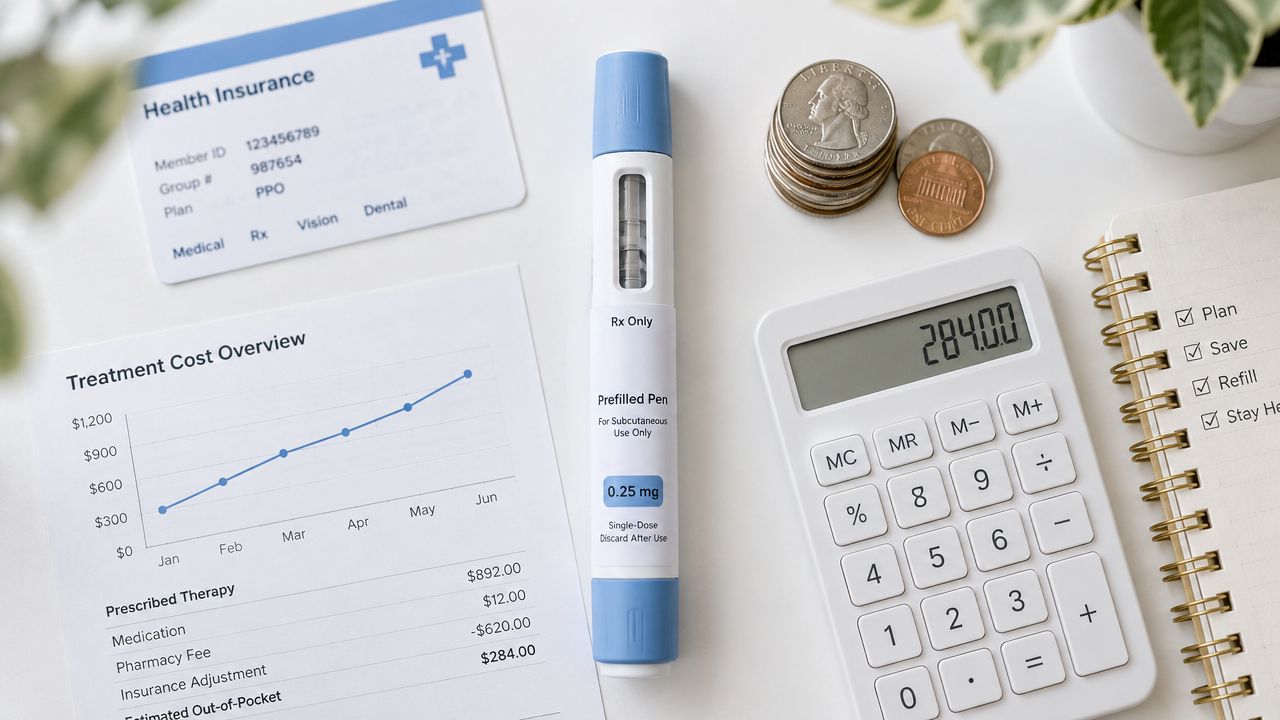
Tirzepatide cost breakdown for 2026 — list prices, vial vs pen, insurance and savings options to lower your out-of-pocket expense.
Tirzepatide usually starts around $1,060 to $1,112 per month at branded list price in the U.S., while LillyDirect self-pay vials can run about $299 to $449 per month depending on dose. Out-of-pocket cost depends on the dose, form, and coverage path, so the same medication can feel affordable for one patient and out of reach for another.
A patient can feel that split immediately. One pharmacy quote shows a pen price near a four-figure monthly bill, while another direct-pay option lists a starter vial at a fraction of that amount. That confusion is normal, because tirzepatide cost is not one number, it's a moving target shaped by formulation, channel, and insurance status.
Table of Contents
- Introduction to Tirzepatide Cost in 2026
- Understanding How Tirzepatide Pricing Works
- What Drives Your Monthly Tirzepatide Cost
- Insurance Coverage and Real Out of Pocket Prices
- How to Lower Your Tirzepatide Cost Safely
- Is Tirzepatide Worth the Cost for Weight and Metabolic Health
- Key Takeaways for Managing Tirzepatide Cost
Introduction to Tirzepatide Cost in 2026
A patient can see three different numbers in one week. The insurer portal gives one estimate, the pharmacy counter gives another, and a direct-pay option online may be much lower. That gap is why tirzepatide cost creates confusion before the first dose is filled.
The right way to read the price is to separate what the drug is priced at, what the payer allows, and what the patient pays. Those figures can differ sharply, so the same molecule may feel affordable in one setting and out of reach in another. The branded U.S. list-price benchmark in 2026 sits around $1,060 to $1,112 per month for a 28-day supply, with health publishers citing Eli Lilly pricing for Mounjaro at $1,112.16 and Zepbound at $1,086.37.
That shelf price is only the starting point. Coverage design, self-pay access, and the exact product format can shift the bill far below that level. The vial pathway changed the market materially by 2026, with quoted cash prices around $299 for 2.5 mg, $399 for 5 mg, and $449 for 7.5 mg and higher doses.
A useful rule: if a quote looks far higher or lower than expected, ask which formulation, channel, and coverage rule produced it.
That matters because tirzepatide is a medication choice, not just a purchase. The cost question should sit beside metabolic goals, tolerability, and follow-up planning.
Understanding How Tirzepatide Pricing Works
A patient may see three very different figures for the same prescription. The insurer portal shows one amount, the pharmacy counter shows another, and a direct-pay quote may sit lower still. That spread is why tirzepatide cost is often a procurement and coverage question, not just a drug-price question.
The cleanest way to read those numbers is to separate list price, net price, and out-of-pocket cost. List price is the public benchmark. Net price is what payers and manufacturers settle on after rebates and contracts. Out-of-pocket cost is what the patient owes after coverage rules, coupons, or cash-pay terms are applied.
Those layers can point in different directions. The same molecule can carry a high list price, a lower negotiated price, and a very different patient bill depending on the channel used. For branded tirzepatide, a public benchmark in 2026 sits around $1,060 to $1,112 per month, which frames the starting point before discounts or coverage changes the result.
The three layers that matter
- List price: The published benchmark used for public comparison and negotiation.
- Net price: The amount that reflects payer negotiations, rebates, and commercial arrangements. ICER notes that realized pricing can sit far below the public benchmark, using net-price data to estimate a current net figure of $7,973 per year.
- Out-of-pocket cost: The amount a patient pays at the pharmacy or through a direct-pay pathway. This can be much lower than list price, or still close to it, depending on coverage and eligibility.
Why the same molecule can cost differently
Tirzepatide is the same active ingredient whether it comes in a branded pen, a vial, or a direct-pay channel. The patient bill changes because distribution, packaging, pharmacy margin, and insurance contracting change. A direct-to-patient vial program can cost less than a retail pen because the procurement path is simpler and the dispensing model is leaner.
The result is easy to misunderstand. A lower quote does not necessarily mean a different medicine. More often, it means the same therapy is moving through a different channel, under different rules.
What Drives Your Monthly Tirzepatide Cost
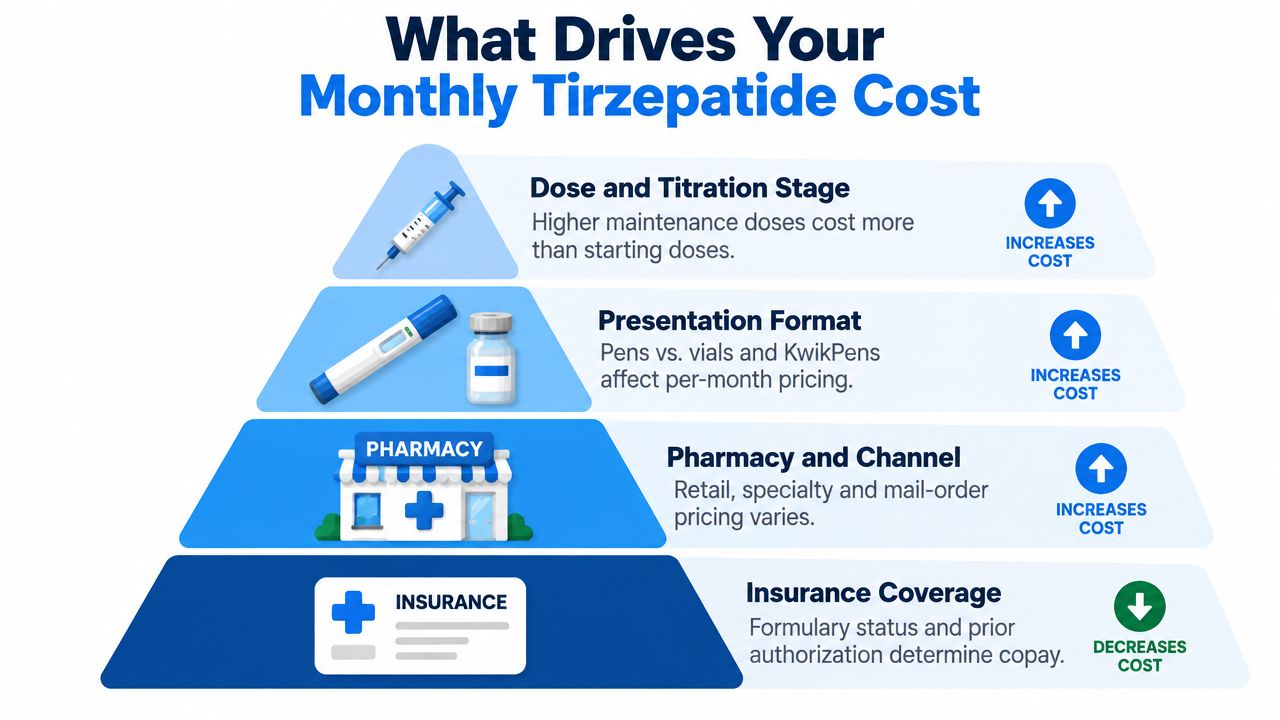
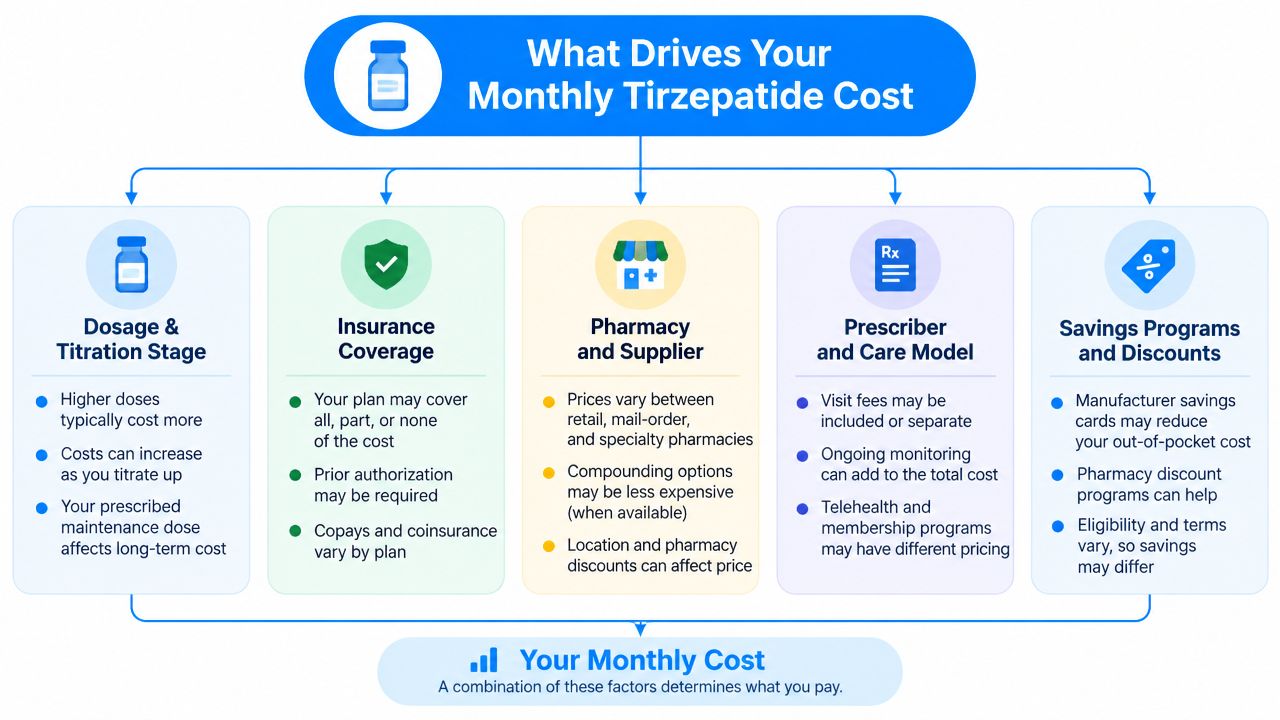
The monthly bill changes because several variables stack together. Dose matters. Formulation matters. The pharmacy channel matters. Insurance matters. Supply status matters. Each one can move the final number by hundreds of dollars without changing the underlying molecule.
A patient can hear one price and still end up with a very different bill at pickup. That is because tirzepatide cost is a procurement and coverage problem as much as a drug-price problem. The same medicine can move through different channels, and each channel carries its own rules, margins, and access limits.
Dose and presentation format
A maintenance dose usually costs more than a starter dose because more drug is dispensed. That becomes more noticeable as treatment moves from titration to steady use. Presentation format also changes the bill. GoodRx reports average monthly retail pricing for Zepbound at about $1,294.46 for single-dose pens versus $604.69 for single-dose vials/KwikPens, showing that format alone can meaningfully alter monthly spending.
Channel, market structure, and supply
The access channel works like the route a package takes to your door. A retail pharmacy, a direct-to-patient vial program, and a cash-pay arrangement can all deliver the same weekly dose, yet the final price can differ sharply. The reason is not the molecule itself. It is the way the product is sourced, packaged, dispensed, and paid for.
International comparisons show that pricing is shaped by health-system policy, not manufacturing cost alone. Health System Tracker cited Mounjaro at about $1,023 in the U.S. versus $444 in the Netherlands and $319 in Japan, which points to the role of payer negotiation and national price policy in final cost.
A safety guardrail on dose decisions
Dose should follow the prescriber's titration plan, not the lowest available price. Skipping steps or stretching intervals to save money can disrupt tolerability, consistency, and response. Cost matters, but it should fit around the clinician-directed plan.
Insurance Coverage and Real Out of Pocket Prices
A prescription can look straightforward and still produce very different bills. One patient has commercial coverage with a savings card, another pays cash, and a third is routed through Medicare or Medicaid. The molecule is the same, but the procurement path is not.
That is why tirzepatide cost should be read as a coverage problem as much as a drug price problem. The monthly amount can sit anywhere from the low hundreds to well over a thousand dollars, depending on formulation, channel, and insurance status.
A simple way to sort it out is to compare the main access paths side by side.
| Access Pathway | Typical Monthly Cost | Who Qualifies | Key Consideration |
|---|---|---|---|
| Commercial insurance with savings card | As low as $25 for some patients | Eligible commercially insured patients | Formulary rules and card eligibility must both line up |
| LillyDirect self-pay vial program | About $299 to $449 depending on dose | Patients using direct self-pay access | Usually a lower-cost path than pens |
| Cash pay through retail-style branded supply | Roughly $1,060 to $1,112 per month at list price | Anyone paying full branded price | Useful as a benchmark, not a typical best-case payment |
| Medicare or Medicaid pathways | Reported as no more than $50 per month for Zepbound in one reported deal, and later $245 monthly for injectable GLP-1s in a federal update | Government coverage populations | Terms can change, so plan-specific verification is essential |
The commercial savings-card route causes the most confusion. A low quoted price can vanish if the plan does not cover the drug, if the pharmacy is not in the right network, or if the savings-card rules do not match the patient's coverage status.
Government coverage follows a different set of rules, and the same savings-card logic usually does not apply. Patients often see the listed price and assume it reflects what they will pay. In practice, the final bill is closer to a coverage decision than a sticker price.
Practical rule: before treatment starts, confirm formulary status, prior authorization requirements, and whether the intended formulation is covered.
Coverage has also become more segmented after 2025 and 2026 policy changes. The FDA's removal of tirzepatide from shortage in October 2025 changed the access picture and may reduce the role of lower-cost compounded supply, which affects how patients budget therapy (Form Blends regulatory overview). The question is no longer just what tirzepatide costs. It is which legal, clinical, and financial path is available now.
How to Lower Your Tirzepatide Cost Safely
A lower monthly bill usually comes from better procurement, not from chasing the first cash quote. With tirzepatide, the same molecule can fall into very different price bands depending on formulation, pharmacy channel, and insurance status. A vial, a pen, and a direct-pay pathway can look similar on paper, but they are often processed differently at the counter.
Start with coverage verification before the prescription is written. Ask whether the drug is on formulary, whether prior authorization is required, and whether the intended use is covered for that plan. If any part of that answer is unclear, treat the pharmacy estimate as provisional, because the final amount owed is usually set by coverage rules, not by the posted price.
Formulation choice matters too. If a patient qualifies for a lower-cost vial format, that can reduce out-of-pocket spending compared with branded pen access. The tradeoff is practical, not just financial. Different devices mean different dispensing steps, different instructions, and different room for dosing confusion. The prescriber should match the formulation to the patient's coverage, training, and ability to use it correctly.
Direct-pay programs can help when coverage is weak. For uninsured or under-covered patients, a manufacturer pathway may offer a legitimate way to obtain therapy, and some savings arrangements can lower the bill for people who qualify. The important step is to confirm eligibility first. A posted cash rate is only useful if the patient meets the program rules.
Compounded tirzepatide deserves extra caution. It has filled access gaps during shortage-era supply problems, but it is not the same as branded medicine from a regulatory standpoint. Compounded products are not reviewed by the FDA in the same way for safety, effectiveness, or quality. That means the decision should stay within a licensed prescriber, a licensed pharmacy, and a clear monitoring plan.
For patients who want physician-directed care with structured evaluation, individualized titration, and accredited pharmacy fulfillment, Vials + Vitals fits that clinical model. The goal is not the lowest advertised number. It is a legal, clinically appropriate regimen that matches the patient's coverage and follow-up needs.
Is Tirzepatide Worth the Cost for Weight and Metabolic Health
A patient may face the same prescription, yet see very different bills. One person gets a covered pen, another pays cash for a vial, and a third runs into a pharmacy channel that falls somewhere in between. That is why tirzepatide cost is really a coverage and procurement question as much as a drug-price question.
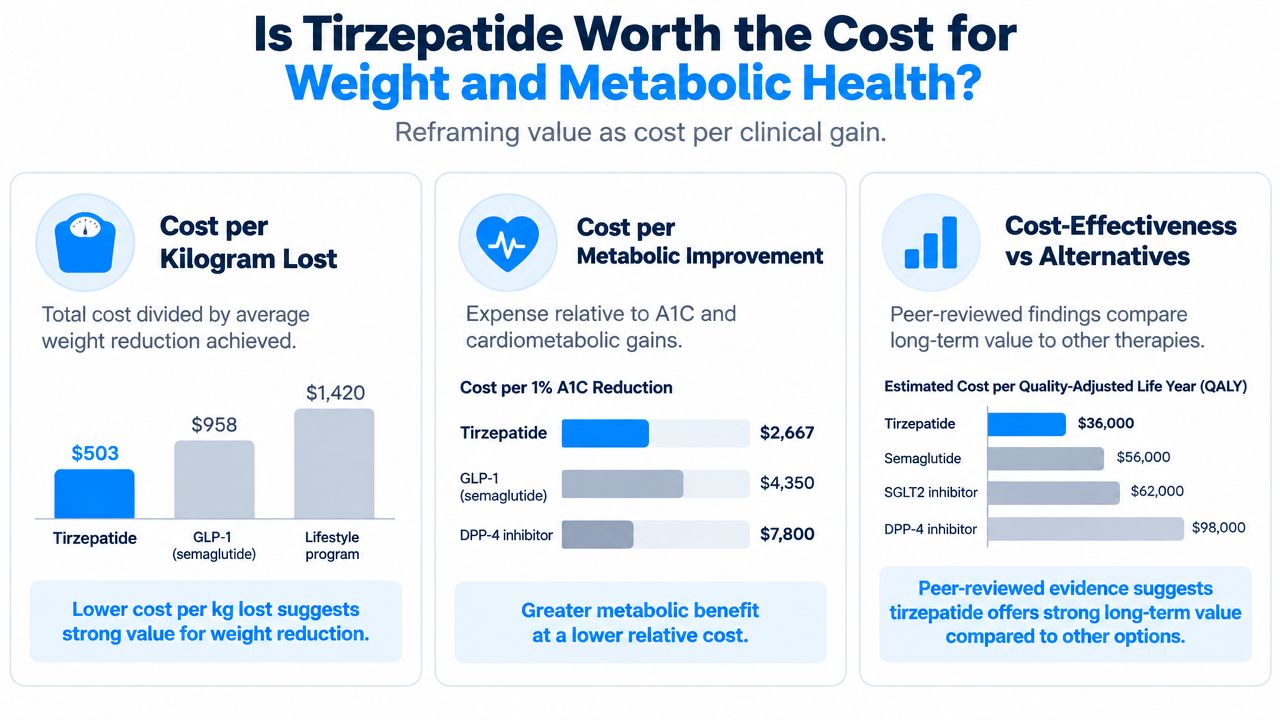
The value question starts with outcomes, not sticker price. A medication can be expensive and still make sense if the expected clinical benefit is meaningful and the patient can stay on therapy.
One peer-reviewed short-term analysis found that tirzepatide 10 mg weekly cost $2,247 more than semaglutide to achieve an additional 1% reduction in hemoglobin A1c, and $237 more for each extra kilogram of body-weight loss. That kind of framing changes the conversation from “What does it cost?” to “What does each unit of benefit cost?”
Broader health economics work points in the same direction. A University of Chicago analysis summarized in clinical reporting found an annual net price of $6,236 in a modeled U.S. payer dataset and estimated the drug would need to fall to about $4,334 per year to meet a $100,000-per-QALY threshold (PMC clinical report summary). ICER's later evidence report estimated the current net price at $7,973 per year and placed a tirzepatide health-benefit benchmark at $11,500 to $15,800 annually.
What that means in practice
- For weight goals: The key question is whether the patient can sustain enough treatment, with follow-up, to keep the weight loss benefit.
- For metabolic goals: Blood sugar, blood pressure, and other cardiometabolic gains belong in the value discussion.
- For access decisions: A lower nominal price can still be the better value if it is the only path a patient can maintain consistently.
International pricing shows the system-level problem clearly. The same therapy costs much less in some peer nations, which points to reimbursement and market structure rather than a different molecule or factory process. As noted earlier, the monthly bill can still land anywhere from the low hundreds to more than a thousand dollars depending on formulation, channel, and coverage.
Clinical takeaway: Value is individualized. The right question is whether tirzepatide fits the patient's goals, comorbidities, and access pathway.
Key Takeaways for Managing Tirzepatide Cost
A patient may see one molecule priced like a clinic benefit in one setting and like a retail drug in another. That is why the monthly cost can range from the low hundreds to more than a thousand dollars. The gap usually comes from formulation, channel, and coverage, not from a different medicine. Once patients see that, surprise bills are easier to question.
The first step is coverage review. Confirm whether insurance applies, whether vial or pen dispensing fits the plan, and whether any savings program or direct-pay option is available. Dose changes should stay clinician-directed, not budget-directed.
Consistency matters more than chasing the lowest sticker price. Tirzepatide tends to work best on a stable, monitored plan with follow-up and tolerability checks. A cheaper route that is unsafe, unverified, or hard to maintain is poor value.
For people starting or continuing therapy, the next move is a clinical review, not price screenshots from the internet. A prescriber should confirm eligibility, review current medicines and risks, and map the most realistic payment path before the first dose is sent.
Ready to see if this protocol fits your biology?
A licensed provider reviews every request before anything is prescribed.
Calibrate your metabolic protocol →