Telehealth Prescription Guide for Safe GLP-1 Access

Learn how to obtain a legitimate telehealth prescription for GLP-1 therapies. Explore clinical intake, legal limits, and safe pharmacy fulfillment.
The most popular advice about a telehealth prescription is also the most misleading: complete a questionnaire, select a medication, and wait for delivery. That model treats prescribing as a transaction. Safe remote care treats it as a clinical decision that depends on identity, location, medical history, medication classification, state law, pharmacy controls, and follow-up.
For metabolic treatment, the prescription is only one part of the process. A legitimate service must determine whether treatment is appropriate, choose a formulation and dose that match the patient's circumstances, explain administration, and respond when symptoms or laboratory findings change the risk profile. The Vials + Vitals Medical Board approaches telehealth through that protocol-driven lens.
Table of Contents
- Understanding the Telehealth Prescription Landscape
- Navigating Federal and State Prescribing Regulations
- The Clinical Intake and Screening Workflow
- Evaluating Compounded GLP-1 Therapies and Pharmacy Standards
- Managing Titration and Ongoing Patient Monitoring
- Recognizing Systemic Stress and Hair Retention Biology
Understanding the Telehealth Prescription Landscape
Telehealth isn't a digital vending machine for medication. A valid remote encounter creates a clinician-patient relationship in which a licensed clinician gathers relevant information, evaluates the patient, documents the reasoning, and makes an independent treatment decision. The format may be online, but the professional standard doesn't disappear when the examination occurs through a screen.
Remote care has become a durable part of healthcare delivery. According to the CDC National Health Interview Survey, 37.0% of U.S. adults reported using telemedicine during the previous 12 months in 2021. That share declined to 30.1% in 2022, while 80.5% of office-based physicians reported using telemedicine for patient care in 2021. These figures describe overall telemedicine use, not the share of encounters that produced prescriptions, but they show that patients and clinicians now use remote clinical encounters as part of ordinary care.
What legitimate remote prescribing requires
A rigorous telehealth prescription process usually includes:
- Patient verification: The service confirms identity, current location, age, and relevant demographic information before clinical decisions are made.
- Clinical history: The patient reports diagnoses, allergies, previous treatments, current medications, pregnancy status where relevant, and treatment goals.
- Risk assessment: The clinician evaluates contraindications, interactions, symptoms, and conditions that could make a medication unsuitable.
- Independent authorization: A U.S.-licensed clinician determines eligibility, product selection, dosing, and follow-up rather than approving every questionnaire automatically.
- Documented continuity: The record should show the rationale for treatment, instructions provided, and the plan for monitoring or escalation.
Documentation matters because remote care produces a clinical record that another qualified professional may need to interpret. Teams building or auditing these workflows can document virtual consultations with structured notes that preserve the patient's reported information, the clinician's assessment, and the resulting plan.
Practical rule: If a service can't explain who reviews the intake, where the patient must be located during the encounter, and what happens when treatment isn't appropriate, the process isn't clinically transparent enough.
The warning signs of superficial care
A short questionnaire isn't automatically unsafe, and a live video visit isn't automatically thorough. The meaningful question is whether the clinician receives enough information to make a defensible decision. A service that ignores medication reconciliation, allergies, contraindications, or the patient's location has omitted the foundations of safe prescribing, regardless of how polished the website appears.
Patients should also distinguish clinical access from medication access. A pharmacy can dispense only after a legally valid prescription, and a clinician can prescribe only within the scope of licensure, professional standards, and applicable federal and state rules. Remote convenience is valuable when it expands access without weakening those safeguards.
Navigating Federal and State Prescribing Regulations
A telehealth prescription is governed by more than a digital consultation. The applicable pathway depends on the medication, the patient's physical location, the prescriber's authority, the encounter format, and the rules of the state involved. A process suitable for a non-controlled metabolic medication cannot automatically be used for a controlled medication prescribed for sleep, pain, or sexual wellness.
The Ryan Haight Act, enacted in 2008 as an amendment to the Controlled Substances Act, generally requires an in-person medical evaluation before a controlled medication can be dispensed through an internet-based prescription. Federal law also provides telemedicine exceptions when specified federal and state conditions are met. During the COVID-19 public-health emergency, practitioners could prescribe Schedule II through V controlled medications through audio-video telemedicine without first completing an in-person evaluation. Under applicable rules, certain FDA-approved Schedule III through V narcotic medications for opioid-use-disorder treatment could also be prescribed through audio-only telemedicine.
Federal flexibility remains subject to change. As of October 2026, the U.S. Department of Health and Human Services telehealth prescribing guidance states that federal telemedicine flexibilities for Schedule II through V controlled substances are scheduled to remain in effect through December 31, 2026. Eligible DEA-registered practitioners may prescribe without a prior in-person evaluation when specific conditions are met, subject to further federal updates. This is not a blanket authorization for online controlled-substance prescribing.
The jurisdiction questions patients should ask
Before requesting treatment, confirm five points:
- Patient location: Which state governs the encounter if the patient is traveling or temporarily away from home?
- Prescriber authority: Is the clinician licensed and otherwise authorized to practice where the patient is located?
- Encounter format: Does the medication and applicable rule permit audio-only care, or is interactive audio-video communication required?
- Prescription movement: Can the pharmacy dispense or transfer the prescription under the relevant state and federal requirements?
- Renewal continuity: What happens if the patient's location, provider license, medication classification, or federal rule changes?
Non-controlled GLP-1 therapies generally follow a different regulatory pathway from controlled substances. They still require a valid clinician-patient relationship and compliance with professional and pharmacy rules. “Nationwide availability” does not mean identical access in every jurisdiction. A responsible service explains geographic and prescribing limits instead of suggesting that one checkout process overrides state law.
Patients should disclose the state where the consultation occurs, report travel or relocation before a renewal, and ask whether the requested therapy is controlled. A provider that dismisses these questions may be overlooking the legal conditions that determine whether a prescription is valid.
The Clinical Intake and Screening Workflow
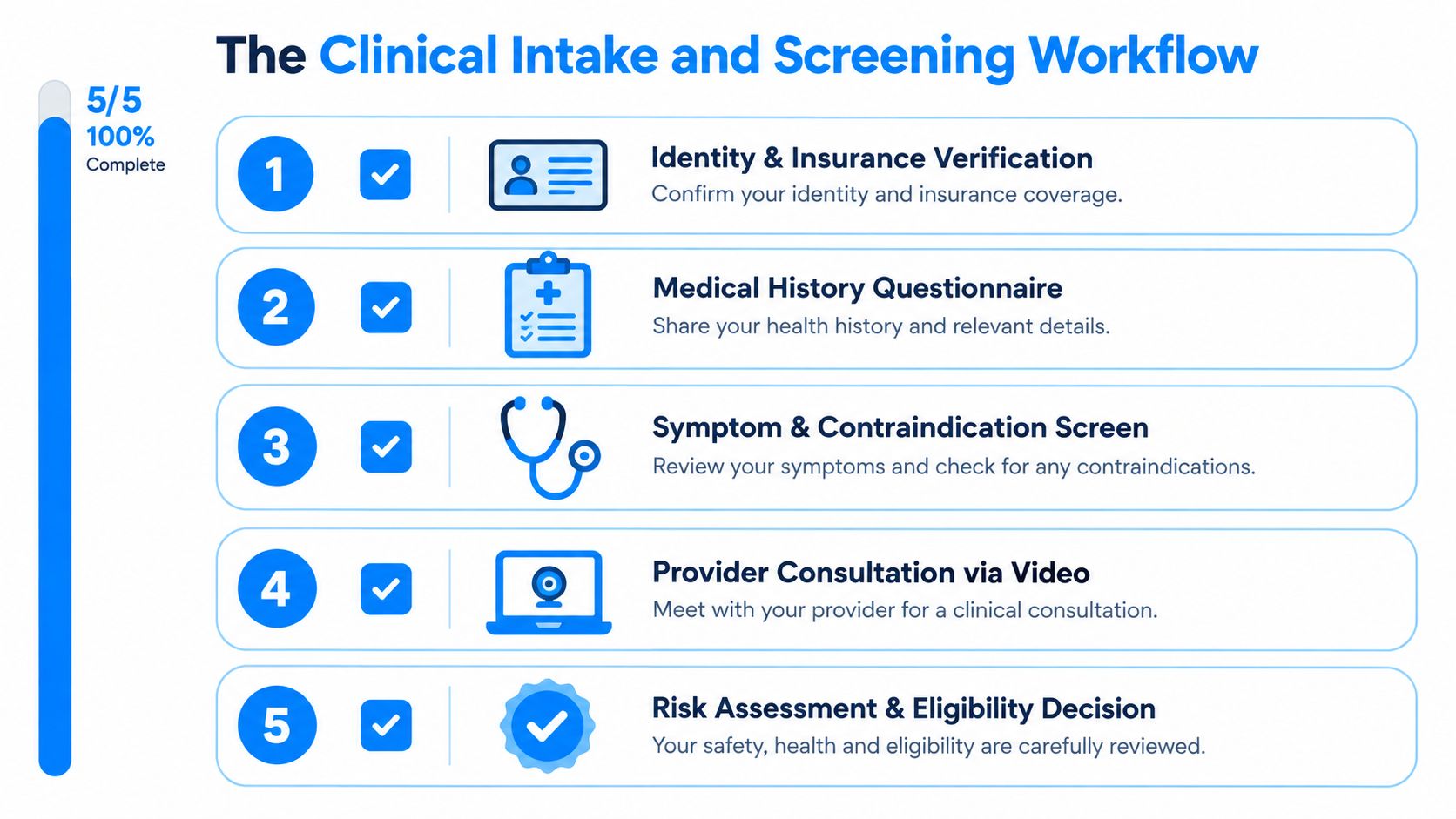
Clinical screening should precede the prescription, not follow it. A technically rigorous GLP-1 workflow verifies identity and location, gathers baseline information, screens for contraindications, assigns the decision to a U.S.-licensed clinician, and reconciles the final prescription with the pharmacy label. The FDA safety communication on unapproved GLP-1 drugs emphasizes these controls because dosing and formulation errors can cause preventable harm.
Five controlled steps
1. Verify identity and location. The service should establish who the patient is, where the patient is physically located during care, age, medication history, allergies, pregnancy status where relevant, and treatment goals. Location affects the clinician's authority to practice and the prescription's legal pathway.
2. Collect baseline clinical data. The intake should address weight, BMI, glycemic history, renal and hepatic considerations, gastrointestinal disease, pancreatitis history, and concurrent medicines. These details help the clinician assess both suitability and monitoring needs.
3. Screen for contraindications and escalation risks. For labeled GLP-1 indications, personal or family history of medullary thyroid carcinoma or MEN2 requires specific attention. The clinician should also investigate symptoms and circumstances that could increase dehydration, gastrointestinal, or other treatment risks.
4. Make an independent eligibility decision. A licensed clinician selects the appropriate therapy, concentration, starting dose, titration interval, and follow-up schedule. Approval shouldn't be an automatic consequence of submitting a form.
5. Reconcile the prescription against the label. The patient and clinical team should confirm the medication name, concentration, units, volume, administration method, storage requirements, and instructions. This final check is especially important when a compounded vial requires measurement with a syringe.
What patients should see in the record
A sound consultation documents why the selected therapy fits the patient's goals and risks. It records the planned escalation sequence, adverse-effect instructions, criteria for pausing treatment, and the next monitoring contact. If the service can't provide clear instructions for missed doses, worsening symptoms, or uncertainty about measurement, the patient should seek clarification before administering medication.
A questionnaire can support care, but it can't replace clinical judgment. The patient's answers must be interpreted in context, and the clinician must be willing to decline treatment, request more information, or recommend an in-person evaluation when remote assessment isn't sufficient.
Evaluating Compounded GLP-1 Therapies and Pharmacy Standards
Compounded GLP-1 therapy requires a more careful question than “Is compounding safe?” The relevant questions are whether the prescription is clinically individualized, whether the pharmacy operates under the applicable compounding pathway, whether the label is clear, and whether the patient understands exactly how to measure and store the product.
The FDA states that compounded drugs aren't FDA-approved and don't undergo the agency's premarket review for safety, effectiveness, and quality. Reporting indicates that tirzepatide shortages were resolved in 2024 and semaglutide shortages in 2025, which changes when pharmacies may routinely produce versions that are copies of approved products. Those shortage determinations don't eliminate the need for individualized compounding when a lawful pathway applies, but they do make formulation and pharmacy status more important to verify. These points are detailed in the FDA clarification on compounded GLP-1 policies.
The comparison that matters
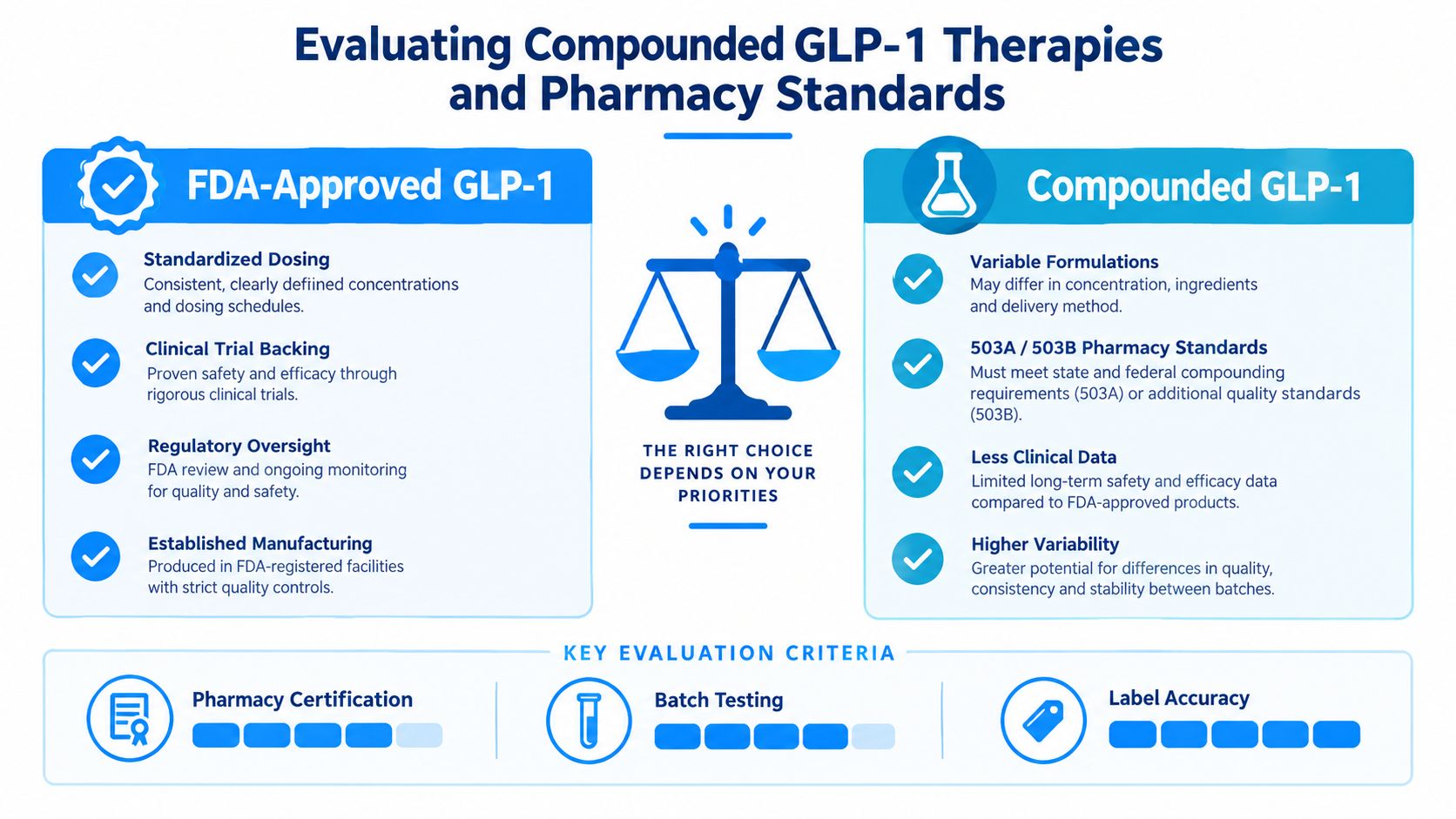
An FDA-approved product comes with standardized labeling and evidence from defined clinical studies. A compounded product may serve a patient-specific need, but the patient and prescriber must verify the pharmacy's controls, formulation, labeling, and legal basis for preparation. Neither category removes the need for medical oversight.
Patients should ask the pharmacy or prescribing service to identify:
- Formulation concentration: The label should state the amount of medication per volume clearly.
- Measurement method: Instructions should connect milligrams with the corresponding volume and syringe markings.
- Storage requirements: The patient should know temperature, light, handling, and beyond-use-date requirements.
- Pharmacy pathway: The dispensing pharmacy should be appropriately licensed and operating under the applicable compounding rules.
- Quality controls: The service should explain relevant potency, sterility, and batch documentation rather than relying on a generic dosing chart.
- Change management: If the formulation or supply changes, the prescriber should recalculate the dose and reassess tolerability.
The main operational hazard is unit conversion. FDA reports adverse events, including some hospitalizations, associated with patients and clinicians mismeasuring or miscalculating compounded injectable semaglutide doses. A dose written in milligrams cannot safely be converted to syringe volume without knowing the exact concentration.
For patients comparing protocol approaches or organizing questions about GLP-1 treatment, a clinical planning resource can help optimize with PepFlow. It shouldn't replace a prescriber's assessment, pharmacy verification, or label reconciliation.
Safety checkpoint: A patient should stop and contact the clinical team when the vial concentration, syringe instructions, label, or prescribed dose doesn't match the consultation record.
FDA has also reported adverse events associated with doses, frequencies, or titration schedules beyond approved labeling. A telehealth service should never accelerate escalation just because the patient wants faster results. The prescriber must document the rationale and pause progression when symptoms, administration uncertainty, or other safety concerns arise.
Managing Titration and Ongoing Patient Monitoring
A prescription establishes a treatment plan. It doesn't finish the clinical work. GLP-1 therapy requires feedback from the patient, because tolerability, hydration, gastrointestinal symptoms, adherence, weight response, concurrent medicines, and treatment interruptions can change the appropriate next step.
The SURMOUNT-1 trial illustrates why dose selection can't be reduced to “more is better.” In the 72-week trial, mean weight reduction with tirzepatide was 16.0% at 5 mg, 21.4% at 10 mg, and 22.5% at 15 mg, compared with 2.4% with placebo, as reported in the published SURMOUNT-1 results. These results support dose-stratified, individualized titration, not automatic movement to the highest dose.
What closed-loop monitoring looks like
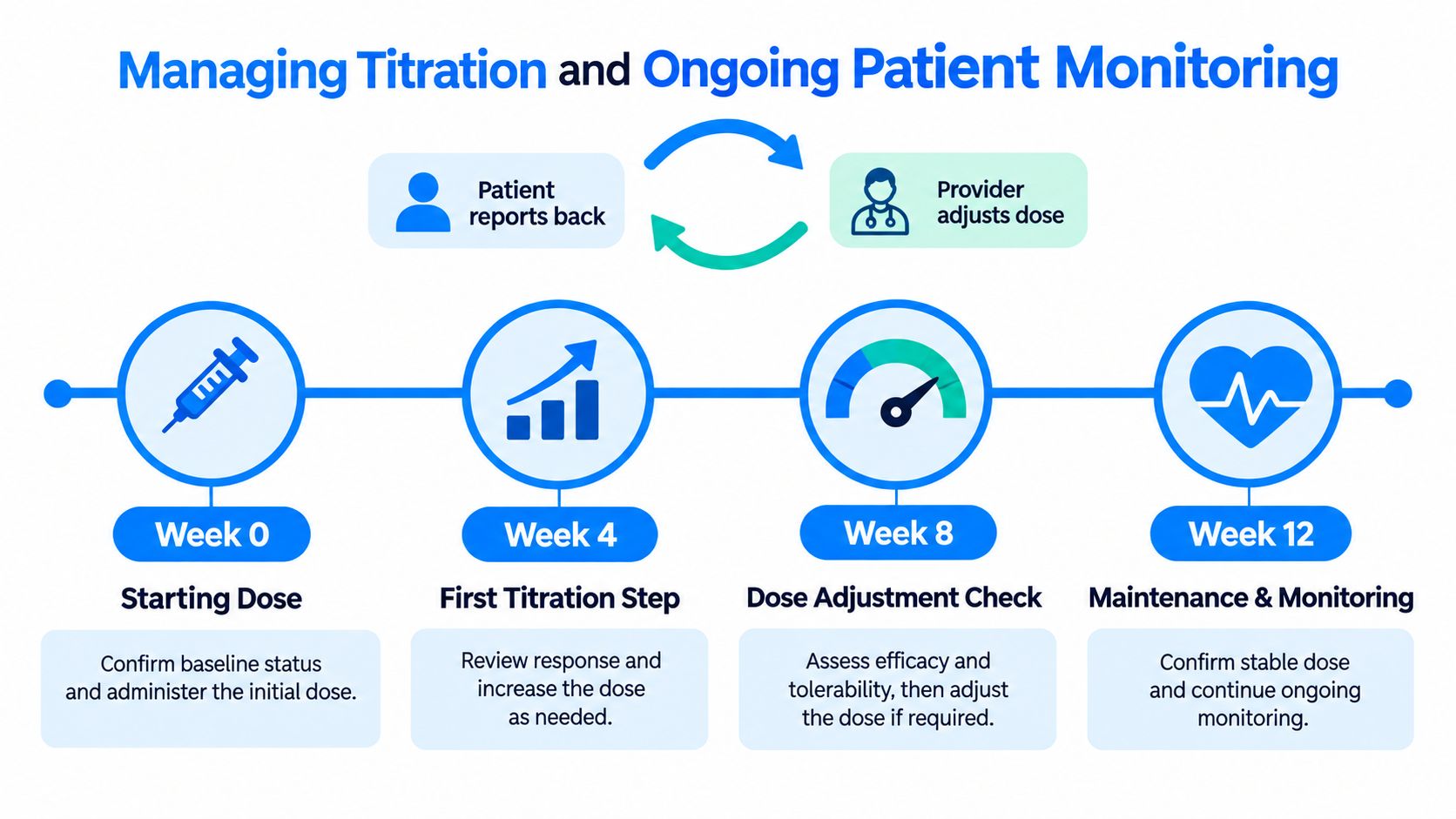
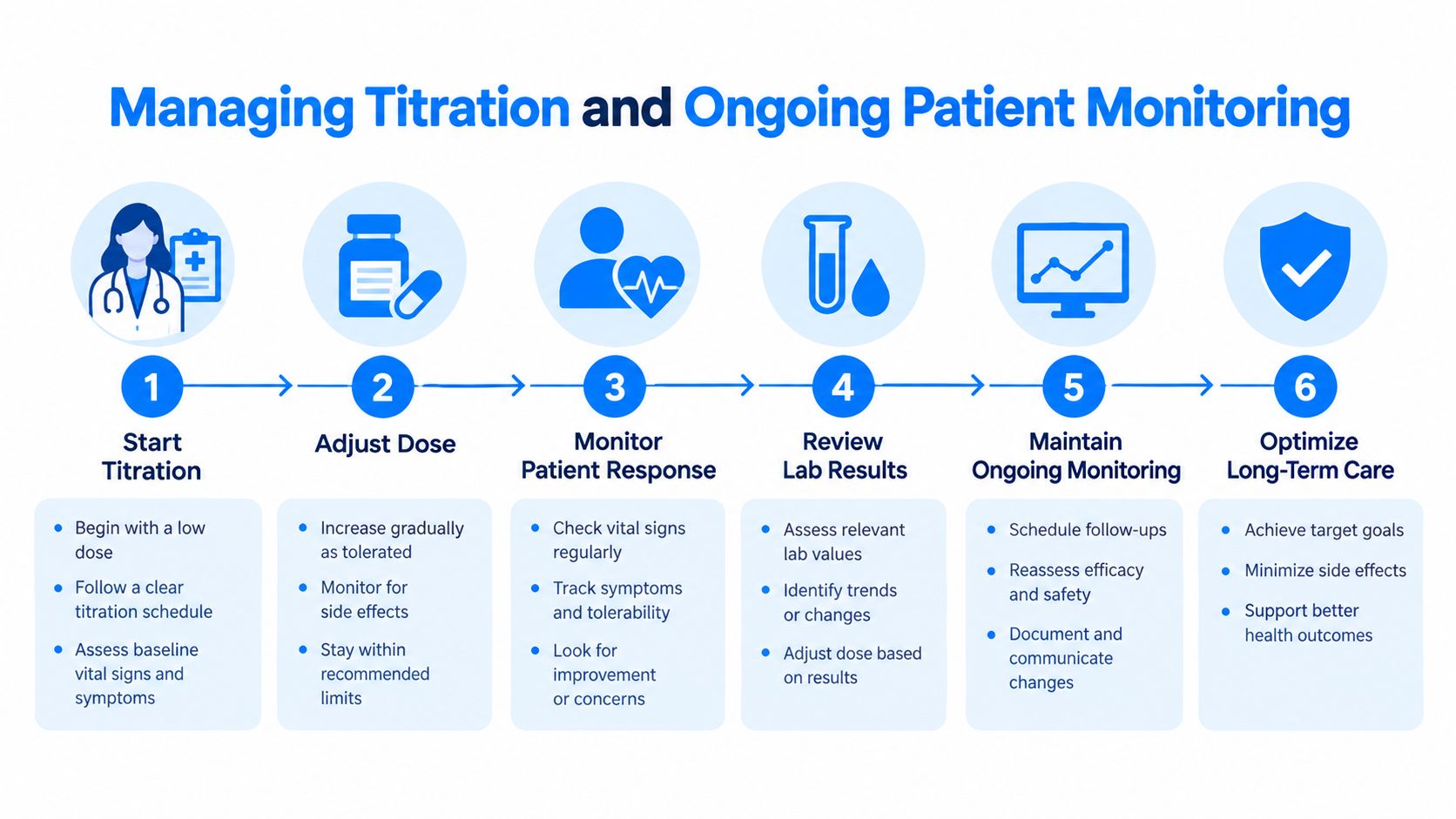
A practical monitoring system creates a repeatable feedback cycle:
- Starting review: Confirm the product, concentration, administration method, baseline symptoms, and patient understanding.
- Early tolerance check: Ask about nausea, vomiting, diarrhea, constipation, abdominal symptoms, hydration, and ability to maintain intake.
- Dose-change review: Reassess tolerability and adherence before any increase.
- Clinical response assessment: Record weight trend, appetite response, glycemic considerations where relevant, and treatment goals.
- Safety decision: Continue, pause, reduce, or stop escalation based on the patient's actual response.
- Documentation: Record the decision, instructions, and next contact so the subsequent clinician can follow the reasoning.
The trial results shouldn't be transferred directly to every patient. Study populations, treatment duration, escalation schedules, adherence, and discontinuation patterns may differ from an individual's circumstances. A patient who stops early, experiences significant adverse effects, or uses a different formulation isn't represented by the same treatment conditions.
A responsible service also teaches the patient what requires prompt contact. Persistent vomiting, inability to hydrate, severe or unusual abdominal symptoms, confusion about measurement, or a treatment interruption should trigger clinical guidance rather than an improvised dose change. A prescription protocol that offers no clear response channel isn't closed-loop care.
Recognizing Systemic Stress and Hair Retention Biology
Hair shedding during metabolic treatment can be alarming, but diffuse shedding doesn't automatically mean permanent follicular loss. A patient who experiences noticeable shedding after substantial weight change may have a temporary stress response, while a patient with a widening part or patterned thinning may have androgenetic alopecia. The two conditions require different clinical reasoning.
Androgenetic alopecia involves progressive follicular miniaturization. Telogen effluvium reflects a shift of follicles into the resting phase after a physiologic stressor, and shedding may appear after a delay. A clinician evaluating a patient on a GLP-1 protocol should ask when the shedding began, whether it is diffuse or patterned, whether weight loss or reduced intake was substantial, and whether nutritional adequacy, thyroid function, or another systemic contributor may be involved.
A practical clinical distinction
A patient noticing hair across the shower drain but no clear patterned change may be experiencing stress-related shedding. That pattern doesn't prove telogen effluvium, but it justifies an assessment of timing, diet, systemic symptoms, and treatment history before labeling the loss permanent.
A patient with progressive recession, crown thinning, or a persistent widening part may have androgenetic alopecia that predates metabolic treatment. Weight change can draw attention to the condition without being its sole cause. In either situation, the clinician should avoid empiric escalation of hair treatment without clarifying the biology.
A dermatology review found no significant difference between oral and topical minoxidil for improving hair density, supporting individualized treatment selection and realistic expectations, as summarized in the review of minoxidil and hair-density outcomes. Hair-density improvement isn't the same as immediate reversal, and a treatment decision should account for contraindications, preferences, tolerability, and the pattern of loss.
Nutrition and hydration also matter during appetite-suppressing treatment. A telehealth clinician should assess whether the patient can maintain adequate intake and should investigate persistent or worsening shedding instead of dismissing it as an unavoidable medication effect. The most useful response combines metabolic monitoring with a separate hair and scalp assessment.
Vials + Vitals provides physician-directed telehealth assessments for GLP-1 therapies, including semaglutide and tirzepatide, with U.S.-licensed clinicians determining eligibility, formulation, and titration when treatment is clinically appropriate. Patients seeking a structured telehealth prescription process with ongoing oversight can visit Vials + Vitals to begin a confidential clinical assessment.
Ready to see if this protocol fits your biology?
A licensed provider reviews every request before anything is prescribed.
Calibrate your metabolic protocol →