Sublingual Semaglutide: What the Evidence Shows

Sublingual semaglutide explained with evidence-based analysis of formulation, efficacy, dosing, and telehealth availability versus injectable options.
Sublingual semaglutide gets sold as if it were a simple upgrade, a needle-free version of a familiar medicine with the same expectations attached. That framing is too neat. The evidence says something more cautious, sublingual semaglutide is a recent formulation concept, not an approved product, and the strongest human data still belong to oral semaglutide, which uses a different absorption strategy altogether U.S. Patent No. 11,833,189 FDA quality review for oral semaglutide.
That distinction matters because a medication's route changes how it behaves, how reliably it absorbs, and how much trust can be placed in marketing language. With sublingual delivery, the question isn't whether the tablet disappears under the tongue. The question is whether the molecule reaches the bloodstream in a predictable way, in a human body, with enough consistency to justify clinical claims.
Table of Contents
- What Sublingual Semaglutide Actually Means
- Sublingual Versus Oral Semaglutide
- What the Preclinical Pharmacokinetic Data Shows
- The Evidence Gap Between Marketing and Clinical Trials
- How Sublingual Dosing Protocols Are Built in Practice
- Regulation, Compounding, and Pharmacy Quality After the Shortage
- Choosing a Telehealth Provider for Needle-Free Semaglutide
- Sublingual Semaglutide Questions Patients Actually Ask
What Sublingual Semaglutide Actually Means
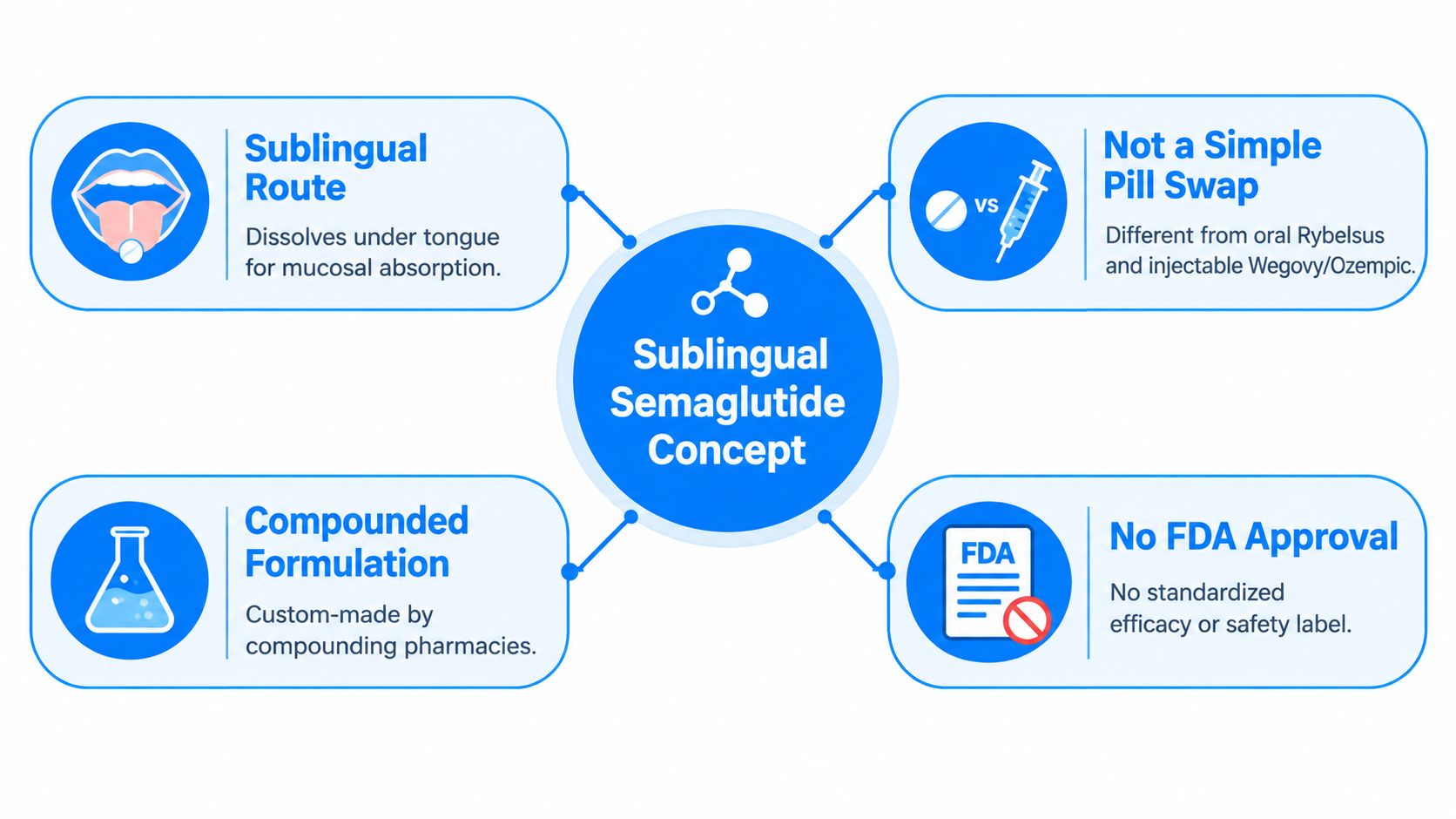
Sublingual semaglutide means a formulation idea, not a standardized, FDA-approved product. The tablet or troche is placed under the tongue, where the goal is for drug to cross the buccal mucosa and enter systemic circulation without going through the stomach first. That route sounds simple, but the pharmacology is not simple at all.
Semaglutide is a peptide, which means it is too large and too fragile to glide through tissue on its own. Any true sublingual version needs help from permeation enhancers, stabilizers, or a carrier matrix that can keep the peptide intact long enough to absorb. That is very different from swallowing a pill.
Why the route matters
The floor of the mouth is attractive because it can bypass first-pass liver metabolism. That does not mean absorption is guaranteed. It only means the route is biologically plausible if the formulation can move a large peptide across mucosal tissue.
Practical rule: a drug can be easy to place under the tongue and still be hard to absorb in a clinically useful way.
This is also where people often confuse compounded sublingual semaglutide with oral semaglutide. Oral semaglutide was built around a specific gastric absorption technology, while sublingual products are custom-made formulations that do not have the same validated pathway. The concept is real. The human evidence base is not mature.
Sublingual Versus Oral Semaglutide
Oral semaglutide and sublingual semaglutide both avoid needles, but they do so by different routes and with different evidence behind them. Oral semaglutide uses SNAC to help the peptide cross the stomach lining, while sublingual products are built for the buccal mucosa, which has its own permeability limits FDA oral semaglutide review.
Delivery differences that actually matter
| Feature | Oral Semaglutide (Rybelsus) | Sublingual Semaglutide (compounded) |
|---|---|---|
| Site of uptake | Stomach | Floor of mouth, buccal mucosa |
| Absorption aid | SNAC | Permeation enhancers, mucoadhesive polymers, custom carriers |
| Food and fluid sensitivity | Very high | Still relevant, but not standardized |
| Evidence base | Established commercial pathway | Limited human evidence |
| Approval status | FDA-approved oral product | No approved sublingual semaglutide product |
The oral route is picky because small changes in fasting time or water volume can shift exposure. Under recommended conditions, oral semaglutide has about 0.8% absolute bioavailability clinical pharmacokinetics analysis. A peer-reviewed review reported that longer fasting after dosing can raise bioavailability to about 1.4% around 120 minutes, while larger water volumes reduce exposure oral peptide review.
Sublingual products borrow the convenience of a tablet held in the mouth, but they do not inherit the oral product's validated pathway. The route is different, the formulation problem is different, and the human evidence base is still thin. That gap matters, because a mouth-held dose can be easy to use and still fail to produce predictable absorption in people.
What the Preclinical Pharmacokinetic Data Shows
The strongest preclinical signal comes from a rat pharmacokinetic comparison. In that study, sublingual semaglutide produced higher exposure than oral dosing at the same low dose, with AUC 82.53 vs. 15.08 ng·h/mL at 1 mg/kg and relative bioavailability of 0.34% for sublingual tablets versus 0.06% for oral tablets rat PK comparison. Plasma drug was detectable within 2 minutes post-dose, which tells readers the route can create early systemic uptake in animals.
What those numbers do and do not mean
Those numbers do not prove clinical weight-loss benefit in people. Rat buccal tissue is thinner and more permeable than human tissue, so the same formulation can look better in rodents than it will in a clinic. The study also used a research-grade mucoadhesive system, which is not the same thing as a commercial compounded tablet.
Clinical translation note: a rodent formulation can show measurable blood levels and still fail to deliver predictable human efficacy.
The biology of semaglutide also matters here. It is a large peptide with a stearic-acid spacer that supports albumin binding, which helps extend its action once it reaches circulation. That pharmacology does not solve the harder problem, getting enough intact peptide across a human mucosal barrier in a reproducible way.
The rat data are useful as proof of concept. They are not a substitute for a human pharmacokinetic study with enough participants to judge variability, safety, and dose-response. Until that exists, any claim that sublingual semaglutide is “better than oral” in people is still speculative.
The Evidence Gap Between Marketing and Clinical Trials
Marketing language often makes sublingual semaglutide sound interchangeable with injectable semaglutide. That is the part readers should challenge first. The available evidence is much thinner than the sales copy suggests, and the difference between “promising” and “proven” is doing a lot of work here.
What exists, and what doesn't
The human evidence base is still narrow. One regulatory search trail points to a 2025 bioavailability study proposal involving only 10 healthy adult volunteers, which underscores how early this route still is FDA-related submission. That is not enough to answer whether the route produces durable weight loss, whether exposure is consistent, or whether adverse effects are acceptable.
What's missing is even more important. There is no published Phase 3 trial, no human weight-loss endpoint study, and no validated sublingual semaglutide product with an approved label. Without that, claims of equivalence to injectable therapy are not evidence-based.
| Marketing Claim | Evidence Tier | Human Data Available |
|---|---|---|
| “Equivalent to injection” | Promotional claim | No published Phase 3 evidence |
| “Works better than oral” | Animal-only suggestion | No confirmed human efficacy data |
| “Clinically proven” | Unsupported for sublingual route | No approved sublingual product |
| “Needle-free GLP-1 option” | Formulation concept | Limited human bioavailability data |
A useful verification habit is simple. Ask whether the claim rests on a human trial, an animal study, a formulation description, or a marketing page. Those are not the same level of proof, and only the first one can support meaningful efficacy claims.
How Sublingual Dosing Protocols Are Built in Practice
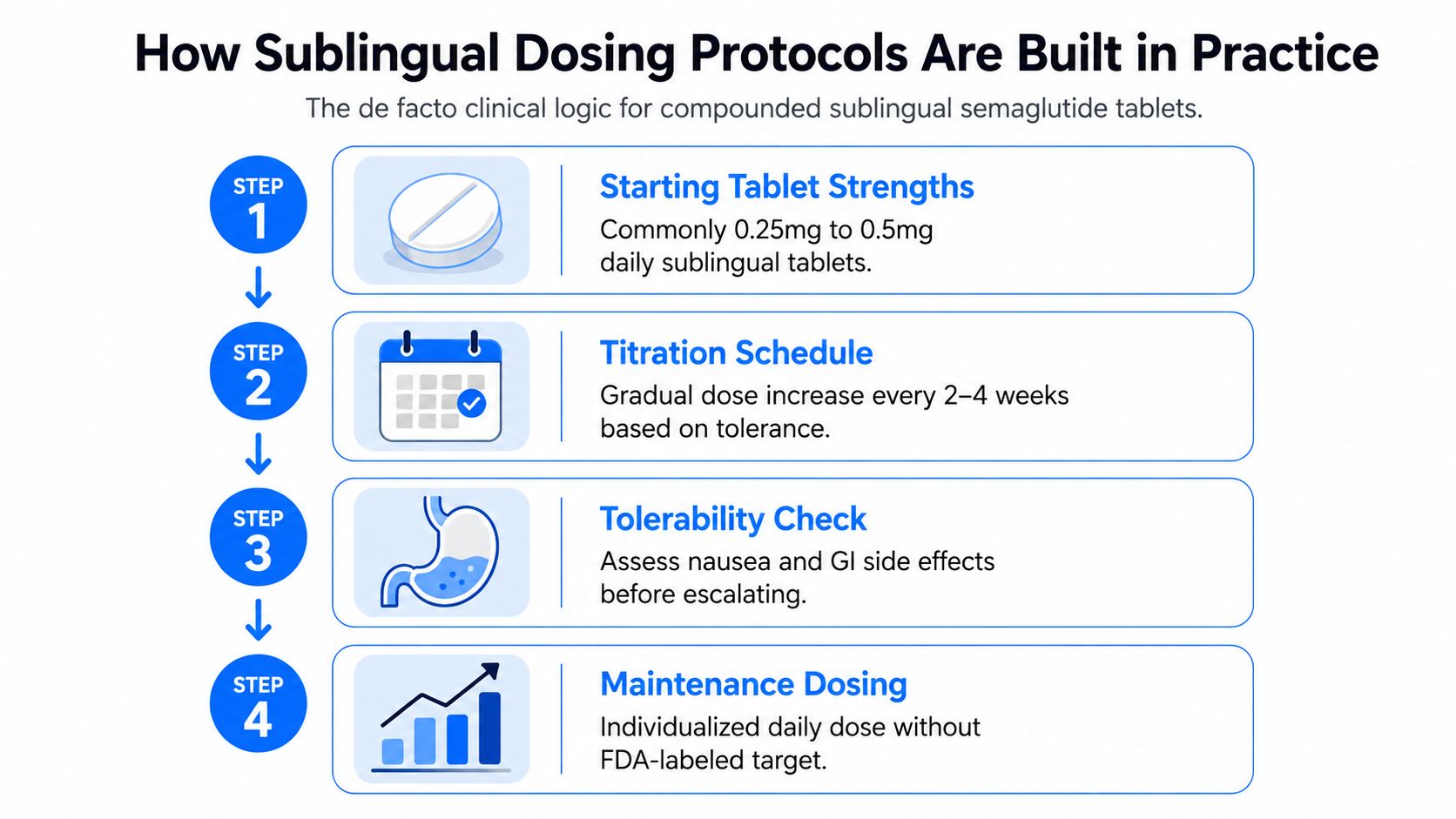
In day-to-day practice, compounded sublingual semaglutide protocols are built empirically because no FDA-labeled schedule exists for this route. That means prescribers often borrow logic from oral semaglutide, then adjust based on tolerability rather than on a validated sublingual dose-response curve. The result can be clinically reasonable, but it is still a workaround.
What clinicians usually ask patients to do
Some compounded tablets are prepared in strengths such as 1 mg, 3 mg, 5 mg, and 10 mg, then titrated gradually as side effects and response are reviewed. A prescriber may ask for empty-mouth fasting, no food or drink during dissolution, and no swallowing of saliva until the tablet has fully dissolved. Placement under the tongue or between the cheek and gum is common because the goal is mucosal contact, not gastric transit.
Practical rule: if food residue, drink, or impatient swallowing changes the dose that reaches tissue, the protocol stops being predictable.
A clinician also usually watches for nausea, reflux-like symptoms, and changes in appetite over the first few weeks. That monitoring matters because a dose that is “tolerated” is not automatically a dose that is absorbed well. Tolerability and bioavailability are related, but they are not identical.
The key limitation is obvious. A titration schedule copied from oral semaglutide is not the same thing as a schedule pharmacokinetically validated for sublingual delivery. Until human route-specific data exist, careful titration is a safety strategy, not proof of efficacy.
Regulation, Compounding, and Pharmacy Quality After the Shortage
The regulatory context changed once the GLP-1 shortage began to stabilize. That matters because many compounded semaglutide products gained attention during the shortage window, when mass compounding was more broadly tolerated under Sections 503A and 503B of the Federal Food, Drug, and Cosmetic Act. As the shortage resolved, FDA guidance narrowed the practical compounding space FDA compounding policy update.
What quality concerns are unique here
Compounded sublingual semaglutide raises a different quality question than an injectable vial. The core issue is whether the finished tablet or troche delivers intact peptide through the mucosa, and whether anyone has validated that with PK/PD testing. In many cases, they have not.
That leaves patients dependent on the compounder's process controls. A reputable pharmacy should be able to discuss source material, batch handling, and testing, but a consumer shouldn't assume those controls are equivalent to FDA-reviewed manufacturing. For sublingual products, the absence of third-party verification is a real gap, not a footnote.
The practical red flags are straightforward.
- Pre-printed dose packs without a real prescription: that suggests the medication workflow may be driven by inventory, not clinical judgment.
- Unverified API sourcing: semaglutide quality depends on the supplier chain, not just the final tablet format.
- No clear potency or sterility documentation: that leaves the patient guessing about what was compounded.
- No explanation of 503A or 503B status: that makes it hard to judge the legal and operational framework.
A pharmacy can be legitimate and still produce a product with uncertain route-specific bioavailability. Those are separate questions, and both matter.
Choosing a Telehealth Provider for Needle-Free Semaglutide
A patient considering needle-free semaglutide should vet the clinical workflow, not just the marketing page. A good telehealth setup makes the prescriber, the pharmacy, and the follow-up plan visible. A weak one hides those details behind a checkout form.
Four checks that should happen before any prescription
- Verify the prescriber: the clinician should be licensed in the patient's jurisdiction and able to support follow-up after the first fill.
- Confirm the pharmacy source: the script should go to a licensed 503A or 503B pharmacy, and the pharmacy's status should be verifiable.
- Request batch documentation: a real compounded batch should come with a certificate of analysis that addresses potency and sterility testing.
- Clarify the care model: the fee should make clear whether it includes labs, check-ins, and dose changes, or just shipping.
Some services, including Vials + Vitals, frame their model around physician review, individualized titration, and fulfillment through accredited pharmacy partners. That kind of setup is worth evaluating on paper because the operational details matter as much as the formulation name.
Red flags are just as important. No baseline labs, no documented weight trajectory, automatic refills without clinical review, or bundled pricing that hides what is included should all prompt questions. A patient deserves written informed consent that says the product is compounded, not FDA-approved, and that a switch to injectable therapy remains an option.
Sublingual Semaglutide Questions Patients Actually Ask
Is it safe in the same situations as injectable semaglutide
Systemic exposure drives the main contraindications, so the usual high-risk situations still matter, including a history of medullary thyroid carcinoma or MEN 2, and pregnancy. The route does not remove the active drug's systemic considerations.
Does it cause hair loss
Hair shedding can happen during rapid weight loss, and GLP-1 receptor agonists have also shown a weak, inconsistent hair-loss signal in pharmacovigilance work. A review reported semaglutide reporting odds ratios for hair loss of 1.24 to 2.46, and one obesity trial found alopecia in 23 of 334 semaglutide participants, 7%, versus 9 of 333 placebo participants, 3% hair loss review. That does not prove the route causes shedding, but it does mean hair counseling should be part of the conversation.
What should a prescriber ask before re-titrating
Baseline HbA1c, lipase, and a clear weight trajectory are reasonable starting points before changing dose. Those data help distinguish expected early nausea from a broader metabolic problem.
Can the tablet be split or crushed
That depends on the formulation, but splitting or crushing usually defeats the design of a mucosal-delivery system. If the tablet is meant to dissolve in place, changing its structure can change exposure.
Do saliva, food residue, or alcohol matter
Yes, because sublingual absorption depends on contact time and mucosal conditions. Anything that changes dissolution or contact can change how much drug is available to absorb.
What side effects fit the route itself
Nausea, delayed gastric emptying, and other systemic GLP-1 effects come from the drug itself. Taste changes and mucosal irritation are more specific to the sublingual route.
If this topic affects a current weight-loss plan, the next step is a clinical review, not a marketing page. Vials + Vitals offers physician-guided evaluation, compounded GLP-1 options, and route-specific counseling for patients who want needle-free care to be handled with medical oversight. Visit Vials + Vitals to review whether a compounded sublingual pathway fits the evidence, the safety parameters, and the need for real follow-up.
Ready to see if this protocol fits your biology?
A licensed provider reviews every request before anything is prescribed.
Calibrate your metabolic protocol →