Sleep Medication Online: A Patient Safety Guide

How to evaluate sleep medication online options through telehealth, what clinicians check, common risks, and safer behavioral alternatives for chronic insomnia.
Three sleepless nights can turn into a pattern that follows a person through work, family obligations, and the next bedtime. After several weeks of staring at the ceiling, a working professional may search for sleep medication online because a clinic visit feels difficult to schedule, privacy matters, and relief seems urgent.
That search deserves more than a list of pills or a promise of fast delivery. The important question is whether the patient's symptoms are appropriate for remote evaluation, whether medication is the right intervention, and whether a clinician has built a plan for monitoring, tapering, and addressing the cause of poor sleep.
Table of Contents
- Why Patients Look for Sleep Medication Online
- How Online Sleep Medication Pathways Actually Work
- What a Clinician Evaluates Before Prescribing Online
- Common Sleep Medication Classes Prescribed Online
- Safety Risks and Regulatory Limits to Understand
- Why Behavioral Therapy Often Beats a Pill
- When Online Sleep Medication Is the Right Choice
- Patient Safety Takeaways Before You Begin
Why Patients Look for Sleep Medication Online
The appeal of online sleep care is understandable. A patient may have spent weeks trying to manage insomnia while working full time, caring for family, or managing another medical condition. A remote assessment can seem like the only realistic way to speak with a prescriber without waiting for a sleep-medicine appointment.
Three pressures usually drive the search.
- Speed of access: A patient may want an evaluation within a practical window rather than waiting for a specialty appointment.
- Privacy: Insomnia often overlaps with anxiety, depression, alcohol use, medication dependence, and relationship stress. Some patients feel uncomfortable discussing those issues in a general clinic.
- Limited local access: Many communities have few clinicians trained in behavioral sleep medicine, and primary care appointments may be too short for a detailed insomnia evaluation.
Patients also frequently arrive after trying to manage symptoms alone. Alcohol, excessive melatonin use, antihistamines, leftover prescriptions, and supplements can all become part of an improvised sleep routine. That routine may hide the original problem and create new risks, especially when a sedating substance is combined with another medication.
Practical rule: Online access is useful only when it improves clinical oversight. Convenience can't substitute for a real assessment.
The commercial channel is not the clinical decision
Online pharmacies and telehealth services have become recognizable channels for insomnia treatment. The broader insomnia-treatment market was valued at $8.7 billion in 2025 and was projected by one industry report to reach $13.2 billion by 2034, while online pharmacies represented an estimated 12.1% of insomnia-treatment distribution in 2025, or about $1.05 billion according to the industry market overview. Those figures describe distribution, not whether a particular patient should receive a sedative.
A prescription can help a carefully selected patient, but a refill doesn't explain why insomnia began. Chronic sleep disruption may reflect obstructive sleep apnea, restless legs, a mood disorder, medication effects, substance use, circadian disruption, or a behavioral cycle that medication alone won't resolve.
What a responsible decision requires
A useful online pathway should answer several questions before recommending treatment:
- Is the problem insomnia, or is poor sleep a symptom of another disorder?
- Is the patient safe to manage remotely?
- Is a non-controlled or behavioral intervention more appropriate?
- If medication is used, what is the stop plan?
The rest of the clinical decision should follow those questions. The goal isn't to find the fastest checkout page. It's to find the safest level of care for the patient's actual sleep profile.
How Online Sleep Medication Pathways Actually Work
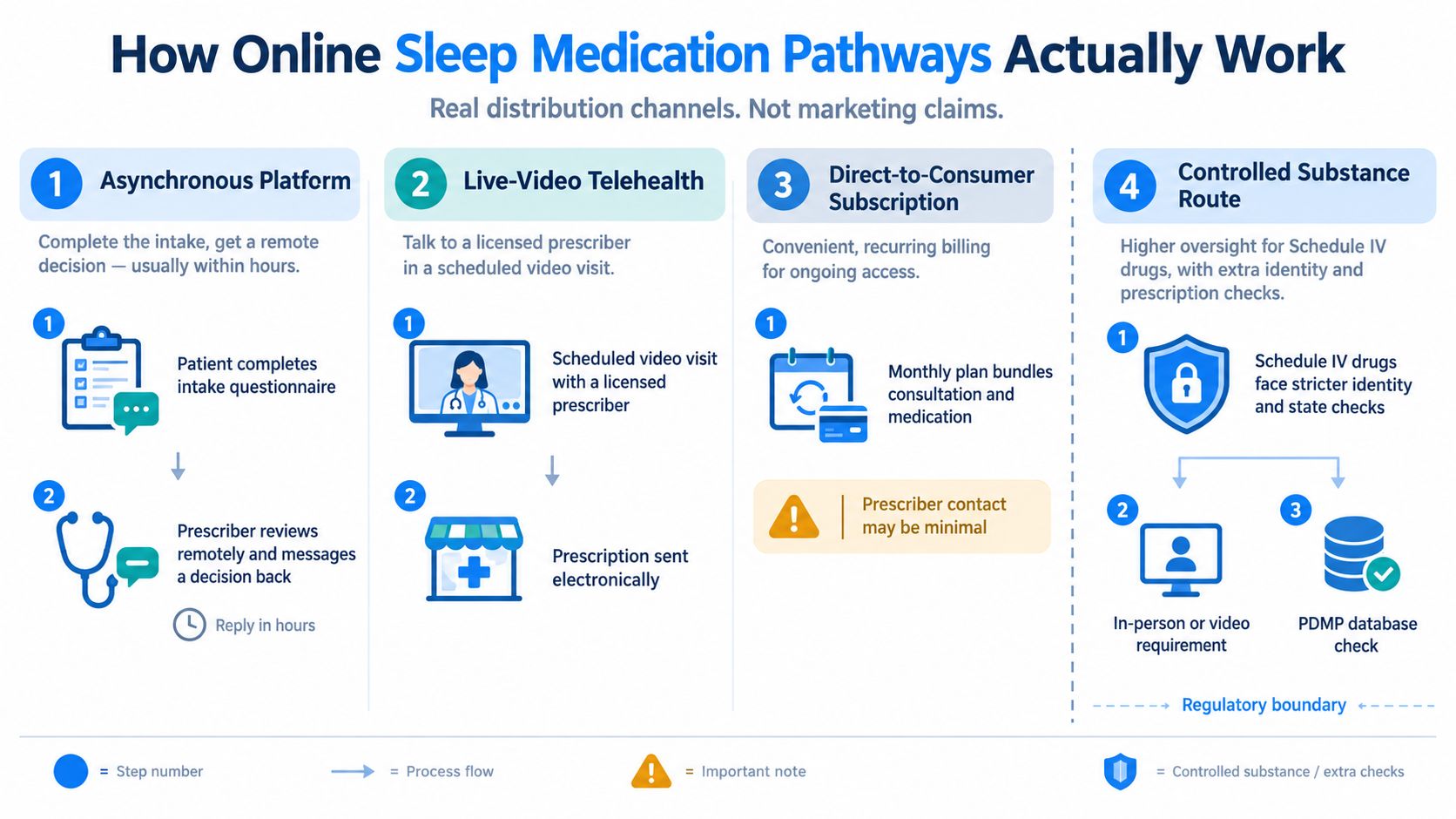
Online sleep care generally follows one of several operating models. The differences matter because the amount of clinical contact, medication review, and follow-up can vary substantially.
An asynchronous pathway begins with a questionnaire about sleep timing, symptoms, medical history, current medications, and treatment goals. A licensed prescriber reviews the information and communicates a decision through a secure message or follow-up process. This model can work for straightforward cases when the intake is detailed and the clinician can request clarification before prescribing.
A live-video visit gives the prescriber an opportunity to observe the patient, ask follow-up questions, assess speech and alertness, and explore risk factors that a form may miss. Video care can be clinically appropriate for insomnia. A review in the Journal of Clinical Sleep Medicine reported that several small studies found telemedicine-delivered cognitive behavioral therapy for insomnia and brief behavioral therapy produced benefits similar to in-person visits, while an American Academy of Sleep Medicine update described a growing literature supporting telemedicine for sleep-disorder management in the clinical telemedicine review.
Dispensing and regulatory boundaries
A direct-to-consumer pharmacy application may collect an intake, route it to a partner clinician network, and send an approved prescription to a mail-order or local pharmacy. A subscription may bundle clinical review, medication, and recurring billing. That structure can be convenient, but patients should determine whether the service provides genuine follow-up or merely renews an order.
Controlled medications create a separate boundary. The Ryan Haight Act, Drug Enforcement Administration requirements, and state telehealth rules affect how Schedule IV medications can be evaluated and prescribed. Zolpidem and benzodiazepines aren't ordinary checkout items. The prescriber must establish a legitimate patient-practitioner relationship, verify identity, follow state licensing requirements, and determine whether the clinical encounter satisfies applicable rules.
A platform may favor non-controlled options for a first-time patient because they can fit a simpler prescribing pathway. That doesn't mean a non-controlled medication is automatically safe or effective for every patient. It means the prescribing model, medication class, state requirements, pharmacy process, and follow-up plan must align.
A legitimate service should explain the expected response time, consultation process, pharmacy options, follow-up schedule, cancellation terms, and refill policy before payment. A platform that can't explain who reviews the case, where the prescriber is licensed, and how a patient reaches the clinical team isn't offering transparent care.
What a Clinician Evaluates Before Prescribing Online
A responsible telehealth evaluation starts with the sleep complaint, not the requested medication. The clinician needs to know whether the patient has trouble falling asleep, wakes repeatedly, wakes too early, or sleeps for an apparently adequate period but remains unrefreshed. Each pattern can point toward a different cause and treatment pathway.
The sleep history comes first
The clinician typically asks about:
- Bedtime, wake time, naps, and work schedule.
- The onset of symptoms and any recent trigger.
- Nighttime awakenings, snoring, gasping, limb discomfort, and unusual behaviors during sleep.
- Daytime sleepiness, impaired concentration, mood changes, and driving safety.
- Caffeine, alcohol, cannabis, nicotine, and other substances.
- Previous sleep medications, supplements, behavioral programs, and attempts to taper.
A sleep diary can clarify whether the problem is consistent or tied to irregular schedules. It can also show whether a patient is spending excessive time in bed while sleeping only intermittently, a pattern that behavioral treatment addresses more directly than a refill.
The clinician should review every prescription, over-the-counter product, supplement, and recreational substance. A patient may not consider an antihistamine or a high-dose supplement to be a medication, but the prescriber needs the complete list before assessing sedation, interaction risk, or next-day impairment.
Screening for conditions that change the pathway
Online prescribing becomes less suitable when symptoms suggest another disorder. Screening commonly covers obstructive sleep apnea, restless legs syndrome, parasomnias, depression, anxiety, bipolar-spectrum symptoms, trauma-related symptoms, and substance use disorder.
The prescriber may recommend basic laboratory testing when the history suggests a medical contributor, or a sleep-study referral when breathing-related sleep disruption is suspected. An in-person examination may be necessary when the clinician needs physical findings, vital signs, neurological assessment, pregnancy evaluation, or coordinated management of several medications.
Certain red flags should push care away from an online refill pathway:
- Fall risk, particularly in an older adult or a patient already experiencing dizziness or daytime sedation.
- Suspected complex sleep apnea or significant breathing symptoms.
- Active substance use disorder or escalating use of alcohol or sedatives.
- Pregnancy, when medication selection and risk assessment require specialized oversight.
- Multiple sedating medications, especially opioids, benzodiazepines, or another controlled hypnotic.
- Severe psychiatric symptoms, suicidal thinking, mania, psychosis, or unstable mood.
The patient shouldn't be asked to choose between “approved” and “declined” without an explanation. A safe clinician explains what information changed the recommendation and whether the next step is primary care, sleep medicine, behavioral treatment, psychiatry, or in-person evaluation.
Common Sleep Medication Classes Prescribed Online
Medication selection depends on the sleep pattern, coexisting conditions, prior treatment, age, pregnancy status, substance history, and interaction profile. No class is universally safest, and “non-controlled” doesn't mean risk-free.
| Drug Class | Examples | Mechanism | Dependence Risk | Online Prescribing Fit |
|---|---|---|---|---|
| Non-benzodiazepine Z-drugs | Zolpidem, eszopiclone | Enhance inhibitory signaling through the GABA system | Dependence, tolerance, rebound insomnia, and complex sleep behaviors are clinical concerns | May require a live visit, state-specific compliance checks, prior records, and close follow-up |
| Dual orexin receptor antagonists | Lemborexant, daridorexant, suvorexant | Reduce wake signaling mediated by orexin pathways | Lower dependence concern than benzodiazepines, but sedation and next-day impairment remain possible | May fit a carefully documented telehealth pathway when the prescriber reviews comorbidities and interactions |
| Benzodiazepines | Temazepam | Enhance GABA-mediated inhibitory activity | Meaningful dependence, tolerance, withdrawal, and misuse risk | Usually a poor fit for casual asynchronous prescribing and may require prior treatment history or in-person evaluation |
| Sedating antidepressants | Trazodone, low-dose doxepin, mirtazapine | Varies by drug, with effects on histamine, serotonin, and other signaling systems | Generally lower misuse concern than controlled hypnotics, but adverse effects and withdrawal considerations remain | Can fit telehealth when the indication, psychiatric history, and interaction profile are documented |
| Melatonin receptor agonist | Ramelteon | Acts at melatonin receptors involved in circadian sleep timing | Low dependence concern, though response varies by sleep pattern | Often compatible with a structured remote evaluation |
| Over-the-counter antihistamines or melatonin | Medication and supplement products in these categories | Antihistamines promote sedation, while melatonin products influence sleep timing | Antihistamines can produce tolerance and anticholinergic effects; supplement quality and dose consistency can vary | Patients should disclose use rather than assume over-the-counter products are harmless |
How clinicians should compare the options
Z-drugs may improve sleep onset or maintenance, but a prescriber must discuss amnesia, unusual sleep behaviors, next-day impairment, and dependence. Benzodiazepines carry an even more consequential long-term risk profile and should not become the default response to chronic insomnia.
Orexin antagonists target wakefulness rather than broadly suppressing central nervous system activity. They may be reasonable for selected patients, but they can still cause next-day sleepiness and aren't appropriate without reviewing other sedatives, breathing disorders, and driving demands.
Sedating antidepressants may be considered when insomnia occurs alongside a relevant mood or anxiety condition, but prescribing should follow the psychiatric picture rather than use sedation as the only rationale. Doxepin, trazodone, and mirtazapine don't share the same mechanism or side-effect profile, so grouping them as interchangeable “non-habit-forming” sleep aids is poor clinical practice.
Ramelteon and carefully selected nonprescription options may suit some patients, particularly when the main problem involves sleep timing. They still require a medication review. A patient who combines several sedating products can create a hazardous regimen even when none of the individual products is controlled.
Safety Risks and Regulatory Limits to Understand
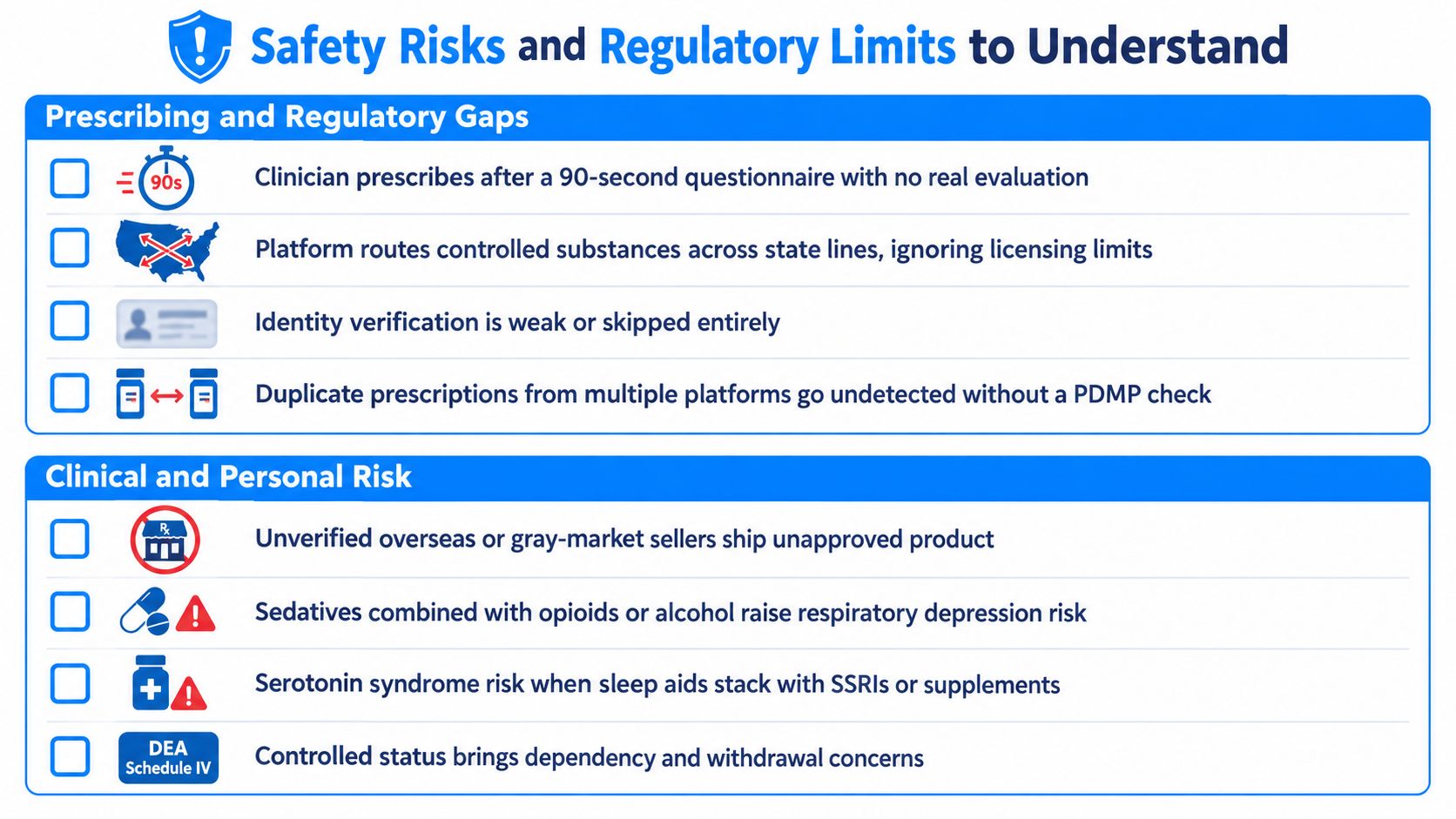
The most dangerous online sleep-medication pathway is the one that treats insomnia as a product request. A ninety-second questionnaire can't reliably identify sleep apnea, active substance use, mood instability, pregnancy, medication interactions, or a patient who already receives sedatives from another prescriber.
A second failure occurs when a platform ignores geography. Controlled prescriptions may cross state lines through a pharmacy, but the clinician still must satisfy the licensing and prescribing rules that apply to the patient and the encounter. The telemedicine prescribing review describes telemedicine as a suitable alternative for some sleep-related controlled-substance prescribing when delivered through a live interactive visit, while also noting that certain states require a prior face-to-face encounter for particular controlled medications.
The clinical risks are not theoretical
Sedative combinations deserve direct questions. Alcohol, opioids, benzodiazepines, antihistamines, and hypnotics can compound respiratory depression and impairment. A prescriber should also review antidepressants and supplements because stacking products can create additional interaction risks, including serotonin toxicity with certain combinations.
Controlled hypnotics may cause complex sleep behaviors, parasomnias, amnesia, rebound insomnia, and next-day driving impairment. A patient who reports sleepwalking, eating, driving, or other activity without recall needs prompt clinical review rather than an automatic refill.
Patients using metabolic therapies need a broader medication conversation. A 2026 sleep-focused analysis associated GLP-1 receptor agonist therapy with increased hypersomnolence at both one year, with a hazard ratio of 1.21, and five years, with a hazard ratio of 1.23, as reported in the sleep and GLP-1 analysis. The finding doesn't establish that a GLP-1 medication caused an individual patient's sleepiness, but it supports careful counseling when a patient reports daytime somnolence, impaired alertness, or a new need for sedatives.
Metabolic care also requires hair and sleep counseling
Patients using semaglutide or tirzepatide may ask about hair shedding during weight loss. A large 2026 review reported hair-loss outcomes for 626,894 patients, with 9,933 cases of hair loss, or 1.6%, and 52 reports of hair regrowth, or 0.008%; the review found the strongest reporting signals for semaglutide and tirzepatide in the GLP-1 hair-outcomes review.
A separate dermatology review summarized labeling and observational evidence in which semaglutide for weight management listed hair loss as a common adverse reaction at 2.5%, compared with 1.0% for placebo, with higher frequency among patients who lost at least 20% of body weight, as described in the dermatology review of GLP-1-associated hair loss. Rapid metabolic change, nutritional adequacy, thyroid disease, iron status, androgen effects, and other causes may need evaluation. Sleep medication shouldn't be used to obscure fatigue caused by an unrecognized medical issue.
A real encounter feels like a visit. It includes identity verification, state authorization, medication reconciliation, risk screening, informed consent, and a follow-up plan. If the process feels like a checkout page with a prescription attached, the patient should stop before dispensing.
Why Behavioral Therapy Often Beats a Pill
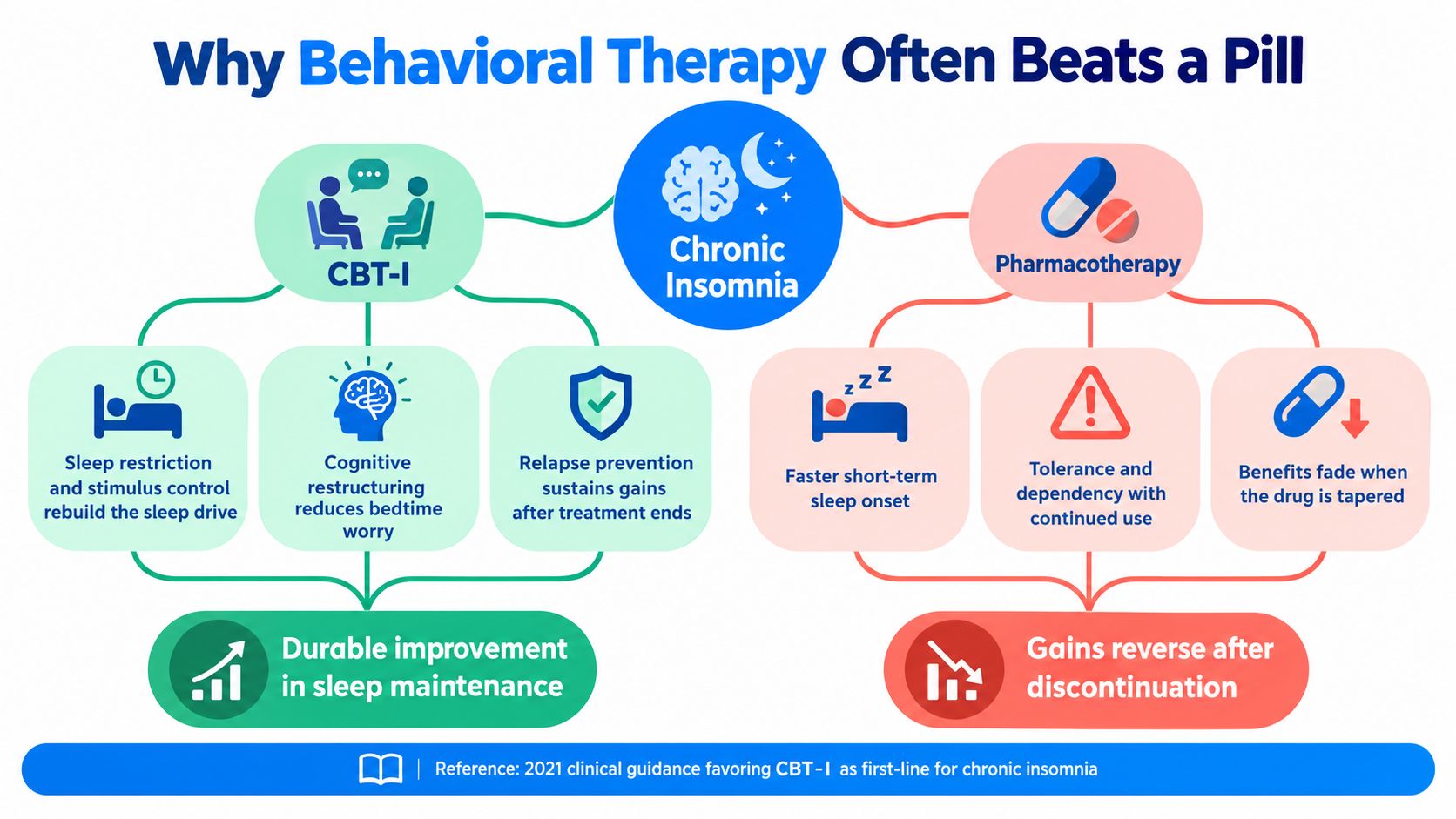
For chronic insomnia, cognitive behavioral therapy for insomnia, or CBT-I, should usually be the foundation. Medication can reduce symptoms quickly for selected patients, but it doesn't retrain the association between bed and wakefulness, address catastrophic thinking about sleep, or create a durable plan for tapering.
The core elements are practical:
- Sleep restriction: Time in bed is calibrated to the patient's actual sleep pattern, then expanded as sleep becomes more consolidated.
- Stimulus control: The bed returns to its role as a cue for sleep rather than wakeful worry, scrolling, or work.
- Cognitive restructuring: The patient examines predictions such as “one poor night will ruin the next day” and replaces them with more accurate interpretations.
- Relaxation training: A structured method reduces physiological arousal at bedtime.
- Sleep hygiene: Light exposure, caffeine timing, bedroom conditions, and regular scheduling support the program, but they aren't the whole treatment.
Why durability matters
A sedative can make a difficult night easier. It may not solve the pattern that keeps insomnia recurring after the prescription ends. CBT-I addresses sleep maintenance, conditioned arousal, and relapse prevention, which is why a serious clinician may start with behavioral treatment or pair it with a short medication bridge.
The telemedicine evidence supports that approach. The sleep-medicine review cited earlier found that small studies of telemedicine-delivered CBT-I and brief behavioral therapy produced benefits similar to office-based care. That makes remote behavioral treatment more than a convenience feature. It can be the primary intervention when the patient has access to a structured program and appropriate clinical screening.
Automated digital CBT-I programs, app-based interventions, and therapist-led video care can all serve different patients. The important distinction is whether the program teaches the actual CBT-I components, tracks sleep patterns, and provides escalation when symptoms suggest sleep apnea, severe mood symptoms, substance use, or another condition outside a self-guided pathway.
Clinical position: Medication can be a bridge. It shouldn't be the destination for chronic insomnia.
A 204-patient telehealth CBT-I program that included gradual medication reduction reported an 8.28-point improvement in the Insomnia Severity Index, a 10.69% increase in sleep efficiency, and a 63.4% clinical response rate by ISI criteria, as reported in the telehealth CBT-I and medication-reduction study. Participants reduced or discontinued several medication classes, including benzodiazepines, Z-drugs, orexin antagonists, melatonin, antihistamines, antidepressants, cannabis, and alcohol.
The lesson isn't that every patient should stop medication immediately. It is that a treatment plan can improve sleep while reducing reliance on sedating substances. A service that jumps straight to a controlled prescription has skipped a clinically important step.
When Online Sleep Medication Is the Right Choice
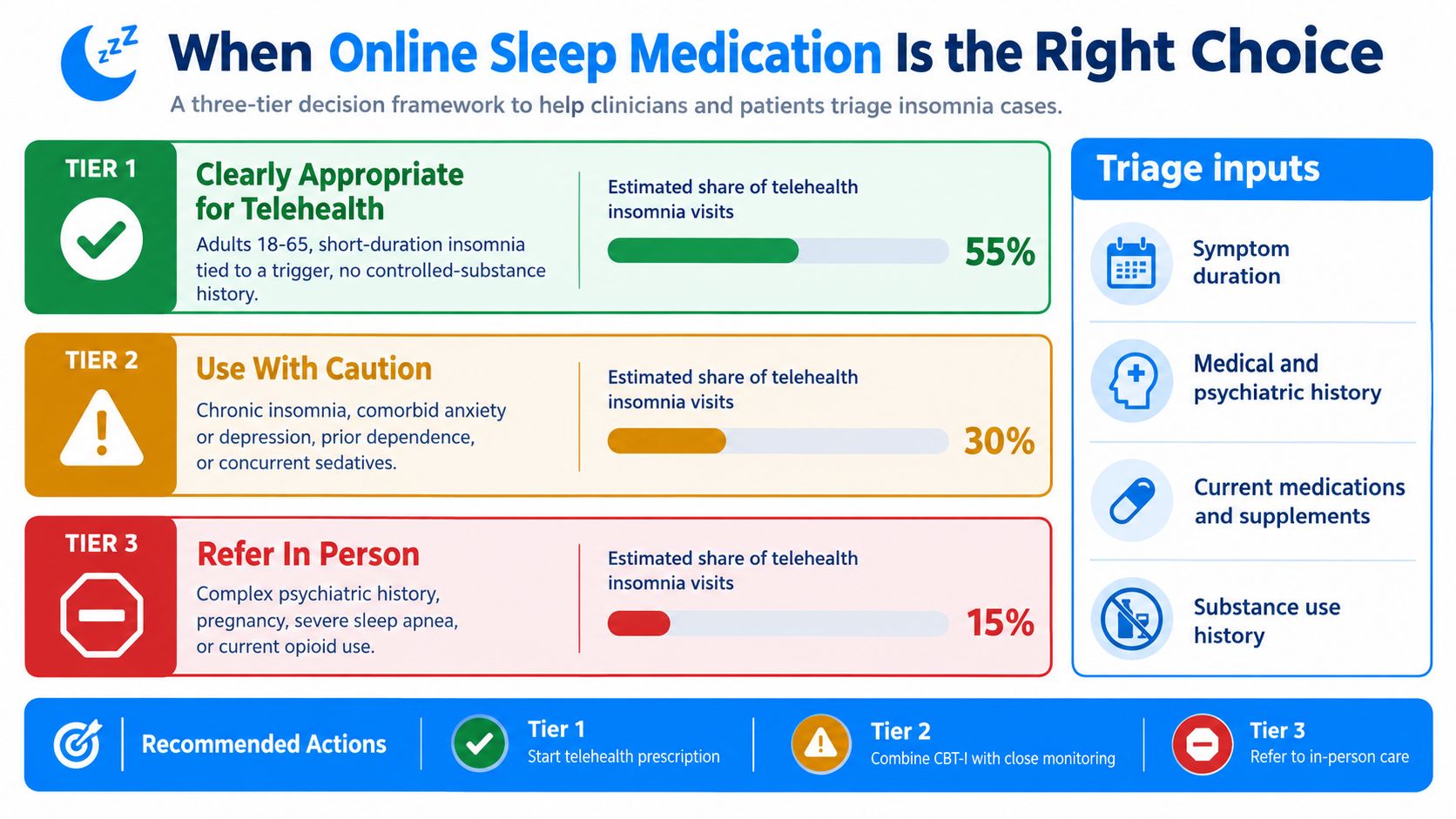
Telehealth is appropriate when the clinical problem is clear, the patient is medically stable, and remote care can provide adequate evaluation and follow-up. Convenience alone isn't a triage criterion.
Tier one supports remote management
The clearest candidates are adults with short-duration insomnia linked to an identifiable trigger, stable mental health, no substance-use history that raises prescribing concern, and access to primary care or another clinician for coordination. Examples may include a temporary schedule disruption, acute stress, or a limited episode after travel.
These patients still need medication reconciliation, screening for breathing-related symptoms, and a plan that doesn't turn a brief episode into indefinite treatment. A non-controlled option or behavioral intervention may be preferable to a hypnotic.
Tier two calls for a bridge
Some patients have chronic insomnia, anxiety or depression, a history of dependence, or concurrent sedating medication. Online care may still have a role, but medication should be treated as a short-term bridge while the patient begins CBT-I, addresses the underlying condition, or transitions to coordinated in-person management.
Situational insomnia, post-acute withdrawal, and jet-lag patterns may require temporary support. The clinician should define the duration before the first dose, identify the outcome that will justify continuation, and specify how the medication will be stopped. A refill request should trigger reassessment rather than automatic approval.
Tier three requires referral before prescribing
The following findings should redirect the patient to in-person or specialist evaluation:
- Suspected obstructive sleep apnea or severe breathing symptoms.
- Restless legs or another possible movement disorder.
- Parasomnias or complex sleep behaviors.
- Complex psychiatric comorbidity, mania, psychosis, or suicidal thinking.
- Pregnancy.
- Polypharmacy involving opioids, benzodiazepines, or several sedatives.
- A controlled sedative already prescribed by another clinician.
- Significant daytime sleepiness that threatens driving or workplace safety.
The decision should pivot on clinical signals
A safe flowchart begins with symptom duration and daytime impairment. It then checks medical and psychiatric history, current medications and supplements, substance use, breathing symptoms, and prior treatment. If red flags appear, referral takes priority. If the profile is stable, telehealth may proceed with a defined treatment target and follow-up.
This framework also applies to patients receiving metabolic care. A patient reporting fatigue, hypersomnolence, hair shedding, weight-loss-related nutritional concerns, or a new medication interaction may need a broader medical review rather than a sleep prescription.
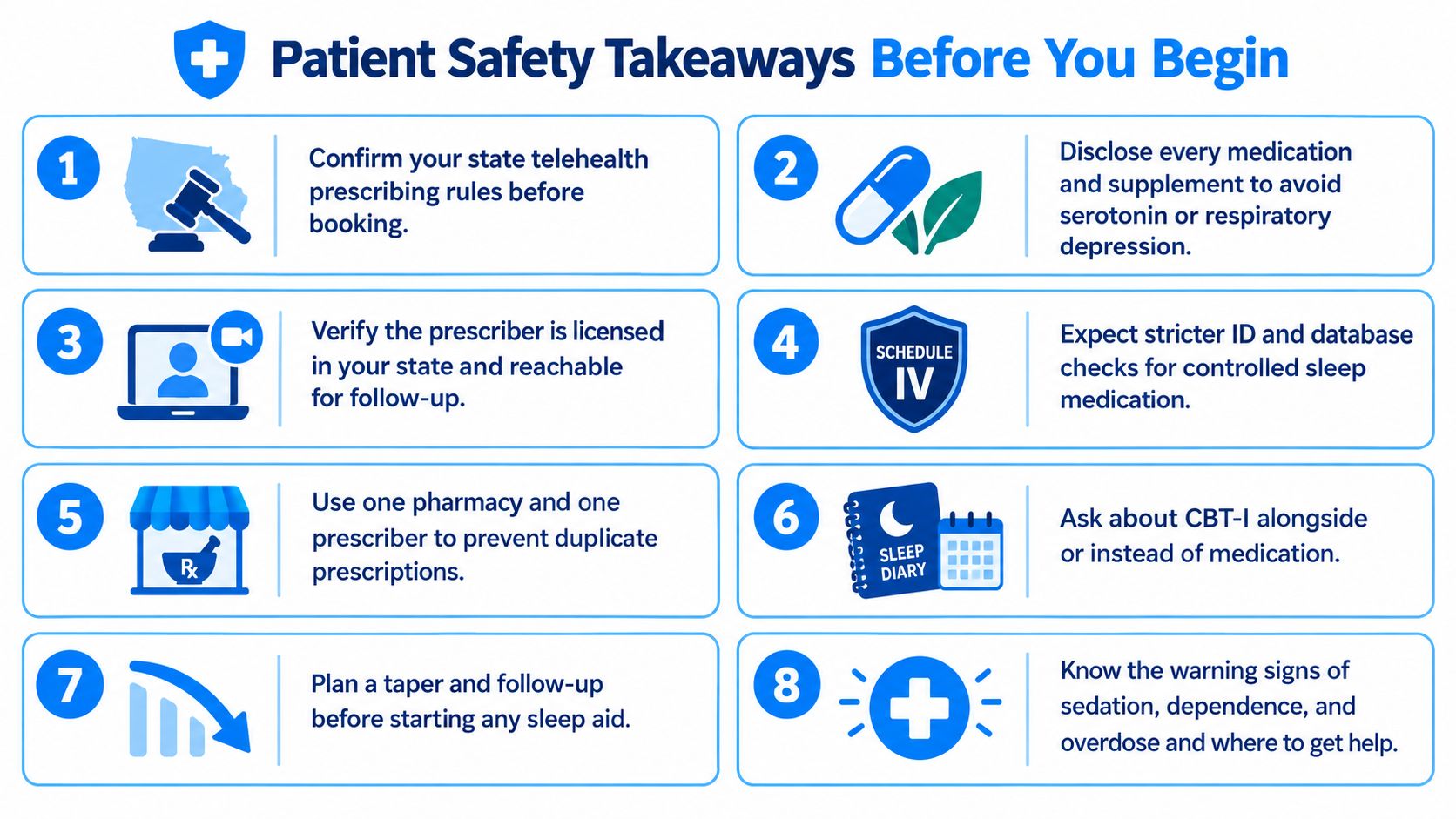
Patient Safety Takeaways Before You Begin
A patient preparing for an online sleep consultation should approach the appointment with the same information expected in a well-run clinic. The following checklist can be printed, completed, and brought to the encounter.
Confirm state rules before booking. The patient should verify that the clinician is licensed where the patient is located and ask whether the requested medication requires a video visit or prior in-person evaluation.
Disclose every medication and supplement. This includes alcohol, cannabis, antihistamines, melatonin products, opioids, antidepressants, GLP-1 therapies, and medications prescribed by other clinicians. Complete disclosure helps the prescriber assess respiratory depression, serotonin toxicity, sedation, and duplication.
Require meaningful clinical review. A clinician should review the intake, ask follow-up questions, and explain the diagnosis or working differential before prescribing. A form that produces an approval without clinical dialogue is an inadequate safeguard.
Ask about sleep-apnea and substance-use screening. Snoring, gasping, morning headaches, daytime sleepiness, escalating alcohol use, and prior sedative misuse can change the appropriate care setting.
Use one prescriber and one pharmacy. A single coordinated medication record reduces the risk of duplicate prescriptions and makes it easier to identify adverse effects or an unsafe combination.
Request CBT-I as part of the plan. A patient with persistent insomnia should ask whether behavioral treatment, a structured sleep diary, or a therapist-led remote program is available alongside or instead of medication.
Establish follow-up before the first dose. The patient should know when efficacy, next-day alertness, mood, breathing symptoms, and adverse effects will be reviewed. A refill should never be the only planned contact.
Know the taper and emergency plan. The prescriber should explain whether the medication can be stopped abruptly, how tapering will work when needed, and which symptoms require urgent help, including severe sedation, confusion, breathing difficulty, overdose, or dangerous sleep behaviors.
The most useful question isn't “Which sleep medication can be shipped?” It is “What is causing the sleep problem, what level of care is safe, and how will the patient sleep without depending on a refill?” That question protects patients from both undertreatment and unnecessary exposure to sedatives.
Vials + Vitals offers physician-directed telehealth assessments and protocol-guided care for eligible patients, with licensed U.S. providers determining whether treatment is clinically appropriate. Patients seeking a medically supervised conversation about sleep, metabolic therapies, or related medication risks can visit Vials + Vitals to begin the evaluation.
Ready to see if this protocol fits your biology?
A licensed provider reviews every request before anything is prescribed.
Calibrate your metabolic protocol →