Semaglutide Sublingual Drops: Clinical Guide

Explore the clinical evidence, absorption science, and regulatory realities of semaglutide sublingual drops in this comprehensive medical guide.
Placing a medication under the tongue doesn't guarantee that it reaches the bloodstream in a clinically useful amount. That popular assumption is especially risky with semaglutide sublingual drops, because semaglutide is a large, hydrophilic peptide with poor passive permeability. A liquid can dissolve quickly and still deliver an unpredictable dose.
The Vials + Vitals Medical Board treats this distinction as fundamental. An approved oral semaglutide tablet and a compounded liquid or orally disintegrating formulation aren't interchangeable products, even when they contain the same active ingredient. The approved tablet has regulatory review, defined manufacturing controls, and a studied absorption system. Compounded sublingual products remain a recent, nonstandard dosage form without an established human clinical-trial evidence base. Independent medical reporting from Stanford describes compounded sublingual drops as products that haven't been studied in clinical trials.
Table of Contents
- The Reality of Sublingual Peptide Delivery
- Biological Barriers to Mucosal Absorption
- Comparing Sublingual Drops to Approved Oral Tablets
- Regulatory Oversight and Compounding Safety
- Clinical Efficacy and Patient Selection Criteria
- Monitoring Metabolic Changes and Hair Retention
- Navigating Your Treatment Pathway Safely
The Reality of Sublingual Peptide Delivery
The route sounds simple, but the pharmacology isn't
Sublingual administration is attractive for an obvious reason. It avoids a needle and appears to bypass the digestive tract. Yet avoiding the stomach isn't the same as overcoming mucosal absorption barriers. The tissue under the tongue can absorb some medicines efficiently, but that advantage depends on molecular size, chemical properties, formulation design, contact time, and the condition of the oral mucosa.
Semaglutide's approved oral history illustrates the challenge. The FDA approved an oral tablet in September 2019, making it the first oral GLP-1 receptor agonist approved for type 2 diabetes. That product is taken once daily and uses the absorption enhancer SNAC, which was developed to help overcome the long-standing difficulty of delivering peptide medicines through the gastrointestinal route. A detailed review of oral semaglutide development identifies that tablet formulation as the benchmark for semaglutide taken by mouth.
Compounded drops and dissolving tablets are different. They may be prepared for administration beneath the tongue, but they don't have an FDA-approved equivalent route, and human clinical trials haven't established their bioavailability, dose equivalence, consistency, or clinical outcomes.
Clinical takeaway: “Under the tongue” describes a location, not proof of absorption.
What patients should and shouldn't infer
A patient may notice appetite changes, gastrointestinal symptoms, or no noticeable effect after using drops. None of those observations can establish the amount of semaglutide that entered systemic circulation. Symptoms aren't a reliable pharmacokinetic test, and the absence of nausea doesn't prove that a preparation is inactive.
The practical question isn't whether a liquid can contact the mucosa. It's whether the formulation reliably transports enough intact peptide across that tissue to create a predictable exposure. Current independent sources don't establish that answer for compounded semaglutide sublingual drops in humans.
Biological Barriers to Mucosal Absorption
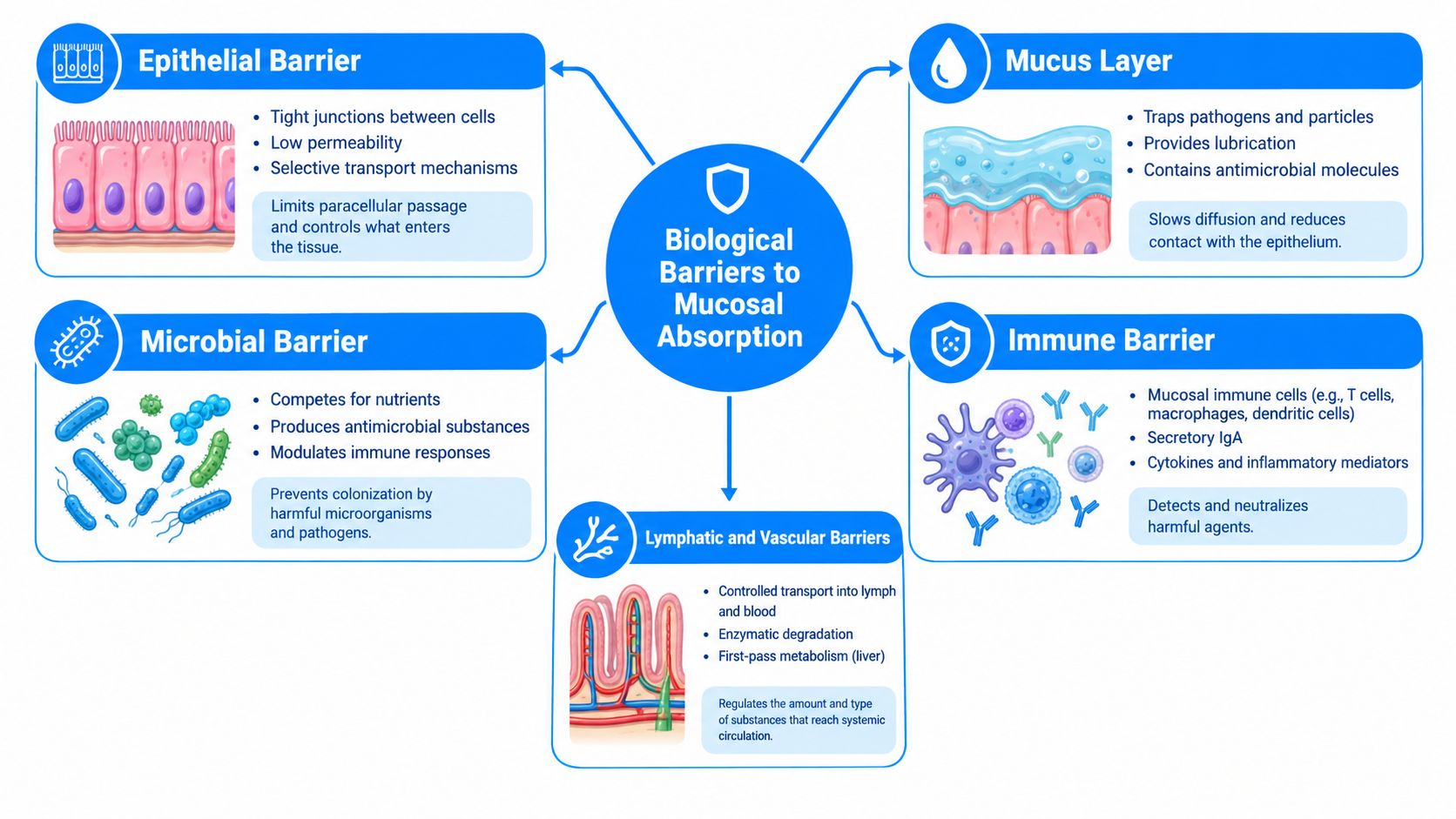
The oral mucosa is vascular, but it isn't an open doorway. A semaglutide molecule must remain intact in the formulation, reach the epithelial surface, cross that surface, avoid being trapped or degraded, and enter circulation in an amount that produces a reproducible pharmacologic effect.
Why peptide size matters
Semaglutide is a large, hydrophilic peptide. Large hydrophilic molecules don't readily pass through the lipid-rich structures of cell membranes by passive diffusion. Small, lipophilic medicines can often cross mucosal barriers more easily. Semaglutide requires a formulation strategy that does more than dissolve the active ingredient in a liquid vehicle.
The mucosa also presents physical and chemical obstacles:
- Epithelial structure: The surface cells form a selective barrier rather than a freely permeable membrane.
- Mucus and saliva: Secretions can dilute the preparation, move it away from the intended site, or trigger swallowing.
- Enzymatic activity: Peptide molecules can be vulnerable to enzymatic breakdown before they reach systemic circulation.
- Limited contact time: A patient who swallows quickly may convert a sublingual administration into an uncertain oral dose.
- Formulation dependence: Permeation enhancers, stabilizers, concentration, pH, and vehicle composition can all influence exposure.
These barriers explain why a pharmacy can't validate a product's performance merely by confirming that semaglutide is present in the bottle. Identity and concentration aren't the same as proven bioavailability. A preparation may contain the labeled ingredient while still producing variable systemic exposure.
The approved oral route reveals the scale of the problem
The approved oral tablet depends on gastric delivery plus SNAC, not ordinary swallowing. FDA labeling reports very low absolute bioavailability, about 0.4% to 1% for Rybelsus, with newer oral tablet labeling describing approximately 1% to 2%, and absorption occurring predominantly in the stomach. Peak concentration is reached at about one hour after dosing. The FDA-approved prescribing information provides these pharmacokinetic details.
That low exposure isn't evidence that oral semaglutide is ineffective. It shows that the manufacturer needed specialized chemistry and controlled administration mechanics to produce a usable oral product. A compounded sublingual formulation faces a different barrier profile, but it still needs evidence demonstrating that its strategy works consistently in humans.
Comparing Sublingual Drops to Approved Oral Tablets
The approved oral tablet and compounded semaglutide sublingual drops solve different delivery problems. The tablet was developed around gastric absorption and SNAC. Drops attempt to use the oral mucosa, but their human pharmacokinetic performance hasn't been established.
Administration mechanics are part of the dose
Approved oral semaglutide must be taken fasting with no more than 120 mL of water, followed by a 30-minute wait before food, drinks, or other medicines. Absolute bioavailability is about 0.8% under recommended conditions, and it can fall with a larger water volume while improving with longer post-dose fasting. A pharmacokinetic review of oral semaglutide explains why these mechanics matter.
A separate review of oral semaglutide administration emphasizes the same point. The dosing instructions aren't cosmetic. They help preserve the conditions under which the tablet's absorption system was studied. The clinical pharmacology review describes the fasting, water-volume, and waiting requirements.
Preclinical evidence for a sublingual wafer is interesting but limited. In a rat study, detectable plasma levels appeared as early as 5 minutes, with a second peak around 240 minutes that may reflect delayed lymphatic absorption. The reported AUC0–8h was approximately 11,000 ng·h/mL for the sublingual wafer versus 553 ng·h/mL for oral Rybelsus, implying roughly 20-fold higher relative bioavailability in that animal model. The rat pharmacokinetic study doesn't establish an equivalent human dose.
Oral Tablet vs. Sublingual Formulations
| Feature | Approved Oral Tablet | Compounded Sublingual Drops |
|---|---|---|
| Delivery site | Primarily the stomach | Intended for the oral mucosa beneath the tongue |
| Absorption strategy | Uses SNAC to support gastric absorption | Depends on formulation design and mucosal permeability |
| Regulatory status | FDA-approved product | Not an FDA-approved semaglutide dosage form |
| Human evidence | Supported by regulatory and phase 3 studies | Human dose equivalence and reproducibility remain unvalidated |
| Administration | Fasting, limited water, then a 30-minute wait | Prescriber and pharmacy instructions vary |
| Dose predictability | Studied under defined conditions | May vary with formulation, handling, mucosal conditions, and technique |
| Interpretation of animal data | Not applicable | Rat findings cannot be converted directly into a human regimen |
The rat findings support further formulation research, not self-directed dose conversion. FDA-linked documentation states that no approved sublingual or transmucosal semaglutide product exists, and compounded products don't undergo the same pharmacokinetic and pharmacodynamic verification required for approved medicines.
Regulatory Oversight and Compounding Safety
Compounding occupies a different regulatory position from commercial drug manufacturing. A compounded preparation may be prescribed for an individual clinical situation, but it hasn't passed through the FDA's premarket review for safety, quality, and effectiveness. That distinction becomes more important when the dosage form itself is nonstandard.
The policy question is becoming sharper
The FDA's 2026 proposal to exclude semaglutide from the 503B bulks list states that the agency hasn't identified a basis to conclude that approved oral or injectable semaglutide products are medically unsuitable in a way that would justify a compounded buccal or sublingual product. The regulatory analysis of the FDA proposal explains why that position matters for nonstandard routes.
This doesn't answer every state-specific compounding question, and it doesn't determine whether an individual patient has a legitimate medical need. It does signal that access may change as regulators reassess shortage policies, bulk-drug rules, and the clinical rationale for alternative routes. Patients considering treatment should ask how a pharmacy and prescriber will respond if the legal or operational basis for compounding changes.
What oversight can and can't confirm
A pharmacy's credentials, labeling, documentation, and testing practices matter. They can help establish whether a product was prepared in a controlled environment and whether the labeled concentration was assessed. They cannot turn an unapproved dosage form into an FDA-approved medicine or create human efficacy data where none exists.
Patients should request clear answers about:
- Pharmacy authorization: Is the dispensing pharmacy properly licensed for the patient's state?
- Prescription process: Did a U.S.-licensed clinician review the medical history and prescribe the formulation?
- Testing: Does the pharmacy perform analytical potency testing and, where applicable, sterility testing?
- Beyond-use dating: What evidence supports the assigned date and storage instructions?
- Continuity: What happens if the formulation becomes unavailable or regulatory policy changes?
- Adverse-event reporting: Who receives and evaluates reports of unexpected effects?
Compounding quality is necessary for safety, but it isn't a substitute for clinical validation.
FDA warnings about compounded drugs focus on their higher risk profile and the absence of premarket review. The agency has also taken action over false or misleading claims involving compounded GLP-1 products. A patient should be cautious when a seller presents animal data, testimonials, or a “natural” route as proof of human effectiveness.
Clinical Efficacy and Patient Selection Criteria
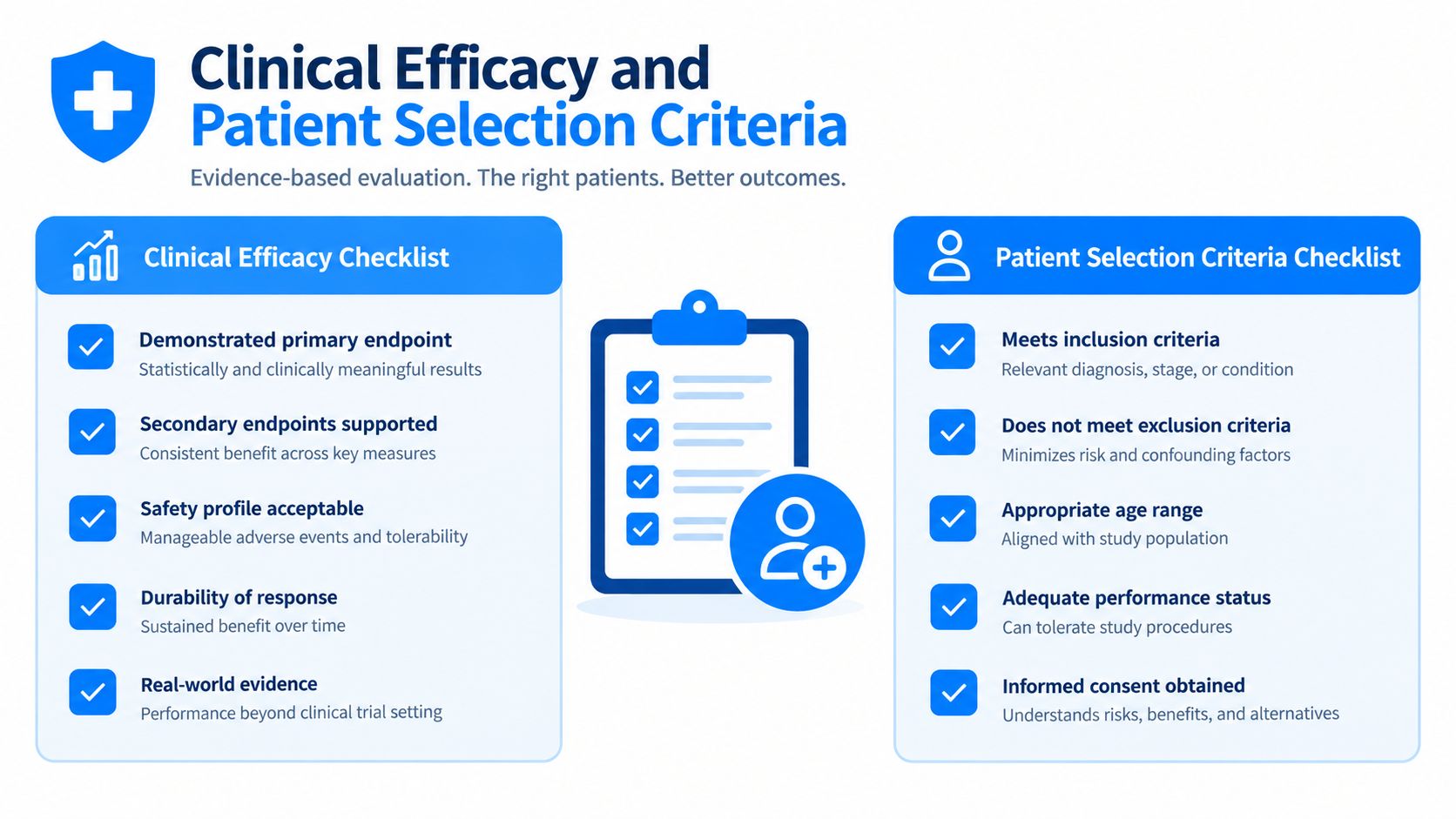
A needle-free preference can be clinically relevant, but it shouldn't determine the formulation by itself. The prescribing decision should begin with the patient's diagnosis, treatment goals, medical history, current medicines, contraindications, and ability to follow the administration routine.
A practical selection sequence
First, establish the indication. The clinician should determine whether a GLP-1-based therapy is appropriate for metabolic care and whether semaglutide, tirzepatide, or another approach fits the patient's risk profile. A request for drops isn't a diagnosis and shouldn't replace a medical assessment.
Next, compare validated and nonstandard options. An approved injection or oral tablet has a stronger evidence base than compounded sublingual drops. A patient who can use an approved formulation safely will generally need a specific clinical reason before accepting the uncertainty of a nonstandard route.
Then, assess adherence realistically. A daily sublingual routine can be harder than a weekly injection for someone who struggles with regular medication use. Conversely, severe needle aversion may make an injection so unacceptable that a supervised nonstandard option becomes the more practical treatment discussion.
Finally, define monitoring and exit criteria. The plan should specify how tolerability, glycemic measures, weight trends, nutrition, and adverse symptoms will be reviewed. If the preparation produces no meaningful clinical response or causes persistent local or systemic problems, the prescriber should reconsider the route rather than escalating indefinitely.
Plateau management requires diagnosis, not automatic escalation
A plateau can reflect adherence, insufficient nutrition, loss of lean mass, sleep disruption, an incorrect dose, or a pharmacologic mismatch. It shouldn't automatically trigger a switch to semaglutide sublingual drops or a higher compounded concentration.
The same principle applies to orally disintegrating tablets. A dissolving format may improve acceptability for some patients, but its sensory convenience doesn't prove superior absorption. The prescribing team should document what is known, what is uncertain, and what outcome would justify continuing the trial.
Selection principle: A nonstandard route is reasonable only when its practical advantage outweighs its evidence and consistency limitations for that particular patient.
Monitoring Metabolic Changes and Hair Retention
A treatment plan that tracks only scale weight misses an important part of metabolic care. Appetite reduction can lower total food intake, and rapid body-weight change can create a physiologic stress signal that shifts hair follicles into the resting phase. The result may appear later as diffuse shedding rather than immediate thinning.
Why timing matters
A systematic review reported that hair-loss symptoms often emerge during the three- to six-month window, aligning with the period of greatest weight reduction and the classic timing of telogen effluvium after a physiologic stressor. The systematic review of GLP-1 therapy and hair loss supports evaluating the timing of shedding alongside weight trajectory, nutrition, illness, and other causes.
A 2026 real-world cohort study found higher odds of nonscarring hair loss with GLP-1 receptor agonist exposure. At 12 months, telogen effluvium risk was notably higher, with an adjusted odds ratio of 1.76 and a 95% confidence interval of 1.34 to 2.32. The cohort study abstract supports a biologically plausible relationship, but it doesn't prove that every episode of shedding is caused by semaglutide or that changing the route will prevent it.
A monitoring approach that protects more than weight
A clinician should assess the pace of weight change, protein and calorie adequacy, hydration, gastrointestinal symptoms, menstrual or hormonal changes where relevant, and the scalp pattern itself. Diffuse shedding often differs from patterned loss, inflammatory scalp disease, or a focal alopecia that needs dermatologic evaluation.
The Follicular Retention Index can help organize follow-up around hair density, shedding reports, nutrition, and treatment timing. The tool doesn't replace examination or laboratory assessment, but it can keep hair retention in the same care plan as metabolic markers.
Patients should report sudden, patchy, painful, scarring, or persistent hair loss. They shouldn't stop a prescribed GLP-1 therapy abruptly without discussing the risk-benefit balance with the prescribing clinician.
Navigating Your Treatment Pathway Safely
The safest decision framework starts with a simple comparison: approved oral tablets and injections offer established regulatory and clinical evidence, while compounded sublingual drops offer a needle-free route with unresolved human pharmacokinetic questions. Convenience matters, but it shouldn't be confused with equivalence.
A responsible pathway includes:
- Medical evaluation: A U.S.-licensed clinician reviews the patient's history, current medicines, metabolic goals, and safety risks.
- Formulation discussion: The clinician explains why an approved formulation is or isn't suitable and identifies the uncertainties of any compounded route.
- Pharmacy verification: The patient receives medication from a licensed U.S. pharmacy with documented quality processes, appropriate testing, clear labeling, and storage instructions.
- Guardrailed titration: Dose changes follow a prescriber-directed schedule rather than online conversion charts or symptom-based escalation.
- Ongoing review: Weight, glycemic status when relevant, gastrointestinal tolerance, nutrition, hair changes, and access continuity are reassessed.
- Contingency planning: The patient knows what to do if the product is unavailable, the formulation changes, or regulators narrow compounding options.
A pharmacy can't guarantee that sublingual exposure matches an injection or an approved tablet. A telehealth service can't remove the need for clinical judgment. The meaningful protection comes from transparent uncertainty, qualified prescribing, controlled dispensing, and follow-up that changes course when the evidence or the patient's response calls for it.
Vials + Vitals provides physician-directed telehealth assessment for semaglutide, tirzepatide, and selected needle-free compounded formulations, with individualized titration and fulfillment through accredited U.S. pharmacy partners. Patients considering semaglutide sublingual drops should use the online assessment to discuss whether a nonstandard route is clinically appropriate rather than treating it as a direct substitute for an approved tablet or injection.
Vials + Vitals can evaluate metabolic goals, needle aversion, hair-retention concerns, and medication safety through a physician-directed telehealth pathway. Visit Vials + Vitals to begin a confidential clinical assessment and discuss an evidence-conscious treatment plan with appropriate oversight.
Ready to see if this protocol fits your biology?
A licensed provider reviews every request before anything is prescribed.
Calibrate your metabolic protocol →