Semaglutide Contraindications: A Clinical Reference Guide

Complete clinical reference on semaglutide contraindications, including MTC, MEN 2, pregnancy, hypersensitivity, and key cautions
Many people reach semaglutide screening after the same question lands in a portal message or telehealth intake, can this start safely this week, or is there a reason to stop before the first dose? The answer should not be a vague yes or no. It should separate absolute exclusions from monitoring cautions, then match each one to a clear clinical action.
That distinction matters because semaglutide is used under more than one label, including Ozempic, Wegovy, and Rybelsus, and the safety language overlaps but isn't identical. A decision-ready review has to identify who should not start, who can start with monitoring, and which screening steps catch the remaining risk before the prescription is written. In practice, the hardest failures come from missed thyroid history, missed allergy history, and missed pregnancy planning.
Table of Contents
- Why This Semaglutide Contraindications Guide Exists
- How Clinicians Categorize Semaglutide Safety Flags
- Medullary Thyroid Carcinoma and MEN 2 History
- Serious Hypersensitivity to Semaglutide or Excipients
- Pregnancy Planning and Reproductive Cautions
- Soft-Stop Conditions That Warrant Caution
- The Thyroid Warning Versus Modern Human Evidence
- Pre-Initiation Screening for Telehealth and In-Person Care
- Ranking Contraindications by Clinical Weight
- Quick-Reference Checklist for Safe Initiation
- Frequently Asked Questions on Semaglutide Contraindications
Why This Semaglutide Contraindications Guide Exists
Semaglutide screening works best when the first question is narrow and practical, is it safe to begin now? That is a different task from explaining how the drug works or whether it may help with weight loss. The prescriber needs a framework that sorts the answer into hard stop, soft stop, or start with monitoring.
The core hard stops have remained stable across U.S. labeling since semaglutide's major approvals, including the thyroid-cancer warning tied to medullary thyroid carcinoma and MEN 2 history, plus serious hypersensitivity and pregnancy-related discontinuation guidance. The FDA labeling for Wegovy also ties the thyroid warning to rodent findings at clinically relevant exposures while noting that the human relevance is unknown, and that warning has been carried forward across later revisions for semaglutide products. That is why a single unified reference is useful, rather than three separate product summaries.
Practical rule: if a history question can change the answer before the first dose, it belongs in intake, not in follow-up.
This guide is written for clinicians, telehealth prescribers, and informed patients who want the same thing, a single screening logic that mirrors the label but still reflects how real-world obesity care is handled. The practical scope is simple. Who should not start at all, who can start with monitoring, and what has to be documented before initiation.
How Clinicians Categorize Semaglutide Safety Flags
Semaglutide safety language falls into three buckets. Contraindications mean the drug should not be given because the risk outweighs the benefit. Warnings and precautions mean the drug may still be used, but only after risk mitigation, consent, and often baseline monitoring. Common adverse effects are expected reactions, not reasons by themselves to rule the medication out.
That distinction is not academic. A contraindication should halt prescribing. A precaution should change the plan, for example by slowing titration, adjusting a concomitant drug, arranging follow-up, or checking baseline renal function or eye status. If that line is blurred, telehealth screening either becomes too restrictive or misses a real safety issue.
What lands in each tier
The label-based hard exclusions are the clearest. Personal or family history of medullary thyroid carcinoma and MEN 2 remain the foundational exclusion, and prior serious hypersensitivity to semaglutide or an excipient is the other firm stop point. Pregnancy is different. It is not framed as a chronic absolute for all settings, but it does require discontinuation when pregnancy is recognized and a washout plan before conception.
By contrast, items like pancreatitis, gallbladder disease, renal impairment, diabetic retinopathy, hypoglycemia risk with insulin or sulfonylureas, and resting tachycardia are handled as cautionary conditions. They usually do not prohibit use on their own, but they do change monitoring and may shift the decision toward deferral if the condition is active or unstable.
Semaglutide screening fails when a soft stop is mistaken for a hard stop, or when a hard stop gets buried inside a vague intake form.
The practical job of intake is therefore not to memorize every adverse event. It is to catch the small number of conditions that decide whether treatment can begin this week.
Medullary Thyroid Carcinoma and MEN 2 History
The most important semaglutide contraindication is still the thyroid-cancer screen. A personal history or family history of medullary thyroid carcinoma or known MEN 2 remains the core exclusion across major semaglutide labels, and the FDA label says the warning is based on rodent findings in which semaglutide caused thyroid C-cell tumors at clinically relevant exposures, while the human relevance is unknown (FDA semaglutide label).
Why the warning stays in place
That warning has persisted because regulators have kept the same exclusion even as labels changed over time. The practical rule is not dose-based and not age-based. It is history-based. A family tree matters as much as the patient's own cancer history, because the label treats the inherited risk pattern as a stop point rather than a nuance to monitor through.
In real intake work, the most useful question is specific. Ask whether anyone in the first line of family history had medullary thyroid carcinoma, not just “thyroid cancer.” Ask whether the patient has ever been told they have MEN 2, not only whether they have “an endocrine condition.” That wording matters because many patients know the organ involved but not the pathology subtype.
What to do when the history is unclear
A distant family history of unspecified thyroid cancer is not the same as a documented MTC history, and that distinction matters. If the answer is vague, the safer move is to pause and clarify the diagnosis before starting. That may mean obtaining records, asking about prior thyroid surgery, or sending the patient to endocrinology when the family history sounds suspicious but isn't confirmed.
Clinical takeaway: the thyroid warning is a label-based exclusion, not a casual precaution. If the history matches MTC or MEN 2, semaglutide stays off the table.
The reason this still matters in 2025 care is that the warning has not been retired just because broader human data have not shown a clear causal pattern. The label governs the prescription decision, and screening has to respect that boundary.
Serious Hypersensitivity to Semaglutide or Excipients
The second absolute exclusion is serious hypersensitivity. Current Wegovy labeling says semaglutide is contraindicated in anyone with a prior serious hypersensitivity reaction to semaglutide or to any excipient, and reports serious reactions including anaphylaxis and angioedema (Wegovy label). That distinction matters because a mild intolerance is not the same thing as a true allergy.
What the intake has to capture
A good allergy history should separate three events. First, a non-allergic side effect like nausea. Second, a local injection-site reaction. Third, a systemic allergic event such as facial swelling, tongue swelling, wheeze, or emergency treatment for anaphylaxis. Only the third category should trigger a hard stop for semaglutide.
It also helps to ask about reactions to other GLP-1 receptor agonists, because prior intolerance to one agent doesn't automatically mean cross-reactive allergy, but a prior serious reaction raises concern and should be documented before any re-challenge with the class. Telehealth forms often miss this because patients check “no allergies” when they mean “no medication allergies I know by name.”
What happens if a reaction occurs
If a true hypersensitivity event happens after a dose, the medication should be stopped immediately and the reaction treated according to severity. Mild symptoms need clinical review, but anaphylaxis or angioedema needs emergency management and permanent avoidance of semaglutide formulations. That is a complete stop, not a dose-adjustment issue.
Practical rule: if the reaction involved airway symptoms, facial swelling, or urgent treatment, semaglutide is no longer a candidate.
This is one of the few places where the line is clean. True allergy isn't something to “watch and wait” through in a weight-management program.
Pregnancy Planning and Reproductive Cautions
Pregnancy changes semaglutide planning in a different way than thyroid cancer or allergy history. It is usually handled as a discontinuation trigger, not a permanent contraindication in the abstract. The key operational point is that pregnancy should be excluded before treatment, and the drug should be stopped when pregnancy is recognized. In weight-management care, that matters because weight loss has no benefit during pregnancy and may cause fetal harm.
What screening needs to happen before the first dose
A reproductive-age patient should have pregnancy status documented before initiation, along with contraception status if pregnancy is possible. If conception is planned, the stop window needs to be built into the timeline before treatment starts, not after the first injection. Multiple clinical reviews also treat semaglutide as contraindicated in pregnancy and recommend stopping it before conception because of its long half-life.
A practical intake question often gets missed. It is not just “Are you pregnant now?” It is also “Are you trying to conceive in the next stretch of time?” That answer changes whether semaglutide belongs on the table at all.
How telehealth should handle this
Telehealth workflows should include a pregnancy check, a contraception check, and a stop plan if pregnancy is recognized during treatment. If the main goal is weight loss, clinicians should have a transition plan ready, since that patient may need support while semaglutide is discontinued. Oral contraceptive timing also deserves attention during dose escalation because delayed gastric emptying can affect absorption.
In practice, the safest pattern is simple. Confirm pregnancy status, confirm contraception if relevant, document planned conception timing, and make sure the patient knows to contact the prescriber immediately if pregnancy occurs.
Soft-Stop Conditions That Warrant Caution
Not every problem is a reason to refuse semaglutide. Some conditions are better thought of as soft stops, meaning the medication may still be used, but only after the risk is weighed and the follow-up plan is clear. The clinical weight of each issue is different, so the ranking should reflect that.
Ranked by how much they change the decision
| Condition | Clinical Concern | Recommended Action |
|---|---|---|
| History of pancreatitis | Recurrence concern and need for symptom vigilance | Defer if active, review history carefully, counsel on urgent symptoms |
| Active gallbladder disease | Cholelithiasis or cholecystitis risk | Review gallbladder history, consider imaging or referral if symptomatic |
| Renal impairment or dehydration risk | GI side effects can precipitate AKI | Check renal function, reinforce hydration, monitor more closely |
| Diabetic retinopathy | Rapid glycemic change can worsen eye disease | Coordinate ophthalmology follow-up |
| Concomitant insulin or sulfonylurea use | Hypoglycemia risk increases | Adjust the companion diabetes regimen |
| Resting tachycardia | Heart rate can rise modestly | Document baseline pulse and monitor during titration |
How to use the ranking
Pancreatitis and active gallbladder disease deserve the most caution because they can become acute problems quickly. Renal impairment matters because vomiting or poor fluid intake can turn a tolerable side effect into a kidney problem. Eye disease and hypoglycemia risk are more about coordination and monitoring than exclusion, but they still belong in intake rather than being discovered later.
A practical note matters here. If the patient is already medically fragile, semaglutide should not be started casually just because the indication is strong. The prescriber has to decide whether the monitoring burden is acceptable in that setting.
The Thyroid Warning Versus Modern Human Evidence
The persistent question around semaglutide is why the thyroid warning remains if human data have not reproduced the rodent signal. The answer is that labeling rules and evidence nuance are not the same thing. Human reviews and society statements have been more reassuring than the boxed warning might suggest, but the contraindication still stands under U.S. labeling.
How to talk about non-MTC thyroid history
Nonspecific thyroid disease should not be treated like MTC. A history of hypothyroidism, hyperthyroidism, a benign thyroid nodule, or a benign thyroidectomy is not the same as medullary thyroid carcinoma or MEN 2. Those histories may justify routine thyroid management, but they do not automatically trigger semaglutide exclusion.
What patients often need is a translation, not a debate. The label is specific to MTC and MEN 2 because that is where the formal stop rule lives. Other thyroid diagnoses may warrant documentation and common-sense follow-up, but they are not interchangeable with the labeled contraindication.
When further workup is reasonable
If the history sounds suspicious, endocrinology review is reasonable. If the family history is nonspecific or the chart mentions a thyroid nodule without pathology, clarification is better than guessing. Routine calcitonin screening is not the default answer for everyone, but selective evaluation can be appropriate when the history is unclear and the clinical stakes are high.
The patient may hear “thyroid warning” and assume all thyroid disease is the same. It isn't, and the intake form has to reflect that difference.
The practical task is to honor the label without overextending it. That keeps patients with ordinary thyroid disease from being unnecessarily excluded while still protecting those with true MTC or MEN 2 risk.
Pre-Initiation Screening for Telehealth and In-Person Care
A workable intake process catches the major risks before the first dose and works in both telehealth and clinic settings. The sequence should be the same whether the patient is on video or in person, because the safety questions don't change just because the visit format does.
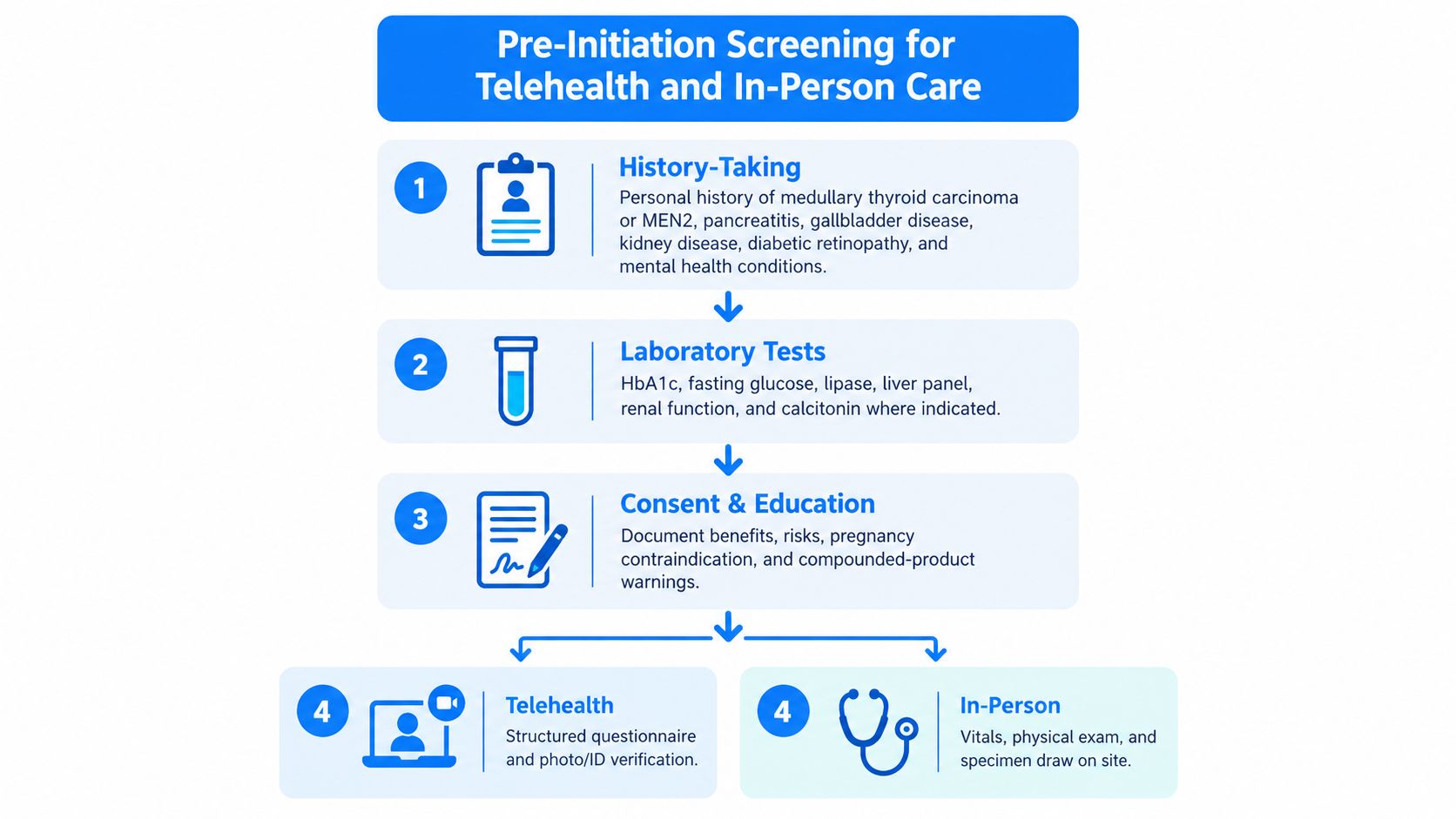
What has to be in the intake
First, take a focused history. That includes personal and family history of MTC and MEN 2, prior pancreatitis, gallbladder disease, kidney disease, retinopathy, current pregnancy, and contraception status. Second, obtain the needed labs and objective checks, which commonly include HbA1c, renal function, and pregnancy testing when relevant. Third, document informed consent, including the boxed warning, expected gastrointestinal effects, and the symptoms that should trigger urgent contact.
For some patients, the follow-up question is whether they are taking semaglutide for weight loss or diabetes. That matters because the treatment context changes which monitoring issues rise to the top, even though the core contraindications are the same.
How to route the work
Telehealth should use a structured questionnaire, verification of the medication list, and a clear path for pregnancy or allergy concerns that need clinician review. In-person care can add vital signs, a physical exam, and specimen collection on site. Either way, the point is the same, catch the stop points before the first dose, not after the first side effect.
A practical option some programs use is a physician-directed telehealth intake that screens the same contraindications and then routes eligible patients to prescribing review. That model only works if the screening questions are explicitly asked and documented.
Ranking Contraindications by Clinical Weight
A shorter decision table is often easier to use in real time than a long narrative. The point is to separate absolute, relative, and monitor-only issues without mixing them together.
| Category | Condition | Clinical Action | Re-evaluation |
|---|---|---|---|
| Absolute | Personal or family history of MTC or MEN 2 | Do not prescribe | Not applicable unless history is revised |
| Absolute | Prior serious hypersensitivity to semaglutide or excipients | Do not prescribe | Not applicable |
| Relative | Pregnancy or planned conception | Defer and discontinue if pregnancy is recognized | Reassess after pregnancy or after planned washout |
| Relative | Active pancreatitis | Defer and evaluate | After resolution and specialist input if needed |
| Relative | Severe gastroparesis | Defer and consider specialist input | After symptom control |
| Monitor-only | Gallbladder history | Monitor symptoms and counsel carefully | At follow-up and if symptoms change |
| Monitor-only | Diabetic retinopathy | Coordinate eye follow-up | During dose escalation |
| Monitor-only | Renal impairment | Check renal function and hydration status | Early after initiation or dose changes |
| Monitor-only | Concomitant insulin or sulfonylurea | Adjust companion therapy | During titration |
| Monitor-only | Elevated resting heart rate | Document and monitor pulse | Early follow-up |
The key distinction is that absolute contraindications stop the prescription. Relative issues often delay it. Monitor-only issues allow treatment if the follow-up plan is explicit.
This is the framework telehealth screening should mirror. If the answer is “stop,” the chart should say stop. If the answer is “monitor,” the chart should specify what gets watched and when.
Quick-Reference Checklist for Safe Initiation
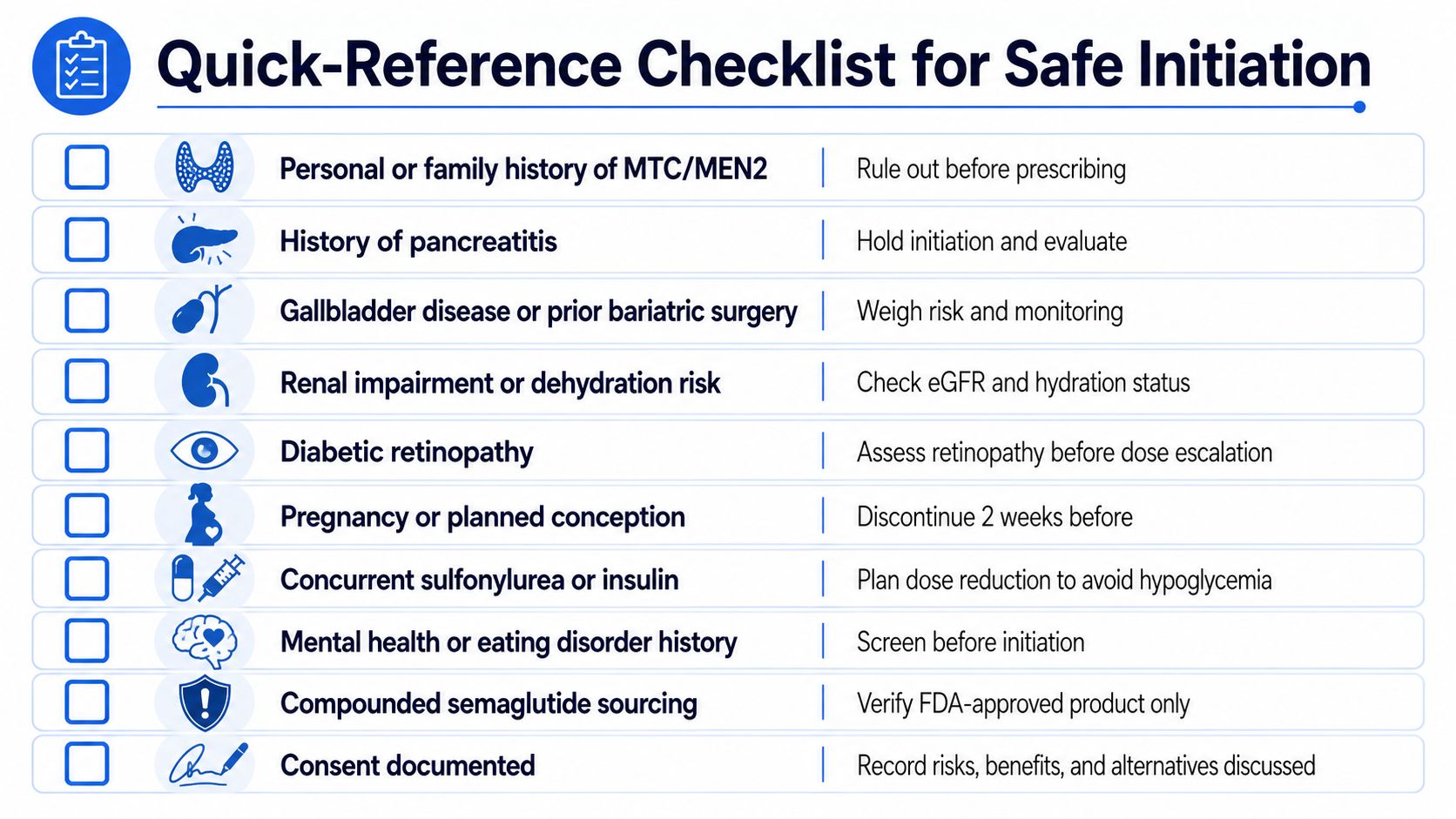
Use this as the last check before the first dose:
- MTC or MEN 2 history. If present in the patient or family history, do not start.
- Prior anaphylaxis or angioedema to semaglutide or an excipient. If yes, do not start.
- Pregnancy status or planned conception. If pregnant or planning conception soon, defer and stop when pregnancy is recognized.
- Pancreatitis or gallbladder disease. If active or recent, refer and reassess.
- Renal function and retinopathy status. If impaired or unstable, monitor more closely.
- Insulin or sulfonylurea use. If present, adjust the companion regimen.
- Resting heart rate and symptom review. If raised or symptomatic, document baseline and monitor.
- Contraception status. Confirm it for reproductive-age patients when pregnancy is possible.
Used properly, the checklist doesn't replace judgment. It keeps the major errors from happening at the point of prescribing, which is where they're easiest to prevent.
Frequently Asked Questions on Semaglutide Contraindications
How long should semaglutide be stopped before conception? The practical answer is at least two months before a planned pregnancy, because the drug clears slowly and pregnancy planning should happen before exposure becomes an issue.
Does a distant family history of unspecified thyroid cancer automatically block treatment? No. The labeled stop point is medullary thyroid carcinoma or MEN 2, not every thyroid diagnosis in the family tree.
Can stable treated hypothyroidism use semaglutide? Yes, if the patient does not meet a labeled contraindication and the thyroid disease is otherwise stable.
Does switching from tirzepatide or liraglutide require the same screening? Yes. The thyroid and allergy questions still need to be asked, and pregnancy planning still needs to be reviewed.
What about alcohol use? Moderate alcohol use is not itself a semaglutide contraindication, but it doesn't remove the need to think about pancreatitis or gallbladder symptoms.
Vials + Vitals provides physician-directed telehealth intake for GLP-1 and dual-incretin care, including semaglutide and tirzepatide protocols, with prescribing decisions based on eligibility and risk screening. For patients who need a structured review of semaglutide contraindications before starting, visit Vials + Vitals to see how a clinician-led intake can organize that decision safely.
Ready to see if this protocol fits your biology?
A licensed provider reviews every request before anything is prescribed.
Calibrate your metabolic protocol →