Physicians Review: What Telehealth Inspection Involves

Learn what a physicians review in telehealth involves, from credential checks to clinical oversight. A straightforward guide for healthcare leaders.
You've finished a detailed online health assessment, uploaded a medication list, and answered questions about prior conditions. Now the waiting begins. The practical question is simple: what does the physician do with all that information before a prescription is written?
The answer shouldn't be an automatic approval. The intake is raw clinical data. Physician review is the accountable decision that determines whether treatment is appropriate, which formulation fits the patient's circumstances, how dosing should begin, and what monitoring must follow.
A responsible service treats this checkpoint as medicine, not paperwork. The clinician may identify an unanswered question, request outside records, reconcile a medication interaction, or decide that treatment shouldn't proceed. That pause protects the patient, even when it delays fulfillment.
Telehealth also has an operational side. Medical teams may need to understand documentation and billing requirements alongside clinical responsibilities, and a resource such as how to bill modifier 95 can help clarify one part of that administrative environment. Billing, however, doesn't replace clinical judgment.
The important distinction is this: a completed questionnaire isn't a prescription, and a rapid approval isn't proof of adequate care. The review should connect the patient's answers to a defensible treatment decision, a specific dose, and a plan for what happens if the patient develops side effects, stops responding, or needs to discontinue therapy.
Table of Contents
- Why This Moment Matters in Your Telehealth Journey
- What Physicians Review Actually Means
- The Step-by-Step Path of a Clinical Intake Review
- How Trial Evidence Shapes the Titration Decision
- Compounded Formulations and the Dosing-Error Risk
- Continuity of Care After the First Prescription
- Hair Retention and Metabolic Treatment
- Patient Protections and What to Verify Before You Start
Why This Moment Matters in Your Telehealth Journey
A patient may submit an intake expecting the next message to contain a shipment notice. A clinician should see something different: a clinical record that still needs interpretation.
The reviewer considers the patient's goals, health history, current medicines, allergies, prior treatment response, and relevant symptoms together. A single answer rarely determines eligibility. The clinical question is whether the full picture supports a particular therapy and whether the foreseeable risks can be managed safely.
That distinction matters for metabolic treatment. Semaglutide and tirzepatide can be effective, but their use requires individualized decisions about eligibility, formulation, dose progression, tolerability, and follow-up. The STEP 1 trial and SURMOUNT-1 trial describe outcomes in defined study populations and regimens. Those results don't authorize an algorithm to prescribe the same way for every patient.
The intake is evidence, not an endpoint
A questionnaire can reveal that a patient has gastrointestinal symptoms, takes medicines that affect appetite or hydration, or has previously struggled with injections. It may also expose uncertainty. If the patient gives incomplete information about prior pancreatitis, kidney disease, pregnancy-related concerns, or a current prescription, the physician should stop and clarify rather than fill in the gaps.
An automated system can flag a response. It can't independently assume professional accountability for the final prescribing decision.
Practical rule: A credible physician review should be able to explain not only why treatment was selected, but also why the chosen dose, formulation, and monitoring plan fit the individual patient.
The review becomes especially important with compounded products. The FDA's discussion of unapproved GLP-1 drugs explains why compounded products require careful clinical and dosing oversight. The physician must decide whether an FDA-approved product could meet the patient's needs and, if a compounded option is considered, document why that choice is medically appropriate.
That's the moment the patient has entered. The next step isn't a formality. It's a structured clinical act with consequences for prescribing, administration, and continuing care.
What Physicians Review Actually Means
Physician review has roots in hospital quality control and professional accountability. The history of physician peer review in the United States describes how hospital standards and physician-review practices developed during the early twentieth century. In 1952, the Joint Commission on Accreditation of Healthcare Organizations began requiring physician peer review at hospitals seeking accreditation, and Congress enacted the Health Care Quality Improvement Act in 1986 after highly publicized disputes and litigation.
Hospital peer review and direct-to-patient telehealth review aren't identical. Hospital peer review generally involves physicians evaluating colleagues' clinical work, competence, conduct, and adherence to accepted standards. In telehealth, a licensed clinician evaluates the patient's information and decides whether prescribing is clinically appropriate.
The shared principle is professional accountability. Review is not merely a technical filter that sorts patients into approved and rejected groups. It's the physician's exercise of judgment, including the responsibility to ask for more information or decline treatment.
Three meanings that shouldn't be confused
Administrative review checks whether information is present, forms are complete, and the case can move through a workflow. It can be useful, but it doesn't establish that prescribing is safe.
Peer review examines professional practice among clinicians. It supports quality improvement, oversight, and accountability within a healthcare organization.
Clinical physician review applies judgment to a particular patient. The physician interprets the history, weighs risks and benefits, selects or rejects a treatment, and documents the rationale.
A longitudinal study of U.S. hospitals illustrates why the existence of a review process isn't enough. Researchers received 270 hospital responses, representing a 59% response rate, and examined changes from 2007 through 2015. The study found that peer review was primarily intended to improve quality and patient safety, while execution varied substantially. The median annual rate of major changes to review structure, processes, or governance was 20%, and only 35% of hospitals reached at least 60 points on the researchers' quality-improvement model score. These findings are reported in the International Journal for Quality in Health Care study.
The working definition is straightforward: physicians review patient information to make, document, and revisit an accountable clinical decision. In telehealth, that decision includes more than whether a patient appears eligible. It includes what should happen next.
The Step-by-Step Path of a Clinical Intake Review
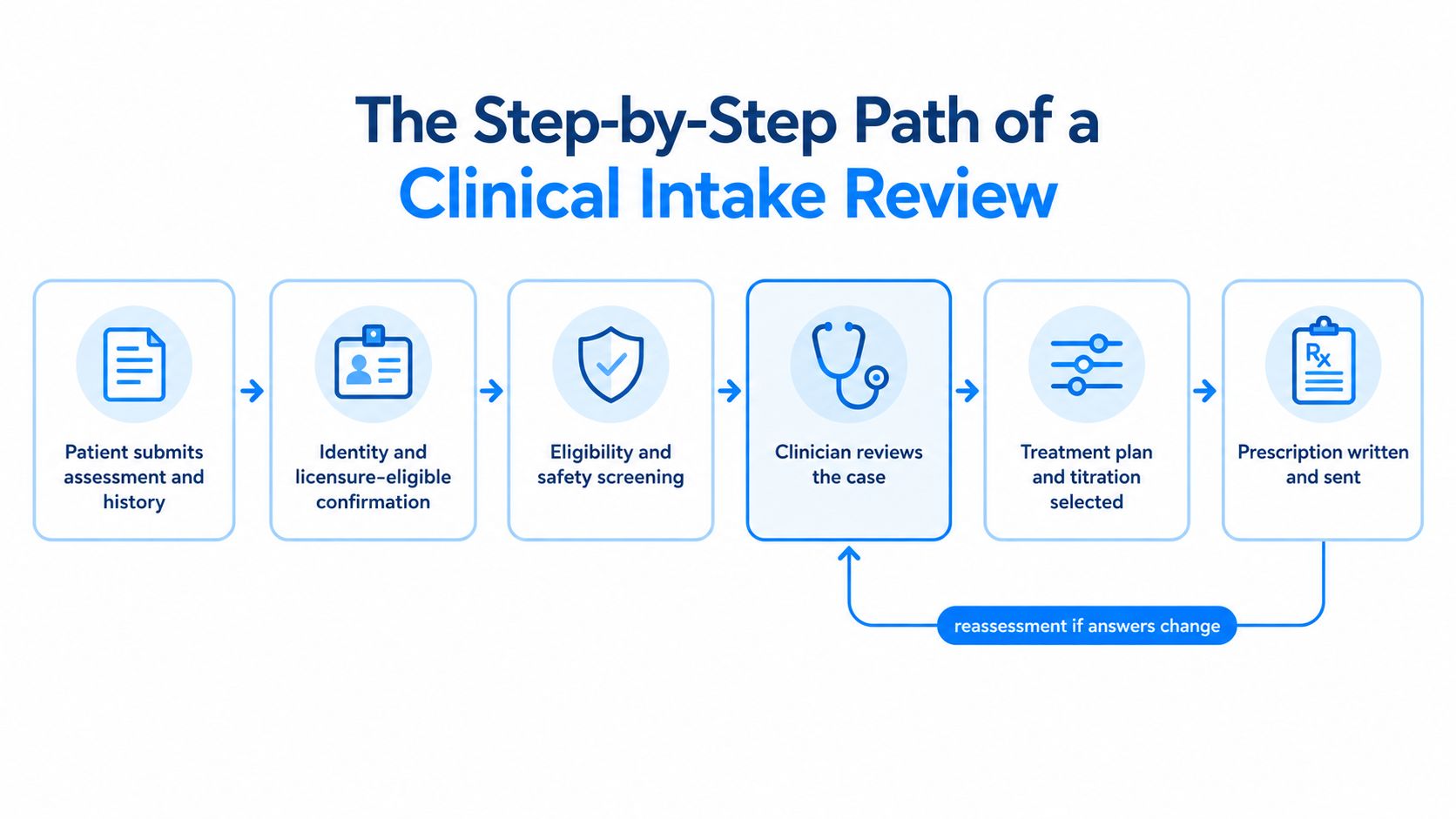
A complete review follows a sequence, although clinicians may move backward when an answer raises a concern.
First, the service confirms the patient's identity and the jurisdiction in which care will be provided. The physician must be licensed or otherwise authorized to practice where the patient is located under applicable rules. A reviewer also confirms that the information belongs to the person seeking treatment, not merely to an account created for someone else.
Next comes the medical history. The physician reviews diagnoses, prior procedures, allergies, current prescriptions, supplements, previous weight-management therapies, and relevant symptoms. Medication reconciliation matters because the safety of a new therapy depends partly on what the patient is already taking.
Where the physician may pause
The clinician then screens for contraindications, exclusions, and unresolved risks. Some answers may allow the review to continue. Others require a follow-up question, a consultation with another clinician, or a decision not to prescribe.
The formulation decision follows. For compounded GLP-1 therapy, the physician should first consider whether an FDA-approved product can meet the patient's needs. If compounding is selected, the rationale should be individualized rather than based solely on convenience or availability.
A proper decision record should identify:
- Clinical eligibility: Why the patient's history and goals support or do not support treatment.
- Medication review: Which current therapies, allergies, and conditions affect the decision.
- Formulation choice: Why the selected route and product type fit the patient.
- Dose translation: The prescribed amount in mass units and, when applicable, the exact administration volume.
- Monitoring plan: What symptoms, response measures, and follow-up points determine the next step.
The final prescription should correspond to the actual product the pharmacy will dispense. A clinical workflow may intersect with operational support. A patient intake coordinator can help collect and organize information, but administrative coordination must not be mistaken for the physician's clinical review.
The record should show the reasoning
The prescription should include an individualized titration schedule and administration instructions. If a patient is receiving a multidose vial, those instructions need to match the vial concentration and syringe type. The clinician should also explain storage, missed-dose handling, prohibited self-escalation, and symptoms that require medical attention.
A patient shouldn't have to infer the plan from a label alone. The review is clinically meaningful when it creates a documented decision that connects patient data, formulation, dose, and follow-up.
How Trial Evidence Shapes the Titration Decision
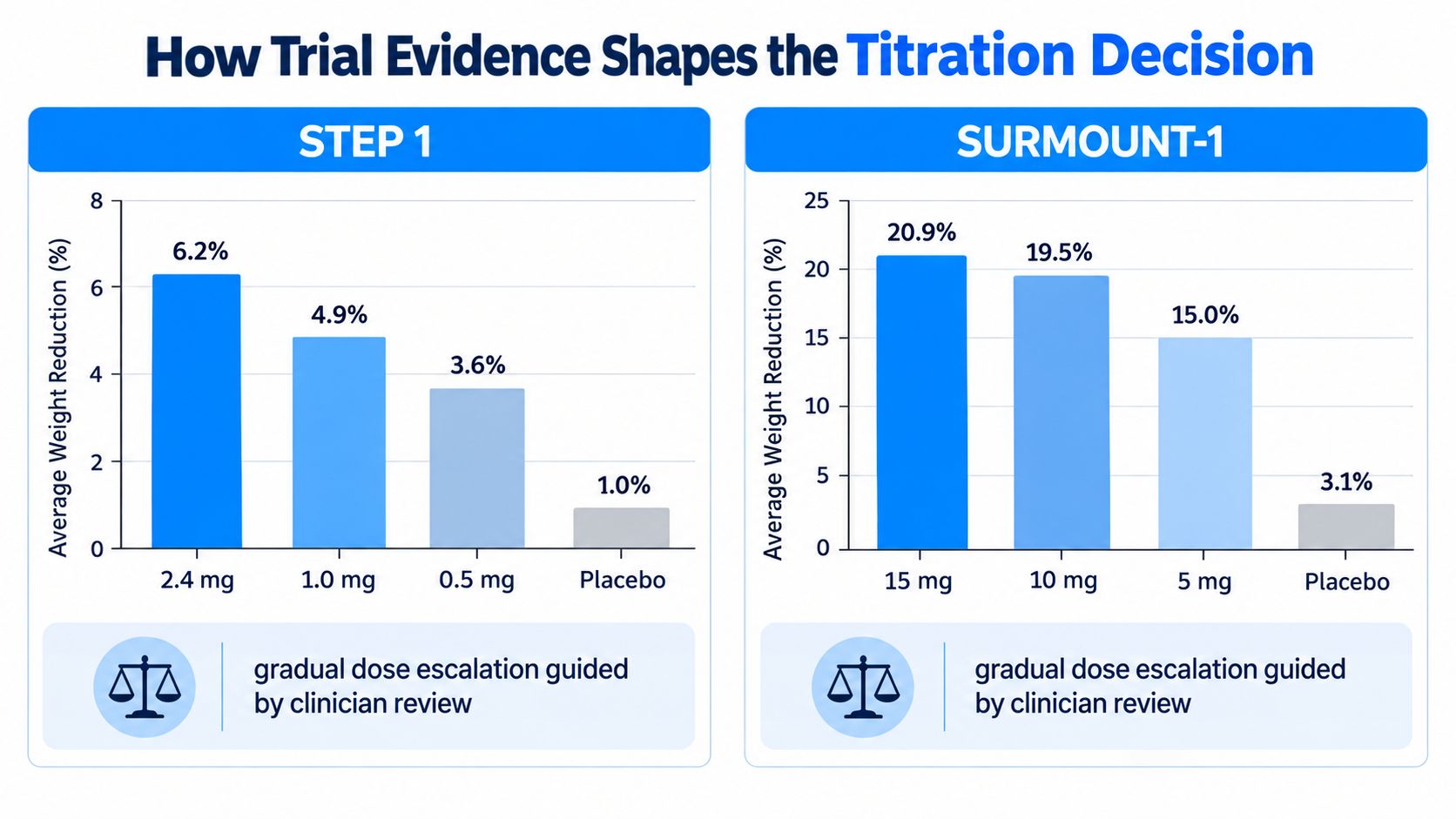
Trial results help explain why automatic dose advancement is unsafe. In the 68-week STEP 1 trial, adults with overweight or obesity without diabetes who received once-weekly semaglutide had a mean body-weight reduction of 14.9%, compared with 2.4% with placebo. Gastrointestinal adverse events occurred in 74.2% of semaglutide-treated participants and 47.9% of placebo-treated participants, while treatment discontinuation because of gastrointestinal events occurred in 4.5% and 0.8%, respectively. These figures come from the published STEP 1 trial.
Those results don't mean every patient will experience the same response. They show why the physician must monitor tolerability while evaluating benefit. Persistent vomiting, dehydration, inability to maintain oral intake, or worsening gastrointestinal symptoms may justify holding, reducing, or stopping treatment rather than advancing the dose.
Tirzepatide shows a related pattern. In the 72-week SURMOUNT-1 trial, mean weight loss was approximately 16.0% with 5 mg, 21.4% with 10 mg, and 22.5% with 15 mg, compared with 2.4% with placebo. At least 5% weight loss occurred in 89% of participants receiving 5 mg and 96% receiving either 10 mg or 15 mg, compared with 28% with placebo. The SURMOUNT-1 publication also reported adverse-event discontinuation rates of 4.3%, 7.1%, and 6.2% for the three tirzepatide doses, compared with 2.6% for placebo.
Efficacy doesn't set the patient's next dose
The numbers show dose-related efficacy in a studied population. They don't establish that the highest tolerated or studied dose is automatically the right target for a particular patient.
A physician should define:
- The starting dose, based on the selected medication, formulation, history, and risk profile.
- The earliest reassessment point, including symptoms, intake, hydration, and treatment response.
- The conditions for advancement, such as acceptable tolerability and a clinically appropriate response.
- The reasons to hold or reduce, including persistent gastrointestinal effects, poor hydration, or other concerning symptoms.
- The stopping or referral pathway, when treatment no longer fits the patient's needs.
This is why a clinician may write, “remain at the current dose,” rather than allowing a software rule to advance automatically. Titration is a series of clinical decisions, not a countdown.
The review therefore repeats at each meaningful titration step. A patient's answers can change, side effects can emerge, and a formulation can become unavailable. A service that reviews only the first intake misses the point of clinician-directed care.
Compounded Formulations and the Dosing-Error Risk
Compounded semaglutide and tirzepatide require unusually careful translation from prescription to administration. Compounded products aren't subject to FDA premarket review for safety, effectiveness, or quality, as described in the FDA alert on unapproved GLP-1 drugs. That places greater responsibility on the prescriber, pharmacy, and patient to verify what is being supplied and how it will be used.
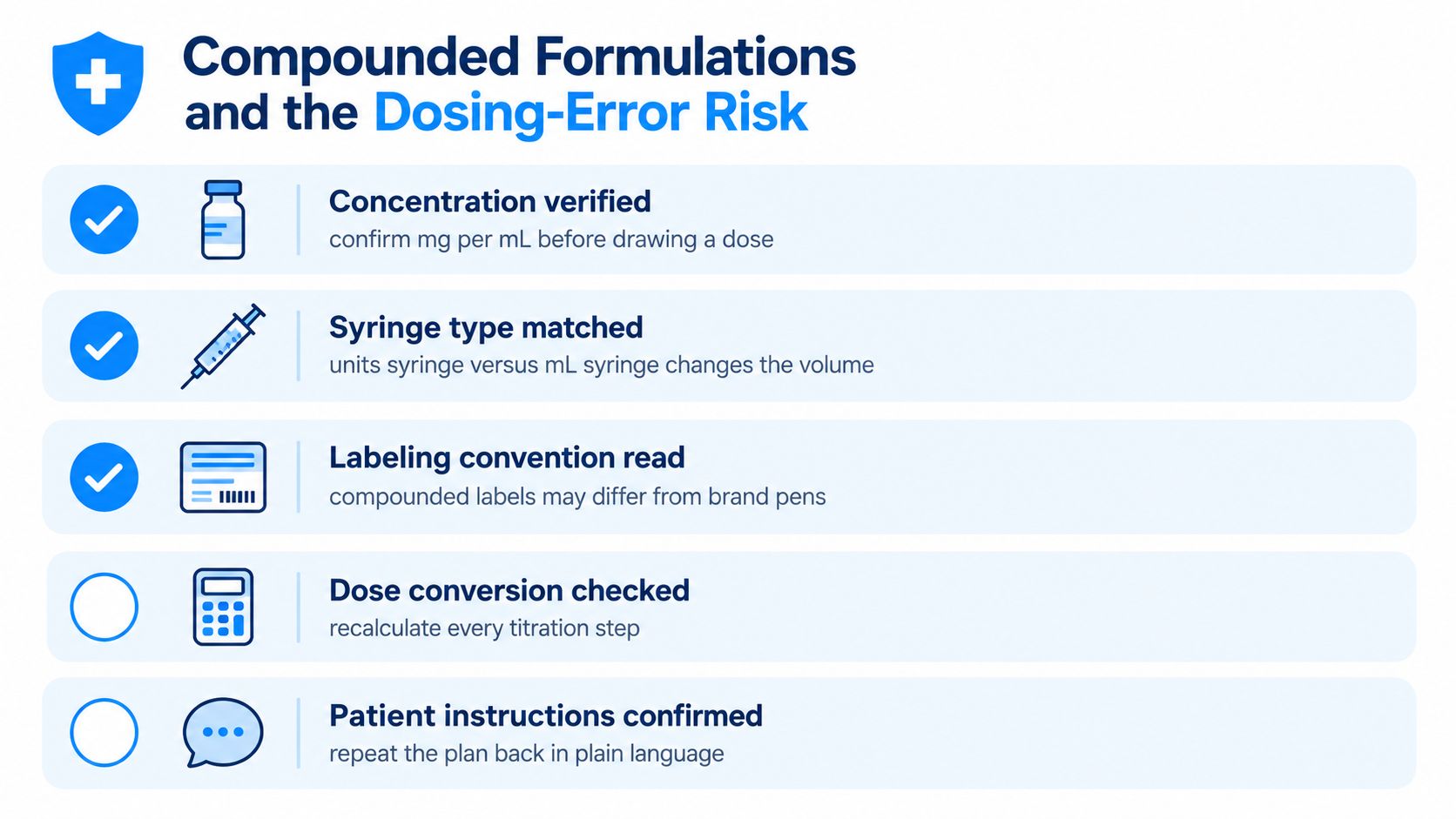
The clinician must confirm the concentration, usually expressed in milligrams per milliliter, then translate the prescribed dose into the volume the patient should draw. The prescription should also identify the syringe specification. A mismatch between a syringe marked in units and one marked in milliliters can produce a dangerous misunderstanding.
The dispensing checkpoint
Before dispensing, the review should confirm:
- Concentration: The exact amount of medication per milliliter.
- Dose conversion: The prescribed mass and corresponding volume.
- Syringe type: The device that matches the instructions and supplied medication.
- Label interpretation: The pharmacy's terminology and measurement conventions.
- Storage: Temperature and handling requirements for the specific formulation.
- Titration limits: The schedule, escalation thresholds, and prohibition on self-escalation.
- Missed-dose instructions: What the patient should do instead of improvising.
The FDA's dosing-error alert describes errors involving compounded injectable semaglutide and tirzepatide. Reported patients administered several times the intended dose, with outcomes including gastrointestinal symptoms, dehydration, syncope, and other serious effects.
Administration safeguard: The patient should be able to repeat the dose in plain language, identify the correct syringe, and explain what would prevent the next escalation.
Counseling should include a demonstration of how to draw the medication, a prohibition on taking extra medication to accelerate results, and clear symptoms that require urgent evaluation. The clinician should reassess tolerability and response before each escalation, with permission to pause, reduce, or discontinue treatment.
Needle-free sublingual orally disintegrating tablets may be relevant for patients with needle aversion, but a different route doesn't remove the need for review. The physician still has to confirm the product, instructions, suitability, and follow-up plan. Route selection changes the administration problem. It doesn't eliminate clinical responsibility.
Continuity of Care After the First Prescription
A careful initial review is necessary, but it isn't the same as longitudinal medical management. The harder question is what happens when the patient plateaus, develops side effects, changes formulation, misses doses, or wants to stop.
A 2025 survey found that 67% of primary-care physicians agreed or strongly agreed that obtaining GLP-1 prescriptions through third-party telehealth could put patients' health at risk. Their leading concerns included clinically inappropriate prescribing, reported by 56%, and continuity of care involving follow-up, titration, or tapering, reported by 50%. Those findings are summarized in the survey report on prescribing and continuity concerns.
The plateau audit
Patients can test a telehealth service's continuity plan with direct questions:
- Progress review: Who evaluates weight trend, appetite, glycemic concerns where relevant, gastrointestinal symptoms, hydration, and daily function?
- Titration ownership: Does a physician review the patient before each increase, or does the system advance the schedule automatically?
- Plateau interpretation: How does the clinician distinguish an expected plateau from inadequate response, poor adherence, an administration error, or an adverse effect?
- Dose changes: What happens if the patient needs to hold, reduce, or discontinue therapy?
- Care transfer: Can the service provide a treatment summary to a primary-care clinician or another treating physician?
- Access interruptions: What happens after a missed dose, pharmacy change, supply interruption, or formulation change?
- Communication: Which clinician receives information about new symptoms, pregnancy-related concerns where relevant, or changes made by another prescriber?
A patient may not need a complicated system. The patient does need a named clinical pathway.

The strongest model treats review as a feedback loop. The physician examines the new information, compares it with the intended plan, and changes course when the patient's clinical state changes. That includes an exit plan, not just a refill process.
A fast approval may solve access. It doesn't by itself solve continuity.
Hair Retention and Metabolic Treatment
Hair shedding can appear after metabolic change, and the timing often confuses patients. Telogen effluvium is a delayed follicular response in which physiologic stress shifts more follicles from the anagen growth phase into the telogen resting phase. The shedding may occur after the initiating stress rather than immediately, because the follicle cycle has to progress before affected hairs are released.
The available GLP-1-specific evidence remains limited. A scholarly review describes telogen effluvium and worsening androgenetic alopecia as the most commonly described hair-loss patterns among patients using GLP-1 receptor agonists. A retrospective U.S. TriNetX analysis found an increased telogen-effluvium signal among GLP-1 receptor agonist users receiving weight-loss treatment compared with other weight-loss interventions, with the subgroup signal attributed primarily to tirzepatide. The analysis didn't find a significant increase for semaglutide or liraglutide. These findings appear in the scholarly review of GLP-1 receptor agonists and hair loss.
Shedding needs context
An association doesn't establish that a medication directly damages hair follicles. Rapid weight loss, inadequate protein or micronutrient intake, illness, and preexisting patterned hair loss may all contribute.
A physician review should ask about baseline density, family-pattern loss, recent illness, dietary intake, and the timing of shedding. It should also distinguish diffuse shedding from patchy, scarring, inflamed, or painful loss. Persistent or atypical findings warrant dermatologic assessment rather than automatic attribution to a GLP-1 medication.
Hair retention belongs in the same clinical conversation as appetite and weight response. Tools such as a Follicular Retention Index can help organize the concern, but the tool doesn't replace examination, history, laboratory evaluation when indicated, or a treatment decision by a qualified clinician.
The practical goal isn't to promise that shedding won't occur. It's to identify contributors early, protect nutrition and treatment adherence, and avoid dismissing a symptom that may need separate evaluation.
Patient Protections and What to Verify Before You Start
A patient can assess the seriousness of a telehealth review before beginning treatment. The service should make its clinical and operational safeguards visible rather than asking the patient to infer them from testimonials or a fast checkout process.
Start with the prescribing decision. The patient should be able to understand why treatment was considered appropriate, which formulation was selected, how titration works, and what symptoms require contact with a clinician. A documented rationale creates accountability and reduces the risk that an intake form becomes an automatic prescription.
A practical verification list
- Clinical documentation: Confirm that a U.S.-licensed physician reviews every intake and that the treatment decision is documented.
- Privacy procedures: Ask whether the assessment, consultation, and communication processes are HIPAA-compliant.
- Refund policy: Verify whether the full consultation fee is refunded when treatment isn't clinically appropriate.
- Pharmacy credentials: Check whether pharmacy partners provide recognizable NABP and LegitScript signals.
- Compounding controls: Ask whether compounded formulations follow USP-aligned processes and undergo analytical potency and sterility testing.
- Shipping conditions: Confirm discreet, unbranded shipping and cold-chain handling when the formulation requires temperature control.
- Dose education: Require concentration-specific instructions, syringe matching, storage guidance, missed-dose handling, and a clear ban on self-escalation.
- Continuity plan: Ask who reviews progress, responds to side effects, manages plateaus, and coordinates discontinuation or transfer.
These safeguards address different failure modes. HIPAA processes protect sensitive information. Pharmacy verification addresses dispensing risk. Potency and sterility testing address product quality. Cold-chain handling protects formulations that require controlled temperature. Clinical follow-up addresses the problems that appear after the first prescription.
Vials + Vitals is one physician-directed telehealth option that uses online assessment, U.S.-licensed physician review, individualized formulation and titration decisions, accredited U.S. pharmacy fulfillment, and ongoing oversight. Its stated patient protections include HIPAA-compliant processes and a full consultation fee refund when treatment isn't clinically appropriate.
The central test remains simple: does the service perform physician review, or does it only process intake? A genuine review should connect the patient's history to a prescribing rationale, an exact administration plan, and a continuing-care pathway.
Vials + Vitals provides physician-directed evaluation for GLP-1 and dual-incretin protocols, including individualized eligibility review, formulation selection, and titration oversight. Visit Vials + Vitals to complete a confidential assessment and learn whether a clinician-guided protocol is appropriate.
Ready to see if this protocol fits your biology?
A licensed provider reviews every request before anything is prescribed.
Calibrate your metabolic protocol →