Oral vs Topical Minoxidil: What the Evidence Shows

Compare oral vs topical minoxidil for hair loss, covering evidence, side effects, daily use and when a clinician may recommend each option.
Is a pill better than a scalp solution for thinning? Current head-to-head evidence shows no clear overall winner, so the decision depends on individual risk screening. Clinicians consider blood pressure, cardiovascular history, scalp tolerability and whether someone can maintain the treatment routine.
Topical minoxidil is FDA-approved for hair loss; oral minoxidil is used off-label. A clinician can also assess whether thinning reflects pattern hair loss or another cause of shedding, then determine whether either option is appropriate. The practical choice follows from that assessment, not from assuming that one formulation works better.
Table of Contents
- Oral and Topical Minoxidil Side by Side
- How Each Form Works and Its Regulatory History
- What the Head-to-Head Trials Show About Regrowth
- Side Effects and Safety Trade-Offs
- Daily Routine, Timelines and Staying on Track
- When a Clinician May Consider Each Option
- Confirm Your Option With a Clinician Before Starting
Oral and Topical Minoxidil Side by Side
Neither route has established a clear overall regrowth advantage in direct comparisons. The practical differences involve regulatory status, systemic exposure, scalp tolerability and the work required to continue treatment.
Oral vs topical minoxidil at a glance
| Factor | Oral minoxidil | Topical minoxidil |
|---|---|---|
| FDA status for hair loss | Not FDA-approved for hair loss; used off-label under clinician supervision | FDA-approved for male pattern hair loss and for women |
| How it is taken | Tablet taken by mouth, acting throughout the body | Solution applied directly to the scalp |
| Head-to-head evidence | No established overall superiority over topical treatment | No clear overall disadvantage relative to oral treatment on the main measured outcomes |
| Main side effects | Unwanted hair growth, lightheadedness, fluid retention and faster heart rate | Scalp itching, irritation and contact dermatitis |
| Daily burden | A tablet schedule, without scalp application | Repeated scalp application, with drying time and possible residue |
| Prescription needed | Yes, through clinician evaluation | Product labeling and local rules determine access; nonprescription topical options exist |
The table compares documented features, not the probability of an individual result. It also shouldn't be read as proof that the treatments are interchangeable. A trial that doesn't establish superiority cannot guarantee that every participant would respond equally well to either formulation.
Convenience doesn't establish suitability
Oral minoxidil can lower blood pressure, cause fluid retention and increase heart rate. Those effects matter even when a person is seeking treatment only for hair loss. Removing scalp application from the routine doesn't remove the need for medical assessment.
Topical treatment creates a different practical challenge. Someone who can tolerate a scalp product and apply it consistently may have little reason to accept systemic treatment solely for convenience. Someone who repeatedly stops topical treatment because of irritation may have a reasonable basis for discussing an alternative.
Decision principle: A simpler routine is useful only when the treatment is medically appropriate and tolerable enough to continue.
Three questions help frame the comparison:
- Blood pressure and heart history: Are there known cardiovascular concerns, episodes of dizziness or medicines that affect blood pressure?
- Application feasibility: Can a scalp product fit consistently into grooming, work and sleep routines?
- Diagnosis: Has a clinician assessed the pattern and cause of the shedding?
The strongest comparison is therefore not pill versus solution in isolation. It's each formulation considered alongside the person who would use it.
How Each Form Works and Its Regulatory History
Topical minoxidil has the longer hair-loss-specific regulatory history. The FDA approved topical minoxidil for male pattern hair loss in 1988 and expanded approval to women in 1991, according to the Hair Science overview of hair-loss treatment research.
Topical treatment places the medicine directly on the scalp, limiting exposure mainly to the application area. Clinical studies commonly use a 5% formulation twice daily, as described in that overview. Product-specific directions still matter, since a study regimen isn't automatically the correct regimen for every formulation or patient.
Oral minoxidil follows a different path. It is an established blood-pressure medicine that clinicians have studied and used for hair loss at doses much lower than those historically used for hypertension. Taking it by mouth produces systemic exposure rather than primarily local application.
The same ingredient, different exposure
Off-label use means prescribing a medicine for an indication outside its FDA-approved labeling. Oral minoxidil's use for hair loss falls into that category. It doesn't become FDA-approved for hair loss because a clinician prescribes it or because a published trial evaluates it.
The route matters because the desired effect and the unwanted effects don't necessarily stay in the same place. A person seeking scalp regrowth may also experience effects elsewhere in the body when the medicine is taken orally.
Sharing an active ingredient doesn't mean sharing the same risk profile or monitoring needs.
A clinician weighs the cause of hair loss, cardiovascular history, blood pressure and other medicines before choosing a route. That assessment is especially important when the patient already takes medication that affects circulation or has a history of swelling or lightheadedness.
The practical distinction is straightforward: topical minoxidil has the longer hair-loss approval history; oral minoxidil introduces systemic exposure and a different supervision requirement. Neither fact, by itself, predicts which treatment will produce a satisfactory result.
What the Head-to-Head Trials Show About Regrowth
The trials compare specific doses, populations and measurements, so their results do not establish a universal advantage for either route. In a 2024 double-blind randomized trial published in JAMA Dermatology, 90 men with androgenetic alopecia received 5 mg oral minoxidil once daily or 5% topical minoxidil twice daily for 24 weeks.
For frontal terminal-hair density, the between-group difference was 3.1 hairs/cm², with a 95% confidence interval of −18.2 to 21.5 and P=.27, according to the 2024 trial. Photographic assessment favored oral treatment at the vertex by 24%, while the frontal-sc alp difference was 12%, as reported in the same randomized trial. These results concern separate measures and scalp regions, rather than one overall measure of regrowth.
Key head-to-head trial results
| Study | Design | Key result |
|---|---|---|
| 2024 double-blind randomized trial | 90 men; 5 mg oral once daily versus 5% topical twice daily for 24 weeks | Frontal terminal-hair difference 3.1 hairs/cm² (95% CI, −18.2 to 21.5; P=.27), reported in the 2024 trial |
| Photographic analysis from the same trial | Same design | Vertex advantage for oral therapy of 24% (95% CI, 0–48; P=.04); frontal difference 12% (P=.24), reported in the 2024 trial |
| Randomized trial of 65 people | 1 mg oral daily versus 5% topical for six months | Both groups improved hair-shaft diameter, with no significant between-treatment difference, in the randomized trial indexed in Europe PMC |
The randomized trial indexed in Europe PMC compared 1 mg oral minoxidil daily with 5% topical minoxidil for six months in 65 people. Both groups improved hair-shaft diameter, but the study did not find a statistically significant difference between treatments. Its findings add to the comparison, while the limited size and duration leave uncertainty about longer-term differences.
How to Read the Statistics
A result that is not statistically significant means the study could not distinguish the treatments with sufficient confidence on that measure. It does not prove equal effectiveness for every person or establish that neither treatment helps.
The vertex photographic finding is relevant, but it addresses a narrower question than overall superiority. A difference in one scalp location does not establish better performance across all regions or hair-count measures.
The evidence has practical limits:
- Sample size: Small trials leave uncertainty about differences between treatments.
- Follow-up: These comparisons do not establish long-term comparative outcomes.
- Population: The prominent trial involved men, limiting its direct application to women.
- Treatment regimen: Findings from one studied dose should not be assumed to apply to another.
A review also includes a randomized comparison involving female-pattern hair loss, so the evidence is not exclusively male. Still, women should consider how closely the participants, diagnosis and treatment regimen match their own circumstances.
For personal tracking, dated scalp photographs taken consistently can help show change over time. Study doses describe experiments, not individualized prescribing instructions.
Side Effects and Safety Trade-Offs
The key safety distinction is where effects occur: oral minoxidil can affect the body beyond the scalp, while topical treatment can irritate the application area. The balance depends on the individual's health history, scalp tolerability and ability to follow the chosen routine.
| Effect | Oral minoxidil |
|---|---|
| Unwanted hair growth, or hypertrichosis | Reported in the multicenter retrospective study discussed in the JAMA Dermatology safety discussion and in a female-pattern trial summarized in a 2023 review of low-dose oral minoxidil |
| Scalp irritation or contact dermatitis | The comparative review in the Journal of Cosmetic Dermatology reports contact dermatitis with topical treatment, not as an oral-treatment event |
| Lightheadedness | Reported in the retrospective population described in the JAMA Dermatology safety discussion |
| Fluid retention or pretibial edema | Reported in the retrospective population and the female-pattern trial summarized in the 2023 review |
| Faster heart rate, or tachycardia | Reported in the retrospective population described in the JAMA Dermatology safety discussion |
| Orthostatic hypotension | One participant in a randomized comparison, as summarized in the 2023 review |
| Discontinued because of adverse effects | Reported in both retrospective and randomized evidence discussed in the JAMA Dermatology safety discussion |
The JAMA Dermatology discussion reports hypertrichosis in 15.1% of 1,404 patients receiving low-dose oral minoxidil in a multicenter retrospective study. It also reports lightheadedness in 1.7%, fluid retention in 1.3%, tachycardia in 0.9%, and discontinuation for adverse effects in 1.2% of that population. These findings describe observed events, not a personal forecast.
The 2023 review reports 27% hypertrichosis and 4% pretibial edema in a female-pattern trial using 1 mg oral treatment. It also describes orthostatic hypotension in one participant in a separate randomized comparison. Differences in participants, doses and study methods limit direct comparisons across these results.
Local irritation versus whole-body effects
Hypertrichosis means unwanted hair growth, including facial or body hair, rather than additional scalp regrowth alone. Pretibial edema is swelling around the shins. Orthostatic hypotension refers to a blood-pressure drop associated with standing.
The comparative review reports contact dermatitis in topical-treatment participants and none in the oral group in one randomized comparison. That pattern illustrates the trade-off: oral treatment can bring systemic effects, while topical treatment may cause local scalp problems. The side-effect comparison chart summarizes these differences.
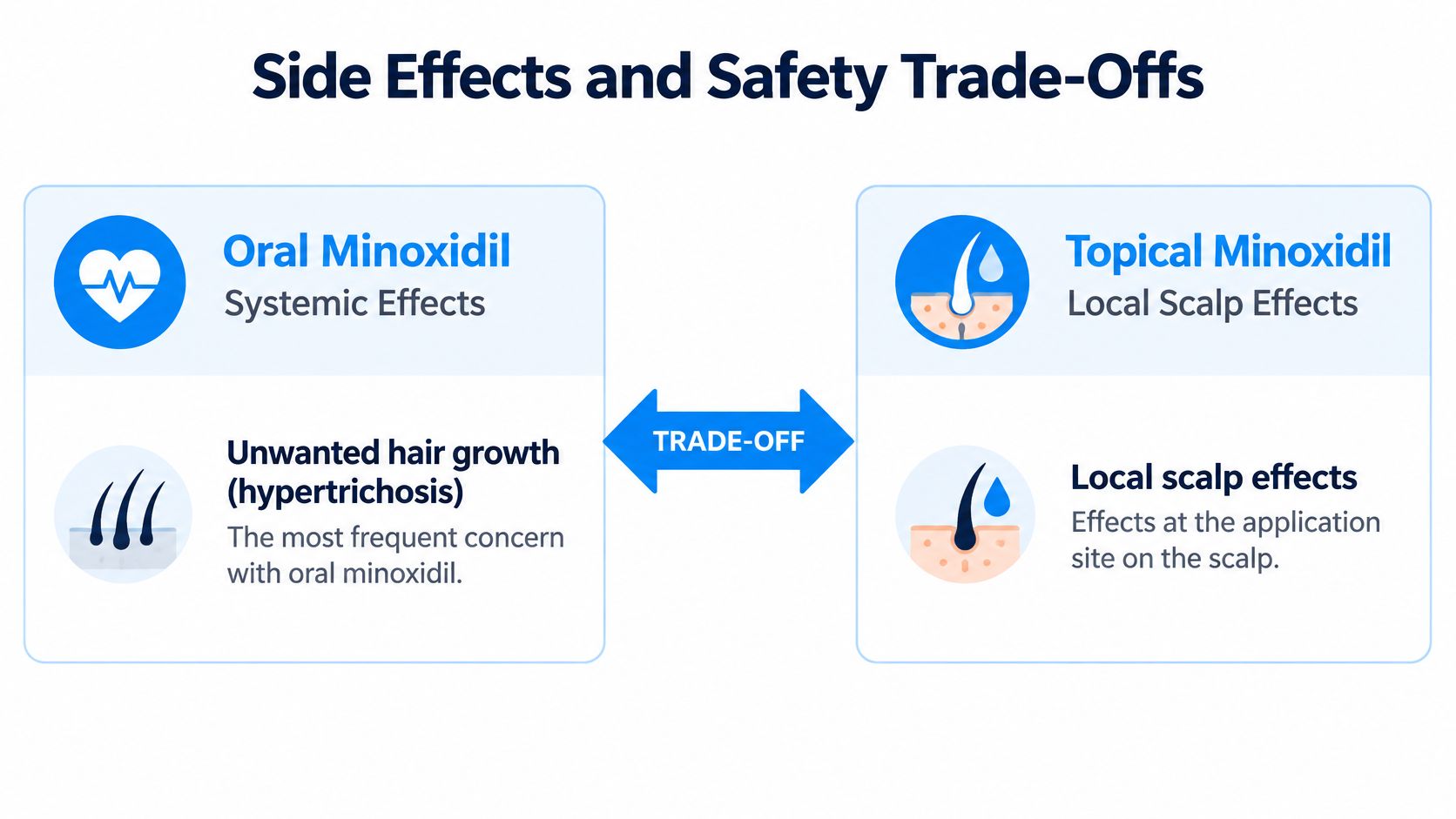
These study results should not be combined into a single expected risk. Retrospective records and randomized comparisons have different strengths, and effects that do not lead someone to stop treatment can still matter to that person. Blood pressure, cardiovascular history, other medicines and dose all inform clinical assessment.
Minoxidil-related swelling, palpitations, dizziness or unwanted body hair can occur with Re-Grow. The hair-loss treatment side-effects guide offers further information about possible effects, but symptoms still need to be considered in their clinical context.
Urgent warning: Chest pain, shortness of breath, fainting or rapid unexplained weight gain require prompt medical attention when taking oral minoxidil.
Daily Routine, Timelines and Staying on Track
A useful routine makes the treatment schedule, tolerability and follow-up visible. Topical application requires time and attention to the scalp; oral treatment requires following the prescription and reporting symptoms. Neither approach removes the need to assess how the regimen is working.
Two routines with different demands
With topical treatment, the medicine must reach the scalp rather than coat the hair. Allow time for application and drying, and watch for irritation or cosmetic residue. Follow the product label for the schedule and instructions.
With prescribed oral treatment, there is no scalp application. The routine still includes taking the medicine as prescribed, attending recommended follow-up and reporting symptoms. A tablet does not replace assessment or monitoring.
The consumer labeling archived in DailyMed says results with topical solution may appear after about three months of twice-daily use, while some men may need at least six months. These estimates apply to the labeled context and do not establish a timeline for every diagnosis or oral regimen.
A practical tracking method
A consistent record can help a clinician interpret response and tolerability. Keep it simple:
- Record use: A calendar or medication log can show missed applications or tablets more clearly than memory.
- Document symptoms: Note when itching, dizziness, swelling or unwanted hair growth begins, and share concerns with the treating clinician.
- Standardize photographs: Take monthly photographs with consistent lighting, hairstyle, camera distance and scalp part. This makes comparisons more useful than casual images.
- Prepare for reassessment: Bring the use log, symptom notes and photographs to the review. Record changes in hair appearance, missed doses and any side effects, then discuss whether the plan remains appropriate. Do not change the regimen independently.
Follow-up can distinguish a treatment that is being used inconsistently from one that is difficult to tolerate or has not produced a clear response. The journal's guide to slowing hair loss provides related educational context. Sudden or patchy loss warrants evaluation rather than relying on self-treatment alone.
When a Clinician May Consider Each Option
A clinician's decision should start with the diagnosis, not a preferred formulation. Gradual pattern thinning, abrupt shedding and discrete bald patches don't automatically call for the same approach.
The international Delphi consensus on low-dose oral minoxidil, published in 2025, involved 43 dermatologists across 12 countries. It supported considering oral treatment when topical minoxidil is difficult to apply, poorly tolerated or associated with scalp inflammation, while emphasizing gaps in larger trials and standardized long-term guidance.
A decision sequence rather than a ranking
Diagnosis comes first. The clinician assesses the pattern, duration and associated symptoms before deciding whether minoxidil addresses the concern. Sudden or patchy loss may require a different evaluation before treatment selection.
Tolerability and adherence come next. Someone who applies topical treatment reliably without irritation may reasonably prefer to avoid systemic exposure. Someone whose inflamed scalp or repeated application difficulties prevent consistent treatment may have a reason to discuss oral therapy.
Medical screening then determines whether that alternative is suitable. Convenience alone doesn't outweigh cardiovascular or medication concerns.
The review may include:
- Circulation: Blood pressure, cardiovascular history and episodes of dizziness or faintness.
- Fluid handling: Existing swelling, fluid-retention risk, kidney disease or liver disease.
- Reproductive considerations: Pregnancy status and related clinical considerations.
- Medication interactions: Prescription medicines, nonprescription products and supplements.
Follow-up belongs in the initial decision
The consensus identifies salt and fluid retention as a potential issue that may become apparent within roughly four to six weeks. That timing is described in the consensus linked above and explains why a follow-up plan matters even when the initial routine seems uncomplicated.
The clinician can specify which symptoms require contact, whether any home measurements are appropriate and how treatment will be reassessed. A patient shouldn't improvise a monitoring plan from a published study.
For adults considering remote care, the journal's guide to choosing a hair-loss treatment clinic provides related context about evaluation. At Vials + Vitals, treatment areas are marked prescription required, with eligibility and availability varying and provider approval required.
Neither formulation fits everyone. The appropriate option is the one supported by the diagnosis, tolerability, medical review and a workable follow-up plan.
Confirm Your Option With a Clinician Before Starting
“What should I tell a clinician before choosing oral or topical minoxidil?” A useful consultation starts with clear information about the hair changes, health history and daily routine. This helps a clinician assess whether the pattern fits hair loss that may respond to treatment, whether further evaluation is needed and which option's risks may matter most.
The checklist below can help organize that discussion.
Information worth preparing
- Pattern and duration: Note when shedding began, whether it was gradual or sudden, and which areas are affected.
- Dated photographs: Bring images that show change over time, taken with similar lighting and hair positioning.
- Family history: Record known hair-loss patterns among close relatives.
- Medicines and supplements: List prescription and nonprescription products, including scalp treatments and blood-pressure medicines.
- Previous treatment experience: Describe irritation, unwanted effects, difficulty applying products and reasons for stopping.
- Treatment goals: Explain whether you are concerned about ongoing shedding, a widening part, visible scalp or difficulty maintaining a routine.
What an online intake can and can't do
Vials + Vitals provides marketing, management and access to private online intake for hair-health care. Independent licensed clinicians review the information and decide whether care or a prescription is appropriate. Licensed U.S. pharmacy partners fill valid prescriptions. Eligibility and availability depend on clinical assessment and location.
An intake can organize relevant details, but it cannot establish a diagnosis by itself or guarantee a prescription. A clinician may decide that more information or another form of evaluation is needed before treatment can be considered.
The decision can account for the likely diagnosis, blood pressure and cardiovascular history, scalp tolerability, and whether the proposed routine is workable. The official hair-health page offers a starting point for exploring care.
Educational disclaimer: This article provides general information and does not diagnose a condition, promise results or replace an individual clinical evaluation. Published trial regimens should not be used to select or change a personal dose.
Optional journal measurement
May we count eligible search visits and whether the session reaches a care page or a confirmed new email signup? These first-party counts do not record page addresses, searches or contact details. A random session code prevents repeat counting for up to 30 minutes. This choice lasts for this tab; marketing email consent is separate. You can withdraw here.
Nothing is counted before you choose Allow.