Oral Semaglutide vs Injectable Semaglutide: A Clinical Guide
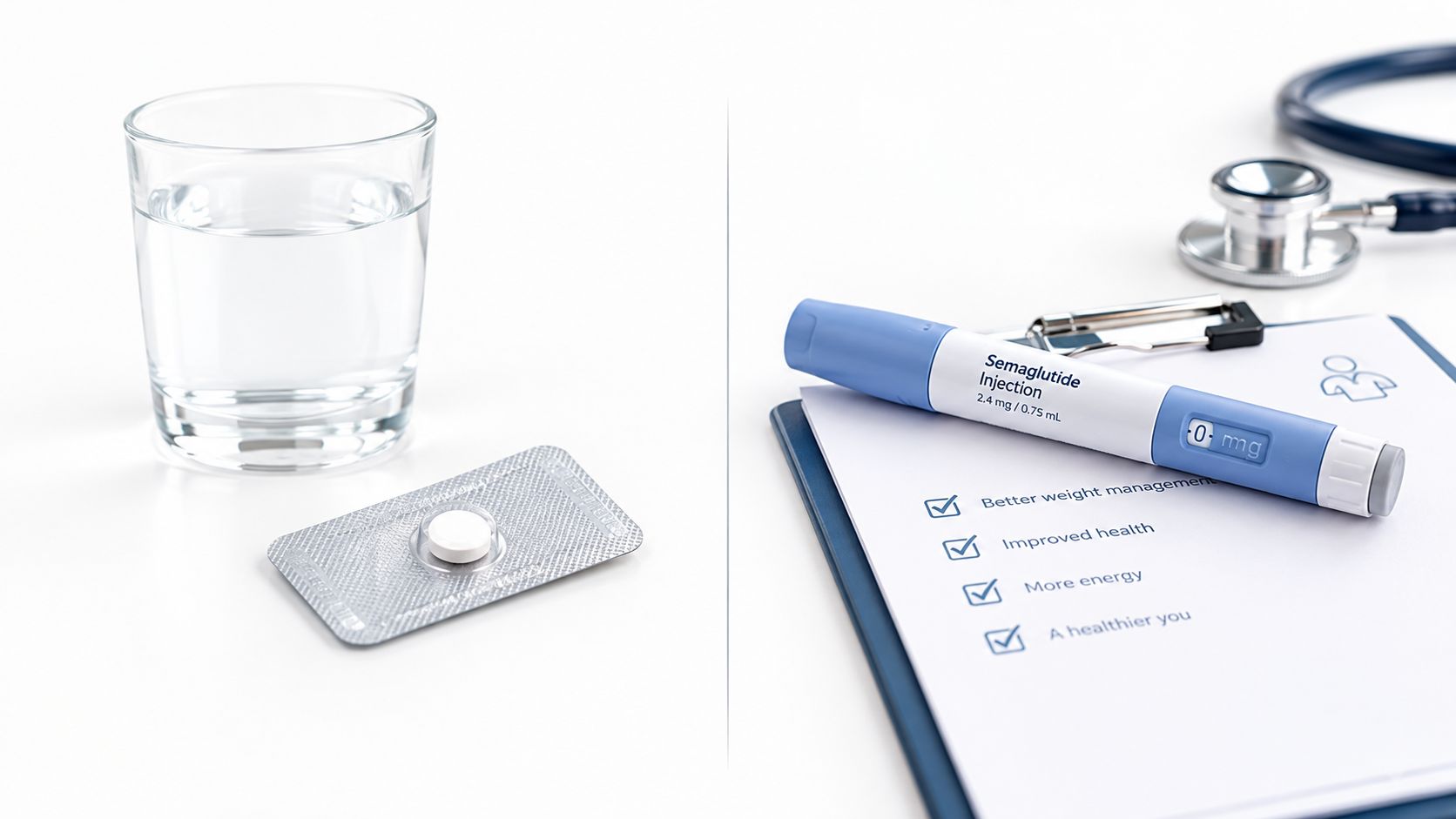
Oral semaglutide vs injectable semaglutide compared on efficacy, absorption, dosing, side effects, and adherence so you can choose the right format
The most common advice on semaglutide is too simple: pick the pill if you hate needles, pick the injection if you want stronger results. That framing misses the essential clinical question. Oral semaglutide vs injectable semaglutide is not a contest between convenience and efficacy; it is a match-to-patient decision shaped by absorption, routine, comorbidity burden, and how reliably a person can follow the dosing rules that the oral form demands.
| Attribute | Oral Semaglutide (Rybelsus) | Injectable Semaglutide (Ozempic / Wegovy) |
|---|---|---|
| Route | Daily tablet | Weekly subcutaneous injection |
| Absorption | Highly dependent on fasting and limited water, with very low bioavailability | Bypasses the gastrointestinal tract, with much higher systemic bioavailability |
| Dosing burden | Must be taken before food, drink, and other oral medicines | Simple weekly schedule |
| Weight-loss benchmark | Later indirect evidence suggests meaningful weight loss, but direct comparison remains limited | Established benchmark from STEP 1, with landmark obesity-trial efficacy |
| Practical fit | Best when the patient can protect a strict morning routine | Best when the patient wants to avoid absorption variables and daily timing friction |
Table of Contents
- Why the Oral vs Injectable Question Is Not Just About Needles
- What Oral and Injectable Semaglutide Actually Are
- How Absorption and Efficacy Compare
- Dosing Routines and Real-World Adherence
- Side Effects and Discontinuation Risk
- Which Patient Profile Fits Each Format
- Working With a Supervised Telehealth Protocol
- Making the Decision and Looking Ahead
Why the Oral vs Injectable Question Is Not Just About Needles
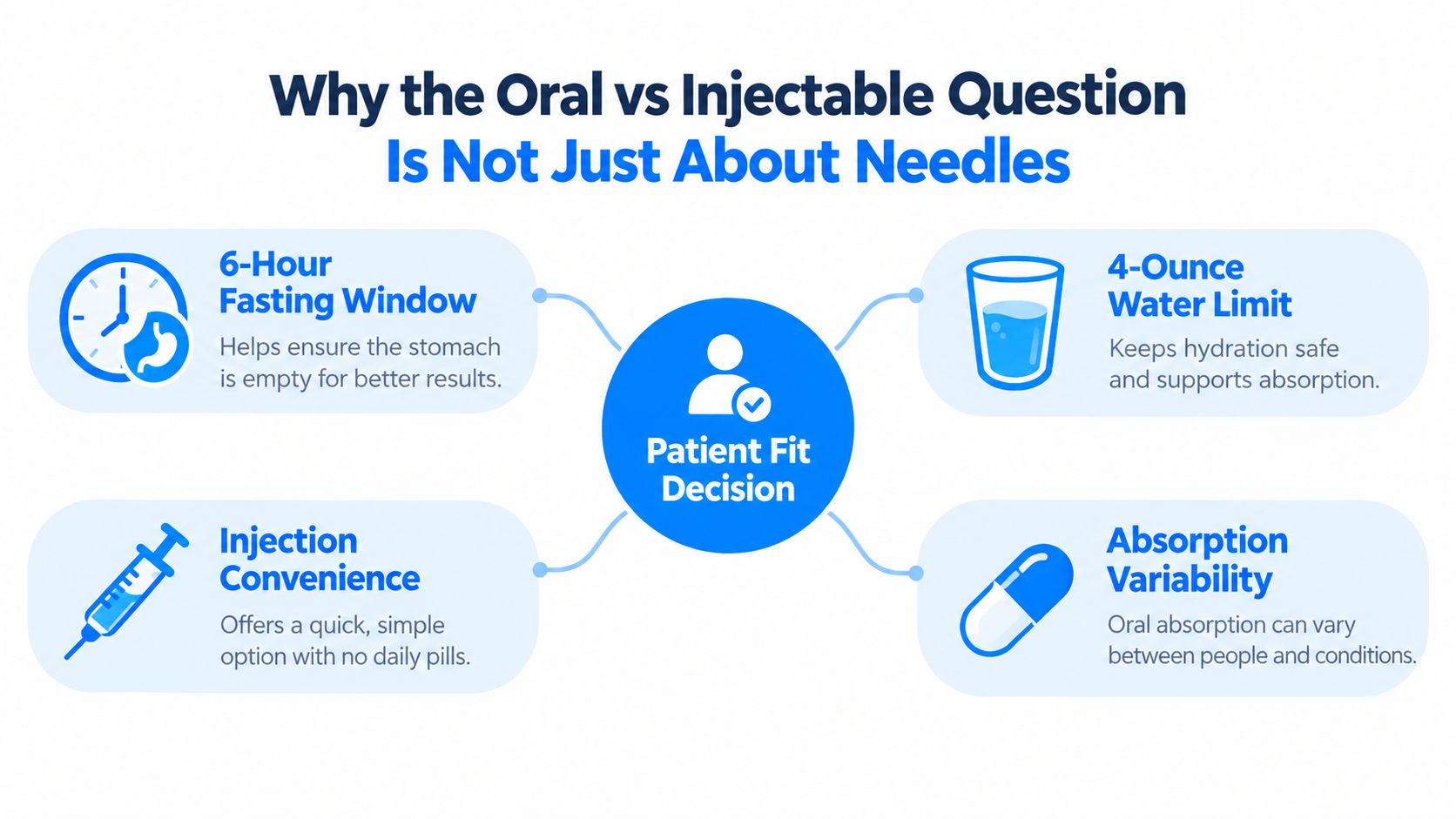
Needles get the attention, but the harder clinical question is whether a patient can follow the oral dosing window every morning without slipping. Oral semaglutide depends on controlled administration, and FDA pharmacology data show extremely low absolute bioavailability, about 0.795% in clinical pharmacology studies and 0.471% in phase III studies (FDA clinical pharmacology review).
The hidden cost of convenience
That low exposure is why the tablet asks so much of the first part of the day. It has to be taken with limited water, followed by a fast, and exposure falls if food arrives too soon (oral absorption review). The question is not merely whether a patient prefers a pill. It is whether the morning routine can stay controlled enough for the pill to perform as intended.
Practical rule: if breakfast, coffee, thyroid medication, or a rushed commute usually interrupt the first 30 minutes of the day, the oral route can become harder to sustain than it first appears.
That is one reason the oral versus injectable decision works better as a patient-match question. A strict oral schedule suits some routines very well. For others, a weekly injection avoids daily timing friction and the risk that small deviations in the morning reduce exposure.
A second issue is continuity. Either format can run into supply problems, shipping delays, or pharmacy interruptions. The better option is often the one the patient can keep using when life gets messy.
What Oral and Injectable Semaglutide Actually Are
Semaglutide is the same active molecule in both formats, but the delivery route changes how the drug is used in practice. The oral tablet was built to survive stomach conditions long enough to be absorbed, using SNAC, sodium N-(8-(2-hydroxybenzoyl)amino-caprylate), an enhancer that helps protect the peptide as it passes through the stomach lining (NCBI Bookshelf). That design makes the pill possible, but it also makes administration more finicky than a standard tablet.
Approved use and dose logic
In routine care, oral semaglutide is titrated gradually, usually starting at 3 mg and increasing to 14 mg for diabetes treatment, with later obesity-focused development using higher-dose studies. The injectable form is also titrated stepwise, typically beginning at 0.25 mg weekly and moving upward toward higher maintenance doses depending on indication and tolerance.
Both formats use dose escalation because gastrointestinal side effects often settle as the body adapts. The point is not just reaching a target dose, it is getting there without making the regimen unsustainable.
Why the absorption science matters
The injectable route bypasses the gastrointestinal tract, so it avoids the absorption bottleneck that oral therapy cannot escape. Comparative review literature describes subcutaneous semaglutide as achieving much higher systemic exposure, which helps explain why the weekly injection produces more reliable drug delivery per dose.
That difference matters when the choice is being matched to a patient's routine. The pill can work, but it has to be handled as a precision medication rather than an ordinary morning tablet.
| Oral vs Injectable Semaglutide at a Glance | Oral (Rybelsus) | Injectable (Ozempic / Wegovy) |
|---|---|---|
| Delivery | Tablet | Subcutaneous injection |
| Absorption enhancer | SNAC-dependent | Not needed |
| Typical administration pattern | Morning, fasting, with limited water | Weekly, no fasting window |
| Absorption risk | Food and timing sensitive | Less affected by GI timing |
| Clinical use case | Needle-averse patients who can follow strict rules | Patients who want a simpler adherence structure |
How Absorption and Efficacy Compare
As noted above, the exposure gap explains why oral dosing is more timing-sensitive, and why efficacy data need to be read in that light. Oral semaglutide depends on careful administration because its absorption is limited and easily reduced by food, water volume, or poor timing. Subcutaneous semaglutide avoids that bottleneck, so drug delivery is more predictable across patients, which is why the two formats should not be treated as interchangeable in practice (clinical pharmacokinetics review).
Weight loss evidence is not perfectly symmetric
The injectable formulation set the obesity benchmark first. In STEP 1, 1,961 adults were enrolled, and once-weekly semaglutide 2.4 mg produced an average body-weight reduction of 14.9% at 68 weeks. Oral semaglutide later extended the class into tablet form, but the obesity evidence base is still less mature for direct comparison.
A later indirect analysis from the OASIS 4 program reported oral semaglutide 25 mg with body-weight and cardiometabolic outcomes comparable to injectable semaglutide 2.4 mg in that analysis, but it was still an indirect comparison rather than a definitive head-to-head obesity trial. The same caution applies to interpretation of newer oral GLP-1 data. Comparable signals are useful, but they do not erase the practical difference between a pill that must be taken under strict conditions and an injection with fewer absorption variables.
The pill can be clinically meaningful, but the injection still has the cleaner efficacy story when the goal is predictable weight reduction and fewer absorption variables.
| Efficacy Evidence | Oral Semaglutide | Injectable Semaglutide | Trial / Source |
|---|---|---|---|
| Weight-loss benchmark | Later oral obesity data showed meaningful loss at higher-dose study levels | 14.9% average body-weight reduction at 68 weeks | STEP 1 summary |
| Indirect comparison | Comparable body-weight and cardiometabolic outcomes in OASIS 4 analysis | Comparable body-weight and cardiometabolic outcomes in OASIS 4 analysis | OASIS 4 report (Novo Nordisk OASIS 4 announcement, ObesityWeek 2025) |
| Glycemic control | Can be clinically competitive | Stronger HbA1c lowering in meta-analytic comparison | 2025 meta-analysis summary |
Dosing Routines and Real-World Adherence
Oral semaglutide may look simpler because it avoids needles, but it asks patients to protect a narrow morning window. The tablet must be taken fasting with no more than 120 mL of water, then food, liquids, and other medications have to wait at least 30 minutes (PK review). That requirement is not a footnote. It is what allows absorption to happen at all.
A patient who takes levothyroxine at 6:30 a.m. and coffee at 7:00 a.m. has to change that routine, because the oral semaglutide window can collide with thyroid medication, breakfast, and the first drink of the day. That is where weekly injection often gives more consistent use. The dose itself is simpler to remember, and it does not depend on whether the morning is busy, rushed, or interrupted by other pills.
What adherence looks like in real life
Weekly injections avoid the fasting rule, so they fit more easily into mornings built around coffee, school drop-off, or multiple prescriptions. The trade-off is needle acceptance and the need for injection teaching, but the schedule is usually less brittle.
A 2025 review noted the same practical divide, and a 2026 patient-preference analysis found that about one in four participants were unwilling to use a weekly injectable and preferred daily oral treatment instead (patient preference review). That matters because adherence is personal. Some patients will follow a pill routine more reliably than an injection schedule, even when the pill has stricter instructions.
Clinical takeaway: the better regimen is the one the patient can repeat without skipped mornings, timing errors, or constant negotiation.
The same review also found higher discontinuation risk with oral semaglutide because of side effects, with RR 1.79 compared with subcutaneous semaglutide (patient preference review). That does not make the pill a poor option for everyone. It means daily dosing leaves less room for routine disruption.
| Dosing Routine | Oral Semaglutide | Injectable Semaglutide |
|---|---|---|
| Frequency | Daily | Weekly |
| Water rule | No more than 120 mL | Not applicable |
| Food timing | Wait 30 minutes before food, drink, or oral meds | No fasting requirement |
| Operational burden | Higher, because timing mistakes can reduce exposure | Lower, because the schedule is simpler |
| Adherence risk | Sensitive to routine disruption | Sensitive more to injection acceptance than timing |
Side Effects and Discontinuation Risk
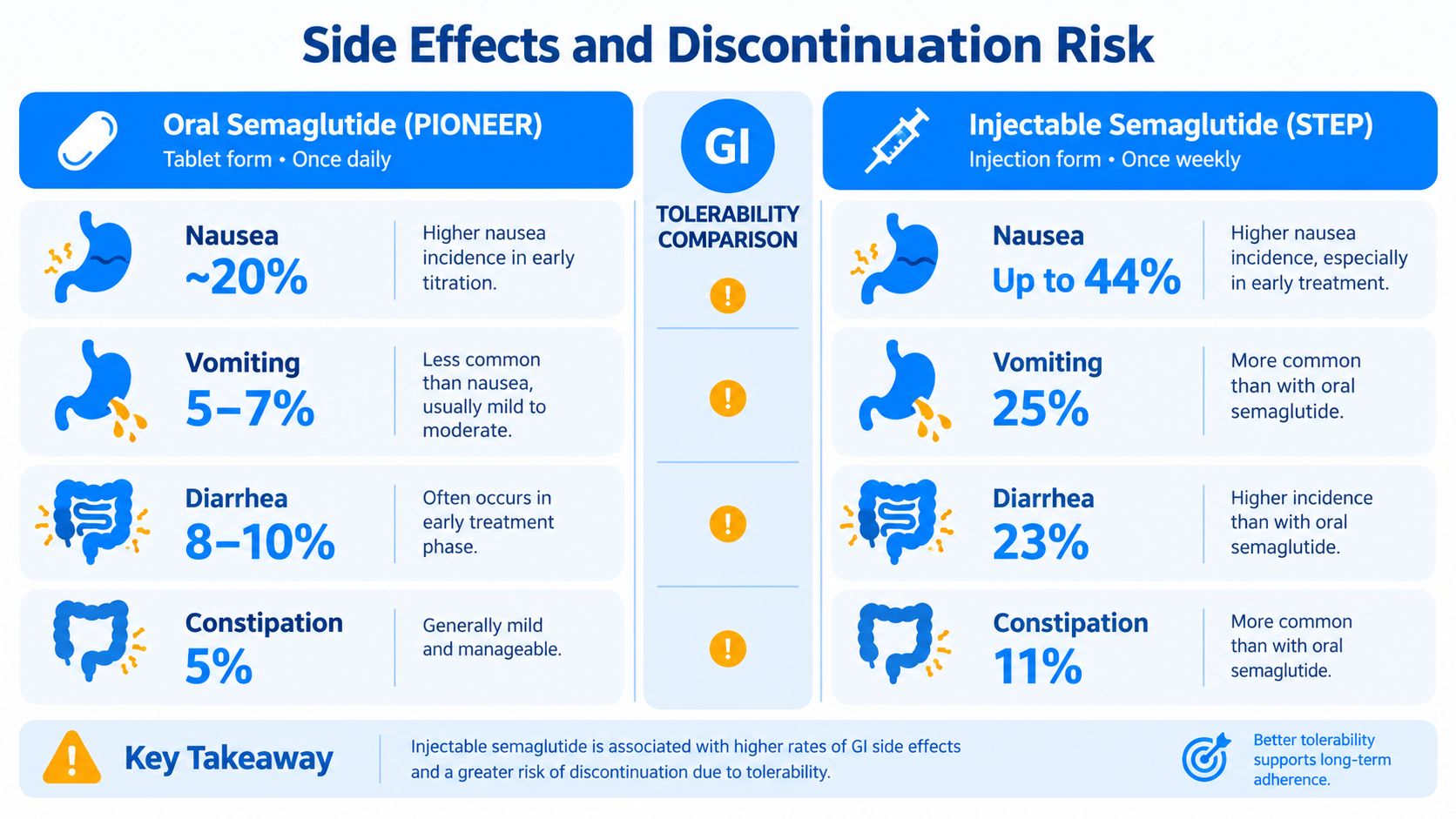
Both formulations share the same GLP-1 side effect profile, especially nausea, vomiting, diarrhea, and constipation. What changes in practice is how those effects interact with the dosing routine and how much room patients have to recover during titration. Oral semaglutide can go smoothly for some people, but it is less forgiving when the fasting window, water limit, or timing rules slip.
What tends to drive stopping treatment
Discontinuation usually reflects side effects plus regimen burden. In the 2025 comparative review, oral semaglutide showed a higher risk of stopping because of side effects, with RR 1.79. The practical issue is often not one symptom alone, but persistent GI upset combined with the frustration of getting the morning routine exactly right.
When nausea drives discontinuation, clinicians typically pause titration for one week, reinforce the 30-minute fasting window for oral therapy, and check hydration status before resuming escalation. Persistent vomiting deserves a slower step-up or a temporary hold. Serious adverse events remain uncommon relative to everyday GI intolerance, but both formats still call for monitoring pancreatitis symptoms, gallbladder problems, and dehydration if vomiting continues. Hypoglycemia is mainly a concern when semaglutide is paired with other glucose-lowering drugs, not as a standalone effect in obesity care.
Which Patient Profile Fits Each Format
The best candidate for oral semaglutide is usually not the person chasing the highest possible weight-loss response. It is the person who strongly dislikes injections, can protect the fasting window, and does not stack a complicated morning medication list on top of the pill. Travelers who prefer a tablet and patients who value a needle-free routine often fit that profile better.
When the injection tends to win
Weekly subcutaneous dosing usually fits better when the patient wants fewer timing constraints, has erratic mornings, or has a medication list that includes agents sensitive to delayed gastric emptying. It also tends to be the more stable choice when the clinical target is aggressive weight reduction, because the exposure is less vulnerable to administration errors.
Borderline cases deserve more caution. Prior bariatric surgery, cognitive impairment, mild gastroparesis, or concurrent use of medications such as levothyroxine or bisphosphonates can make the oral fasting window harder to manage. In those settings, the injection often becomes the cleaner operational choice even when the patient initially prefers a pill.
Clinical judgment point: preference matters, but it should not override the patient's ability to take the medication correctly every day.
A useful shorthand is this. If the patient can defend the morning routine, oral therapy can be reasonable. If the routine is already crowded, the weekly injection usually leaves less room for failure.
Working With a Supervised Telehealth Protocol
Any semaglutide decision should start with eligibility, not product preference. A careful workup reviews medical history, body mass index, HbA1c, lipid values, pregnancy status, gallbladder history, pancreatitis history, and drug interactions that could matter if delayed gastric emptying changes oral absorption. That screening matters because the same molecule can be safe in one patient and poorly matched in another.
Titration and follow-up in practice
For oral therapy, clinicians usually begin low and build gradually, using the 3 mg starting phase before advancing as tolerated. Injectable therapy usually begins at 0.25 mg weekly and moves upward in a stepwise schedule until the maintenance dose is reached. Follow-up labs at about 12 weeks and symptom-triggered check-ins help catch intolerance, dehydration, or a poor response early.
A supervised telehealth program can coordinate the details that patients usually struggle with on their own. That includes shipping, needle disposal counseling for the injectable arm, fasting-window coaching for the oral arm, and asynchronous side-effect check-ins. In a protocol-driven setting such as Vials + Vitals, the point is not to push one format universally. It is to make the regimen fit the patient's biology and routine.
| Telehealth Workup and Titration Comparison | Oral Semaglutide | Injectable Semaglutide |
|---|---|---|
| Intake focus | Morning routine, concurrent oral meds, fasting feasibility | Injection comfort, storage, weekly adherence |
| Starting phase | Low-dose initiation before escalation | Low weekly dose before titration |
| Follow-up | Labs and symptom checks after initiation | Labs and symptom checks after initiation |
| Operational support | Fasting coaching and timing reminders | Injection teaching and disposal guidance |
Making the Decision and Looking Ahead
The better question is fit, not superiority. Oral semaglutide suits patients who can protect a strict fasting window, keep morning doses consistent, and prefer a tablet. Injectable semaglutide fits patients with erratic mornings, higher medication burden, prior bariatric surgery, or a strong preference for weekly dosing. Needle aversion matters, but so do absorption and timing.
Safety guardrails that do not change
Both formats still require the same counseling on pancreatitis warning signs, gallbladder symptoms, thyroid-related concerns, pregnancy avoidance or stopping treatment if pregnancy occurs, and contraception review when appropriate. The route changes the routine, not the monitoring.
The decision is also changing as the evidence base grows. The Novo Nordisk announcement points to newer oral data that support this format as a real option for selected patients, while newer oral GLP-1 programs are forcing a closer look at how well tablet therapy holds up outside controlled trials. For now, the practical takeaway is simple. Choose oral semaglutide if the fasting rules are realistic and the daily routine is stable. Choose injectable semaglutide if mornings are unpredictable, oral medication timing is crowded, or prior anatomy makes absorption less reliable.
Ready to see if this protocol fits your biology?
A licensed provider reviews every request before anything is prescribed.
Calibrate your metabolic protocol →