Online Weight Loss Medication: A Patient Safety Guide

Navigate online weight loss medication with confidence. Learn how telehealth assessments, GLP-1 protocols, and safety monitoring actually work in 2026.
Telehealth obesity care is no longer a niche experiment. In U.S. claims data, telehealth claim lines tied to a primary diagnosis of overweight or obesity rose from 0.3% of all medical claim lines in 2019 to 10.3% in 2024, a relative increase of 3,483.3%, according to FAIR Health's obesity and GLP-1 white paper. That single shift changes the right question.
The question isn't whether online weight loss medication is real care. It is. The question is whether the program behind the prescription behaves like medicine or like retail. That distinction determines who gets screened properly, who gets the right drug, who gets monitored when symptoms change, and who gets missed.
From a medical board perspective, safe online prescribing stands on five pillars: assessment verification, medication selection, titration and monitoring, pharmacy quality, and outcome follow-through. If one pillar is weak, convenience starts outrunning clinical judgment.
Table of Contents
- How Online Weight Loss Medication Became Mainstream
- What a Legitimate Online Assessment Must Verify
- Comparing GLP-1 and Dual Incretin Options
- Titration Schedules and Safety Monitoring Online
- Pharmacy Standards and Discreet Cold-Chain Fulfillment
- Can Telehealth Match In-Person Outcomes
- Hair Retention During Rapid Medically Supervised Weight Loss
How Online Weight Loss Medication Became Mainstream
In U.S. telehealth claims, visits tied to overweight or obesity grew from a small slice of remote care to a meaningful share of it. FAIR Health reported that obesity-related claim lines made up 1.5% of telehealth claim lines in 2019 and 3.5% in 2024. That shift matters because it reflects repeat follow-up, medication management, and ongoing care, not just one-time prescription demand.
Mainstream adoption happened because obesity medicine fits several parts of virtual care well. Follow-up for nausea, constipation, appetite suppression, refill timing, dose escalation, and treatment response can often be handled remotely if the program has a real protocol behind it. I see the same pattern across telehealth intakes. The convenience gets patients in the door, but the model scales only when clinicians can reliably review side effects, adjust titration, and decide who should pause treatment or get seen in person.
Outcomes data supports that broader acceptance. In a large U.S. study of telehealth weight management, investigators reported average weight loss of 8.9% at 3 months among 37,565 patients, 14.1% at 6 months among 24,140 patients, 17.7% at 9 months among 15,169 patients, and 19.4% at 12 months among 6,089 patients, according to this Obesity study on telehealth weight management outcomes.
Those numbers do not prove that every online program is practicing good medicine.
They show that telehealth can produce meaningful results at scale. The harder question is what separates a program that manages chronic disease from one that processes medication requests. The safety gap usually sits in the details a checkout flow does not show: whether weight and comorbidity data are verified, whether contraindications are reviewed, whether dose increases are held when symptoms worsen, and whether someone notices early signs that the plan is failing.
That distinction is why online weight loss medication became mainstream and more heavily scrutinized at the same time. Access expanded faster than clinical consistency. The programs that hold up are the ones that treat prescribing as one step in a monitored protocol, not the whole service.
What a Legitimate Online Assessment Must Verify
Prescribing weight loss medication online becomes unsafe fastest at intake. The gap is rarely the drug itself. It is the failure to confirm whether the patient in front of the prescriber meets criteria, understands the risks, and has any signal that treatment should be slowed, redirected, or declined.
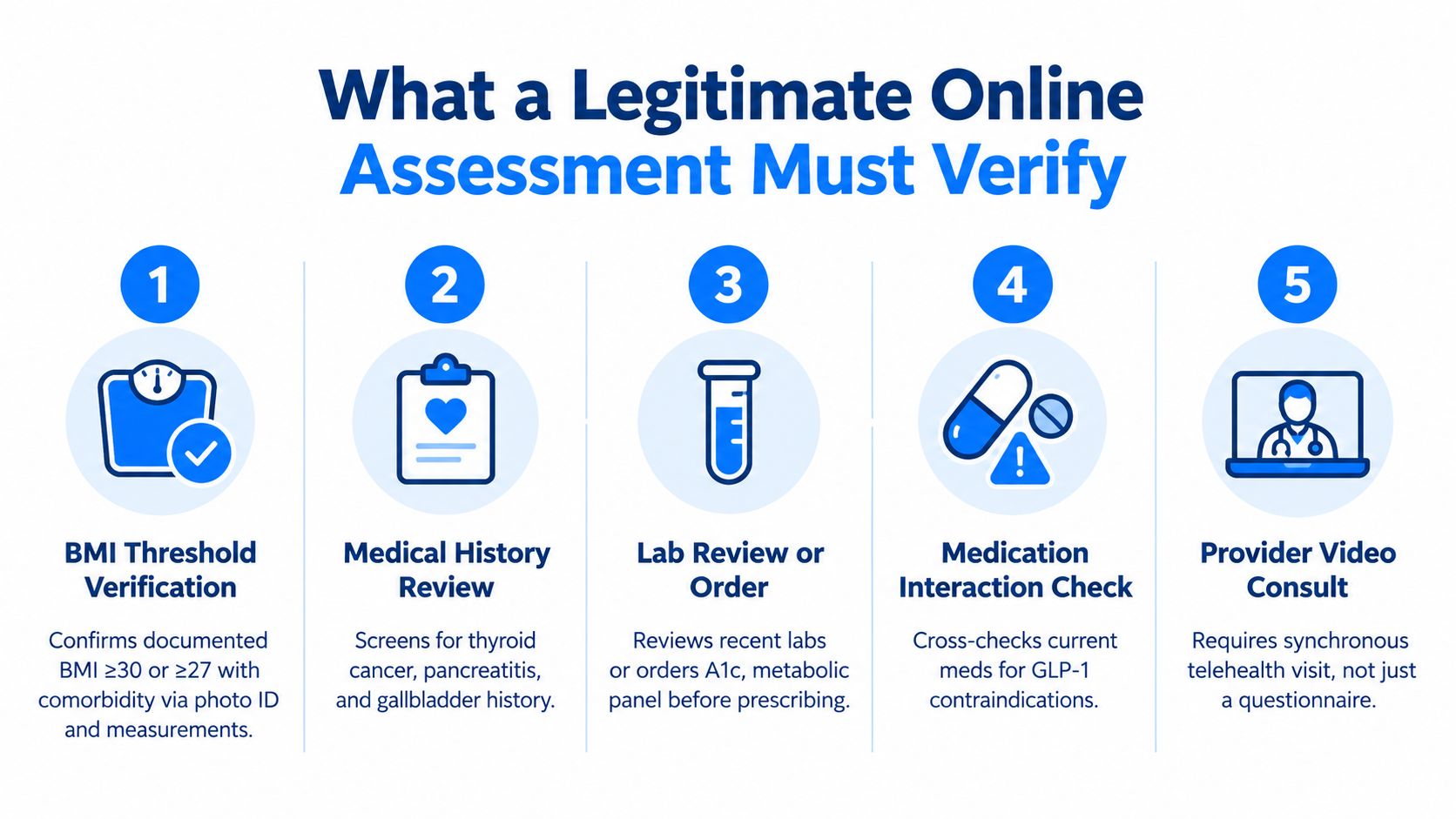
A form gathers answers. A clinician has to test them.
In obesity telehealth, that means more than confirming interest in a GLP-1 or dual incretin medication. The prescriber should be able to defend four things in the chart: why the patient qualifies, why major contraindications were ruled out, what baseline risks were identified, and what follow-up plan will catch trouble early. If any of those steps are weak, convenience has outrun clinical judgment.
What the assessment needs to verify
A legitimate online assessment should verify:
- Eligibility for treatment with documented height and weight, not a rough estimate entered once without any follow-up.
- Relevant exclusions and contraindications including personal or family history of medullary thyroid carcinoma, multiple endocrine neoplasia type 2, prior pancreatitis, significant gastroparesis, and pregnancy status when applicable.
- Medication reconciliation so the prescriber can review current therapies, interaction concerns, duplicate treatment, and whether oral options create route-specific problems.
- Baseline clinical risk through recent labs, prior records, or a clear plan to order testing before or shortly after starting, depending on the case.
- Psychiatric and behavioral context including active suicidality, severe mood instability, substance use concerns, or an eating disorder history that may make a standard telehealth pathway inappropriate.
These checks matter because online questionnaires miss the exact problems that change prescribing decisions. Patients underreport prior adverse effects. They misremember diagnoses. They answer “no” to a condition they have never heard explained in plain language. I see the same pattern in chart reviews. The risk is not dishonesty. The risk is untested history.
What stronger programs do that weak ones miss
The General Pharmaceutical Council has issued guidance aimed at higher-risk online prescribing that centers on independent verification of identity, clinical need, and the information used to prescribe, rather than relying only on self-declared online responses, as outlined in the GPhC guidance for registered pharmacies providing pharmacy services at a distance, including on the internet.
That principle matters. A legitimate assessment often needs a follow-up message, phone call, video review, access to prior records, or contact with the patient's usual clinician when answers conflict or the history carries risk. A checkout-style workflow cannot do that well.
A defensible online intake ends with a prescribing decision that would still make sense under chart audit.
Patients should expect more than a yes or no after a short form. They should expect confirmation of contraindications, review of recent labs or a lab plan, and direct clinician follow-up whenever the intake leaves uncertainty. Monitoring catches what a questionnaire cannot. Good online obesity care starts before the first dose is sent.
Comparing GLP-1 and Dual Incretin Options
In phase 3 obesity trials, average weight loss ranged from about 15% with semaglutide to just over 20% at the highest studied tirzepatide dose. That spread matters, but online prescribing decisions should not be built around the largest headline number.
The clinical question is narrower. Which mechanism fits the patient's medical history, tolerance profile, dosing reliability, and weight-loss target without creating avoidable risk during escalation?
The two medication classes patients usually see online are GLP-1 receptor agonist monotherapy and dual incretin therapy. Semaglutide sits in the first group and is available in injectable and oral forms. Tirzepatide sits in the second and acts on both GIP and GLP-1 pathways. That difference can affect appetite suppression, gastrointestinal side effects, dose progression, and the amount of follow-up a prescriber should plan from the start.
What the evidence supports today
For semaglutide, the best-established obesity data come from once-weekly subcutaneous treatment. In STEP 5, semaglutide 2.4 mg plus lifestyle intervention produced mean weight loss of 14.9% at 68 weeks and 15.2% at 104 weeks, as summarized in this review of semaglutide obesity trial data. The same review also notes that oral semaglutide 50 mg daily produced a 15.1% mean reduction at week 68.
Tirzepatide reached a higher ceiling in studied maintenance doses. In SURMOUNT-1, mean weight change was −15.0% with 5 mg, −19.5% with 10 mg, and −20.9% with 15 mg, compared with −3.1% with placebo, according to the SURMOUNT-1 trial report in NEJM. For telehealth prescribing, that dose separation matters because a patient's result and tolerability can look very different depending on how far titration progresses.
GLP-1 and Dual Incretin Options Compared
| Medication | Mechanism | Dose Range | Expected Weight Loss | Route |
|---|---|---|---|---|
| Injectable semaglutide | GLP-1 receptor agonist | Up to 2.4 mg once weekly | About 15% in phase 3 obesity trials | Subcutaneous injection |
| Oral semaglutide | GLP-1 receptor agonist | Higher daily dosing studied for obesity-level exposure | About 15.1% at week 68 in phase 3 data | Oral tablet |
| Tirzepatide | Dual GIP and GLP-1 receptor agonist | 5 mg, 10 mg, 15 mg maintenance doses studied | Dose-dependent, from 15.0% to 20.9% over 72 weeks | Subcutaneous injection |
| Emerging dual or triple incretin candidates | Broader incretin pathway targeting | Varies by development status | Early results are promising, but published obesity outcomes remain limited | Varies |
Matching the route to the patient
Route matters more than marketing suggests.
A patient who strongly prefers tablets may still be a poor fit for oral therapy if they are unlikely to follow route-specific instructions consistently. A patient who wants the highest expected weight-loss range may be a reasonable tirzepatide candidate, but only if the intake has already screened for factors that make slower escalation, closer symptom review, or earlier dose holds more likely. A patient asking for the newest option often needs a correction in expectations first. Newer does not mean easier to tolerate, easier to monitor, or more appropriate for a long treatment course.
This is one of the safety gaps in online care. A questionnaire can record that someone wants weekly injections or prefers a pill. It usually does not capture whether prior nausea led to dehydration, whether reduced intake is likely to become nutritionally inadequate, or whether the patient is treating the medication as a short sprint instead of chronic therapy.
Practical rule: Choose the medication by clinical fit, not by the largest advertised weight-loss claim.
Vials + Vitals is one example of a physician-directed telehealth model that uses individualized eligibility review and titration oversight. The standard should be the same in any program. Drug selection should follow verified history, realistic adherence, and a monitoring plan that can catch problems early.
Titration Schedules and Safety Monitoring Online
Most problems with online weight loss medication start after the prescription is written. The usual failure is dose escalation without enough symptom review, nutrition review, or follow-up data to tell whether the patient is tolerating treatment or just pushing through it.
Titration is a safety protocol. It sets the pace of exposure so the prescriber can separate expected appetite reduction from dehydration, inadequate intake, or intolerance that needs a pause.
GLP-1 Titration and Monitoring Milestones
| Week | Semaglutide Dose | Tirzepatide Dose | Monitoring Checkpoint |
|---|---|---|---|
| 1 to 4 | 0.25 mg weekly | 2.5 mg weekly | Baseline symptom review, hydration counseling, confirm starting instructions |
| 5 to 8 | 0.5 mg weekly | If tolerated, next scheduled increase after 4 weeks | Review nausea, bowel pattern, appetite suppression, food intake adequacy |
| 9 to 12 | 1.0 mg weekly | Continue stepwise increase in 2.5 mg increments every 4 weeks as tolerated | Assess adherence, side effects, blood pressure trends if available, dose-hold criteria |
| After week 12 | 1.7 mg, then 2.4 mg as tolerated | Continue toward individualized maintenance dose up to 15 mg if tolerated | Reassess response, consider repeat labs, check for plateau or intolerance patterns |
What monitoring should already be on the calendar
A legitimate program should define the monitoring plan before the first dose. That usually means baseline review of metabolic status and safety markers, often including a metabolic panel, HbA1c, TSH, lipid panel, and pregnancy testing where relevant. Follow-up labs during early maintenance and later treatment often catch the problems an intake form cannot. Declining renal function after prolonged vomiting, worsening glycemia that changes the treatment plan, or a thyroid issue that helps explain weak response are common examples.
The practical gap in low-friction telehealth is not access. It is missed surveillance. A program that auto-approves a refill at week 8 without checking nausea severity, hydration status, bowel pattern, and protein intake can miss the point where escalation should stop.
That is where online prescribing either behaves like medical care or behaves like ordering software.
GI guardrails and dose-hold criteria
Gastrointestinal adverse effects drive many of the early dropouts and many of the preventable complications. Patients need clear instructions before symptoms start, not after they become severe. That includes how to adjust meal size, reduce high-fat meals during escalation, maintain fluid intake, and recognize when reduced appetite has crossed into under-eating.
Systematic review evidence supports that focus on tolerability. In randomized trials, semaglutide produced meaningful weight loss, and the analysis also found higher rates of gastrointestinal adverse events in the semaglutide group, with most events transient and mild to moderate, as described in the semaglutide systematic review and meta-analysis.
Reasonable virtual safety parameters include:
- Hydration review when oral intake drops, vomiting begins, or dizziness appears.
- Dose holds for persistent vomiting, severe abdominal pain, or marked resting tachycardia.
- Escalation pauses when weight is falling but protein intake is too low, weakness is increasing, or constipation is becoming clinically significant.
- Medication reconciliation if the patient starts other drugs that can worsen nausea, affect hydration, or change glucose control.
- Mood review around the third month, when treatment fatigue, body-image changes, and adherence strain become easier to detect.
Good monitoring also uses information that a refill form rarely captures. Home blood pressure trends, photos or video review of injection-site reactions, worsening orthostasis, and a clear account of what the patient ate last week often explain whether the next dose increase is appropriate. That is the safety boundary in telehealth. Convenience can get treatment started. Monitoring determines whether continuing and escalating that treatment is clinically appropriate.
Pharmacy Standards and Discreet Cold-Chain Fulfillment
A prescription can be clinically appropriate and still become unsafe at the dispensing stage. I see this gap often in telehealth. The intake may be acceptable, the dose plan may be reasonable, and the weak point is the pharmacy workflow the patient never sees.
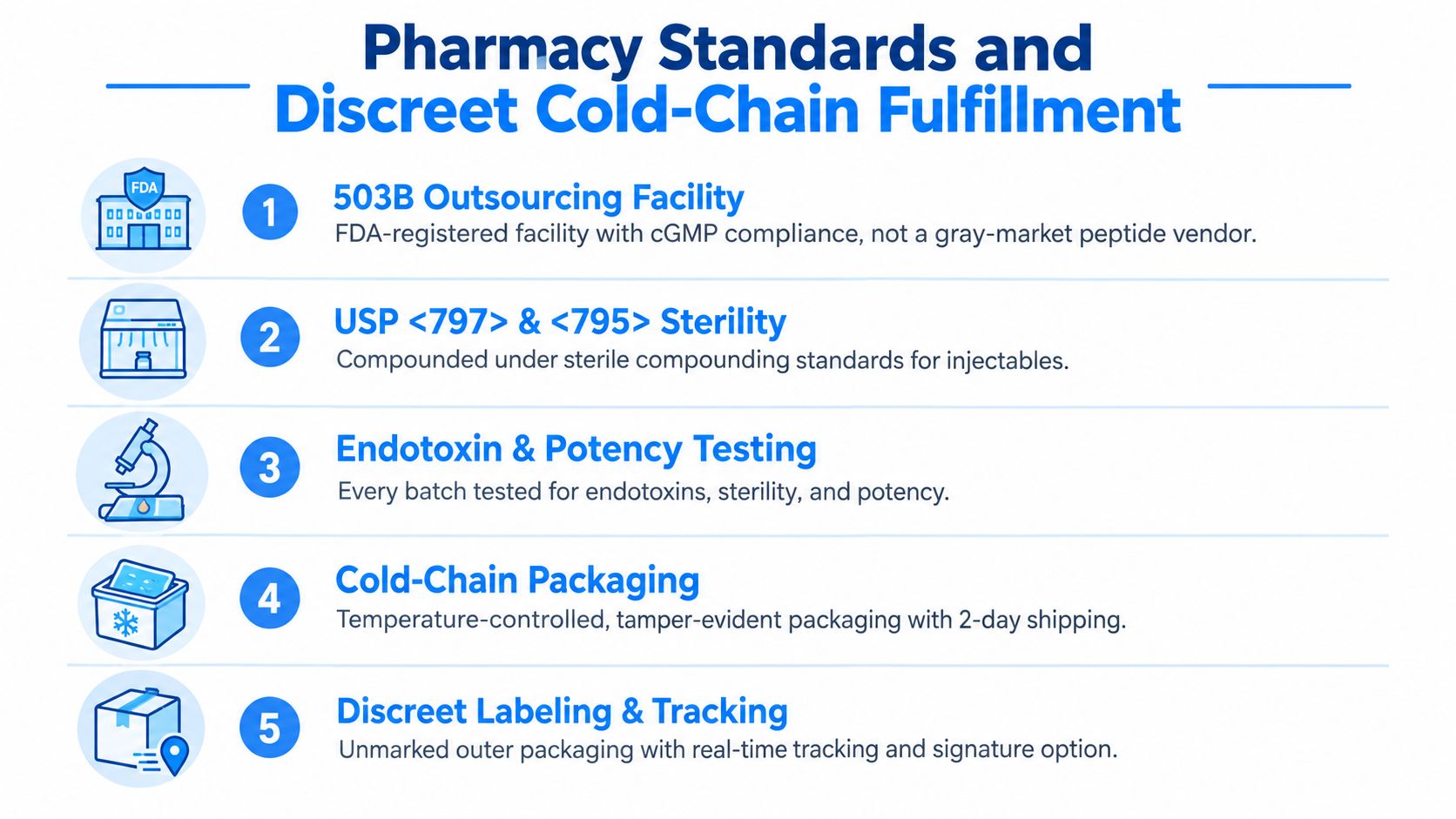
For GLP-1 and dual incretin treatment, fulfillment quality matters because these products are sensitive to handling, labeling, and storage. That is even more important when a compounded injectable is involved. The prescriber is responsible for more than selecting a drug. They also need confidence that the dispensing pharmacy can prepare, label, store, and ship it in a way that preserves product integrity.
What quality looks like operationally
Patients cannot audit a clean room, but they can check for signals that a pharmacy is operating with real controls in place:
- Sterile compounding procedures for injectables, with documented handling standards.
- Batch testing or release controls that address sterility, potency, and endotoxin risk when applicable.
- Clear labeling that includes beyond-use dating, storage instructions, active ingredients, and pharmacy contact details.
- Cold-chain shipping methods appropriate to the formulation, with packaging designed to maintain refrigeration in transit.
- Independent verification that the pharmacy is properly licensed and in good standing.
For patients considering compounded GLP-1 products, the FDA has also issued specific warnings about unapproved versions, dosing errors, and quality concerns in the compounding market, especially when products are sourced outside standard regulatory channels, as described in FDA guidance on compounded GLP-1 drugs.
Those checks are not cosmetic. In remote care, they are part of the safety assessment.
Red flags patients should treat seriously
Poor fulfillment usually shows up in small operational failures first. A vial arrives with incomplete labeling. Storage instructions are vague. The shipment is delayed, but there is no clear documentation of how refrigerated conditions were maintained. The patient has a question and cannot reach a pharmacist.
If the product arrives without clear labeling, usable storage instructions, or a pharmacist contact line, the safety problem started before the first dose.
Other warning signs include unclear sourcing, missing lot information when it should be available, and pricing that does not fit normal pharmacy economics. Discreet packaging is reasonable. Opaque clinical documentation is not. A plain box protects privacy. It should not prevent the patient from confirming what was dispensed, how it should be stored, and who is accountable if something looks wrong.
This is one of the clearest safety gaps in online obesity care. Convenience can hide weak pharmacy practice unless the prescriber and patient both know what to verify.
Can Telehealth Match In-Person Outcomes
The assumption that remote obesity care is automatically inferior doesn't hold up when the program is structured. Telehealth can underperform, but it doesn't have to.
The strongest support comes from outcome studies in actual remote care pathways, not just from convenience metrics. In a large telehealth cohort of adults treated for overweight or obesity with GLP-1 medications, semaglutide delivered through remote clinical management produced weight loss that researchers described as trial-level, with a safety profile similar to expectations from conventional care, according to the telehealth semaglutide cohort report in Obesity.
Where telehealth performs well
Telehealth does especially well when treatment depends on protocol consistency:
- Scheduled titration review rather than ad hoc office availability
- Frequent symptom touchpoints by message, video, or both
- Integrated lab review without the patient having to coordinate multiple offices
- Maintenance care once the diagnosis and treatment direction are already clear
That model is supported by larger telehealth outcome data as well. A 2026 analysis of more than 50,000 telehealth GLP-1 users reported 8.9% average weight loss at 3 months and 19% at 12 months, showing that virtual care can produce clinically meaningful results. The same analysis noted that public use was still rising, with 11% reporting GLP-1 use for weight loss in 2026 versus 3% in 2024, and nearly 20% of respondents saying they used a compounded version, as summarized in the JMIR analysis of telehealth GLP-1 use and outcomes.
Where telehealth should stop and refer
Remote care has real limits. It can miss a subtle abdominal exam, an evolving gallbladder picture, orthostatic findings, or an eating disorder history that only becomes clear in a deeper in-person conversation.
Telehealth is a reasonable setting for uncomplicated obesity treatment and ongoing maintenance when the patient is stable. It is not the right endpoint for every problem.
A patient generally needs escalation or referral when there is:
- New severe abdominal pain suggestive of pancreatitis or another acute abdominal process
- Cardiac symptoms such as chest pain, syncope, or concerning palpitations
- Pregnancy or planned pregnancy
- Complex comorbidity that requires physical examination or point-of-care testing
- Disordered eating concerns that need a different level of assessment
Structured telehealth can match in-person outcomes for the right patient. It cannot replace in-person medicine when new diagnostic uncertainty enters the picture.
Hair Retention During Rapid Medically Supervised Weight Loss
Hair shedding often starts months after the weight loss acceleration that caused it. That delay is why online prescribers miss it. Patients report a new symptom today, but the trigger was often rapid caloric reduction, low protein intake, or a nutritional gap that developed earlier in treatment.
In medically supervised weight loss, diffuse shedding usually fits telogen effluvium, a shift in the hair cycle that commonly appears 2 to 3 months after the inciting event, as described in this summary of telogen effluvium after rapid weight loss. The pattern matters. Diffuse shedding after a period of fast weight loss raises a different set of questions than patchy loss, scalp inflammation, or breakage.
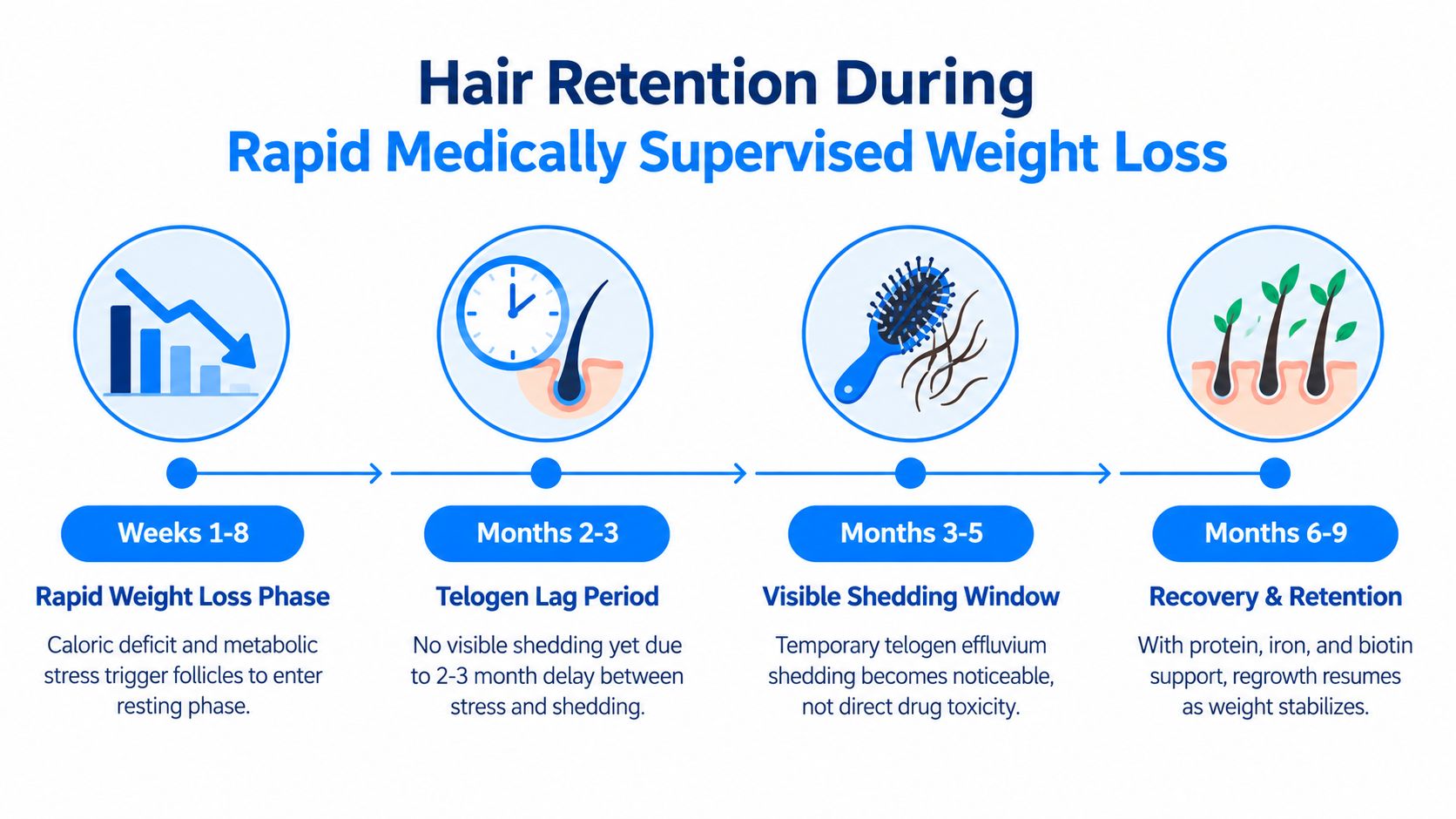
What the prescriber should recognize early
A hair complaint during GLP-1 or dual incretin treatment is often a monitoring problem before it is a medication problem. I look for whether the rate of weight loss has outpaced the nutrition plan, whether appetite suppression has reduced total intake more than the patient realized, and whether the follow-up process caught that change early enough.
A legitimate online follow-up should assess:
- Diet adequacy, with attention to protein intake during the early months of treatment
- CBC and thyroid context when shedding is pronounced, prolonged, or paired with other symptoms
- Iron and micronutrient status when intake has dropped sharply or deficiency is plausible
- Dermatologic history that may point to underlying androgenetic alopecia becoming more visible during a shedding episode
Questionnaires alone fall short. Hair loss history needs timing, pattern, rate of weight change, and nutrition context. A refill form rarely gets that right.
What usually helps and what doesn't
The practical response is usually slower weight loss, better protein coverage, and targeted lab review when the history supports it. Iron deficiency, low zinc intake, thyroid disease, and inadequate overall calories can all sit behind the same complaint. As described in the same review, the biology supports correcting the trigger rather than reflexively chasing supplements.
What does not help is indiscriminate supplement stacking without an assessment. It adds cost, complicates the picture, and can delay the fix if the patient is under-eating or losing weight faster than intended.
Patients should contact the prescriber again if shedding is severe, keeps going, comes with fatigue or other deficiency symptoms, or is patchy rather than diffuse. Patchy loss deserves a different workup.
Hair shedding during GLP-1 treatment is often temporary. It still deserves clinical follow-up, because it can be the first visible sign that medication intensity and nutritional support are no longer matched.
In good obesity medicine, hair retention is a useful surveillance marker. It helps show whether the treatment plan is reducing weight while still protecting recovery, intake, and overall nutritional status.
Vials + Vitals offers physician-directed telehealth evaluation, protocol-based GLP-1 and dual incretin titration, and pharmacy fulfillment designed around the safety issues that matter in online weight loss medication. Patients who want structured eligibility review, monitoring guardrails, and discreet home delivery can learn more at Vials + Vitals.
Ready to see if this protocol fits your biology?
A licensed provider reviews every request before anything is prescribed.
Calibrate your metabolic protocol →