Online Peptide Therapy: A Clinical Guide for 2026

Explore online peptide therapy in 2026, from GLP-1 protocols and compounding standards to telehealth access, safety, and what patients should know.
A large share of patients looking into online peptide therapy are in the same position right now. They've heard that remote prescribing can make treatment easier to start, but they're also seeing mixed messages about compounded GLP-1s, vial quality, hair loss, and whether a telehealth prescription is still legally appropriate after the shortage era ended.
That confusion is understandable. Online access did expand quickly, but convenience is no longer the main question. In 2026, the decision turns on three practical issues: whether the prescription is clinically indicated, whether the product is being dispensed under appropriate compounding and sterile-handling standards, and whether the telehealth program has enough safeguards to reduce dosing and follow-up errors.
Table of Contents
- What Online Peptide Therapy Means in 2026
- Why Telehealth Reshaped Peptide Access
- Therapeutic Categories Available Online
- Injectable, Sublingual, and Vial Formulations Compared
- Tirzepatide and Semaglutide Outcomes in Practice
- Compounding Standards and Safety Guardrails
- A Patient Pathway From Assessment to Delivery
- Common Misconceptions and the Clinical Bottom Line
What Online Peptide Therapy Means in 2026
Online peptide therapy now covers several very different kinds of care under one label. In the narrow medical sense, it refers to a licensed clinician evaluating a patient remotely, determining whether a peptide-based treatment is appropriate, issuing a prescription when indicated, and arranging dispensing through a qualified pharmacy. In practice, the term is used most often for GLP-1 and dual-incretin treatment, especially semaglutide and tirzepatide, but some programs also market broader wellness or hair-related peptide protocols.
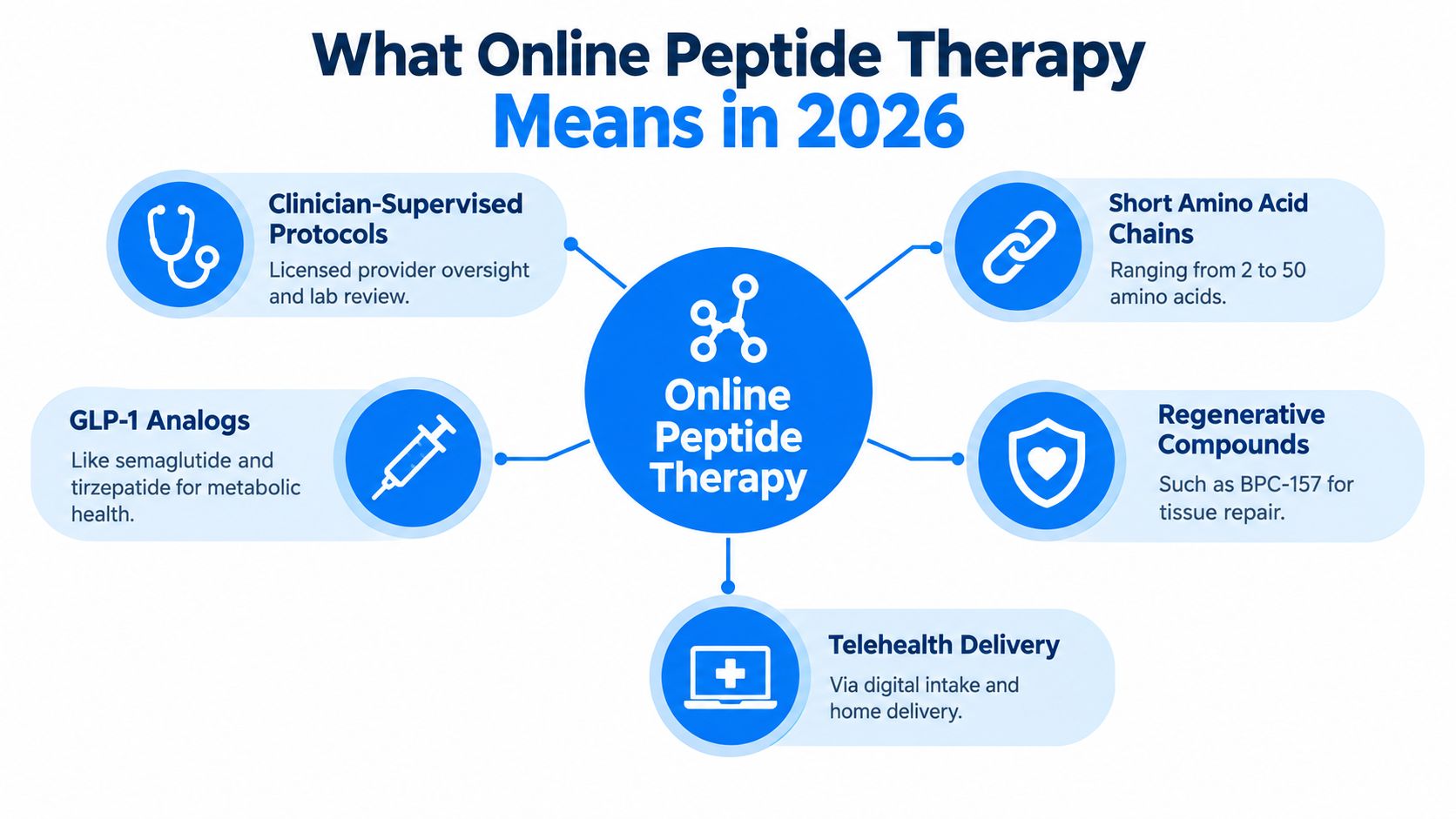
What makes a peptide protocol clinically real
A credible program has three verifiable elements:
- A state-licensed prescriber who evaluates the patient and signs the order.
- A documented indication such as obesity, type 2 diabetes, or another condition that the clinician can defend in the chart.
- A pharmacy process that matches the formulation, especially when a sterile injectable vial is involved.
That third point matters more than most consumer articles suggest. For sterile injectable peptide products, USP <797> is the key quality benchmark. Revised sterile-compounding controls cover environmental monitoring, personnel competency, and beyond-use dating, and industry reporting tied to FDA-linked implementation noted that the revised chapter took effect for new operations on July 1, 2026, and for existing operations after transition by September 1, 2026 (USP <797> sterile compounding update).
Why the definition changed after the shortage era
Patients also need to separate FDA-approved products from compounded preparations. That distinction became more important after the shortage basis for compounded semaglutide ended in February 2025 and tirzepatide ended in late 2024. Reporting on the post-shortage period noted that compounded GLP-1 prescribing still continued into 2026, which left many patients unclear about what remains lawful, what requires patient-specific justification, and how to transition safely when routine copies are no longer appropriate (post-shortage compounded GLP-1 legal confusion).
Clinical takeaway: In 2026, online peptide therapy isn't simply a home-delivery model. It's a regulated prescribing pathway that only makes sense when diagnosis, formulation, and pharmacy standards all line up.
Why Telehealth Reshaped Peptide Access
Telehealth changed peptide access because obesity treatment changed at the same time. Once GLP-1 prescribing accelerated, remote care stopped being a niche convenience option and became a practical intake and follow-up channel for metabolic medicine.
One 2024 industry estimate placed the telehealth weight-loss market at $6.9 billion, with telemedicine use peaking at 37% of U.S. adults in 2021 and then easing to 22% by 2023 as some care returned in person. In the same period, commercial GLP-1 monthly prescription fills rose from 680,000 in January 2020 to 4.7 million by May 2025, a 591% increase over five years (telehealth weight-loss and GLP-1 prescribing growth).
Why this became a structural shift
The more useful number for clinicians is where prescriptions begin. A 2026 market report projected the GLP-1 telehealth platforms market at USD 660.2 million in 2025, rising to USD 763.8 million in 2026 and USD 3.28 billion by 2036, implying a 15.7% CAGR over 2026-2036. The same source said telehealth accounted for 35% of new peptide prescriptions, up from 8% before the pandemic in 2019.
Those figures support what many patients already notice on the ground. Remote metabolic care is no longer just refill management. It now includes intake review, eligibility screening, dose escalation, side-effect checks, and in some programs, home delivery of temperature-sensitive medication.
What telehealth does well and what it doesn't
Telehealth works best when the treatment path is protocol-driven. GLP-1 care is a good fit because clinicians can standardize screening, start low, escalate gradually, and monitor tolerance at defined intervals. It works less well when a program treats all peptide requests as lifestyle purchases and removes the checkpoints that would normally slow a prescription down.
Remote care improves access. It doesn't remove the need for diagnosis, monitoring, or documentation.
A strong online peptide therapy program should make it easy to verify the prescriber, the dispensing pharmacy, and the follow-up cadence. If those details are hard to find, the convenience is often doing too much of the selling.
Therapeutic Categories Available Online
Not every peptide category available online has the same evidence base or the same regulatory footing. Grouping them together creates confusion. In clinical practice, telehealth peptide offerings fall into a few distinct buckets, and patients should judge them differently.
Where evidence is strongest
The metabolic category is the most established. This includes semaglutide and tirzepatide used for obesity, overweight with related comorbidity, or type 2 diabetes when appropriate. These protocols generally pair medication with nutrition, activity, and follow-up on tolerability and adherence.
Hair retention sits in a separate lane. Some programs combine prescription hair-loss therapy with peptide-containing topical or procedural adjuncts, but the peptide component usually isn't the primary evidence anchor. Hair complaints during weight treatment also need a metabolic explanation, not just a cosmetic one.
Categories patients often see online
The table below helps sort common offerings by purpose rather than marketing language.
| Category | Representative Peptides | Primary Indication |
|---|---|---|
| Metabolic health | Semaglutide, tirzepatide | Obesity, overweight with comorbidity, type 2 diabetes |
| Sexual wellness | Bremelanotide and related peptide-based protocols | Hypoactive sexual desire and selected sexual wellness concerns |
| Sleep support | Peptide-adjacent or peptide-based formulations depending on protocol | Sleep disruption when clinically evaluated |
| Longevity and recovery | Growth hormone-releasing peptide classes and related compounds | Selected wellness programs, with variable evidence |
| Hair retention | Topical peptide complexes used alongside standard therapies | Hair thinning support within a broader hair protocol |
| Musculoskeletal recovery | Compounds often discussed in regenerative settings | Limited human evidence, often inappropriate for routine telehealth prescribing |
Where caution should be highest
The weakest area is the broad wellness market for injectable compounds promoted for recovery, anti-aging, or tissue repair without strong human evidence. Some of these products are discussed heavily online, but that doesn't make them ready for routine remote prescribing. For many, the best a cautious clinician can say is that evidence remains limited and the regulatory status may be uncertain.
For hair, the better question is often whether the patient is dealing with telogen effluvium after rapid weight change. A dermatology review explains that diffuse shedding often follows a physiologic stressor or sudden metabolic change, with approximately 50% to 100% of scalp hairs potentially shed after the trigger, usually starting 2 to 3 months later (telogen effluvium review).
Practical rule: When a program offers the same intensity of confidence across metabolic care, recovery injections, hair support, and longevity stacks, the evidence is probably being flattened to fit the sales page.
Injectable, Sublingual, and Vial Formulations Compared
A patient can qualify for remote peptide care, receive a prescription, and still end up with the wrong fit if the formulation choice is careless. In 2026, that choice is less about convenience and more about dosing accuracy, post-shortage product eligibility, and whether the telehealth program reduces avoidable handling errors.
For GLP-1-based care, the route matters. So does the device.
Injectable formats offer the clearest dosing control
Subcutaneous injection remains the standard route for semaglutide and tirzepatide programs because absorption is more predictable and titration is easier to structure. That matters during dose escalation, when small changes can decide whether a patient stays on treatment or stops because of nausea, reflux, constipation, or appetite suppression that overshoots the goal.
Single-dose pens and premeasured devices reduce the number of steps at home. Multi-dose vials ask more of the patient. They require reading a label correctly, matching the prescribed dose to the vial concentration, drawing up the right volume, using clean technique, and storing the vial properly after first puncture.
I see more preventable confusion with vials than with fixed-dose devices.
That does not make vials inappropriate. It means the prescribing model has to account for the extra failure points. A careful telehealth workflow usually includes written syringe-specific instructions, concentration-specific dosing charts, teach-back during onboarding, and a clear process for missed or incorrect doses.
Sublingual and orally disintegrating options solve a different problem
Patients who avoid injections often ask for sublingual or orally disintegrating formats first. The benefit is obvious. No needles, fewer supply issues, and less resistance to starting care.
The trade-off is clinical predictability. Non-injectable absorption can vary more from patient to patient, so response has to be judged by follow-up rather than assuming it will mirror an injectable protocol. That makes these formats a better fit for selected patients who understand the uncertainty and will stay engaged with dose review, symptom tracking, and reassessment.
Topical and transdermal peptide products belong in a separate category. They may have a role in localized protocols, such as hair support, but they are not substitutes for systemic metabolic treatment.
| Formulation | Dose accuracy | Titration control | Handling demands at home | Best fit |
|---|---|---|---|---|
| Single-dose injectable pen | Usually highest for patient-administered use | Strong | Lower | Patient who wants standardized weekly dosing with fewer steps |
| Multi-dose injectable vial | High if concentration is clear and technique is correct | Strong and flexible | Higher | Patient comfortable drawing doses and following sterile handling instructions |
| Sublingual or ODT format | More variable between patients | Moderate, depends on follow-up response | Lower | Patient with strong needle aversion who accepts less predictable absorption |
| Topical or transdermal | Depends on indication, usually local rather than systemic | Limited for metabolic goals | Lower | Patient in a localized-support or hair-focused protocol |
What to verify before choosing a route
Patients should ask practical questions, not just whether one option sounds easier.
- What concentration is being dispensed: A vial labeled in mg/mL creates a different error risk than a premeasured device. The written dose should state both the drug amount and the injection volume if a syringe is used.
- How is sterility maintained after dispensing: For compounded sterile injectables, the pharmacy's handling standards, beyond-use dating, and cold-chain instructions affect safety as much as the prescription itself.
- What training is provided before the first dose: Remote care works better when the program includes syringe teaching, injection-site guidance, and a way to confirm the patient can measure the dose correctly.
- How are missed doses or dosing mistakes handled: Patients need a written protocol before a problem occurs.
- Why was this route selected for this patient: Needle aversion, prior GLP-1 exposure, visual limitations, hand dexterity, and comfort with vial technique all matter.
Vials + Vitals uses both injectable vial protocols and select sublingual options. The more important point is the decision standard. Route choice should follow clinical eligibility, compounding and handling requirements, and the patient's ability to dose correctly at home.
Tirzepatide and Semaglutide Outcomes in Practice
Patients comparing semaglutide and tirzepatide should expect a real difference in average weight-loss potential. These medications aren't interchangeable just because they both sit inside the GLP-1 conversation.
In a randomized trial of adults with obesity but without diabetes, tirzepatide produced a least-squares mean body-weight change of -20.2% at 72 weeks versus -13.7% with semaglutide, a statistically significant difference (P<0.001).
What broader evidence shows
That result lines up with comparative pooled analyses. A network meta-analysis found that tirzepatide 15 mg and tirzepatide at the maximum tolerated dose produced the largest reductions in body weight and waist circumference and outperformed both semaglutide doses across at least 5%, 10%, and 15% weight-loss thresholds. Another meta-analysis reported a 4.28 percentage-point advantage in percentage weight reduction and 4.43 kg greater absolute weight loss favoring tirzepatide.
Real-world data are also helpful because patients often think in milestones, not trial averages. In a U.S. study of adults with overweight or obesity, within 1 year 81.8% of tirzepatide users achieved at least 5% weight loss versus 64.6% of semaglutide users. For at least 10% weight loss, the rates were 62.1% versus 38.0%, and for at least 15%, 42.3% versus 19.3%. Hazard ratios also favored tirzepatide at 1.76, 2.42, and 3.04 across those thresholds (real-world milestone outcomes with tirzepatide and semaglutide).
How follow-up should be structured
The main clinical lesson isn't just that tirzepatide often produces more weight loss. It's that titration and monitoring matter, because stronger appetite suppression can also amplify tolerability issues or contribute to under-eating, lean-mass loss, and adherence problems if the program only chases the scale.
| Timepoint | Semaglutide Expected Loss | Tirzepatide Expected Loss | Clinical Checkpoints |
|---|---|---|---|
| Early titration | Modest early response with GI monitoring | Often faster early response with GI monitoring | Nausea, hydration, bowel pattern, injection technique |
| Mid-course review | Progressive loss if dose escalation is tolerated | Often greater milestone achievement | Blood pressure, food intake quality, activity, adherence |
| Longer follow-up | Meaningful weight reduction when maintained | Greater average reduction in many patients | Plateau review, lean-mass protection, maintenance planning |
The best telehealth programs don't just ask whether weight is down. They ask whether the patient is still eating adequately, tolerating escalation, and following a plan that can be maintained.
Compounding Standards and Safety Guardrails
The most important safety issue in online peptide therapy isn't whether a website looks polished. It's whether the underlying dispensing model can stand up to regulatory and clinical scrutiny.
What regulators are watching
FDA has warned that telehealth companies promoting compounded drugs, including GLP-1 receptor agonists, must not make false or misleading claims about safety, efficacy, or regulatory status (FDA guidance on telehealth promotion of compounded drugs). For patients, that means marketing language matters. If a platform blurs the line between compounded and FDA-approved product, the risk isn't just semantic. It suggests weak internal controls.
The second issue is dosing and product consistency. Recent coverage of compounded GLP-1 telehealth operations noted FDA warning letters, false-equivalence marketing concerns, and adverse-event reports tied to compounded semaglutide. It also cited a JAMA Health Forum analysis finding that patients often received products with variable concentrations or instructions that could increase dosing-error risk (telehealth compounded GLP-1 dosing and safety concerns).
A practical verification checklist
Patients should verify the following before starting treatment:
- Prescriber identity: The clinician's name, state licensure, and prescribing role should be easy to confirm.
- Pharmacy status: The dispensing pharmacy should be state-licensed and appropriate for the type of product supplied.
- Sterile standards: Any shipped injectable vial should come from a process that follows sterile compounding controls consistent with USP <797>.
- Label clarity: Packaging should show a visible lot number, concentration, and patient-specific directions.
- Monitoring plan: Follow-up should include dose review and symptom review, not just automatic monthly refill prompts.
Red flags that deserve immediate caution
Some warning signs are straightforward:
- No clinician accountability: If the prescription appears detached from a named provider, stop there.
- Unlimited refills without reassessment: Weight-loss peptides require titration review and side-effect surveillance.
- Unclear concentration language: Patients shouldn't need to guess how many units equal the intended dose.
- Aggressive equivalence claims: Compounded products should never be presented as if they are the same as an FDA-approved brand.
A reputable online peptide therapy program should make the safety architecture visible before payment, not after checkout.
A Patient Pathway From Assessment to Delivery
A safe telehealth peptide course follows a fairly predictable sequence. When that sequence is compressed too far, mistakes usually appear in eligibility, dosing, or follow-up.
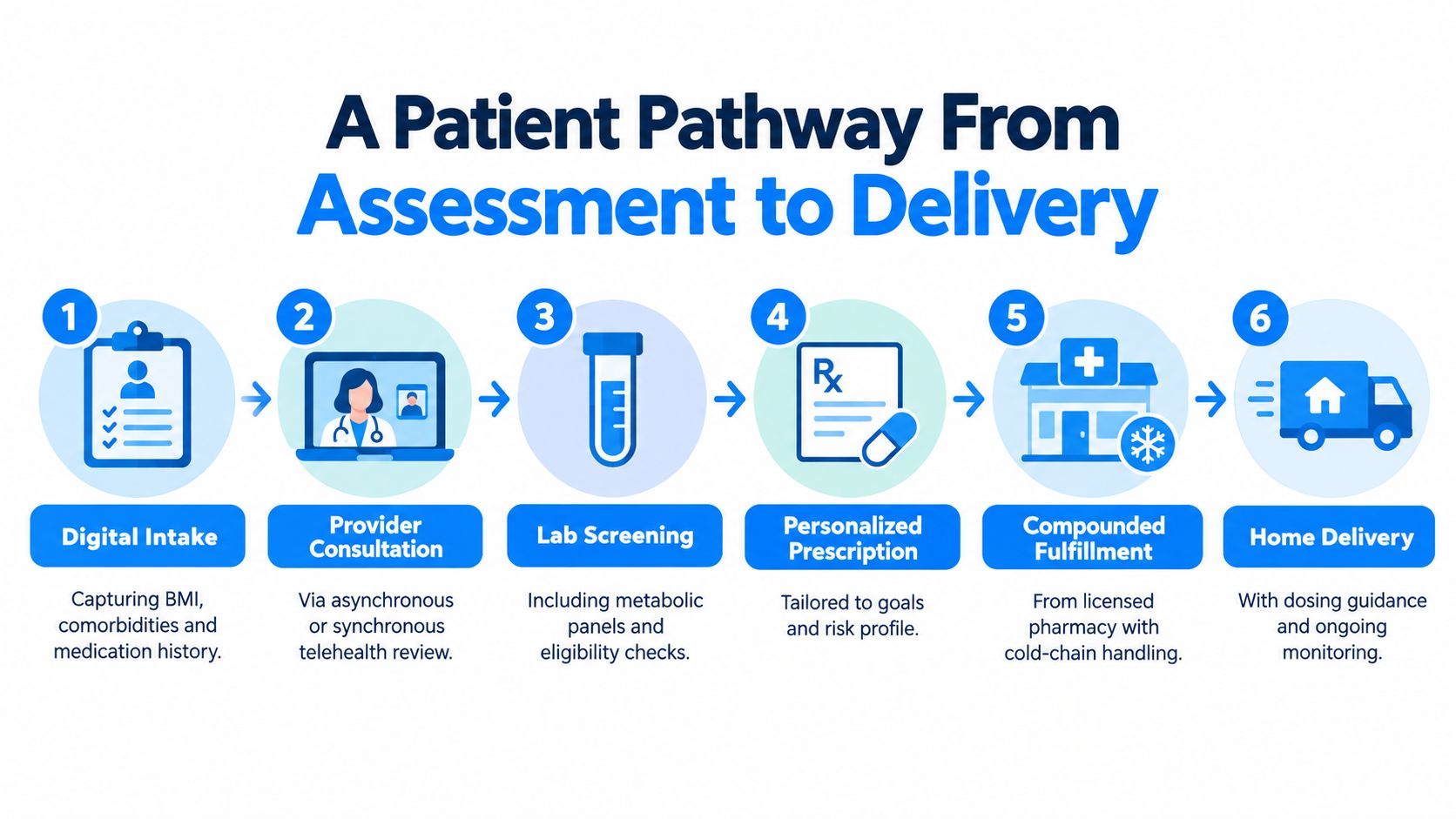
Step one through step three
Most legitimate programs begin with a digital intake. That intake should capture weight history, current medications, relevant diagnoses, and contraindication screening. For metabolic therapy, it should also identify whether the patient is seeking obesity treatment, diabetes treatment, or a less clearly defined wellness goal.
The next step is clinician review, either asynchronous or live depending on the program and jurisdiction. That review should confirm whether treatment is clinically indicated and whether there are reasons to avoid a GLP-1 or dual-incretin approach.
Then comes laboratory and baseline review, when appropriate. Not every patient needs the same workup, but the absence of any baseline thinking is a problem. Telehealth doesn't remove the need to assess risk.
Step four through delivery
If the patient qualifies, the clinician issues an electronic prescription and routes it to a properly licensed pharmacy. For injectables, shipping should account for cold-chain needs when the formulation requires it. The patient should receive written directions that match the exact concentration dispensed.
The first dose is where many programs either prove their quality or expose their shortcuts. A strong program gives the patient technique guidance, explains site rotation, and provides clear instructions for a missed dose or delayed shipment.
Good remote care feels organized before the first injection. It shouldn't depend on the patient assembling the protocol from text messages, refill reminders, and guesswork.
Where online care most often breaks down
Common failure points include:
- Incomplete assessment: Medication history and contraindications aren't fully reviewed.
- Dose escalation without symptom check: The schedule advances because the calendar says so, not because tolerance supports it.
- No shortage-transition plan: The patient is started on a formulation without any discussion of what happens if legal or supply conditions change.
- Technique gaps: Injection-site rotation, syringe measurement, or storage instructions are missing.
- Delivery without continuity: The product arrives, but there is no defined checkpoint for response, side effects, or next-step decisions.
Patients should expect a pathway that is both convenient and documented. If it feels improvised, it probably is.
Common Misconceptions and the Clinical Bottom Line
A patient completes an online intake, pays, and receives a vial a few days later. The question starts there. In 2026, the hard part is not access alone. It is whether the prescription still fits post-shortage rules, whether the pharmacy prepared it under appropriate sterile compounding standards, and whether the remote program reduced the common dosing and follow-up failures that show up in routine practice.
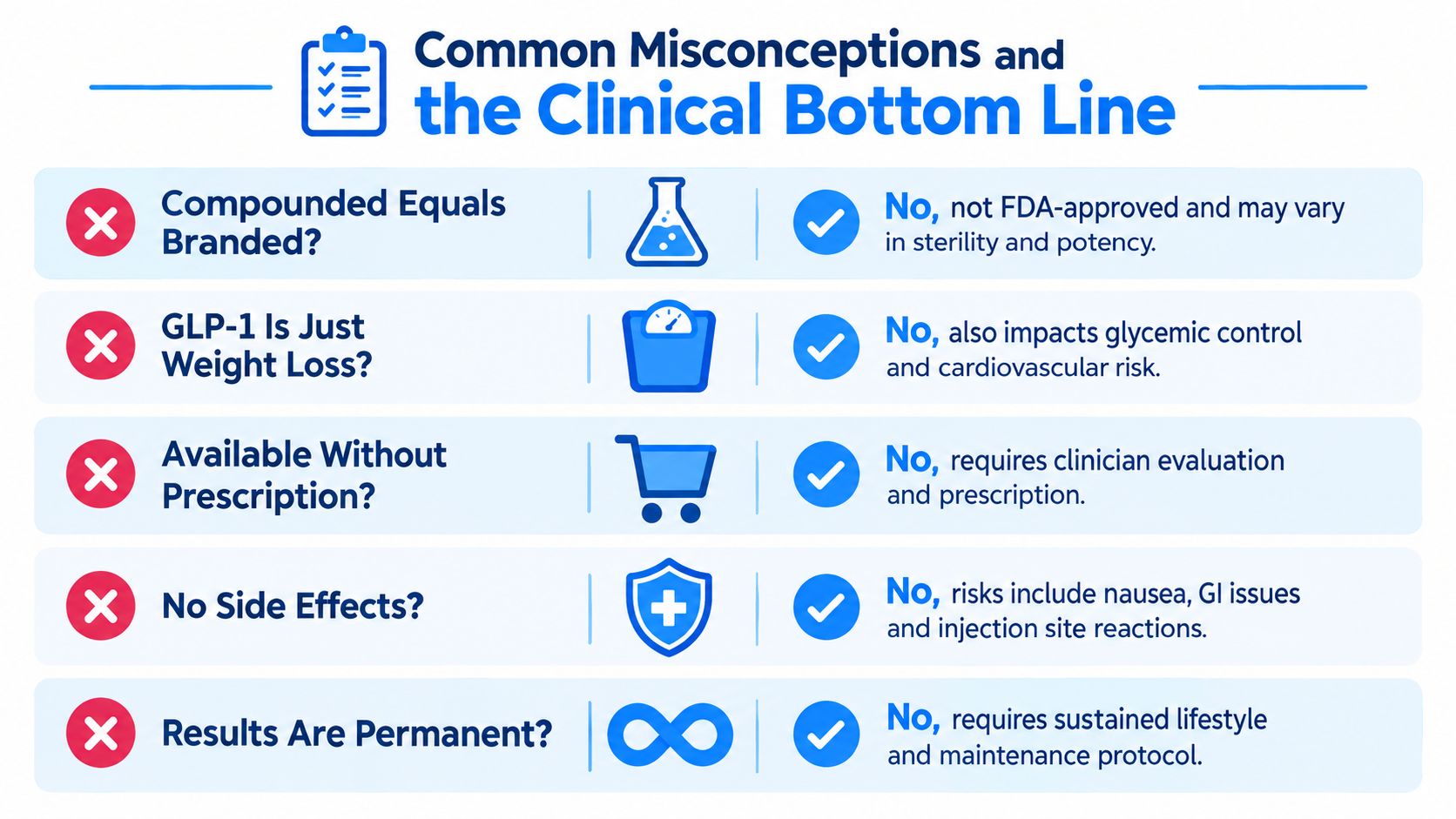
Misconception one through three
Compounded peptides are the same as branded drugs. They are not equivalent products. A compounded medication is not FDA-approved, and the patient has to verify more than the drug name. Concentration, beyond-use dating, sterility controls, labeling clarity, and pharmacy licensing matter because each one affects how safely the dose can be prepared, shipped, measured, and escalated.
Hair loss on GLP-1 therapy means the medication is directly injuring hair follicles. In practice, that explanation is often incomplete. Shedding after weight loss is commonly more consistent with telogen effluvium, which can follow rapid metabolic change, lower calorie intake, illness, or stress and may appear months after the trigger. That distinction matters because management usually centers on rate of weight loss, protein intake, iron and thyroid review when indicated, and patience if the pattern fits self-limited shedding.
Telehealth skips the usual medical safeguards. Some programs do. Better programs still use a standard medical sequence: history, contraindication review, dose selection, documented consent, a prescription from a licensed clinician, and follow-up tied to tolerance and response rather than to an autopay schedule.
Misconception four and five
Once the weight comes off, treatment can always be stopped abruptly. Weight regain is common when treatment ends without a plan. The practical choices are ongoing maintenance dosing, a slower taper, or transition to another strategy with close monitoring of appetite, glycemic markers, and weight trend. Patients should ask that question before the first prescription, not after the first successful month.
The end of the shortage era means compounding is either fully available or fully shut down. This scenario is narrower and more technical. Eligibility now turns on the drug, the timing, the pharmacy's legal basis for dispensing, and whether the prescription is patient-specific and clinically defensible. This is why two online programs can look similar on the surface while operating under very different compliance standards.
The clinical bottom line
Online peptide therapy can still be appropriate, especially in metabolic medicine, but convenience is no longer a useful screening test. A safer remote program identifies the prescriber, names the dispensing pharmacy, states the exact concentration on the prescription and label, explains how titration will change if side effects appear, and gives the patient a clear path for missed doses, delayed shipments, or shortage-related changes in formulation.
Patients should also verify how the injectable was compounded and whether the instructions match the vial in hand.
That scrutiny serves patients. It filters out remote prescribing models that treat peptide care like a generic mail-order transaction and favors programs that preserve the same discipline expected in careful in-person practice.
The right question is not whether online peptide therapy is easy to get. The right question is whether the remote model preserves dosing accuracy, compounding quality, and clinical follow-up after the prescription is written.
Vials + Vitals provides physician-directed telehealth evaluation for GLP-1, dual-incretin, hair, sleep, sexual wellness, and related peptide-based protocols, with eligibility review, titration guardrails, and licensed U.S. pharmacy fulfillment when treatment is clinically appropriate. Adults who want a structured remote pathway can visit Vials + Vitals to review how assessment, formulation selection, and follow-up are handled before starting care.
Ready to see if this protocol fits your biology?
A licensed provider reviews every request before anything is prescribed.
Calibrate your metabolic protocol →