Metabolic Health Programs: What to Expect
Evidence-based overview of metabolic health programs, covering GLP-1 therapy, expected outcomes, safety parameters, and how to choose the right protocol.
The most popular advice about a metabolic health program is also the least complete: get access to a GLP-1 prescription, follow the dosing instructions, and wait for the scale to move. That model treats obesity care as a medication transaction. Clinical care doesn't.
A credible metabolic health program starts after the prescription is written. Medication selection, dose progression, nutrition planning, resistance training guidance, adverse-effect surveillance, and maintenance strategy all shape whether weight loss is metabolically useful or merely visible. That distinction matters because patients can lose weight while also losing lean mass, under-consuming key nutrients, or entering a cycle of early success followed by regain.
The Vials + Vitals Medical Board views this as the central gap in current care. The clinically important question isn't only whether a program can help a patient start semaglutide or tirzepatide. It's whether that program can supervise the full arc of treatment, including body composition preservation, hair retention concerns, and decisions about when medication intensity should change.
Table of Contents
- What Separates a Metabolic Health Program From Simple Prescriptions
- Core Components of a Protocol-Driven Metabolic Program
- Expected Outcomes and Realistic Timelines
- Safety Parameters and Hair Retention Considerations
- When Medication Alone Is Not Enough
- Building a Sustainable Long-Term Metabolic Strategy
What Separates a Metabolic Health Program From Simple Prescriptions
The weak point in many obesity programs is not medication access. It is everything that follows. A patient can receive a GLP-1 prescription, lose weight for several months, and still finish treatment with less lean mass, poorer dietary intake, new hair shedding, and no clear maintenance plan.

A prescription is an entry point, not a program
Simple prescribing solves access. A metabolic health program is responsible for treatment quality over time. That includes selecting the right candidate, setting dose-escalation rules, preserving lean tissue during weight loss, monitoring adverse effects, and deciding what to do when early appetite suppression no longer predicts results.
That distinction matters clinically.
A transactional model often explains how to start medication but says little about protein targets, resistance training, gastrointestinal tolerance, micronutrient adequacy, or when a plateau reflects underdosing versus a failing routine. Patients are left managing a chronic disease with intermittent instructions instead of a defined protocol.
Clinical takeaway: Weight loss induced by GLP-1 therapy isn't automatically the same as complete metabolic care.
What a protocol-driven model looks like
The better standard resembles longitudinal obesity medicine. The prescription is one component, not the whole intervention.
In practice, several elements separate a program from a refill process:
- Physician-directed eligibility review: A licensed clinician assesses whether treatment fits the patient's metabolic risk, history, and contraindications, rather than placing every patient on the same path.
- Defined titration rules: Dose escalation follows a plan based on tolerance and response. The question is not only whether the patient can increase the dose, but whether increasing it is likely to improve the outcome enough to justify added side effects or cost.
- Nutrition design: Patients need a structure that protects protein intake, supports satiety, and reduces the risk of under-eating during rapid weight loss.
- Monitoring that changes management: Weight alone is an incomplete signal. Programs should also look for symptoms, adherence problems, appetite rebound, strength decline, and other markers that treatment quality is slipping.
- Maintenance planning from the start: A chronic condition needs a long-view strategy. Programs that wait until regain begins are usually intervening late.
A strong program also pays attention to outcomes that are easy to dismiss because they are not always captured on the scale. If body weight falls while strength, hair density, or dietary quality worsens, the program should treat that as a medical management problem, not a cosmetic tradeoff.
Questions patients should ask
Patients can screen for clinical depth with a few direct questions:
- Who adjusts the protocol: Is dose progression individualized by a physician, or largely automatic?
- What gets monitored: Does follow-up cover nutrition, activity, tolerability, and adherence, or only scale change?
- How is partial success handled: If weight decreases but lean mass, hair retention, or nutritional quality worsen, does the program respond with a treatment change?
- What happens after the first phase: Is there a maintenance plan before the first plateau, or only after progress stalls?
Programs that cannot answer those questions usually provide medication access. That is useful, but it is narrower than metabolic care.
Core Components of a Protocol-Driven Metabolic Program
A prescription can lower appetite. It does not, by itself, create a metabolic program. The difference is operational. A protocol-driven model links medication choice, dose progression, nutrition targets, and follow-up rules so that each decision changes the next one.
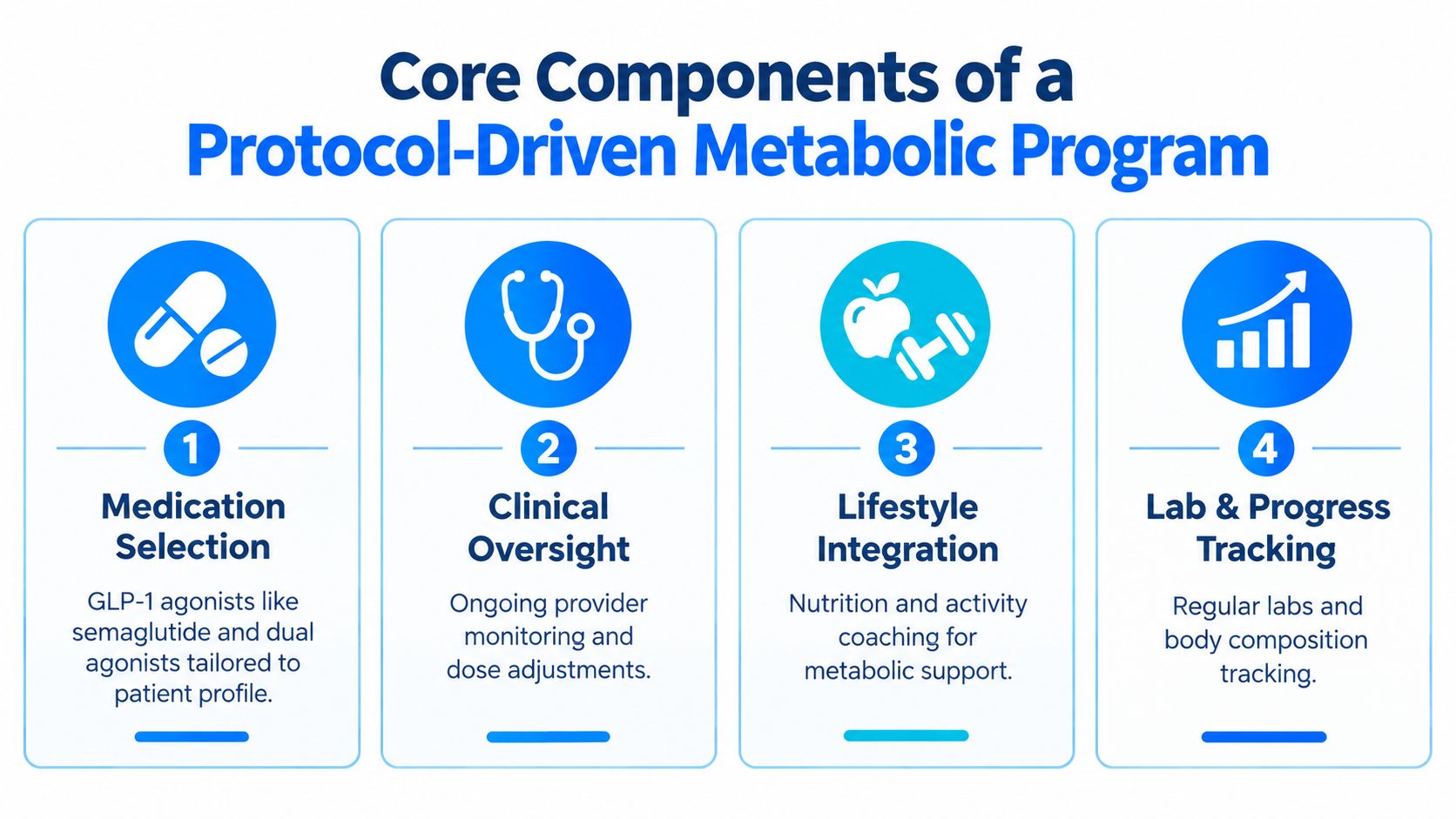
Medication selection and dose logic
Drug selection sets the ceiling for expected response, but dose logic often determines whether patients approach that ceiling. In SURMOUNT-1, adults with obesity treated once weekly for 72 weeks lost a mean of 15.0% of body weight at 5 mg, 19.5% at 10 mg, and 20.9% at 15 mg of tirzepatide, compared with 3.1% with placebo. Those results show more than efficacy. They show that escalation strategy matters.
That has practical consequences in clinic. A patient with early appetite control but persistent excess adiposity may need further titration if tolerability remains acceptable. Another patient may have nausea, low intake, or declining training capacity at a lower dose and benefit more from dose stabilization than automatic escalation.
Nutrition support aimed at lean-mass preservation
Reduced intake is one mechanism of treatment success, but it also creates a predictable risk. Patients can lose weight while protein intake, food variety, and resistance-training capacity drift in the wrong direction.
A serious program responds by treating nutrition as tissue preservation, not just calorie reduction. That means counseling tied to appetite suppression, gastrointestinal tolerance, and daily function. It also means looking past the scale. If weight falls while strength, recovery, or hair density begin to worsen, the nutrition plan is not working well enough.
Patients need a plan that helps reduce fat mass without making lean mass and micronutrient status an afterthought.
Monitoring tools and decision support
Follow-up should answer specific management questions. Is the patient meeting intake targets despite lower hunger? Has satiety improved while energy, bowel tolerance, or adherence worsened? Is a plateau more consistent with biology, missed doses, under-training, or over-restriction?
Some physician-directed telehealth programs, including Vials + Vitals, use structured tools such as GLP-1 titration support, metabolic calorie assessment, and hair-retention screening to standardize those reviews. Tools matter because they reduce guesswork. Clinical judgment still decides whether to hold dose, escalate treatment intensity, or correct a nutrition problem before it becomes a medication failure.
Clinical oversight and escalation pathways
Programs with real protocol depth define what happens when the first-line plan works only partly. That includes exclusion criteria, physician review, dose-adjustment rules, and a response pathway for limited efficacy or poor tolerance.
This is also where many programs underperform. They manage straightforward responders and struggle with edge cases that are common in practice: the patient whose appetite suppression is strong but whose protein intake is too low, the patient whose weight loss slows despite adherence, or the patient whose cosmetic concerns, including hair shedding, threaten continuation. A protocol-driven model treats those as management problems that require adjustment, not as reasons to drift without a plan.
GLP-1 and Dual Incretin Therapy Comparison
| Agent | Class | Avg. Weight Loss |
|---|---|---|
| Semaglutide | GLP-1 receptor agonist | Meaningful weight loss with response varying by dose and duration |
| Tirzepatide | Dual incretin therapy | Higher average weight loss than many single-agent GLP-1 approaches in trial and observational settings |
Expected Outcomes and Realistic Timelines
Fast early weight loss is not the best marker of program quality. The more meaningful question is what happens by month 6, month 12, and after the first plateau, when preservation of lean mass, nutritional adequacy, and treatment durability start to matter as much as pounds lost.
Induction isn't the same as outcome
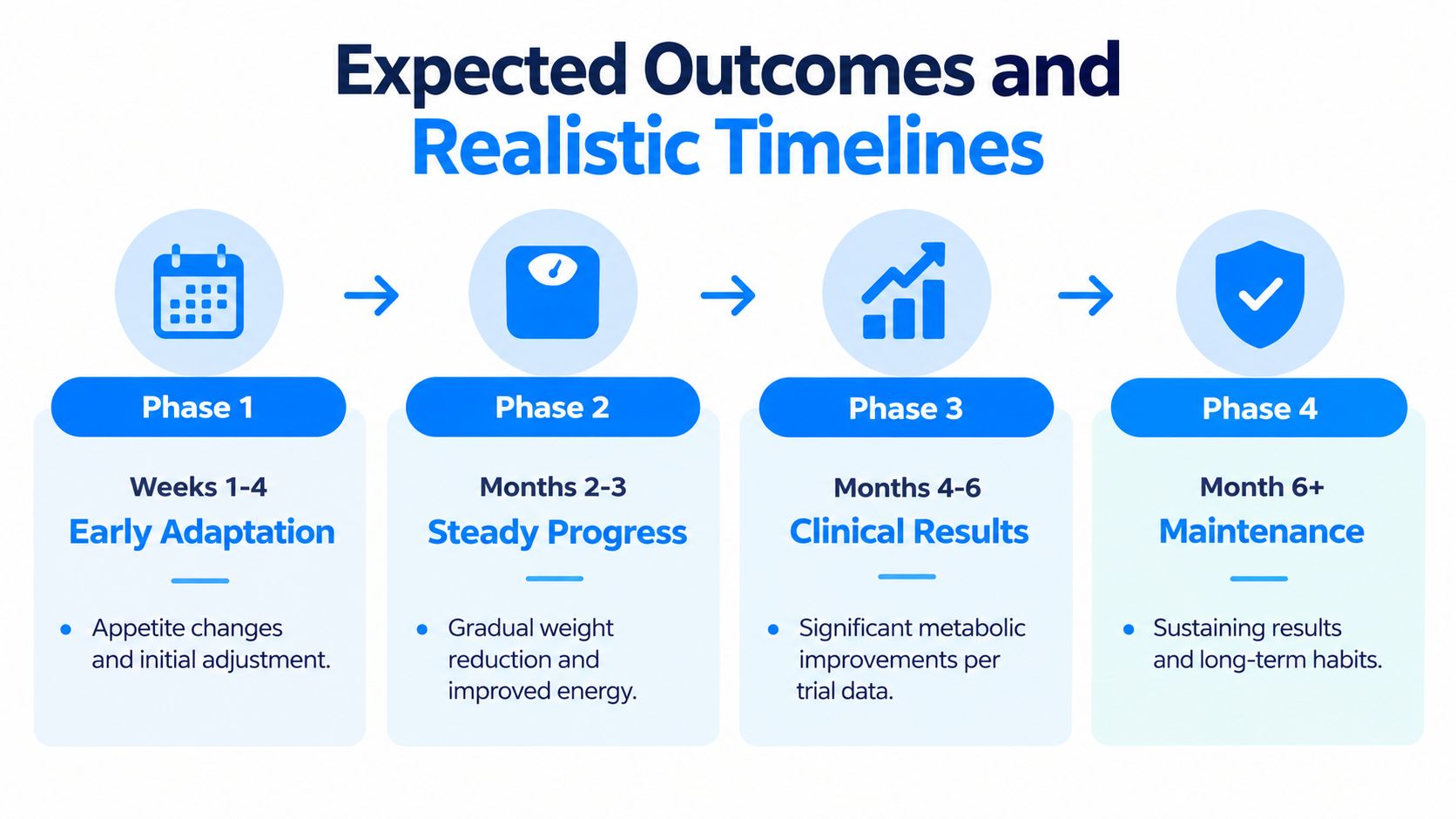
Most protocol-driven programs begin with a titration phase. During those first weeks, clinicians are judging tolerance, meal pattern changes, hydration, and whether reduced appetite is translating into adequate protein intake rather than accidental undernourishment. Weight may fall early, but that period is still an adaptation phase.
The longer view is more informative. In the STEP 5 trial, adults with overweight or obesity treated with semaglutide 2.4 mg plus lifestyle intervention had an estimated mean body weight change of -15.2% at week 104, compared with -2.6% with placebo, according to the trial publication in Nature Medicine. That time frame matters. It shows that clinically meaningful change is usually measured over many months, with durability assessed over years rather than the first refill cycle.
A second point is easier to miss. A strong appetite response can create the appearance of success before body composition and metabolic stability have been evaluated. For patients, that distinction affects expectations. For clinicians, it affects whether the next step is simple continuation or a correction in nutrition and training to reduce avoidable lean-mass loss.
Maintenance determines whether early success holds
Programs gain credibility when results persist after the novelty of treatment wears off. Weight biology often pushes in the opposite direction.
In SURMOUNT-4, participants who continued tirzepatide after the lead-in phase lost an additional 5.5% from week 36 to 88, while those switched to placebo regained 14.0%. That pattern is more than a medication talking point. It shows that obesity treatment usually requires a maintenance strategy, not a short intervention followed by assumed independence from therapy.
The practical implication is straightforward. If a program discusses only how to start medication, it is explaining the easiest part of care.
What timelines should mean to patients
A realistic timeline has distinct phases, and each phase answers a different clinical question:
- Weeks 1 to 12: Can the patient tolerate treatment, eat enough protein, and maintain a calorie deficit without excessive fatigue or gastrointestinal burden?
- Months 3 to 6: Is there a consistent response at a therapeutic dose, or is progress being limited by adherence, underdosing, poor intake quality, or an incorrect medication strategy?
- Months 6 to 12: Is weight loss being maintained with acceptable strength, function, and nutritional status, or is the program trading scale loss for preventable muscle loss and cosmetic side effects?
- After 12 months: Does the plan support maintenance, dose adjustment, or escalation for partial responders rather than treating plateau as treatment failure?
Patients should be cautious with programs that promise certainty from the first few weeks. Early momentum is common. Durable metabolic improvement is slower, less linear, and more dependent on what happens after the prescription starts.
Safety Parameters and Hair Retention Considerations
Efficacy data often dominate obesity conversations. Safety discussions are shorter, even though they determine whether a patient can remain on therapy long enough to benefit. Hair shedding is a good example. It isn't life-threatening, but it can materially affect adherence, distress, and the patient's willingness to continue treatment.

The hair-loss signal deserves direct counseling
A recent systematic review of GLP-1 receptor agonists and hair loss found that semaglutide and tirzepatide showed the highest incidence signals for hair loss in pharmacovigilance datasets. The review also noted that semaglutide-associated hair loss appeared dose-dependent. In an oral semaglutide obesity trial summarized in that review, alopecia occurred in 23 of 334 participants (7%) on semaglutide versus 9 of 333 (3%) on placebo.
That doesn't mean every episode of hair shedding is caused only by the drug itself. Rapid weight reduction, caloric deficit, reduced intake variety, and telogen effluvium biology may all contribute. But from a patient-safety perspective, the distinction isn't whether the medication is the sole mechanism. The distinction is whether the program anticipates the problem and manages it.
What responsible monitoring should include
A careful program should address safety in plain language before treatment begins and revisit it during follow-up.
- Baseline review: Prior hair shedding history, dietary restrictions, and recent rapid weight change should be documented.
- Symptom timing: Diffuse shedding that begins after treatment initiation may fit a treatment-related pattern, especially during periods of aggressive weight reduction.
- Nutritional review: Reduced appetite can lower overall intake enough to unmask weak nutritional habits.
- Formulation and dose reassessment: If hair loss becomes clinically important, the prescribing clinician may need to reconsider pace, dose, or overall strategy.
Hair retention isn't a cosmetic footnote in obesity care. For some patients, it's one of the main factors that determines whether treatment remains acceptable.
Tolerability is part of efficacy
A medication only works if the patient can stay on it under medically acceptable conditions. That's why safety surveillance belongs inside the core design of a metabolic health program, not in an after-visit handout. Programs that minimize discussion of shedding, nutritional adequacy, or persistent adverse effects often overestimate adherence and underestimate the burdens patients experience.
When Medication Alone Is Not Enough
Medication response exists on a spectrum. Some patients do well with standard escalation and behavioral support. Others don't. The clinically useful question isn't whether a GLP-1 can produce weight loss. It can. The harder question is whether a given patient is receiving the right treatment intensity for the biology in front of the clinician.
Not all medication pathways perform the same
The evidence already shows that agent selection matters. A review of randomized and observational evidence reported that tirzepatide produced more weight loss than semaglutide in an open-label randomized comparison, with approximately 20% body-weight loss versus 14%. The same source summarized an observational study showing mean 12-month on-treatment weight change of -15.3% for tirzepatide versus -8.3% for semaglutide.
Those differences support individualized prescribing, but they also expose a common clinical mistake. Programs may keep adjusting the same medication pathway when the larger issue is treatment intensity mismatch. If a patient has poor durability, recurrent regain pressure, or incomplete metabolic improvement despite adherence, another minor protocol tweak may not be enough.
Escalation should be a clinical decision, not a marketing omission
A strong metabolic program acknowledges that medication isn't always the final step. Some patients need deeper monitoring. Some need combined nutrition and exercise intervention with greater structure. Some need discussion of more intensive therapies, including surgery, rather than endless recycling of the same plan.
A 2026 report summarized by ScienceDaily on a WHO-commissioned review noted that GLP-1 use for weight loss had become mainstream, with Gallup reporting 11% of U.S. adults currently using these medications and 15% having used them at some point. The same report summarized average weight reduction of about 16% with tirzepatide after 12 to 18 months and about 11% with semaglutide over 24 to 68 weeks, while also noting that long-term safety data remain limited. It further stated that a 2026 real-world comparison found bariatric surgery far outperformed GLP-1 drugs. The point isn't that medication has failed. The point is that escalation decisions belong inside obesity care from the start.
Treatment Intensity Decision Guide
| Clinical Scenario | Recommended Action | Monitoring Frequency |
|---|---|---|
| Early response with acceptable tolerability | Continue protocol-driven titration and reinforce nutrition and activity structure | Regular physician follow-up during dose progression |
| Weight loss with concerns about lean-mass preservation or nutritional quality | Add more structured dietary review and resistance training guidance | Closer follow-up until the pattern stabilizes |
| Inadequate durability or repeated regain pressure despite adherence | Reassess agent choice, maintenance strategy, and overall treatment intensity | Increased monitoring with formal reassessment |
| Persistent incomplete response despite protocol adjustments | Discuss higher-intensity options, including surgical evaluation when clinically appropriate | Ongoing specialist-directed review |
The deciding issue is completeness
Medication alone isn't enough when the apparent success is metabolically incomplete. A falling body weight curve can obscure low dietary quality, weak maintenance planning, or a patient who needs a different therapeutic intensity altogether. The most effective programs don't ask how much weight was lost. They ask whether the treatment matched the patient's risk, response, and long-term needs.
Building a Sustainable Long-Term Metabolic Strategy
Long-term metabolic care fails when convenience outruns clinical support. That pattern is increasingly visible in telehealth obesity treatment, where access has improved faster than the depth of ongoing supervision. The result is a familiar sequence: effective appetite suppression, visible weight loss, then uncertainty about how to protect the result.

Sustainability depends on what the program protects
A recent telehealth analysis in JMIR identified a major underserved issue in metabolic care: many programs focus on access and weight loss while underexplaining the need for ongoing nutrition, resistance training, and behavioral support to prevent lean-mass loss and micronutrient problems during GLP-1 treatment. The same report noted that virtual programs can produce strong outcomes over time, including average total body-weight reduction of 18.53% at 18 months and 20.27% at 24 months, yet those outcomes don't automatically address body composition quality, nutrition adequacy, or long-term habit change.
That is the central sustainability problem. A patient can succeed by scale criteria while still finishing treatment with less muscle support, weaker dietary structure, or poor readiness for maintenance.
What durable care should include
A long-term strategy should keep supervision focused on function, not only weight.
- Nutrition continuity: The patient needs an eating pattern that remains workable when novelty fades and appetite changes evolve.
- Resistance training support: Lean-mass preservation requires more than encouragement. It requires a repeatable plan.
- Behavioral structure: Appetite suppression lowers friction. It doesn't permanently install habits.
- Maintenance review: Physicians should revisit formulation, dose, and continuation strategy after the most visible phase of weight loss has passed.
The real differentiator in obesity care isn't who starts medication fastest. It's who prevents “successful” weight loss from becoming metabolically incomplete.
How patients can evaluate long-term design
Patients should ask whether a program has a post-induction model. If follow-up becomes thinner as soon as weight starts to fall, the program may be strongest exactly when it is least needed. Better programs remain attentive after early success, when body composition, nutritional adequacy, and adherence become the harder clinical tasks.
Metabolic care works best when treatment is treated as continuous management. Titration, formulation choice, physician oversight, and maintenance planning should function as one care pathway rather than disconnected events.
Vials + Vitals offers physician-directed metabolic protocols that include GLP-1 and dual incretin treatment pathways, individualized titration schedules, and tools designed to support ongoing monitoring rather than one-time prescribing. Patients who want a metabolic health program that takes maintenance, safety, and hair retention concerns seriously can learn more by visiting Vials + Vitals.
Ready to see if this protocol fits your biology?
A licensed provider reviews every request before anything is prescribed.
Calibrate your metabolic protocol →