Low Libido Treatment: Options That Work in 2026

Looking for low libido treatment? Explore evidence-based options that actually work in 2026, from lifestyle changes to medical therapies.
The most popular advice about low libido is often the least useful: check testosterone, optimize hormones, and add a libido-enhancing protocol. That sequence can miss the actual problem. Desire may fall because of an antidepressant, untreated pain, depression, poor sleep, relationship strain, endocrine disease, or a combination of factors. A higher laboratory value won't reliably solve a symptom that was never caused by hormone deficiency.
Effective low libido treatment starts with phenotype, not marketing language. The clinical questions are practical: Is the change new or lifelong? Does it occur everywhere or only in a particular context? Does it cause personal distress? Which medications, medical conditions, symptoms, and relationship factors are active? Only after those questions are answered can a clinician weigh medication, hormone therapy, counseling, or watchful reassessment.
Table of Contents
- Why Low Libido Is a Symptom, Not a Diagnosis
- How Clinicians Classify Low Libido Before Treatment
- FDA-Approved Pharmacologic Options and Their Modest Effects
- Hormone Pathways Worth Considering and Worth Skipping
- Reversible Contributors That Should Be Addressed First
- Counseling, Sex Therapy, and Behavioral Pathways
- A Telehealth-Aligned Care Pathway and When to Reassess
Why Low Libido Is a Symptom, Not a Diagnosis
Low libido is where treatment often goes off track. Desire is a symptom, not a diagnosis, and the first job is to identify what is lowering it before choosing a therapy. Hypoactive sexual desire disorder, or HSDD, refers to persistent or recurrent low desire that causes personal distress or interpersonal difficulty, and it has been reported in approximately 5.4% to 13.6% of women across age groups in a clinical review of HSDD and flibanserin.
In practice, the same complaint can come from very different drivers. Medication effects are common. Depression, anxiety, chronic stress, fatigue, sexual pain, erectile or orgasm difficulties, relationship conflict, and endocrine disease can also suppress sexual interest. A patient whose desire fell soon after starting an antidepressant may need a careful medication review with the prescribing clinician before anything else. Stopping a psychiatric medication abruptly can cause harm. Adding a hormone without checking whether the timeline fits a drug effect often misses the reason desire changed.
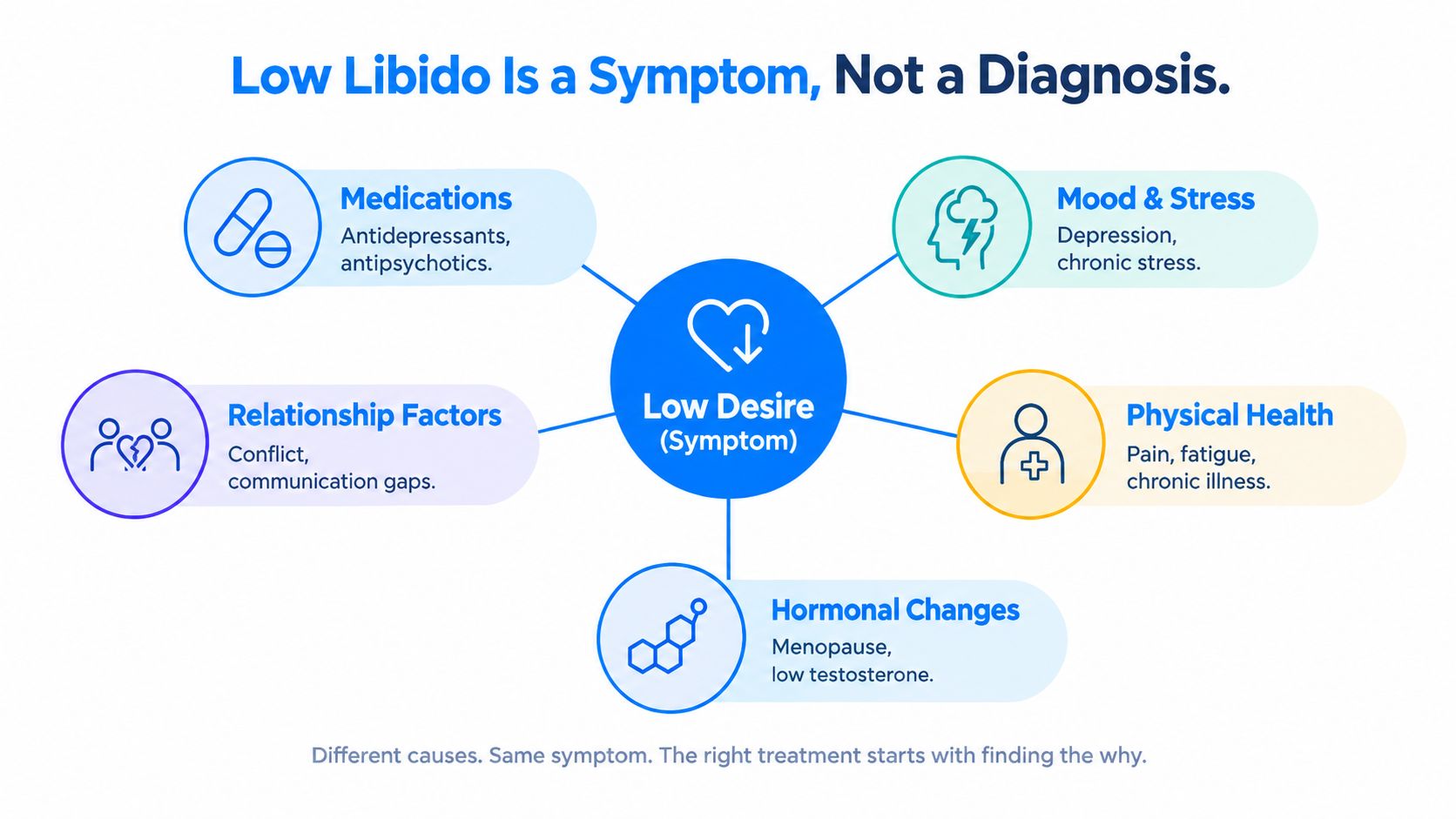
The phenotype comes before the protocol
Clinical care works better when low desire is sorted by phenotype first. The useful distinctions are acquired or lifelong, generalized or situation-specific, and whether the change is distressing enough to represent a disorder rather than a normal variation in sexual preference. Someone who has rarely felt spontaneous desire and is not bothered by it usually does not need a prescription. Someone whose desire changed after painful intercourse, a new medication, or a depressive episode needs evaluation aimed at that context.
Hormone testing has a role when symptoms suggest an endocrine problem, but a lab value does not diagnose HSDD by itself. In women, testosterone interpretation has limits, and treatment decisions are better guided by symptoms, history, and context than by trying to correct a single number in isolation, as outlined in this clinical reference on testosterone therapy for women.
Practical rule: Better outcomes usually come from identifying the main driver and treating that directly.
A focused first pass should cover medication timing, mood, sleep, pain, genitourinary symptoms, menstrual or menopausal status, medical history, and relationship context. That sequence reduces unnecessary treatment and gives later care a clear target, such as less distress, improved comfort, or more satisfying sexual experiences.
How Clinicians Classify Low Libido Before Treatment
A structured intake prevents two people with similar hormone panels from receiving identical care when their symptoms have different causes. Classification begins with the timeline. Acquired low desire develops after a period of typical desire, while lifelong low desire has been present from the beginning of sexual experience or for as long as the person can remember.
The next question concerns distribution. Generalized low desire occurs across situations, partners, and settings. Situational low desire appears in particular circumstances, such as when pain is expected, conflict is unresolved, arousal is difficult, or a specific medication is taken. This distinction can redirect care toward pelvic health, relationship work, medication review, or treatment of an orgasm or erection problem rather than toward a libido drug.

What changes the treatment plan
Distress is central. A low level of desire without personal concern isn't automatically a disorder, while a smaller change can warrant care if it causes significant distress or interpersonal difficulty. The assessment also separates desire from related sexual symptoms. Pain, difficulty with arousal, erectile dysfunction, delayed orgasm, or inability to orgasm can make sexual activity feel unrewarding and indirectly reduce desire.
A telehealth intake should ask:
- Timing: When did the change begin, and what happened around that time?
- Medication exposure: Were antidepressants, antipsychotics, chemotherapy drugs, blood-pressure medicines, or other treatments started or changed?
- Mood and stress: Are depression, anxiety, grief, trauma, or chronic stress present?
- Physical symptoms: Is there pain, dryness, fatigue, sleep disruption, or a new medical illness?
- Pattern: Is low desire generalized or limited to a partner, activity, or situation?
- Personal goal: Is the priority more desire, less distress, more comfort, improved intimacy, or treatment of another sexual problem?
Laboratory testing should answer a clinical question rather than satisfy a protocol. Depending on the history, a provider may consider endocrine, metabolic, medication-related, or gynecologic evaluation. A normal result doesn't invalidate symptoms, and an abnormal result doesn't prove causation.
Before an appointment, patients can write down the onset, medication changes, sleep pattern, pain symptoms, mood changes, and situations in which desire remains or disappears. That record often provides more actionable information than an isolated hormone panel.
FDA-Approved Pharmacologic Options and Their Modest Effects
Medication is rarely the part that needs the most explanation. Expectations do. In practice, the two FDA-approved drugs for low desire fit a narrow group of premenopausal women with acquired, generalized HSDD, and neither works like a broad libido enhancer.
Flibanserin was the first approved option for this indication. The supporting trials studied women aged 19 to 55 years over 24 weeks, with 1,187 participants receiving flibanserin 100 mg nightly and 1,188 receiving placebo, and completion rates of 69% and 78%, respectively. Those details matter because trial populations were selected, and real-world follow-through is often harder when a drug must be taken every night with counseling about sedation and alcohol precautions.
The clinical effect was modest. Some women improved in desire and in the number of satisfying sexual events, but the average gain was small rather than dramatic. That is the right way to frame it at the bedside. A patient deciding on daily treatment should know that benefit, if it appears, is usually incremental, while the burden is concrete: bedtime dosing, dizziness or somnolence risk, and the need to avoid treating low desire as if it were isolated from pain, depression, medication side effects, or relationship strain.
That sequencing matters more than many articles admit.
Bremelanotide uses a different adherence model
Bremelanotide is also approved for appropriately selected premenopausal patients with acquired, generalized HSDD, but it asks for a very different kind of adherence. It is given as a subcutaneous injection at least 45 minutes before anticipated sexual activity, which makes it a situational treatment rather than a nightly one (FDA-reviewed bremelanotide evidence).
Its trade-offs are different too. Trials showed improvement in sexual desire, but not an increase in sexually satisfying events. Recognized risks include transient hypertension and skin hyperpigmentation, and the response remains limited even in well-selected patients. For some patients, the on-demand model feels more acceptable than a daily pill. For others, the injection format or adverse effects make it a poor fit.
The useful clinical question is not which drug sounds stronger on paper. It is whether the patient's presentation matches the approved phenotype, whether reversible drivers have already been addressed, and whether the administration model fits real life. I would continue either medication only when the patient can describe a meaningful benefit that outweighs the inconvenience and adverse effects, and when follow-up confirms improvement in desire, distress, or sexual well-being.
Hormone Pathways Worth Considering and Worth Skipping
Hormone treatment helps a narrower group of patients than marketing often suggests. In practice, the hormone pathway worth considering for low desire is low-dose transdermal testosterone in postmenopausal women with acquired, generalized symptoms, after the broader phenotype has been sorted out. A randomized trial in 814 postmenopausal women showed improved sexual activity and desire, with the clearest signal at the 300-microgram-per-day patch dose, but adverse effects and unresolved long-term safety questions limit how broadly those findings should be applied (testosterone patch trial).
Route matters. Transdermal treatment is generally preferred over oral or intramuscular forms because it produces steadier exposure and is easier to titrate conservatively. A commonly used clinical approach is to start with about 5 mg per day of gel, roughly one-tenth of a typical male starting dose, then reassess over time rather than chasing a quick effect. Some patients notice change after 6 to 8 weeks, and a fair read on benefit often comes closer to 12 weeks.
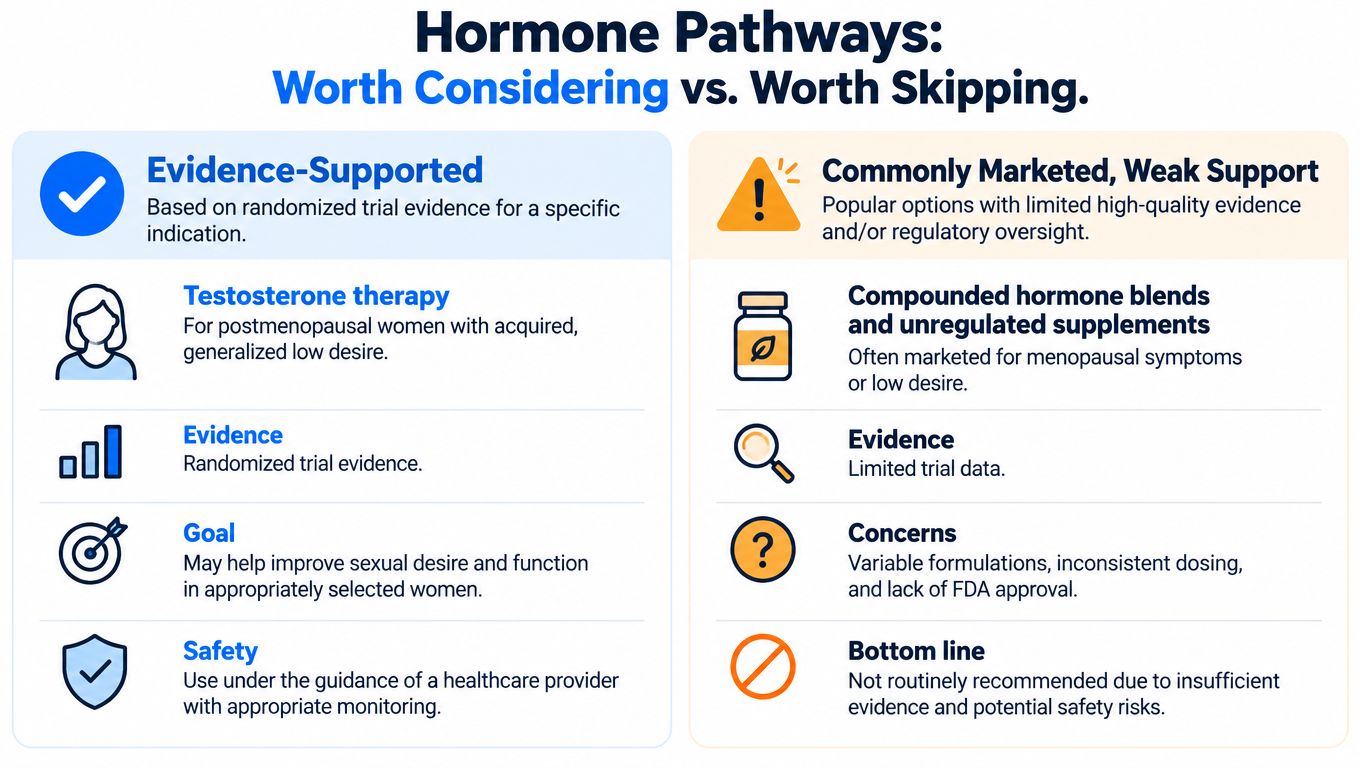
Monitoring is part of treatment
Monitoring is not optional, because this is the point where appropriate use and casual prescribing separate. Before starting therapy, review symptoms, medical history, lipid and liver status, and reasons not to prescribe. During follow-up, ask directly about acne, excess hair growth, scalp hair loss, voice change, and whether desire has improved enough to justify continuing. If there is no meaningful response by six months, stop rather than escalating indefinitely.
For readers trying to separate low-libido treatment from broader menopause care, what is menopausal hormone therapy is a useful primer on the difference between symptom-targeted hormone use and menopausal treatment more broadly.
Men with low libido need a different workup. Testosterone treatment belongs mainly in the setting of compatible symptoms plus confirmed hypogonadism, not as a reflex response to low desire alone. Compounded hormone blends and unregulated supplements do not carry the same level of support as randomized evidence, and an isolated lab value without the right clinical picture is a poor reason to prescribe.
Reversible Contributors That Should Be Addressed First
The most efficient low libido treatment is sometimes a treatment that never reaches the prescription pad. If desire changed after a medication started, the prescribing clinician should review the timing, dose, alternatives, and the risk of changing therapy. Antidepressants, antipsychotics, chemotherapy drugs, and some blood-pressure medicines can reduce desire, but patients shouldn't stop them independently.
A medication review may lead to a dose adjustment, a carefully supervised substitution, or a decision to continue the existing treatment while addressing another cause. The correct choice depends on the illness being treated, the severity of symptoms, and the availability of alternatives. Adding a second agent on top of an unexamined adverse effect can increase complexity without correcting the source.
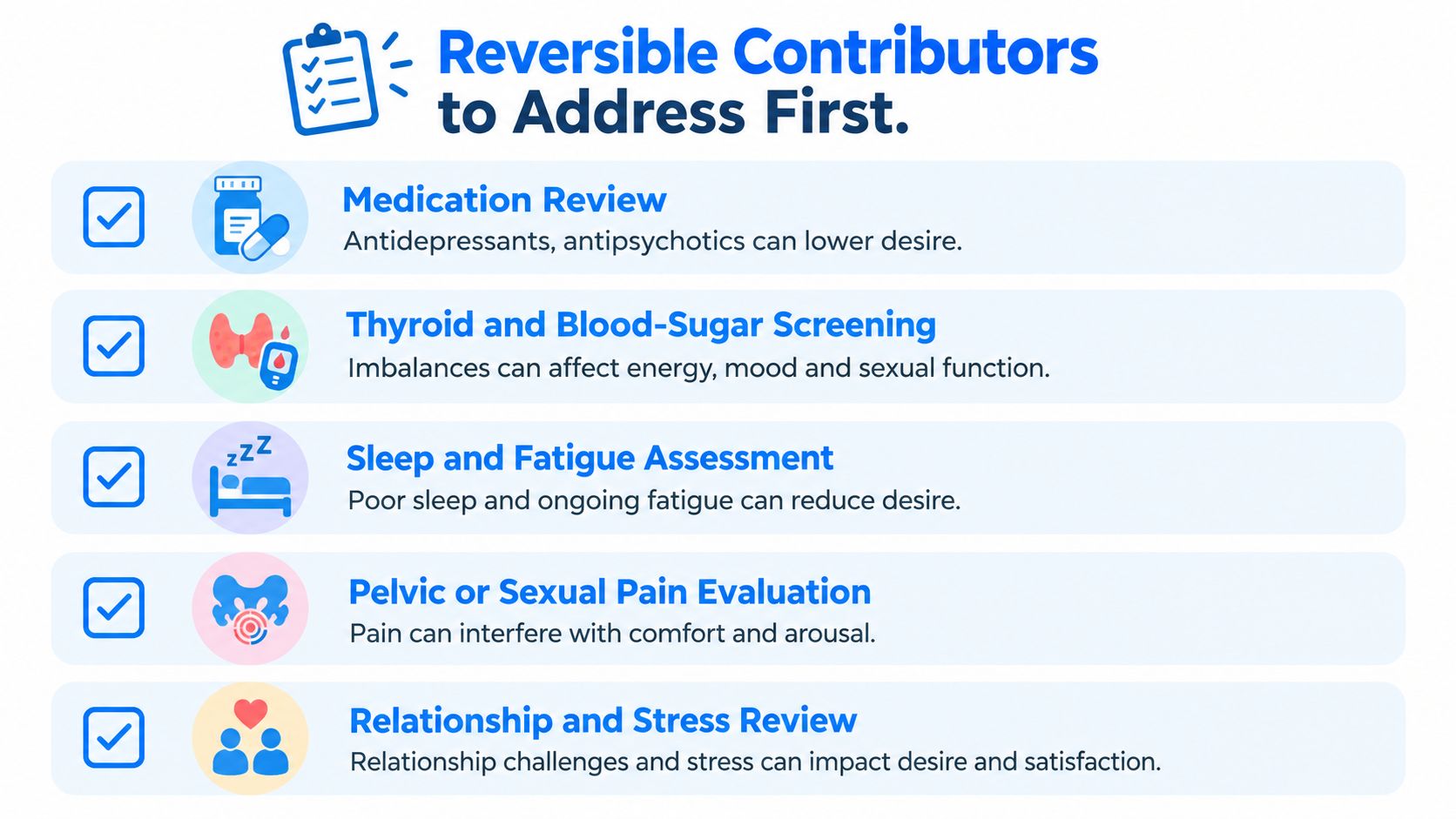
A focused review prevents protocol drift
Depression and anxiety can lower desire directly, while chronic stress and insufficient sleep reduce the energy and attention needed for sexual interest. Sexual pain, vaginal or genitourinary symptoms, erectile difficulty, and orgasm problems can also make sexual activity predictable enough to avoid. Treating the symptom that makes sex unpleasant may improve desire more effectively than stimulating desire directly.
A useful evaluation includes:
- Medication review: Match the onset of low desire to prescriptions and dose changes.
- Mood assessment: Identify depression, anxiety, trauma symptoms, and persistent stress.
- Sleep and fatigue review: Look for insufficient sleep, disrupted sleep, and daytime exhaustion.
- Pain assessment: Evaluate pelvic, genital, musculoskeletal, or penetration-related pain.
- Medical screening: Order thyroid, blood-sugar, or other testing only when the history supports it.
- Relationship context: Ask about conflict, communication, safety, caregiving burden, and privacy.
Clinical priority: Treating pain, depression, sleep disruption, or a medication effect may remove the obstacle that made desire appear to be the primary problem.
Patients can make the visit more productive by bringing a complete medication list and describing what changed first. That simple chronology often distinguishes a plausible medication effect from a coincidental laboratory abnormality.
Counseling, Sex Therapy, and Behavioral Pathways
Counseling and sex therapy aren't soft add-ons. They are appropriate clinical pathways when mood, body image, trauma, pain-related fear, arousal difficulty, or relationship context shapes the symptom. A therapist with training in sexual concerns can help identify avoidance patterns, reduce performance pressure, improve communication, and rebuild pleasurable attention without turning every intimate encounter into a test.
Consider a patient whose desire falls because sexual activity repeatedly ends in frustration from anorgasmia. A libido medication may increase interest without improving the experience that follows. Individual therapy focused on arousal, anxiety, body image, or orgasmic difficulty may be more logical, sometimes alongside medical treatment for pain or other physical symptoms.
A different pattern appears in couples with a persistent desire difference. Structured communication exercises can help partners discuss initiation, rejection, affection, and expectations without assigning blame. Couples therapy may be appropriate when conflict and disconnection are central, while individual therapy is often better when depression, trauma, shame, or medication effects dominate.

What progress should look like
Cognitive-behavioral and sex-therapy approaches commonly focus on thoughts, avoidance, communication, sensory attention, and gradual return to pleasurable activity. The clinician shouldn't measure success only by how often sex occurs. Reduced distress, greater comfort, improved arousal or orgasm, more satisfying experiences, and less conflict may represent meaningful progress even when desire doesn't become constant or spontaneous.
The relationship between emotional health and sexual satisfaction is complex, and a resource on the mental health and intimacy connection can help patients understand why emotional context belongs in a sexual-health assessment. Counseling also gives patients a place to set realistic goals, especially when medication effects are expected to be modest.
A clinician should reassess whether therapy is changing the patient's stated problem. If distress remains unchanged, the formulation may be incomplete, the therapy may need adjustment, or an untreated physical contributor may still be active.
A Telehealth-Aligned Care Pathway and When to Reassess
Telehealth works best after the pattern is clear. The first job is not to prescribe. It is to decide whether low libido looks primarily medication-related, hormonally linked, mood-driven, relationship-dependent, or mixed, then choose the least burdensome next step that fits that pattern.
A safe pathway starts with a confidential intake and physician review. From there, the clinician checks for contraindications, looks for reversible contributors that still need attention, and decides whether treatment belongs in medication, counseling, hormone therapy, or a combined plan. In practice, many patients need sequencing more than intensity. A medication change may come before desire-directed treatment. Therapy may come first when distress, conflict, or avoidance is driving the complaint.
Treatment also needs a timetable. Vials + Vitals describes clinician-directed titration over about 12 weeks, with monitoring, privacy protections, and consultation-fee refund policies when treatment is not clinically appropriate (Vials + Vitals patient-care information). That structure matters because libido treatment is rarely judged by a prescription alone.
Success should be defined before starting. Meaningful improvement may be less distress, better sexual comfort, more satisfying experiences, improved arousal, or a clear change on a validated desire measure.
Reassess when side effects outweigh benefit, when the working diagnosis shifts, or when the expected interval passes without meaningful change. Better treatment follows better sorting. The goal is improved sexual well-being, not chasing a lab result or staying on a treatment that is not changing the problem.
Ready to see if this protocol fits your biology?
A licensed provider reviews every request before anything is prescribed.
Calibrate your metabolic protocol →