Regaining Lost Motivation to Lose Weight

Regain lost motivation to lose weight with evidence-based steps, goal-setting tactics, behavioral tools, medical options, and telehealth support
You can be doing everything “right,” and still feel stuck. The meals are cleaner, the steps are up, the scale has moved a little, then the effort starts to feel heavier than the payoff. That drop in drive is usually not a moral failure, it's a clinical clue that the plan needs a better target, better feedback, or better biology support.
Table of Contents
- Why Losing Motivation to Lose Weight Is Not a Willpower Problem
- Setting Goals That Survive the First Month
- Behavior Levers That Rebuild Momentum
- When a Plateau Means It Is Time to Consider Medication
- Stopping GLP-1s Without Regaining the Weight
- How Physician-Directed Telehealth Fits Into a Stalled Plan
- Your First Two Weeks Back on Track
Why Losing Motivation to Lose Weight Is Not a Willpower Problem
A patient with a 12-pound loss often says the same thing, “I'm just lazy now.” That's usually the wrong diagnosis. In practice, lost motivation to lose weight often shows up when the goal is vague, the need for change feels abstract, or no one is measuring whether the plan is being followed.
The evidence fits that pattern. In a primary-care study, 67.5% of patients said they didn't have enough motivation to stay with a weight-loss program, and 20.5% said they didn't believe they needed to lose weight, which separates low drive from low perceived necessity (primary-care study). That distinction matters clinically, because a person can want change and still not feel urgent enough to sustain it.
What usually breaks first
A plan tends to fail in three places. The target is too fuzzy, the person doesn't feel the downside of staying the same, or the early routine never gets measured well enough to build trust. Once weekly tracking is missing, the brain fills the gap with self-criticism, and self-criticism is not a durable motivator.
Practical rule: Motivation is easier to protect when the plan has a visible finish line, a review date, and a simple way to verify follow-through.
The right response is not “try harder.” It's to turn motivation into data. Define the loss percentage, set a review cadence, and track adherence objectively instead of waiting for feelings to tell the story. That shift matters because the 4-week mark can reveal more than the enrollment visit ever will, especially when early motivation drops before the habit is established (early adherence study00025-6/fulltext)).
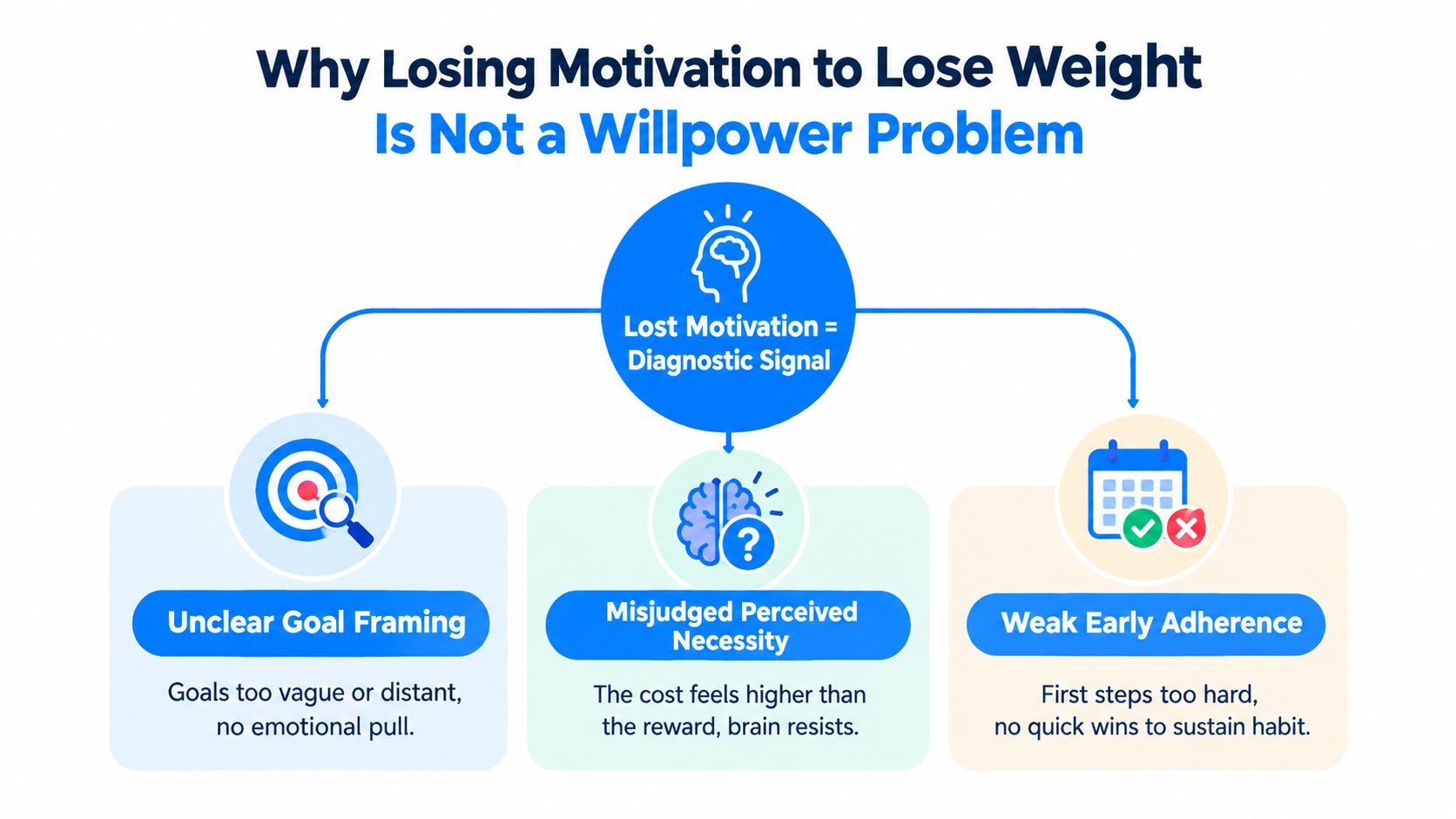
The useful mindset is simple. Motivation loss is information about the plan, not a verdict on the person. If the plan is unclear, unmeasured, or emotionally flat, the next step is to fix the plan.
Setting Goals That Survive the First Month
The most stable goals are concrete, not inspirational. In weight management, the best starting point is usually a 5% to 10% reduction in initial body weight, framed over a workable time horizon rather than as an open-ended wish (goal-setting analysis). That range is modest enough to feel reachable, but meaningful enough to anchor behavior.
A SMART goal that actually functions in clinic
Specific means naming the body outcome, not just “lose weight.” A stronger version might be reducing waist circumference, improving food consistency, or lowering a relevant lab marker.
Measurable means the same scale, same day, same conditions, ideally with a weekly review. Achievable means the calorie deficit matches the person's baseline intake and daily routine. Relevant means the goal connects to something the patient cares about, such as blood pressure, A1c, or energy. Time-bound means a check-in is scheduled before the plan drifts.
A 220-pound adult aiming for 5% to 10% loss is targeting 11 to 22 pounds. That doesn't need to happen overnight, and it shouldn't. A practical cadence is daily food logging, weekly weigh-ins, and monthly lab review when labs are clinically indicated.
| SMART Element | Goal Statement | Measurement Tool |
|---|---|---|
| Specific | Reduce waist circumference and total body weight | Tape measure, scale |
| Measurable | Weigh under the same conditions each week | Weekly weigh-in |
| Achievable | Match intake changes to current habits | Food log, clinician review |
| Relevant | Tie progress to blood pressure or A1c | Home readings, labs |
| Time-bound | Reassess at week 4 and week 12 | Scheduled follow-up |
The trap is scale-only thinking. A person can lose fat, retain fluid, or gain muscle while the scale stalls, so the plan should track more than one signal. That's why a monthly review of trend, waist, and symptoms is more clinically useful than a daily emotional reaction to one number.
Clinical takeaway: A goal is strong when the patient can say exactly what success looks like, how often it will be reviewed, and what data will decide the next step.
Behavior Levers That Rebuild Momentum
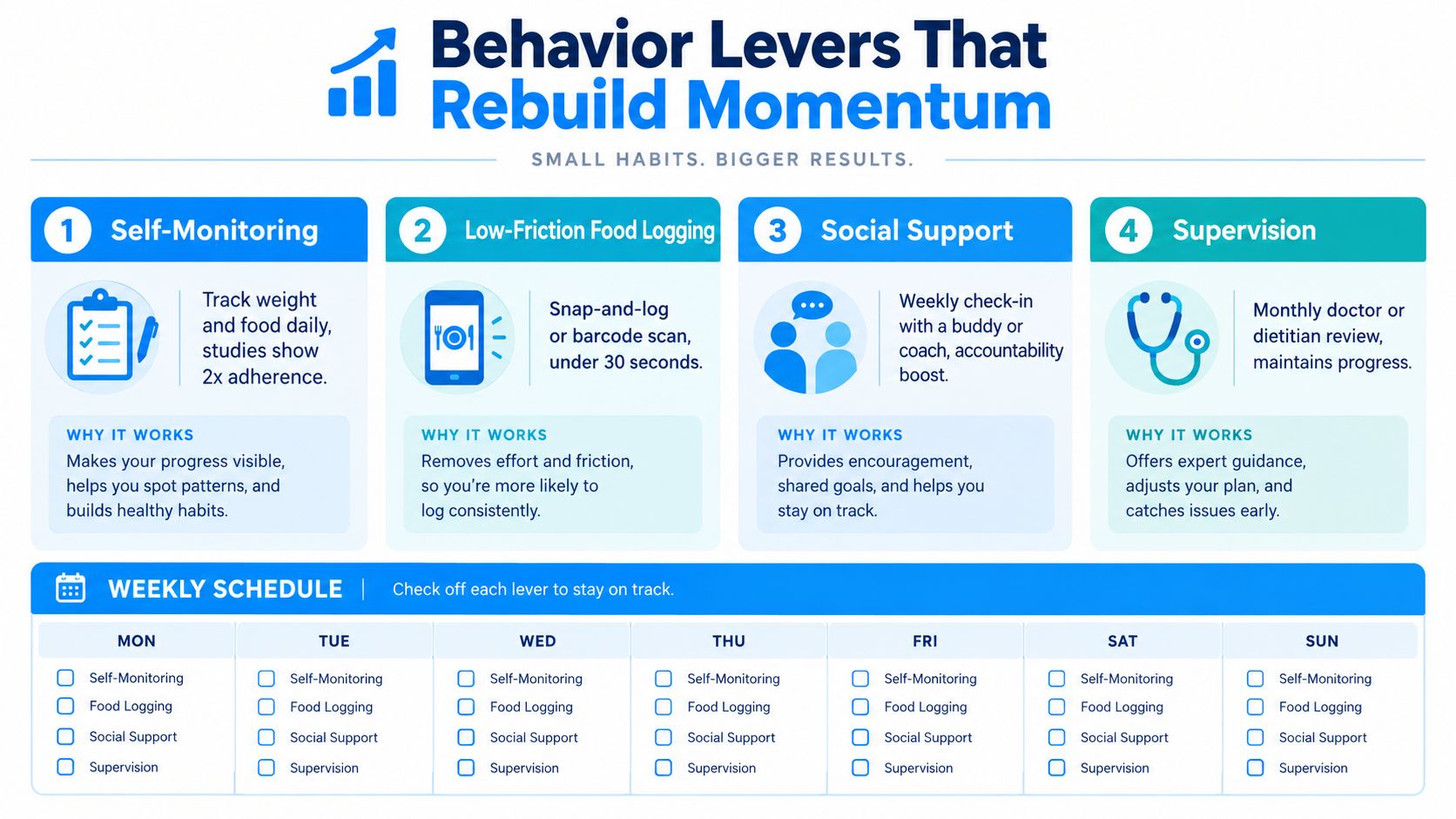
When drive fades, the fix is usually tighter execution, not a new philosophy. The most reliable levers are self-monitoring, low-friction food logging, social support, and supervision, because they reduce the number of places where a plan can fall apart (adherence review).
Build the week around repeatable checkpoints
Monday morning is for weight and waist. Tuesday is for an accountability text to one person who can answer candidly. Wednesday and Friday are for brief food-photo logging instead of full macro entry, because low-friction tracking is easier to keep doing when life gets busy. Thursday or Friday works well for a telehealth review if the patient is already in a monitored plan.
Self-monitoring works because it exposes drift early. In the adherence literature, supervised attendance and social support improve follow-through, and dietary tracking is more dependable than relying on memory alone. Perfection is not the goal; the goal is catching slippage while the patient still has options.
Practical rule: If full logging feels like homework, use a photo plus a hunger score. The goal is usable data, not a perfect diary.
A weekly routine can look like this.
- Monday: Weigh in, note waist, and write down one specific goal for the week.
- Tuesday: Send one accountability message before dinner.
- Wednesday: Photograph lunch and dinner, then note hunger before and after.
- Thursday: Review the trend, not the day's mood.
- Friday: Repeat a brief log and identify one friction point.
- Weekend: Keep the routine simple, then return to the baseline plan on Monday.
Behavioral tactics do have limits. If the person is already consistent and still stalling, the next question is whether biology is defending the current weight despite good effort.
When a Plateau Means It Is Time to Consider Medication
A plateau isn't always a lapse in effort. Sometimes it reflects a defended weight set point, where the body pushes back even while habits stay reasonably steady. That's when the clinician has to separate a behavioral plateau from a pharmacologic plateau.
What suggests the ceiling has been reached
If weight loss has slowed to a crawl for several weeks, hunger remains high after protein-forward meals, and sleep or stress changes haven't fixed the problem, lifestyle alone may be at its practical limit. In that setting, the question becomes whether to add medication, intensify the behavioral plan, or both.
Semaglutide or tirzepatide are generally considered when a patient meets standard obesity-treatment thresholds, such as BMI of 30 or higher, or BMI of 27 or higher with a weight-related condition like hypertension, prediabetes, dyslipidemia, or obstructive sleep apnea. Before prescribing, clinicians usually review metabolic history, current medications, blood pressure, glycemic status, and contraindications.
| Signal | Behavioral Plateau | Pharmacologic Plateau |
|---|---|---|
| Adherence | Missed logs, inconsistent routines | Routines are steady |
| Hunger | Snack drift, skipped protein | Persistent hunger despite structure |
| Sleep and stress | Poor sleep, high stress, irregular meals | Sleep and stress addressed, symptoms persist |
| Progress rate | Slowed by inconsistent effort | Slowed despite consistent effort |
The common safety exclusions matter. A personal or family history of medullary thyroid carcinoma, MEN-2, pregnancy, and active pancreatitis are standard reasons to avoid or defer incretin therapy. Titration also matters, because GI tolerability often determines whether a person can stay on treatment long enough to benefit.
The weight-loss benchmark most patients hear about is 10% to 15%, which has been reported in major semaglutide and tirzepatide trials. That target should be framed as a clinical expectation, not a promise, because response varies and dose escalation has to be individualized.
Clinical takeaway: If effort is steady and hunger still feels unmanageable, the issue may not be discipline. It may be physiology.
Stopping GLP-1s Without Regaining the Weight
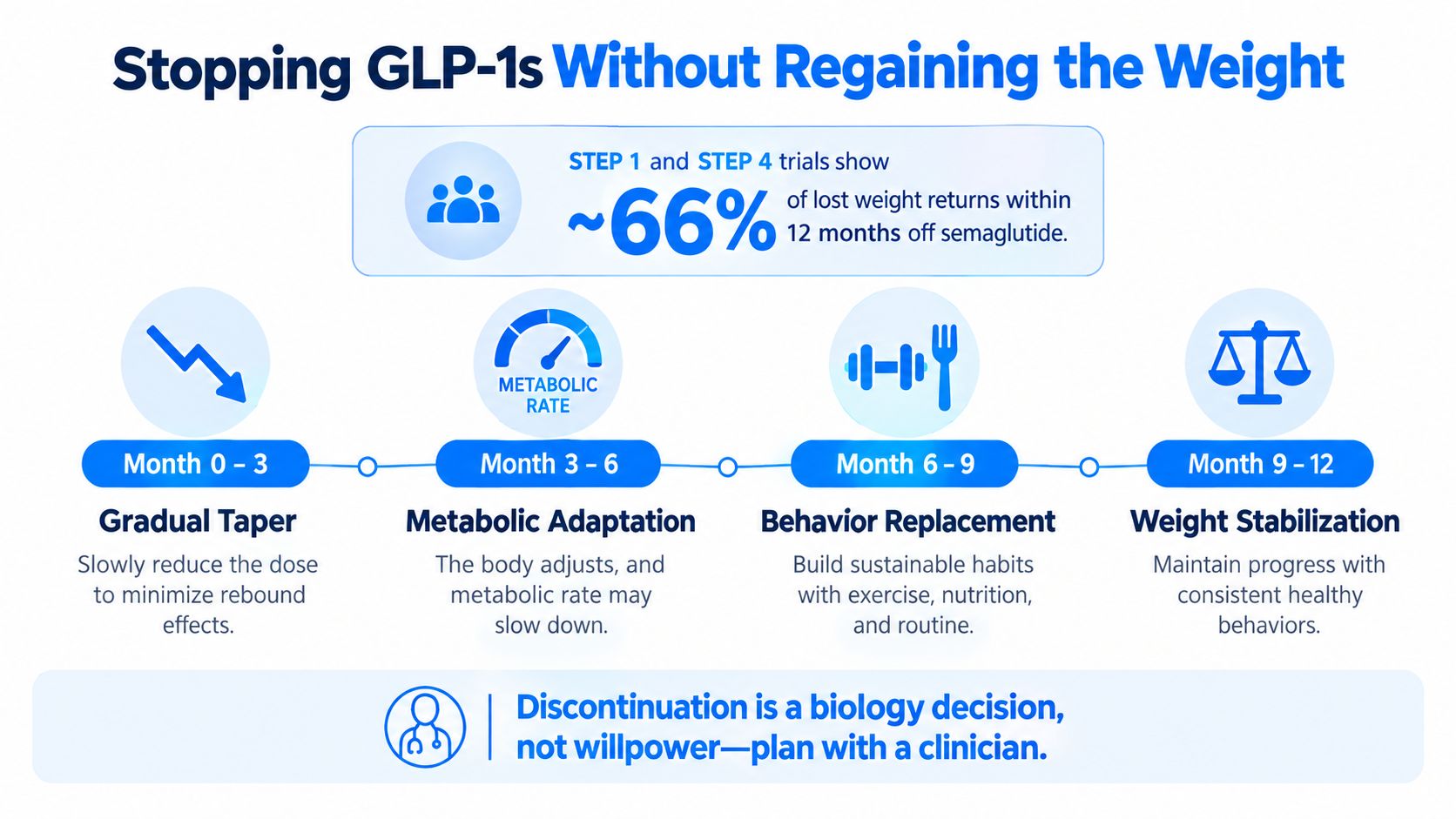
Stopping a GLP-1 is not just a personality test. It is a biology decision. When incretin signaling stops, appetite, gastric emptying, and reward signaling can rebound, and the body often starts defending a higher weight again.
The withdrawal pattern is why discontinuation should be planned rather than improvised. In the semaglutide withdrawal data, about two-thirds of lost weight returned within 12 months off treatment, which is a strong signal that maintenance planning has to begin before the last dose is given (discontinuation evidence). That is not a moral failure. It is the expected behavior of a chronic condition when treatment support is removed.
Three reasonable pathways after weight loss
A prescriber may keep a patient on the lowest effective maintenance dose, especially if appetite suppression is still doing important work. Another option is a gradual taper while simultaneously tightening diet quality, protein intake, activity, and follow-up. A third pathway is transition to an oral option such as metformin or naltrexone-bupropion when it fits the person's medical profile.
Post-cessation monitoring should be deliberate. The most useful markers are fasting glucose, HbA1c, waist circumference, lipid panel, and resting heart rate. Those numbers show whether the body is drifting before the scale makes the problem obvious.
The trade-off is simple. For many patients, continuing therapy is safer and more realistic than stopping. Any taper should happen in shared decision-making with a licensed prescriber, not as a self-experiment based on fear, cost frustration, or a temporary plateau.
How Physician-Directed Telehealth Fits Into a Stalled Plan
Telehealth matters most when the plan has already shown strain. It gives a clinician a way to supervise titration, review side effects, and order labs without making the patient wait for an office visit. That is especially useful during the dose-escalation phase of semaglutide or tirzepatide, when nausea, constipation, or fatigue often decide whether adherence holds.
What to verify before enrolling
A safe program should have a board-certified clinician or equivalent prescriber licensed in the patient's state, a HIPAA-compliant platform, transparent pricing, and pharmacy sourcing through FDA-registered 503A or 503B facilities where applicable. Follow-up also matters more than the intake form. A one-time transaction does not solve a stalled metabolic plan.
For patients who struggle with injections or feel fatigued by needles, one option is a physician-directed program using needle-free orally disintegrating semaglutide tablets when clinically appropriate, such as the service offered by Vials + Vitals. That belongs in the same medical conversation as injectable therapy, not outside it, because the format can affect adherence just as much as the dose.
When telehealth is not enough
New chest pain, syncope, suspected pancreatitis, gallbladder symptoms, pregnancy planning, or unexplained weight loss of more than 1% to 2% per week all need in-person evaluation. Those are not routine follow-up issues. They are reasons to step out of the telehealth lane and into a higher level of care.
The right telehealth setup does one more thing well. It gives the patient a way back in after a gap, without framing the gap as personal failure. That is often the difference between restarting and disappearing from care.
Your First Two Weeks Back on Track
A stalled plan usually improves when the patient gets a short, structured reset instead of a vague lecture. The next 14 days should focus on one measurable goal, one measurement cadence, and one clear escalation rule if progress is absent.
Days 1 through 3
Confirm one SMART micro-goal, such as walking after dinner three times this week or logging breakfast every day. Set baseline weight and waist, and if the stall has lasted more than four weeks, schedule a telehealth review rather than waiting for motivation to return on its own.
Days 4 through 7
Add two friction-reduction tactics. Use one meal photo per day instead of a full tracking diary, and write a two-minute reflection log on what made eating or movement easier or harder. Those notes are often more useful than a perfect calorie count that gets abandoned after three days.
Days 8 through 14
Add one social support contact each week, keep a 20-minute daily walk, and review the adherence data with a clinician if one is already involved. Recheck weight, waist, energy, and hunger scores at day 14, then decide whether to continue the current plan, add medication, or escalate in person.
- Red flags: syncope, severe GI symptoms, new psychiatric symptoms, suspected pregnancy, or a rebound weight gain above 5%.
- Guardrails: one goal, one check-in cadence, one support contact, one review date.
- Non-negotiable: medication changes belong to a licensed prescriber who can review the full history.
A printable reset is only useful if it gets used. The simplest version is this, write the goal, track the week, review the trend, and don't confuse a stalled phase with a failed patient.
Vials + Vitals provides physician-directed telehealth for metabolic health, including semaglutide and tirzepatide-based weight-management protocols, with licensed review, individualized titration, and ongoing follow-up. If the problem is lost motivation, a plateau, or questions about whether medication continuity makes more sense than stopping, visit Vials + Vitals to review care options with a clinician.
Ready to see if this protocol fits your biology?
A licensed provider reviews every request before anything is prescribed.
Calibrate your metabolic protocol →