Longevity Telehealth: What It Is and How It Works

Learn how longevity telehealth delivers metabolic, hormone, and hair care remotely, with clear guidance on safety, monitoring, and choosing a provider.
The popular advice about longevity telehealth is too simple. It treats remote care like a fast lane for prescriptions, when the underlying question is whether a program can build a clinically defensible workup, monitor response over time, and catch the problems that happen after the first refill.
That distinction matters because longevity telehealth sits inside a growing market projected to expand from USD 31.63 billion in 2026 to USD 46.86 billion by 2031, with an 8.18% CAGR over that period, while digital longevity interventions are described as growing even faster at 12.78% annually (Mordor Intelligence). Growth does not equal quality. It only means more patients are being routed into remote systems that need stronger guardrails, better documentation, and clearer follow-up.
Table of Contents
- Why Longevity Telehealth Is Really a Clinical Workup Problem
- From Sputnik Telemetry to Biomarker-Driven Longevity Platforms
- The Four Functional Pillars of a Longevity Telehealth Program
- Remote Services That Hold Up Under Evidence
- Injectable Versus Sublingual GLP-1s and Single Versus Combination Hair Therapy
- Safety Signals Most Telehealth Content Leaves Out
- A Realistic Patient Pathway for the First Ninety Days
- Choosing a Provider and Questions Worth Asking First
Why Longevity Telehealth Is Really a Clinical Workup Problem
Longevity telehealth gets marketed as convenience, but the defensible version is a workflow problem, not a shipping problem. A patient does not need a quicker package of GLP-1s, hormones, or peptide stacks. A patient needs a structured assessment, a baseline, a plan, and evidence that the plan is being adjusted from real data instead of guesswork.
The visit is not the workup
A single video visit cannot replace a clinical foundation. A credible remote longevity encounter should produce a documented history, a review of medications and risks, baseline labs, body-composition data when relevant, and a written reassessment schedule. Without that, the program is just moving prescriptions through a digital funnel.
Practical rule: if the program cannot show what it measures, when it measures it, and what triggers a change in therapy, it is not doing longevity care. It is doing remote dispensing.
That older telehealth lineage matters here. A university source traces a key milestone to October 4, 1957, when Sputnik launched and accelerated technologies for monitoring astronauts' vital signs, and it notes that remote care later reached isolated populations in Alaska (Florida State University). Modern longevity telehealth is following that same logic, continuous monitoring across distance, but now with better consumer diagnostics and more fragmented accountability.
What a credible remote record should contain
The minimum defensible file usually includes:
- Medical history and contraindications, including prior medication intolerance, pregnancy considerations, and cardiometabolic risk.
- Baseline laboratory data, such as lipids, glycemic markers, thyroid studies, and sex hormones when clinically indicated.
- Body-composition or imaging data, especially when weight loss, muscle preservation, or hair health are part of the goal.
- A written titration plan, including when dosing changes happen and what symptoms should trigger a pause.
- A reassessment cadence, so the patient knows when labs, symptom review, and follow-up decisions will happen.
That is the core product behind longevity telehealth, a monitored clinical system. The rest of this article separates that system from marketing language.
From Sputnik Telemetry to Biomarker-Driven Longevity Platforms
The roots of remote care are older than the current wellness boom. The path starts with space medicine, moves through rural telemedicine, and ends with today's biomarker-heavy longevity platforms that can review data without waiting for an office visit.
Remote monitoring has always been part of medicine
The early model was telemetry, not wellness branding. Once clinicians learned how to transmit physiologic data across distance, the concept of caring for a patient without physical co-location became normal in specific settings. That same logic later expanded to isolated communities and other hard-to-reach populations, which is why today's longevity telehealth can feel like a new category while still following a familiar clinical pattern.
The current platform layer is different because it can collect much denser personal data. Continuous glucose monitors, body-composition scans, lipid testing, and wearable outputs let clinicians review trends instead of waiting for isolated snapshots. In a strong program, those data streams are connected to actual prescribing decisions, not just displayed in an app.
The platform is only useful if clinicians can act on it
A biomarker-driven program only works when the data changes care. If a patient's glucose trend, weight trajectory, or symptom pattern is being collected but never translated into titration, nutrition changes, or escalation, the platform is cosmetic. The same is true for sleep and recovery data. Numbers alone do not improve outcomes.
Remote medicine works when the clinician can answer three questions at every check-in, what changed, why it changed, and what should happen next.
The history here explains the present. Longevity telehealth is not a disruptive break from medicine, it is the latest version of an old clinical habit, observing physiology over time and adjusting care accordingly.
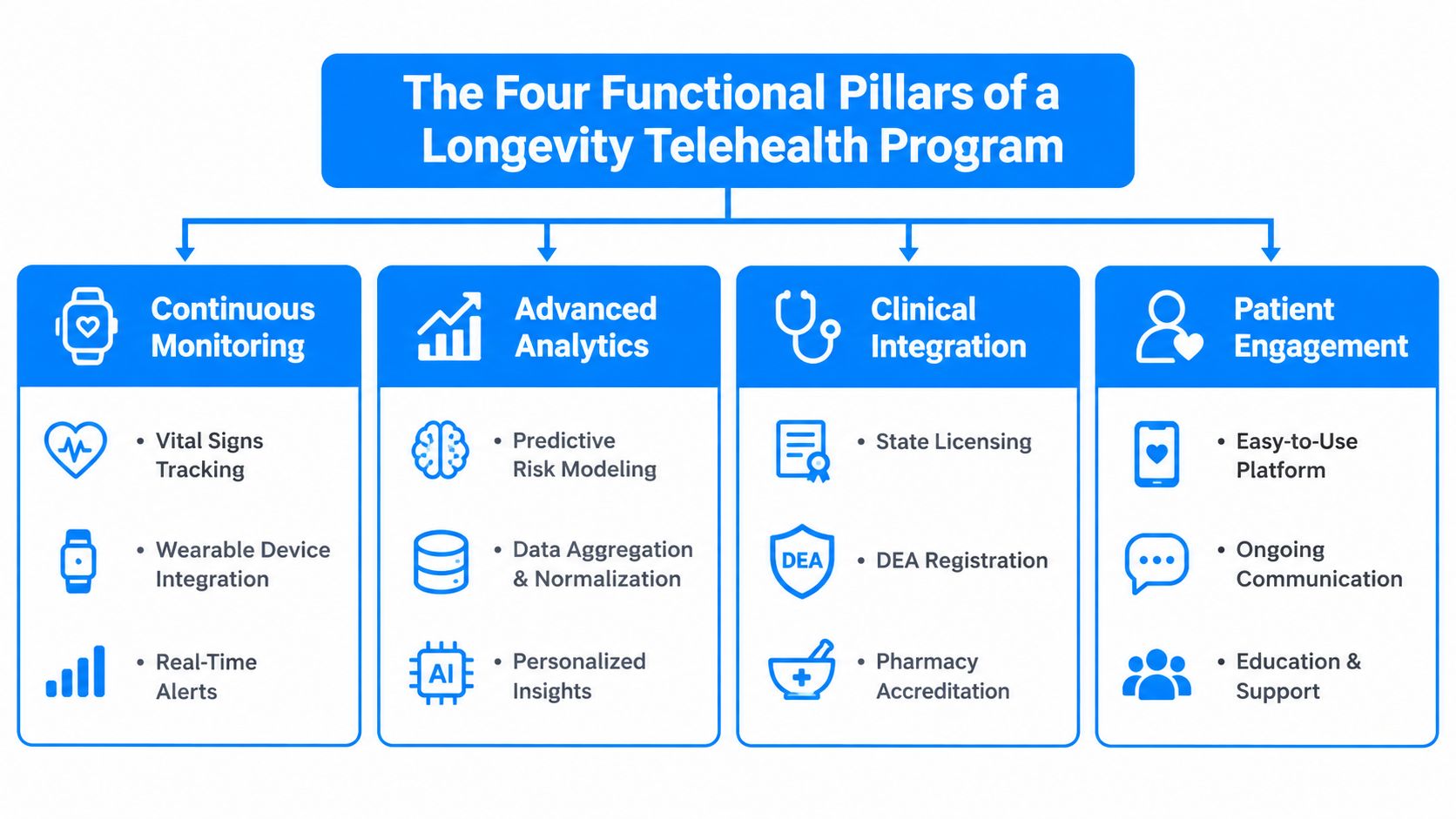
The Four Functional Pillars of a Longevity Telehealth Program
A defensible remote longevity program needs four moving parts, and each one has to be visible to the patient. If even one pillar is weak, the program becomes harder to trust, harder to monitor, and easier to misuse.
Assessment comes first
Assessment means the program gathers structured intake data before therapy starts. That includes the medical history, current medications, relevant labs, and any contraindications that could change whether treatment is appropriate. A program that skips this step is asking the clinician to prescribe blind.
Prescribing has to be individualized
Prescribing should be clinician-led, not formula-driven. The patient should see why a medication was selected, which risks were reviewed, and how dose changes will be made. For metabolic care, that should include explicit titration guardrails rather than automatic refill logic.
Monitoring is the part that keeps care honest
Monitoring needs a schedule. The patient should know when labs will repeat, how side effects will be checked, and what symptoms require a pause or discontinuation. Wearables and glucose data can help, but only when someone is reviewing them.
Coordination prevents care from becoming isolated
The final pillar is coordination. A serious program communicates with primary care or relevant specialists when needed, verifies pharmacy sourcing, and documents escalation pathways. The patient should never feel trapped in a closed loop where the telehealth team sees only the prescription and not the broader medical picture.
| Evidence Strength Across Remote Longevity Services | Typical Interventions | Required Monitoring | Evidence Strength |
|---|---|---|---|
| Metabolic care | GLP-1 receptor agonists, lifestyle support, dose titration | Weight trend, GI side effects, hydration, labs as indicated | Stronger |
| Hormone optimization | Testosterone or thyroid management when clinically indicated | Baseline and periodic labs, symptom review | Moderate |
| Sexual wellness | PDE5 inhibitors, PT-141 in appropriate patients | Cardiovascular screening, adverse-event review | Moderate |
| Hair health | Minoxidil, finasteride, dutasteride, topical adjuncts | Side effects, shedding pattern, response tracking | Moderate |
| Sleep support | At-home sleep testing, behavioral optimization | Sleep study results, symptom follow-up | Moderate |
The checklist is simple. If assessment, prescribing, monitoring, and coordination are not all present, the patient is not buying longevity care. The patient is buying a partial workflow.
Remote Services That Hold Up Under Evidence
Not every remote service category has the same level of evidence. The strongest programs stay within the boundaries of what can be monitored, titrated, and followed over time. The weaker ones lean on branding and hope.
Metabolic care is the clearest use case
GLP-1 therapy has the most mature remote-care logic because the response can be tracked objectively through weight, symptoms, and tolerability. In a real-world telehealth obesity clinic, mean total body weight loss reached 8.9% at 3 months, 14.1% at 6 months, 17.7% at 9 months, and 19.4% at 12 months (PMC obesity clinic study). In a separate 24-month telemedicine cohort, average total body weight loss reached 18.53% at 18 months and 20.27% at 24 months, with about two-thirds of participants losing more than 15% and over one-quarter exceeding 25% (Wiley obesity cohort).
Those results show why ongoing titration matters. This is not a one-and-done prescription. It is a long-duration metabolic program.
Other services require tighter restraint
Hormone optimization can be reasonable when the diagnosis is clear and labs support it, but the monitoring burden is real. Thyroid care and testosterone care both require periodic laboratory follow-up, symptom review, and documentation of the reason treatment is continuing. Sexual wellness care needs cardiovascular screening before prescribing in appropriate cases, especially when vascular disease is a concern.
Hair restoration belongs in the same category of monitored care. Finasteride, dutasteride, and minoxidil can be useful, but the patient should understand that response takes time and side effects need tracking. Sleep optimization also fits remote care well when it starts with at-home testing and follow-up, not with assumptions.
| Service Category | Typical Interventions | Required Monitoring | Evidence Strength |
|---|---|---|---|
| Metabolic | Semaglutide, tirzepatide, nutrition support | Weight, symptoms, dose tolerance | Strong |
| Hormone | Testosterone or thyroid therapy when indicated | Baseline and periodic labs, symptom changes | Moderate |
| Sexual wellness | PDE5 inhibitors, PT-141 | Cardiovascular screening, adverse-event checks | Moderate |
| Hair health | Finasteride, dutasteride, minoxidil | Shedding pattern, sexual side effects, response | Moderate |
| Sleep | At-home testing, behavioral changes | Sleep results, symptom tracking | Moderate |
The key standard is the same across categories. No service should be sold unless the program can say how it monitors safety and when it stops.
Injectable Versus Sublingual GLP-1s and Single Versus Combination Hair Therapy
Patients usually ask for two comparisons first, how the drug gets into the body, and whether one treatment is enough or a combination works better. The right answer depends on monitoring tolerance, not marketing style.
Formulation choice changes the tradeoff
Injectable GLP-1 therapy tends to have more established outcome data and more predictable dosing. Sublingual ODT options can appeal to people who dislike needles, but the absorption variability is tighter and the clinical team has to pay closer attention to response. That does not make one universally better, it makes the monitoring burden different.
Hair treatment follows the same logic
Single-agent therapy is simpler. Combination therapy can be more effective in selected patients, but it also increases cumulative exposure and the need for follow-up. For a patient who is uneasy about side effects, monotherapy may be the cleaner starting point. For a patient whose hair loss is progressing despite standard treatment, a combination strategy can be reasonable if the clinician documents the rationale.
| Decision Axis | Injectable GLP-1 | Sublingual ODT GLP-1 | Hair Monotherapy | Hair Combination |
|---|---|---|---|---|
| Delivery | Injection | Needle-free oral dissolve | Single agent | Oral plus topical or device-based support |
| Dosing precision | More predictable | More variable | Simpler | More complex |
| Tolerability | Often limited by GI effects | May suit needle-averse patients | Fewer moving parts | More monitoring burden |
| Storage | Requires careful handling | Usually less demanding | Standard | Depends on components |
| Follow-up needs | Ongoing titration | Ongoing titration plus response checks | Lower | Higher |
The decision is not “stronger versus weaker.” It is “which option can be monitored safely in this patient.” That framing keeps the conversation clinical instead of promotional.
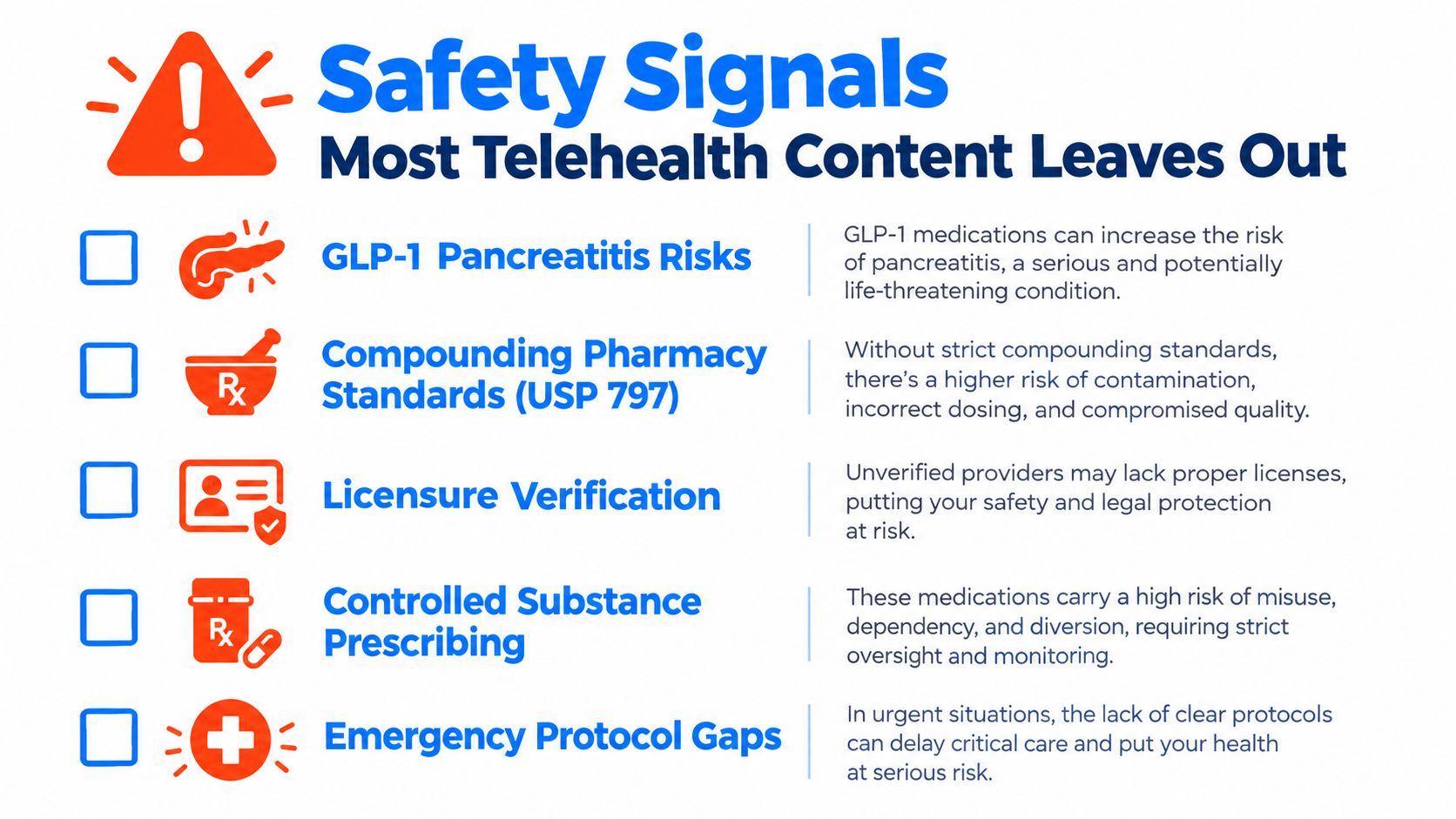
Safety Signals Most Telehealth Content Leaves Out
The safety conversation is where low-accountability programs tend to get quiet. Patients hear about access and convenience, but not about what can surface after the first few weeks of treatment.
GLP-1 safety is mostly about the gut and the maintenance plan
The main adverse effects of GLP-1 receptor agonists are gastrointestinal, including nausea, vomiting, diarrhea, constipation, bloating, and abdominal pain (PLOS Medicine review). Stanford Medicine notes that these effects are tied to the drugs' mechanism and can worsen when thirst is reduced and dehydration sets in, so hydration, constipation prevention, and stepwise dose escalation need to be built into the protocol (Stanford Medicine).
Stopping therapy is another safety issue that telehealth writeups often gloss over. Stanford's 2026 summary reports that the STEP 1 extension found participants regained about two-thirds of their lost weight within one year after stopping semaglutide, and a 2026 analysis of more than 9,000 patients found average regain of nearly 2 pounds per month after discontinuing semaglutide or tirzepatide. That makes follow-up a maintenance problem, not a billing issue.
Hair and compounded product risks deserve equal seriousness
Hair treatments can cause their own problems. Semaglutide-associated alopecia was reported in 23 of 334 participants (7%) versus 9 of 333 (3%) on placebo in OASIS-1, and tirzepatide trials reported alopecia in 119 of 2,183 treated participants (5.4%) versus 22 of 2,221 placebo participants (0.9%) (PMC alopecia review). Hair shedding is not a cosmetic footnote when a patient is already dealing with body-image change or rapid weight loss.
Medication quality matters too. KFF Health News reported that medication-error reports involving popular weight-loss drugs rose from just over 2,000 in 2020 to more than 25,000 in 2025, which shows the safety risks that can come with online access (KFF Health News). Programs that handle intake forms, analytics, pharmacy routing, SMS, and reporting across multiple jurisdictions also need strong data governance and privacy controls.
Informed consent is not a checkbox. It continues every time the dose changes, the refill is approved, or the patient reports a new symptom.
A Realistic Patient Pathway for the First Ninety Days
A rigorous program should feel predictable. The patient should know what happens first, what happens next, and what gets documented before any dose is increased.
Days 1 to 14 set the baseline
The first two weeks should center on intake, history, and objective data. That usually includes fasting glucose, HbA1c, lipid panel, thyroid studies, sex hormones when relevant, and liver and kidney function, along with a body-composition scan when weight or muscle preservation matters. The consent process should also explain risks, expected side effects, and what the program will do if the patient does not tolerate treatment.
Days 15 to 60 establish early response
Once the clinician reviews the data, the treatment plan should be written and the patient should start at a low dose if therapy is appropriate. That window is where lifestyle onboarding matters most, because the medication alone is not the whole intervention. Side effects, hydration, bowel habits, appetite changes, and any red flags should be reviewed at scheduled checkpoints.
Days 61 to 90 shift into maintenance
By the third month, the program should be able to show outcome review, dose stabilization, and a maintenance plan. That plan should define quarterly labs when needed and annual imaging or body-composition reassessment when clinically indicated. A patient should be able to look at the record and see that the program is managing a course of care, not just dispensing refills.
- What the patient should receive: a written plan, a schedule for follow-up, and clear instructions for side effects or worsening symptoms.
- What the patient should document: weight trend, appetite changes, bowel function, sleep, and any new concerns.
- What the patient should hear from the clinician: what is improving, what is uncertain, and what would cause treatment to change.
If those elements are missing, the program is too transactional for serious longevity care.
Choosing a Provider and Questions Worth Asking First
A longevity telehealth program should start with clinical proof, not branding. Patients should verify licensure in the state where care is delivered, confirm that controlled-substance prescribing is handled properly, and check that laboratory and pharmacy partners are legitimate. CLIA-certified labs, HIPAA-compliant systems, and clear escalation pathways are basic requirements.
A good screening tool is simple: ask who is responsible for each part of care.
Twelve questions that expose low-accountability care
- Who reviews the intake, and what credentials do they hold?
- How is licensure verified in the state where the patient is located?
- What pharmacy fills the prescription, and how is sourcing documented?
- Is the medication branded or compounded, and what standards apply?
- What labs are required before treatment starts?
- How often are labs or body-composition data repeated?
- What side effects trigger a dose hold or discontinuation?
- How is adverse-event reporting handled?
- What happens if the program stops offering care?
- How is continuity with primary care or specialists managed?
- What privacy controls protect biomarker and intake data?
- What happens if the patient needs urgent help after hours?
These questions separate structured care from casual selling. Compounded medications may be appropriate in some situations, but the patient should know the source, the standards used, and why compounding was chosen. Insurance coverage varies widely, so patients should ask before enrolling rather than assuming the program will be covered. Red flags include vague monitoring promises, no clear lab cadence, no pharmacy transparency, and a process that treats prescription approval like an instant checkout.
One option in this space is Vials + Vitals, a physician-directed telehealth service that uses an online clinical assessment, U.S.-licensed providers, and accredited U.S. pharmacy fulfillment for GLP-1, sexual wellness, sleep, and hair-related protocols. That kind of structure only helps when the patient still asks the right questions about monitoring, follow-up, and continuity.
A serious longevity telehealth program should be able to show its work, from baseline assessment to titration to maintenance. Patients who want remote care with real clinical oversight should choose a team that documents the workup, tracks outcomes, and explains the safety rules before the first prescription leaves the pharmacy. Visit Vials + Vitals to see how a physician-directed telehealth pathway can be structured around monitoring, eligibility, and ongoing follow-up.
Ready to see if this protocol fits your biology?
A licensed provider reviews every request before anything is prescribed.
Explore hair protocols →