Is Semaglutide the Same as Ozempic? a Medical Guide

Is Semaglutide the Same as Ozempic. Discover if semaglutide is the same as Ozempic. This medical guide clarifies differences between the molecule, brand
The counterintuitive answer is no. Semaglutide and Ozempic are closely related, but they aren't interchangeable names for the same medicine. Semaglutide is the active drug molecule, while Ozempic is a specific FDA-approved product with its own formulation, delivery device, labeling, indication, and dosing schedule. The distinction matters whenever a patient changes brands, considers a compounded preparation, or receives treatment through telehealth. The FDA's Ozempic prescribing information identifies Ozempic as a once-weekly semaglutide injection for adults with type 2 diabetes, used alongside diet and exercise.
Table of Contents
- Understanding Semaglutide and Ozempic
- Why Product Differences Matter More Than the Molecule
- Comparing Dosing and Clinical Outcomes
- The Risks of Compounded Semaglutide
- Balancing Benefits and Treatment Risks
- Making Informed Decisions About Your Prescription
Understanding Semaglutide and Ozempic
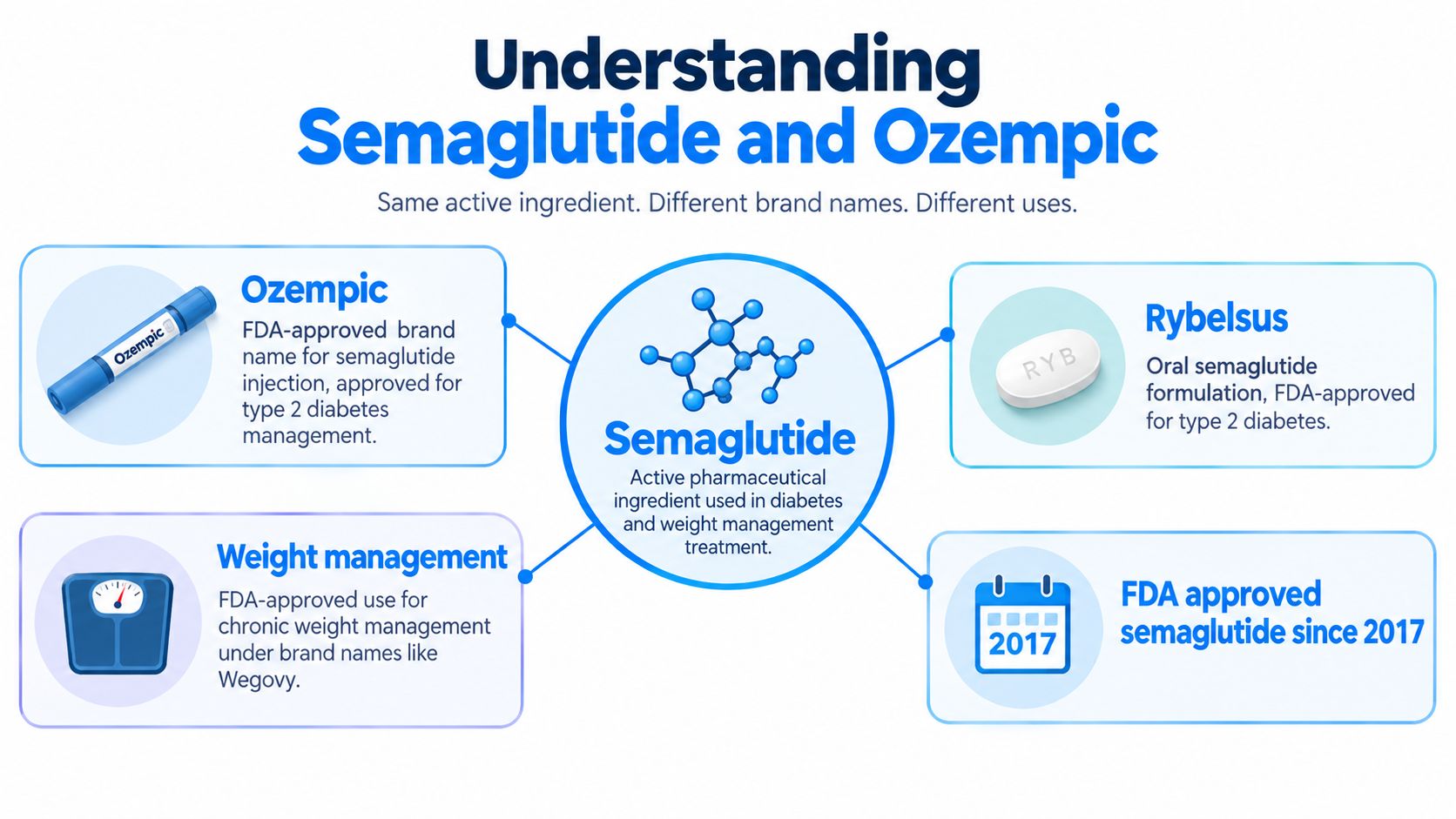
Semaglutide is the active pharmaceutical ingredient. Ozempic is one branded product that contains semaglutide. That relationship is similar to the difference between an active ingredient and a finished prescription product: the ingredient explains part of how the medicine works, but the brand identifies the complete medication supplied to the patient.
Ozempic is a specific manufactured injectable formulation. Its product identity includes the concentration, inactive ingredients, pen device, instructions for use, approved indication, and quality controls. Saying that someone takes “semaglutide” doesn't establish that the person takes Ozempic, that the medication came from the Ozempic manufacturer, or that it follows Ozempic's exact FDA labeling.
The molecule and the medicine
Semaglutide belongs to the GLP-1 receptor agonist class. Ozempic delivers that molecule through a once-weekly subcutaneous injection and is labeled for improving glycemic control in adults with type 2 diabetes, alongside diet and exercise. Its labeling also covers particular cardiovascular and kidney-risk-reduction uses in eligible adults with type 2 diabetes.
Other products can contain the same molecule while serving different clinical purposes. An oral semaglutide product uses a tablet rather than an injection, while a semaglutide product approved for chronic weight management follows a different regulatory framework and dosing plan. The shared ingredient doesn't erase those differences.
Practical rule: A prescription should identify the exact product, formulation, dose in milligrams, route, frequency, and indication. “Semaglutide” alone is incomplete medication information.
The most useful answer to “is semaglutide the same as Ozempic” is therefore: Ozempic contains semaglutide, but semaglutide isn't automatically Ozempic. Patients should treat the product name and the active ingredient as related pieces of information, not interchangeable labels.
Why Product Differences Matter More Than the Molecule
The clinically important question isn't only which molecule is present. It's what the specific product is approved to treat and how it is intended to be dosed.
Ozempic's U.S. labeling is centered on adults with type 2 diabetes. It is used with diet and exercise to improve glycemic control, and specified indications address reduction of certain cardiovascular events and kidney-related risks in eligible adults with type 2 diabetes. Those uses are attached to the Ozempic product and its FDA-approved labeling, not to every preparation that contains semaglutide. The current FDA prescribing information describes these product-specific indications and dosing options.
A different semaglutide product is approved for chronic weight management. FDA documentation identifies Wegovy as semaglutide approved for that purpose in adults with obesity. This doesn't mean that Ozempic and Wegovy are identical products, or that a patient can switch between them without a clinician reviewing the indication, dose, and treatment goals.
Indication determines the clinical framework
A clinician selecting semaglutide considers the condition being treated, the intended outcome, contraindications, concurrent medicines, tolerability, and coverage. A patient being treated for type 2 diabetes may need a product labeled for glycemic control. A patient receiving chronic weight-management care may need a product whose approval, evidence base, and dosing schedule correspond to that goal.
Using Ozempic specifically for obesity or weight management can represent use outside its FDA-approved indication, even though its active ingredient is semaglutide. That decision may sometimes be made by a licensed clinician, but it shouldn't be inferred from the ingredient name or treated as an automatic substitution.
Formulation changes the practical experience
Product differences extend beyond the indication. Semaglutide may be supplied as an injectable pen, an oral formulation, or a preparation made by a compounding pharmacy. These options can differ in:
- Delivery system: A prefilled pen and an oral tablet require different administration techniques and adherence routines.
- Concentration: A vial may require a patient to convert between units and milligrams, creating an opportunity for calculation errors.
- Labeling: Each FDA-approved product has its own approved uses, dose escalation instructions, and patient information.
- Evidence base: Clinical results for one dose and indication shouldn't automatically be applied to another product or regimen.
The molecule is important, but it isn't the whole prescription. Product identity determines how the molecule is delivered, what the FDA has evaluated, and which clinical conclusions can reasonably be applied.
Comparing Dosing and Clinical Outcomes
Dose is one of the clearest reasons semaglutide products shouldn't be treated as interchangeable. Ozempic's labeled initiation schedule starts at 0.25 mg once weekly for four weeks, followed by 0.5 mg weekly. When additional glycemic control is needed, the dose may increase to 1 mg or 2 mg weekly. The 0.25 mg dose is an initiation dose, not a dose intended to provide glycemic control. The FDA label for Ozempic describes this escalation approach.
Weight-management evidence generally centers on a different regimen, semaglutide 2.4 mg once weekly. That dose isn't a stronger version of the standard Ozempic diabetes regimen in a practical or regulatory sense. It belongs to a different product framework, with a different approved purpose and a different body of clinical evidence.
What the trial data actually show
Across the STEP 1, 3, 4, and 8 trials, semaglutide 2.4 mg produced mean weight losses of approximately 14.9% to 17.4% from baseline at 68 weeks in adults with overweight or obesity without type 2 diabetes. Between 69% and 79% of participants achieved at least 10% weight loss, compared with 12% to 27% receiving placebo. Between 51% and 64% achieved at least 15% weight loss, compared with 5% to 13% with placebo. These figures are reported in a review of the defined STEP trial populations and regimens. The clinical review of the STEP trials makes clear that these results describe a specific dose, treatment duration, lifestyle intervention, and patient population.
Those results shouldn't be presented as the expected outcome for every semaglutide product. They don't establish that every patient taking Ozempic will experience the same weight change, and they don't prove that a compounded preparation matches the trial regimen.
| Clinical question | Why the answer matters |
|---|---|
| What condition is being treated? | Diabetes management and chronic weight management have different product indications. |
| What dose is prescribed? | A trial dose of 2.4 mg isn't equivalent to an Ozempic maintenance dose of 0.5 mg, 1 mg, or 2 mg. |
| How is the medication delivered? | A pen, tablet, and vial can require different instructions and safeguards. |
| Which evidence applies? | Results should match the product, dose, population, and treatment duration being discussed. |
Titration is part of the treatment
Gradual escalation isn't an administrative detail. It helps patients adjust to treatment and can improve tolerability. Rapid escalation can increase gastrointestinal adverse effects and make adherence more difficult, even when the active molecule is appropriate.
A patient shouldn't increase the dose to replicate a result from a weight-management trial. The prescribed product and the clinician's titration plan must govern the dose.
The Risks of Compounded Semaglutide
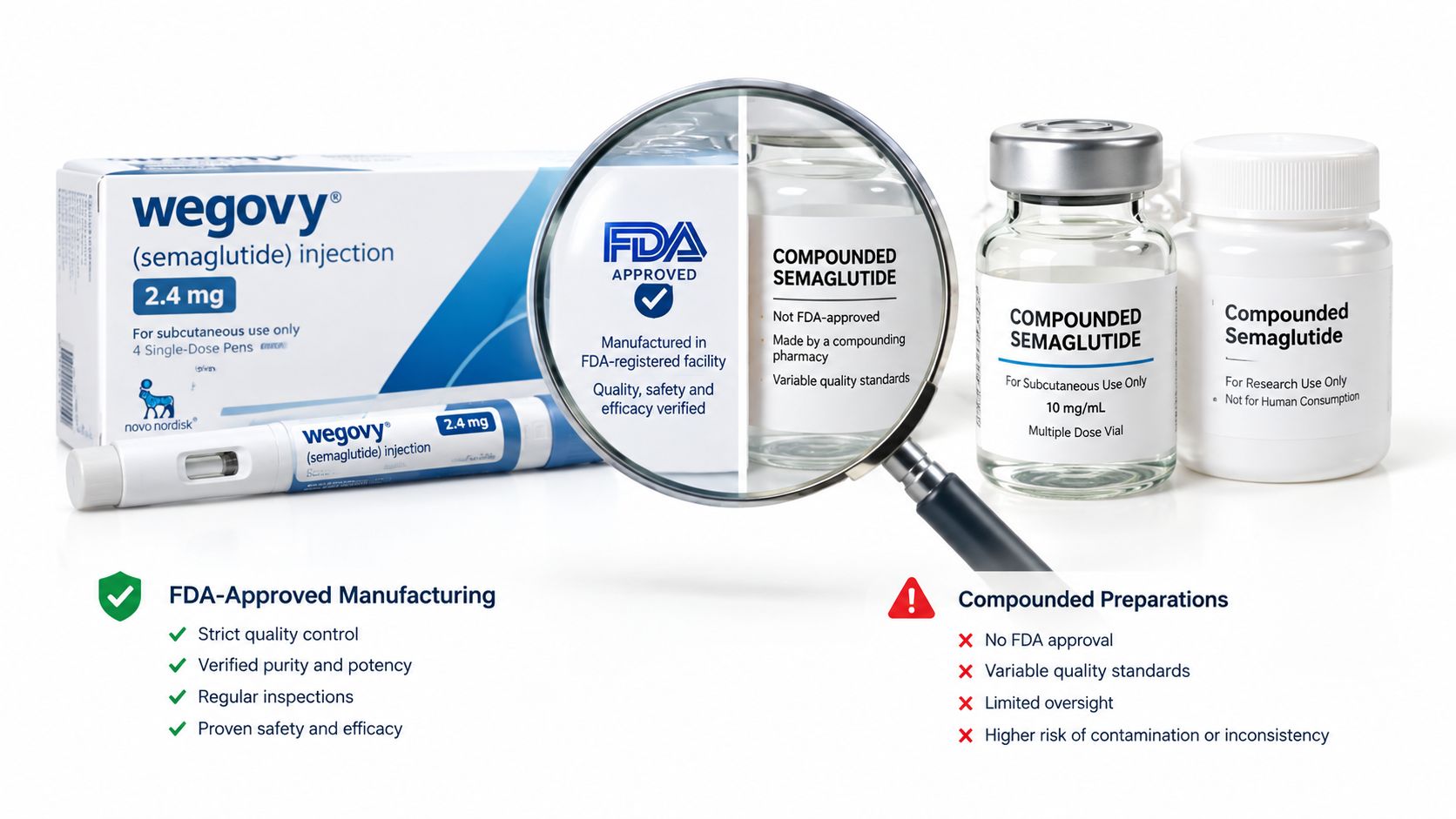
Compounded semaglutide creates a separate question from whether semaglutide and Ozempic contain the same active molecule. A compounded preparation may contain semaglutide, but it hasn't undergone FDA premarket review for safety, effectiveness, or manufacturing quality in the way an FDA-approved product has.
That doesn't make every compounded preparation fraudulent, and it doesn't mean that every compounding pharmacy operates in the same way. It does mean that “contains semaglutide” isn't enough to establish equivalence to Ozempic. Product identity, concentration, pharmacy oversight, testing, storage, and labeling all require separate verification.
Why regulatory status changes the decision
The FDA removed semaglutide from the U.S. drug-shortage list in February 2025. That change ended the shortage-based legal pathway that had allowed pharmacies to compound copies of commercially available semaglutide after applicable transition periods. The FDA's semaglutide compounding update describes the regulatory context and safety concerns relevant to compounded preparations.
Patients also need to understand the difference between a vial label and a verified prescription. FDA warnings and academic discussions have identified risks involving dosing errors, storage, fraudulent labeling, and semaglutide salt forms whose safety and effectiveness in humans haven't been established.
Questions that protect against preventable errors
A patient receiving a compounded preparation should ask the prescriber and pharmacist:
- What exact form is being supplied? The answer should identify the formulation, concentration, and whether it is an approved product or a compounded preparation.
- How does the volume convert to milligrams? Instructions should clearly connect the prescribed milligram dose to the measurement on the syringe.
- Who prescribed and dispensed it? Treatment should involve a licensed clinician and a legitimate pharmacy with appropriate oversight.
- How should it be stored? The pharmacy should provide product-specific storage and handling instructions.
- What happens if the vial, label, or dose seems inconsistent? Patients should pause administration and contact the prescriber or pharmacist rather than guessing.
A compounded medication should never be described automatically as Ozempic. Individualized titration can't correct an incorrectly labeled concentration, improper storage, an unverified ingredient, or a dosing misunderstanding.
Balancing Benefits and Treatment Risks
Semaglutide can produce meaningful clinical benefits, but the strength of the evidence depends on the product, dose, indication, and patient population. The evidence doesn't support a blanket statement that every semaglutide preparation provides the same outcome.
In a randomized trial of adults with obesity and heart failure with preserved ejection fraction, once-weekly semaglutide 2.4 mg produced a mean body-weight change of −13.3% at 52 weeks, compared with −2.6% with placebo. The estimated between-group difference was −10.7 percentage points. The study also reported greater improvement in the Kansas City Cardiomyopathy Questionnaire clinical-summary score, 16.6 points versus 8.7 points, and fewer serious adverse events overall, with a similar frequency of discontinuation because of serious adverse events. The published trial in the New England Journal of Medicine provides the relevant population and clinical context.
Those findings are clinically important, but they don't establish that semaglutide is appropriate for every patient with obesity, heart failure, diabetes, or another metabolic condition. The trial result belongs to the studied regimen and population. It shouldn't be used as a promise for an unapproved preparation or an unrelated dose.
Tolerability affects whether treatment works
Patients often focus on the target dose and overlook the escalation process. Gastrointestinal symptoms can interfere with eating, hydration, daily activities, and adherence. A slower adjustment may be clinically preferable when symptoms persist, while a rapid increase can undermine the very treatment plan it was intended to accelerate.
Medical supervision should include review of:
- Current medicines, including treatments that may affect glucose or gastrointestinal function.
- Relevant comorbidities, which can change the risk-benefit assessment.
- Treatment response, including appetite, glycemic control when relevant, body weight, and functional changes.
- Adverse effects, particularly symptoms that are severe, persistent, or inconsistent with expected tolerability.
- Product handling, including storage, administration technique, and dose measurement.
A favorable trial result is evidence for a defined treatment plan, not permission to recreate that plan with an unidentified product.
The safest interpretation is balanced. Semaglutide may offer substantial benefits for appropriately selected patients, but those benefits depend on accurate product selection, correct dosing, gradual titration, and follow-up that responds to the patient's actual course.
Making Informed Decisions About Your Prescription
Patients can reduce confusion by treating the prescription as a set of verifiable details rather than a single ingredient name. Before starting or switching treatment, the medication record should answer five practical questions.
- What is the exact product name? Determine whether the prescription is for Ozempic, another FDA-approved semaglutide product, or a compounded preparation.
- What condition is the product intended to treat? Confirm whether the clinical goal is glycemic control, chronic weight management, or another clinician-determined use.
- What is the dose in milligrams? Don't rely only on pen clicks, syringe units, or volume. The milligram dose should be clear.
- How often and by what route is it administered? Weekly injection and oral administration aren't interchangeable instructions.
- Which pharmacy dispensed it, and how should it be stored? The pharmacy should provide clear handling guidance and a way to verify the product if questions arise.
The FDA's current Ozempic labeling reinforces why product-specific instructions matter. A clinician may prescribe semaglutide under a particular brand or formulation, but the ingredient alone doesn't establish the product's manufacturer, concentration, excipients, regulatory status, or approved use.
Patients considering telehealth care should ask whether a U.S.-licensed clinician reviews the intake, whether the formulation is identified precisely, how titration decisions are made, and which pharmacy fulfills the prescription. Vials + Vitals provides physician-directed telehealth evaluation for semaglutide and other metabolic therapies, with provider-determined formulation and titration and fulfillment through its stated accredited U.S. pharmacy network.
A patient shouldn't substitute one semaglutide product for another based solely on the shared molecule. The prescriber and pharmacist should confirm the change, document the new dose and administration method, and explain any differences in the device or instructions.
For patients seeking medically supervised guidance, Vials + Vitals offers an online clinical assessment followed by review from U.S.-licensed providers who determine eligibility, formulation, and titration. Visit the service to discuss whether a semaglutide protocol is appropriate and to clarify the product and dosing details before treatment begins.
Ready to see if this protocol fits your biology?
A licensed provider reviews every request before anything is prescribed.
Calibrate your metabolic protocol →