Is Semaglutide Better Than Liraglutide? a Clinical Guide
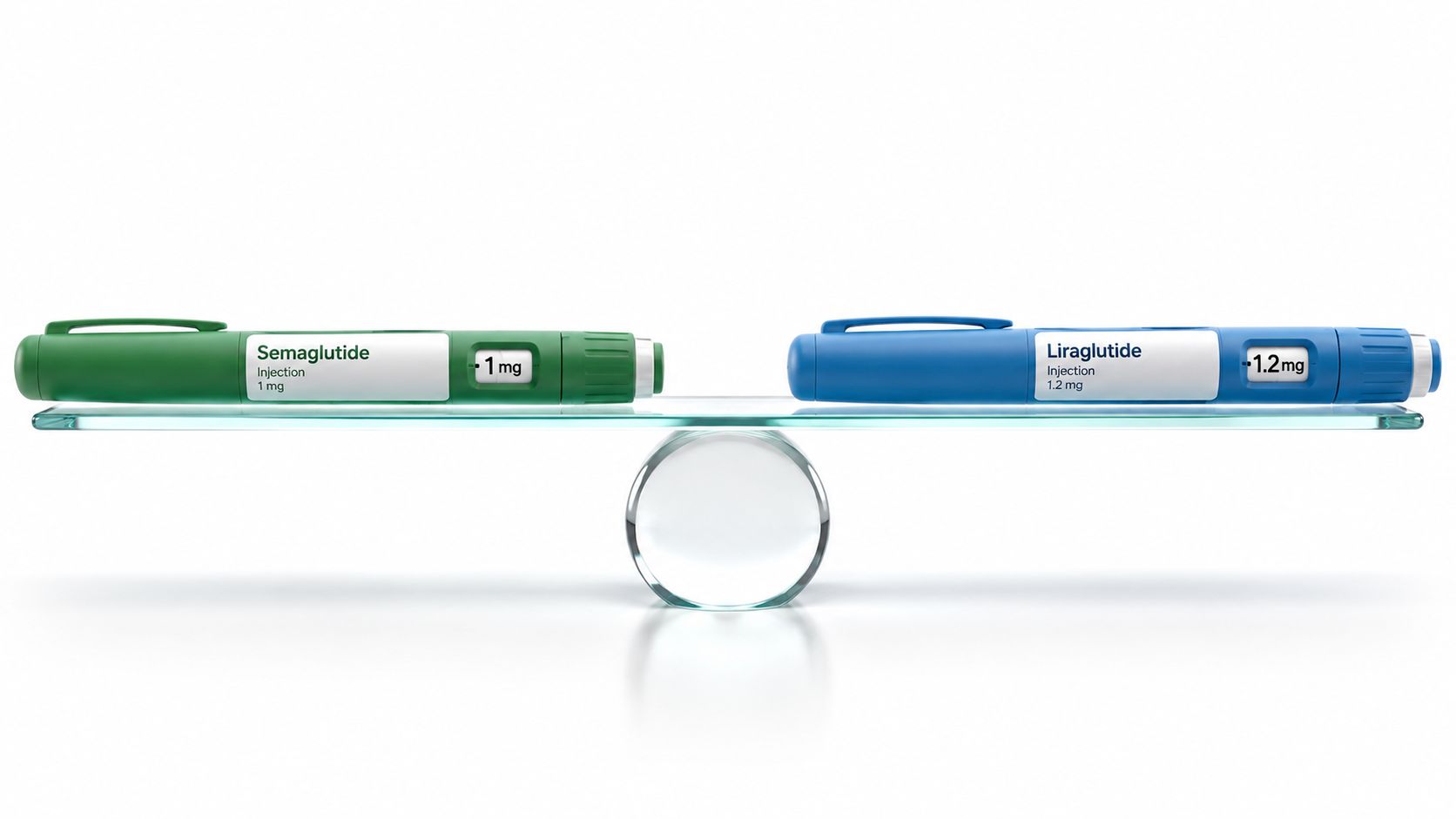
Is semaglutide better than liraglutide? Compare efficacy, dosing, side effects, trial evidence, and patient fit in this evidence-based clinical guide.
Semaglutide generally produces larger weight and HbA1c reductions than liraglutide in head-to-head trials. That answer matters, but it stops being simple once access, persistence, tolerability, and the lack of long-term comparative certainty enter the room.
| Attribute | Semaglutide | Liraglutide |
|---|---|---|
| Dosing pattern | Weekly for injectable use, daily for oral use | Daily injection |
| Weight-loss potency | Usually stronger in trials | Usually less weight loss in trials |
| Glucose-lowering effect | Stronger average HbA1c reduction | Effective, but generally smaller HbA1c drop |
| Practical advantage | Less frequent dosing, broader efficacy signal | Familiar daily routine, sometimes easier to pause or adjust |
| Main trade-off | More potent, but access and GI burden can be limiting | Less potent, but may fit some coverage and tolerance patterns better |
Table of Contents
- What This Comparison Actually Answers
- Side-by-Side Profile of Semaglutide and Liraglutide
- Head-to-Head Trial Evidence for Weight and Glucose
- Where the Evidence Stops and Real Life Begins
- Real-World Effectiveness, Access and Adherence
- Safety, Tolerability and Long-Term Unknowns
- Choosing the Right Fit by Patient Profile
- Clinical Takeaways and Decision Framework
What This Comparison Actually Answers
Semaglutide and liraglutide are both GLP-1 receptor agonists, meaning they work through the same metabolic pathway, but they are not interchangeable in practice. Semaglutide is the more potent drug on average, and that shows up first in body-weight loss and HbA1c reduction, especially when treatment is taken as intended and long enough to matter clinically.
The most useful way to read this comparison is simple. If the question is “which drug produces more loss on average?”, semaglutide wins. If the question is “which drug can this patient consistently stay on?”, the answer often depends on access, side effects, injection burden, and whether the patient can keep the prescription filled.
This guide focuses on weight, glycemic control, dosing logistics, side effects, and who each drug fits best. It does not replace individualized prescribing, because the right choice for a patient with obesity only is not always the right choice for a patient with obesity plus diabetes, cardiovascular disease, coverage instability, or needle aversion.
The practical scope
For obesity, the comparison is mainly between subcutaneous semaglutide 2.4 mg and liraglutide 3.0 mg. For diabetes, the relevant comparison is semaglutide 1.0 mg or 2.0 mg versus liraglutide 1.8 mg.
Clinical rule: when the patient wants the most weight loss and can tolerate treatment, semaglutide is usually the stronger choice. When continuity, budget, or daily routine shape the real decision, liraglutide still has a legitimate place.
Side-by-Side Profile of Semaglutide and Liraglutide
Both drugs are synthetic GLP-1 receptor agonists, but their chemistry explains the dosing difference. Semaglutide was modified to support once-weekly binding, while liraglutide was acylated for once-daily binding, which is why semaglutide fits weekly injection schedules and liraglutide does not.
Dosing, form, and approval pattern
Semaglutide is used as a weekly subcutaneous injection for weight management, with titration from 0.25 mg up to 2.4 mg, and for diabetes up to 2.0 mg. It also exists as an oral daily tablet in the 3 mg to 14 mg range. Liraglutide is a daily injection, titrated from 0.6 mg to 3.0 mg for weight management or 1.8 mg for diabetes.
The structural choice is not just convenience, it changes the entire patient experience. A weekly pen can be easier for a patient who dislikes needles, while a daily regimen can feel more familiar to someone who wants a predictable routine and the ability to skip a single dose if side effects flare.
Indications and clinical positioning
Semaglutide is approved for type 2 diabetes, chronic weight management, and cardiovascular risk reduction in adults with type 2 diabetes and established cardiovascular disease. Liraglutide is approved for type 2 diabetes, weight management in adolescents 12 and older, and cardiovascular risk reduction in type 2 diabetes with cardiovascular disease.
That difference matters because the label influences how clinicians think, how insurers behave, and how patients frame expectations. Semaglutide tends to be the more flexible tool for adult metabolic disease, while liraglutide still has a role when the dosing pattern or access situation suits it better.
| Attribute | Semaglutide | Liraglutide |
|---|---|---|
| Molecule type | Synthetic GLP-1 receptor agonist | Synthetic GLP-1 receptor agonist |
| Dosing frequency | Weekly injection, or daily oral tablet | Daily injection |
| Weight-management dosing | 0.25 mg titrated to 2.4 mg | 0.6 mg titrated to 3.0 mg |
| Diabetes dosing | Up to 2.0 mg | Up to 1.8 mg |
| Key adult indications | Diabetes, chronic weight management, CV risk reduction in T2DM with established CVD | Diabetes, adolescent weight management, CV risk reduction in T2DM with CVD |
Head-to-Head Trial Evidence for Weight and Glucose
The cleanest obesity comparison comes from a major randomized clinical trial published in JAMA on January 11, 2022, which studied 338 adults with overweight or obesity without diabetes over 68 weeks. In that setting, semaglutide 2.4 mg produced 15.8% mean body-weight reduction, while liraglutide 3.0 mg produced 6.4%, a 9.4 percentage-point difference (JAMA trial).
What that actually means clinically
That gap is not trivial. It tells clinicians that semaglutide is not just a modest upgrade, it is a materially stronger obesity drug when the goal is maximum average weight loss. A patient seeking the biggest effect, especially after smaller responses to earlier therapy, should hear that plainly.
A second randomized trial in type 2 diabetes showed the same pattern in a glucose-focused population. Semaglutide produced up to 8.2 kg weight reduction versus 3.7 kg with liraglutide, and 10% body-weight loss responses of 5% to 38% for semaglutide compared with 0% to 8% for liraglutide (trial summary). Reviews from the same evidence base also report that semaglutide generally lowers HbA1c more than liraglutide, making it the stronger choice when both weight and glucose control matter.
Why the headline gap is not the whole story
Trial design inflates the apparent clarity. Semaglutide and liraglutide were tested in different populations, over different timelines, and with different titration schedules. That means the comparison is real, but it is not perfectly symmetrical.
The right question is not whether semaglutide works better in a trial. It does. The real question is whether the patient can stay on it long enough for that advantage to matter.
A network meta-analysis of GLP-1 options also ranked semaglutide at the top for efficacy, with liraglutide trailing in weight-loss performance (network meta-analysis). That lines up with the direct trial evidence and supports the same conclusion, semaglutide is the stronger pharmacologic option when potency is the priority.
| Trial / Endpoint | Semaglutide Result | Liraglutide Result | Delta |
|---|---|---|---|
| JAMA obesity trial, mean body-weight change at 68 weeks | 15.8% reduction | 6.4% reduction | 9.4 percentage points |
| Type 2 diabetes RCT, weight reduction | Up to 8.2 kg | 3.7 kg | Larger loss with semaglutide |
| Type 2 diabetes RCT, 10% body-weight loss response | 5% to 38% | 0% to 8% | Semaglutide favored |
| Comparative reviews, HbA1c reduction | Greater average reduction | Smaller average reduction | Semaglutide favored |
Where the Evidence Stops and Real Life Begins
Trial efficacy is only half the decision. Real-world outcomes depend on persistence, coverage duration, and whether the patient can keep the drug in hand month after month.
A large U.S. real-world cohort found 1-year weight loss of -5.1% with semaglutide versus -2.2% with liraglutide, and outcomes changed sharply when coverage was short. Patients with persistent medication coverage lost -5.5% versus -1.8% when coverage was under 90 days, which shows that continuity can matter as much as molecule choice (real-world cohort).
Why persistence changes the answer
A weekly drug only works if the patient can keep taking weekly doses. A daily drug only works if the patient can keep making daily injections. That sounds obvious, but it is the part many glossy summaries skip.
The decisive question is whether the patient can stay on it long enough for that advantage to matter.
Recent shortage data also matter. Semaglutide injection shortages have resolved, while liraglutide remains in active shortage in major markets. That changes the practical hierarchy. In some settings, the drug with the better trial data is not the one most likely to be available next week.
What real life does to “best”
The most common practical distortions are prior authorization delays, refill gaps, skipped dose escalations, and forced switching. None of those problems show up in a controlled trial, but they can flatten the benefit curve fast.
Practical rule: if a plan only covers a drug inconsistently, the weaker drug that stays available can outperform the stronger one that keeps disappearing.
This is why the semaglutide-versus-liraglutide question should never be reduced to a potency contest. Real-world effectiveness is a combination of efficacy, persistence, and access, and the best medication is the one the patient can keep using without repeated interruptions.
| Metric | Semaglutide (RCT) | Semaglutide (Real-World) | Liraglutide (RCT) | Liraglutide (Real-World) |
|---|---|---|---|---|
| Weight loss | Strong trial effect | Reduced by coverage and adherence gaps | Strong but smaller trial effect | Reduced by daily adherence burden |
| Persistence | High in protocolized care | Variable in practice | High in protocolized care | Variable in practice |
| Access pressure | Often limited by supply or coverage | Can be a major constraint | Often affected by formulary rules | Can be more workable in some coverage settings |
Real-World Effectiveness, Access and Adherence
Insurance does not care which molecule looks prettier in a paper. It cares about formulary tier, diagnosis coding, prior authorization, and whether the plan prefers diabetes treatment over obesity treatment.
That is why some patients can access semaglutide for diabetes more easily than for weight management, while others see liraglutide land on a more workable coverage path. The result is simple, the medication that seems “better” on paper may be the one that never clears the pharmacy gate.
The adherence burden is not symmetric
Daily injections require more repetition, more opportunities to miss, and more friction around travel, work schedules, and routine fatigue. Weekly injections reduce that load, but they also make missed doses more noticeable when the routine breaks.
Storage and device handling matter too. Some patients prefer a familiar daily habit, while others want the fewest possible injection events. Either way, the practical burden of a pen device is part of the prescription, not an afterthought.
Coverage and supply shape the real choice
During supply constraints, prescribers often pivot to whatever can be filled reliably. That is not a compromise in theory, it is a clinical necessity in practice. A drug that can be started and continued beats a more potent drug that sits on back order.
When a patient stops therapy at month three because the refill did not go through, the theoretical superiority of the stronger drug stops mattering.
For patients who need a structured, physician-directed pathway that includes titration planning, a GLP-1 titration calculator and similar clinical tools can help align the dose with the patient's actual tolerance and access pattern. In a telehealth setting, that kind of guardrailed planning is often more useful than a generic “start low, go slow” slogan.
| Barrier | Semaglutide | Liraglutide |
|---|---|---|
| Prior authorization | Common issue | Common issue |
| Supply disruptions | Historically significant | Still a live shortage issue |
| Injection burden | Weekly | Daily |
| Missed-dose friction | Lower frequency helps | Higher frequency makes adherence harder |
| Continuity risk | High if supply or coverage is unstable | High if daily routine is hard to sustain |
Safety, Tolerability and Long-Term Unknowns
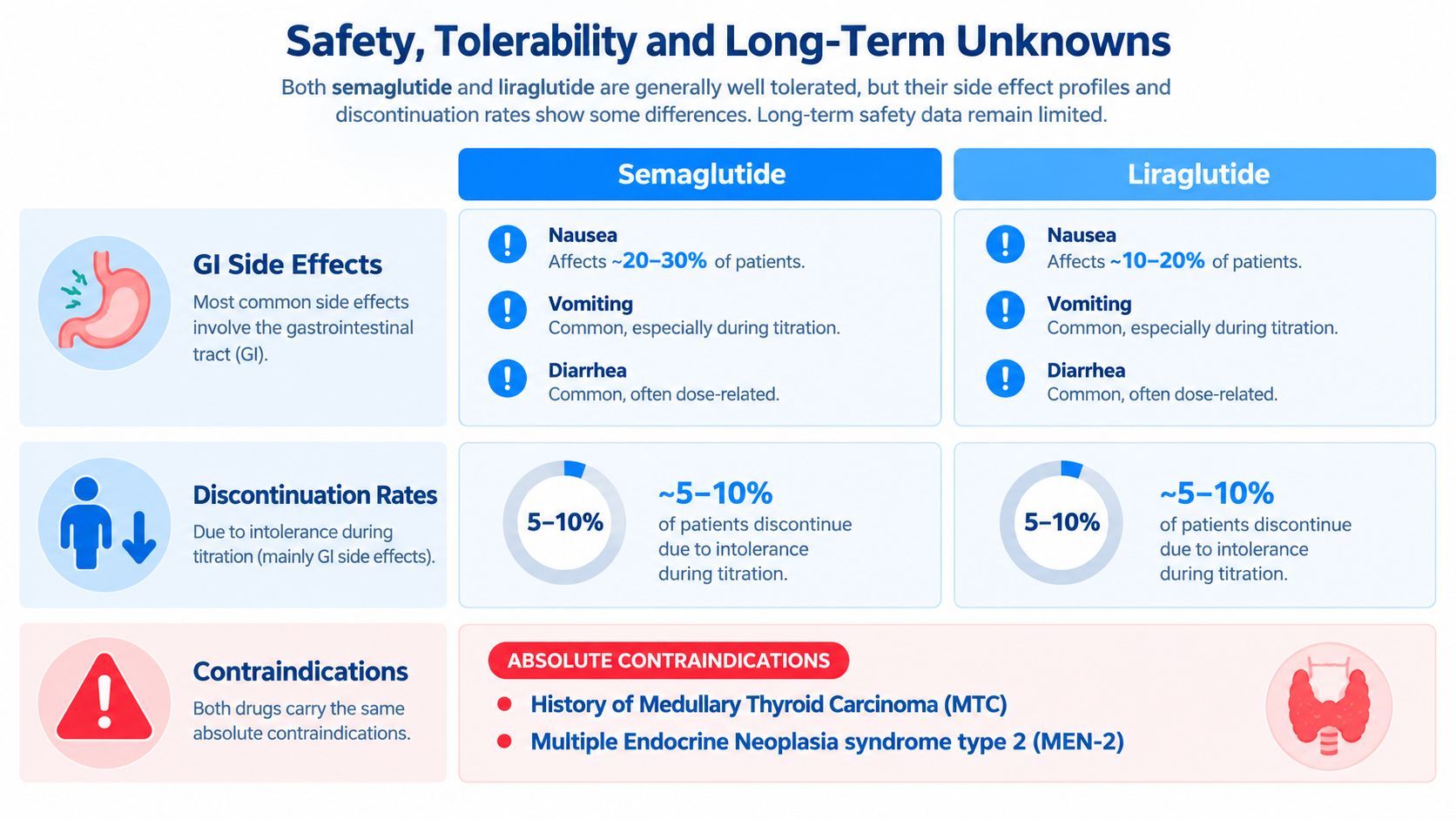
The most common reason patients struggle with either drug is gastrointestinal intolerance. Semaglutide tends to be the more potent option, but that strength can come with more GI burden during titration, which is one reason some patients tolerate liraglutide more smoothly even if they lose less weight.
Safety boundaries that matter
Both drugs carry the same major class warnings, including avoidance in patients with a history of medullary thyroid carcinoma or MEN-2. Those are hard stops, not gray areas. Clinicians also watch for gallbladder symptoms, pancreatitis warning signs, and pregnancy exposure concerns.
The evidence base still has limits beyond roughly two years, so any claim about long-term certainty should be treated carefully. That matters because patients often ask not just whether the drug works now, but whether it will still be the right answer after long-term weight maintenance, glycemic shifts, and dose changes.
Tolerability is part of efficacy
A drug that causes enough nausea or vomiting to stop treatment is not more effective in practice. That is why dose escalation, meal timing, and close follow-up matter. It is also why the same drug can be a great fit for one patient and a poor fit for another.
Long-term uncertainty remains around gallbladder events, pancreatitis signal interpretation, pregnancy exposure, and the downstream effects of major weight loss on body composition and bone health. Semaglutide has stronger cardiovascular outcomes evidence in major trials, while liraglutide has a long-term cardiovascular record of its own, but neither drug eliminates the need for monitoring.
Safety rule: if the patient cannot tolerate escalation, the prescribing plan should adapt fast. Persisting through severe nausea is not a virtue, it is a setup for discontinuation.
The section above shows why “better” does not mean “easier.” Semaglutide often wins on efficacy, but liraglutide can still win on day-to-day tolerability for some patients, and safety monitoring never stops being necessary.
Choosing the Right Fit by Patient Profile
The best choice depends on what the patient can live with, not just what the chart favors. Semaglutide is the stronger option when the goal is maximum average weight loss or stronger glycemic lowering, but liraglutide stays relevant when the patient needs a simpler daily rhythm, different access conditions, or a gentler escalation path.
Profile-based prescribing logic
- Needle-averse or pill-preferring patients: Oral semaglutide is the natural fit when the patient strongly prefers to avoid injections, provided the indication and coverage line up.
- Plateau-driven patients: Semaglutide is the better match when the patient has already stalled and wants the more potent metabolic push.
- Coverage-limited patients: Liraglutide can be the more realistic option when formulary placement or supply makes semaglutide hard to maintain.
- Comorbidity-heavy patients with diabetes and cardiovascular disease: Either drug can be appropriate, but the broader efficacy signal and weekly convenience often lean toward semaglutide.
- Patients already stable on liraglutide: Staying put can be smarter than switching if the current plan is working and tolerability is good.
Where fit beats prestige
Obesity medicine gets blunt. A patient who can fill liraglutide every month, tolerate it, and keep taking it may do better than a patient who starts semaglutide, misses doses, and spends the next six weeks fighting insurance.
That is why a patient-specific plan should weigh dose frequency, side effects, and continuity before chasing the strongest headline number. For some people, the right answer is still semaglutide. For others, the right answer is the drug they can stay on.
| Patient Profile | Better Match | Key Reason |
|---|---|---|
| Wants maximum average weight loss | Semaglutide | Stronger efficacy |
| Wants stronger glucose lowering | Semaglutide | Better HbA1c reduction |
| Needs a daily routine | Liraglutide | Daily dosing may fit habits better |
| Has unstable coverage | Liraglutide | May be easier to keep supplied |
| Avoids injections when possible | Oral semaglutide | Non-injectable option |
| Already doing well on current therapy | Either, often stay put | Switching can add friction |
Clinical Takeaways and Decision Framework
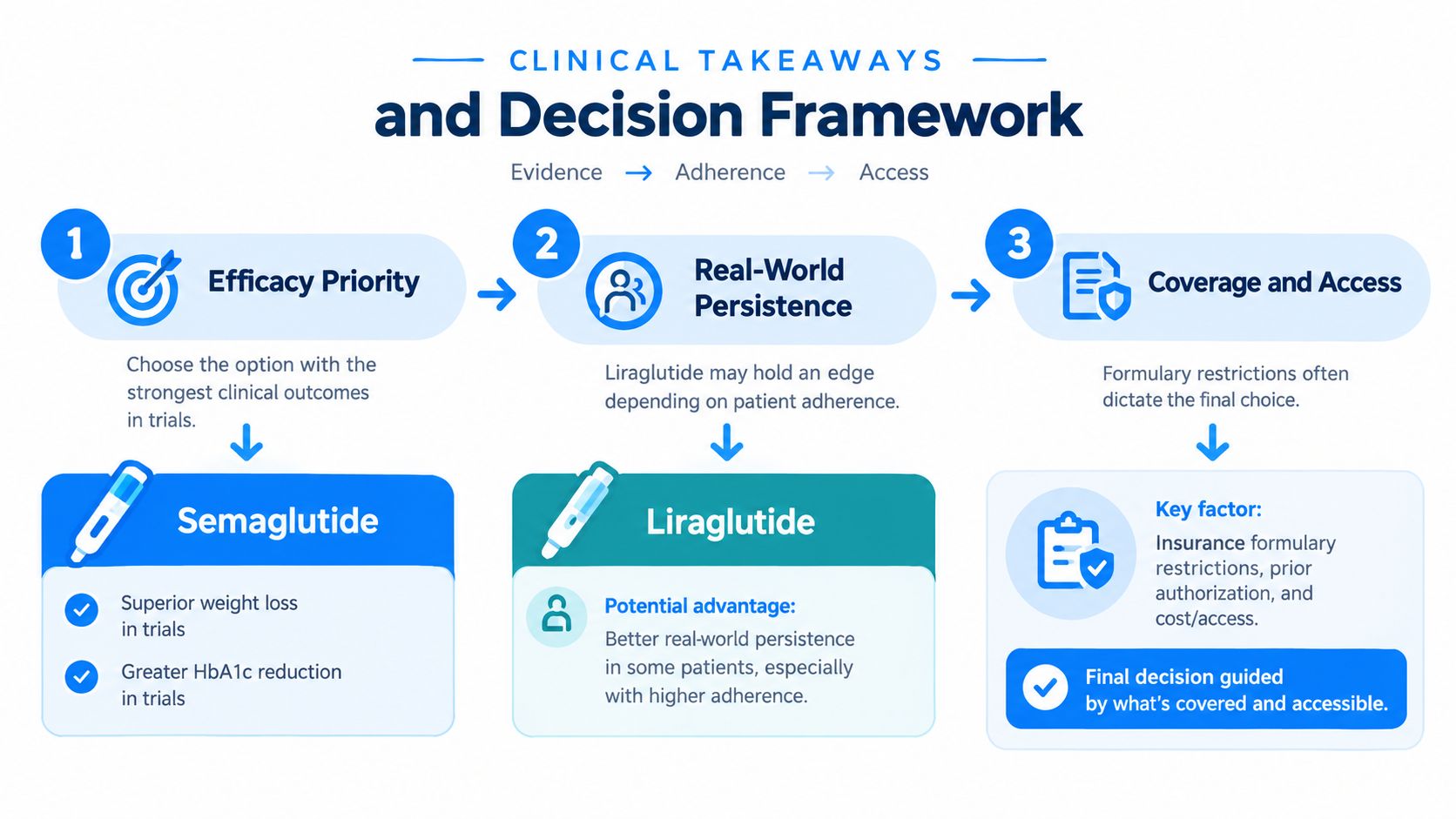
Semaglutide is generally better than liraglutide if the only question is how much weight and glucose lowering the drug can produce in trials. That is the honest answer, and the head-to-head data support it strongly. The answer in practice is more conditional, because the drug has to be tolerated, covered, and continued long enough to work.
A clean decision sequence
- Set the goal first. If the priority is weight loss, semaglutide usually gets the nod. If the priority is a regimen the patient can reliably sustain, liraglutide may be more practical.
- Check access before enthusiasm. If coverage is weak or supply is unstable, the better drug on paper may not be the better prescription.
- Match the dosing style to the patient. Weekly dosing helps many adults. Daily dosing helps others who prefer consistency or want smaller behavioral commitment per dose.
- Watch tolerability early. Nausea, vomiting, and diarrhea often determine whether a patient stays on therapy.
- Reassess response, not hopes. If the patient is not progressing and the regimen is draining adherence, the plan needs adjustment.
Safety guardrails
Screen for thyroid cancer history, MEN-2, pancreatitis warning symptoms, gallbladder symptoms, and pregnancy risk before committing to long-term therapy. If the patient is heading into surgery or has major GI intolerance, the timeline needs review before the next dose is taken.
The bottom line is direct. Semaglutide usually wins on efficacy. Liraglutide can still win on fit. The best prescription is the one the patient will take consistently, not the one that looks strongest in isolation.
Vials + Vitals offers physician-directed GLP-1 care with structured titration, clinical review, and protocols built around metabolic goals, access constraints, and patient tolerance. For patients comparing semaglutide and liraglutide, that kind of guided prescribing can help turn a trial-level question into a workable treatment plan. Visit Vials + Vitals to review how its telehealth process aligns medication choice with real-world follow-through.
Ready to see if this protocol fits your biology?
A licensed provider reviews every request before anything is prescribed.
Calibrate your metabolic protocol →