Is Compounded Semaglutide Safe: A Patient Guide

Is compounded semaglutide safe? Learn about FDA warnings, USP compounding standards, dosing risks, and how to evaluate pharmacy quality before treatment.
Compounded semaglutide isn't automatically equivalent to an FDA-approved semaglutide product. Its safety depends on USP-compliant preparation, accurate dose measurement, and clinician oversight, not on a pharmacy license alone. In a key trial of standardized semaglutide, 89.7% of participants reported at least one adverse event, compared with 86.4% receiving placebo, and gastrointestinal events occurred in 74.2% versus 47.9%. The trial data describe an FDA-reviewed product, not compounded formulations.
That distinction matters because a compounded vial adds another possible failure point. The medication may be correctly prepared, yet the patient or prescriber can still misread the concentration, convert milligrams incorrectly, or draw the wrong volume. The practical question isn't “is compounded semaglutide safe?” It's whether the product, prescribing process, measurement system, titration plan, and follow-up all reduce preventable risk.
Table of Contents
- Why Safety Is the Wrong Yes-or-No Question
- What Compounded Semaglutide Actually Is
- The FDA Dosing-Error Warning Explained
- How to Read USP Compounding Standards
- Accredited Pharmacies and What Accreditation Actually Means
- Patient Safety Checklist Before the First Dose
- What the Post-Shortage Regulatory Shift Means for You
- Hair Shedding, Dose Signals, and Integrated Safety Principles
Why Safety Is the Wrong Yes-or-No Question
“Is compounded semaglutide safe?” is the wrong frame when it treats two separate risks as one. A safer assessment starts with two axes: product safety and dose-delivery safety.
Product safety asks what is in the vial. Was the intended ingredient used? Is the preparation appropriately sterile, potent, and free from problematic contamination? Dose-delivery safety asks what the patient receives. Can the patient identify the prescribed concentration, draw the correct volume, use the right syringe, and follow the clinician's titration schedule?
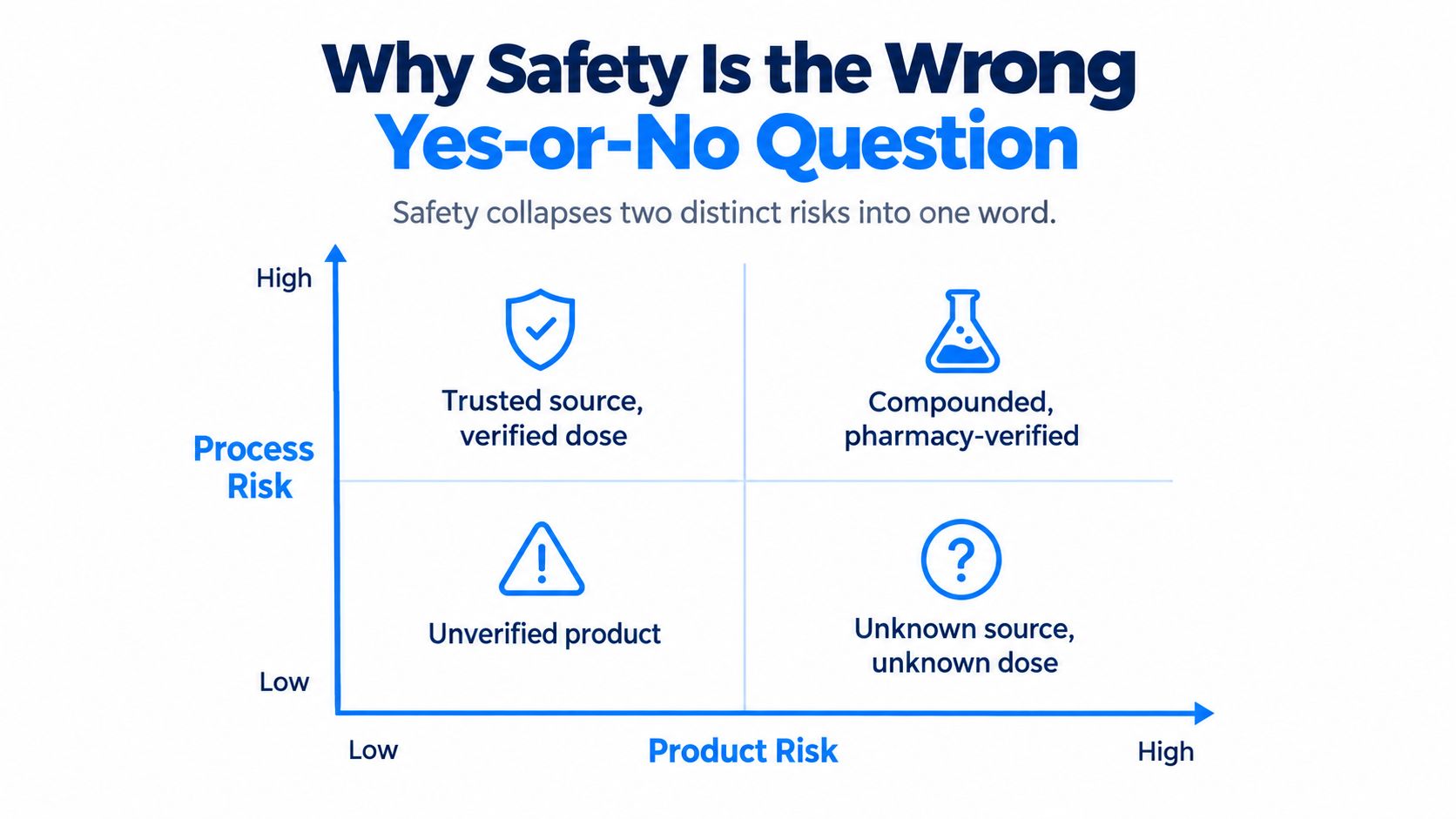
A pharmacy's license addresses regulatory oversight, but it doesn't by itself prove that every patient understands a vial's concentration or measurement instructions. FDA approval addresses a finished product's review pathway, while adherence addresses whether the patient follows the prescribed plan. Each factor covers a different part of the risk surface.
The two questions that clarify risk
A patient evaluating a compounded program should ask:
- What evidence supports the quality of the preparation? The answer should involve the pharmacy's compounding pathway, sterile processes, documentation, and testing.
- What prevents a measurement or titration error? The answer should include written milligram-and-volume directions, a suitable syringe, education, teach-back, and accessible clinical follow-up.
A general discussion of evidence on compounded hormone safety can help clarify why preparation standards and clinical supervision must be considered together, although each compounded therapy still requires its own medication-specific assessment.
The mental map is straightforward: define the product, understand the dosing warning, examine compounding standards, verify pharmacy credentials, complete the first-dose checklist, plan for regulatory changes, and monitor symptoms such as gastrointestinal distress or hair shedding.
What Compounded Semaglutide Actually Is
Compounded semaglutide is a custom-prepared medication made by a compounding pharmacy for an individual prescription or, through a different pathway, for distribution by an outsourcing facility. It may contain the same active pharmaceutical ingredient used in FDA-approved semaglutide products, but it isn't a generic version of those products and isn't automatically therapeutically equivalent.
That difference is easy to miss. A generic drug is an FDA-approved finished product shown to meet specific standards for quality, performance, and equivalence. A compounded preparation follows a different regulatory pathway and hasn't undergone the same FDA premarket review for safety, effectiveness, and manufacturing consistency.

Two compounding pathways
A 503A pharmacy generally prepares medication for a specific patient after receiving a prescription. A 503B outsourcing facility can produce sterile preparations in larger batches under a different oversight model. The designation matters because it tells patients how the medication enters the supply chain, but neither label alone proves that a particular vial is appropriate for a particular patient.
Patients should also distinguish semaglutide base from salt forms such as semaglutide sodium. These aren't different brand names for the same finished product. The active form, formulation, concentration, beyond-use date, and instructions should be clearly documented and reviewed by the prescriber and pharmacist.
Sterile preparation has its own technical requirements, and a plain-language overview of sterile compounding from Herbilabs Labware can help patients understand why aseptic technique, environmental controls, and documentation matter.
The useful one-sentence explanation is this: compounding changes how semaglutide is prepared and supplied for a patient, but it doesn't guarantee FDA approval, therapeutic equivalence, or error-proof administration.
The FDA Dosing-Error Warning Explained
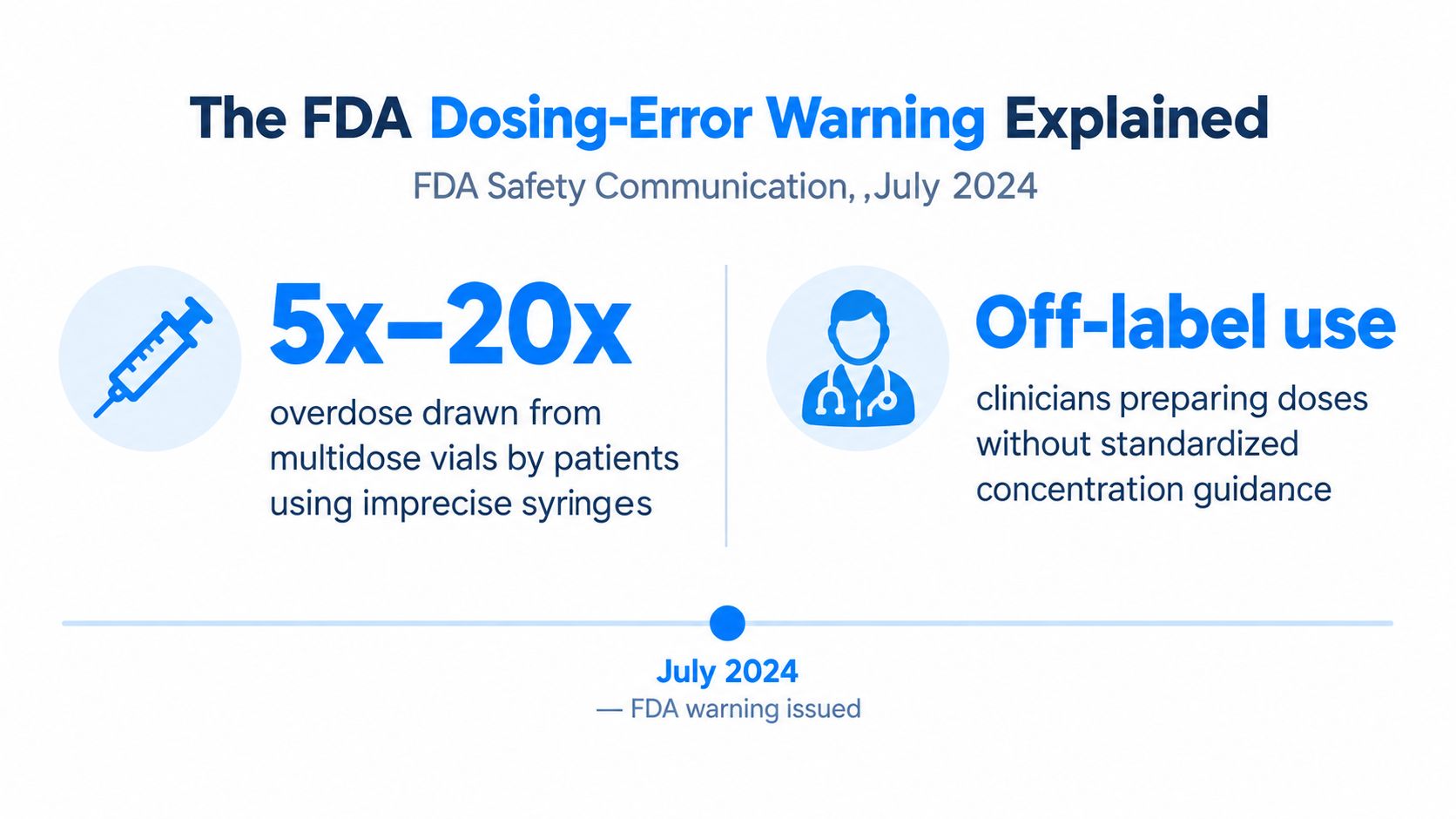
The most concrete warning involves not an unidentified impurity, but a wrong dose delivered from a legitimate-looking vial. In its July 2024 safety communication, the FDA reported adverse events, including cases requiring hospitalization, after dosing errors with compounded injectable semaglutide. Patients sometimes drew up approximately five to 20 times the intended dose, while healthcare professionals' calculation errors produced doses approximately five to 10 times higher than intended. The FDA communication details the problem.
The errors arose when people converted among milligrams, milliliters, and syringe units without a standardized concentration or clear measurement process. A multidose vial requires the patient to select the volume manually. If the label, prescription, syringe markings, and counseling don't align, a small misunderstanding can create a large overdose.
What an overdose can look like
Reported effects included:
- Gastrointestinal symptoms: Nausea, vomiting, and abdominal pain.
- Neurologic or systemic symptoms: Fainting, headache, and migraine.
- Fluid-related complications: Dehydration.
- Serious abdominal complications: Acute pancreatitis and gallstones.
Some patients required hospital care. These voluntary reports don't establish a population-wide adverse-event rate because they lack a controlled denominator. They do establish a specific safety concern: vial-based treatment needs concentration-specific instructions, suitable syringes, patient education, and clinician oversight.
The FDA has also described concerns with dosing beyond approved labeling, including larger doses, more frequent administration, or faster titration. Analyses found GLP-1 administration and dosing issues rising from late 2022 through 2024, unlike the pattern observed for insulin, which reinforces the need to evaluate the entire medication-use system.
Practical rule: A “legitimate” vial isn't enough. The prescriber, pharmacy, and patient must use the same concentration and measurement language.
How to Read USP Compounding Standards
USP chapters can sound technical, but patients don't need to memorize them. They need to understand what each standard is intended to control and what evidence a pharmacy can provide.
USP <795> addresses non-sterile compounding. USP <797> addresses sterile preparations, which is the relevant category for injectable medications. USP <800> addresses handling of hazardous drugs and focuses on protecting workers, patients, and the environment from occupational exposure.
Three tests answer three different questions
| Quality check | What it helps verify | Why it matters |
|---|---|---|
| Potency testing | Whether the preparation contains the labeled concentration | An incorrect concentration can create an underdose or overdose even when the patient measures perfectly |
| Sterility testing | Whether the injectable preparation meets sterility requirements | Injectable contamination can cause serious infection |
| Endotoxin testing | Whether pyrogenic bacterial components are absent at acceptable levels | Endotoxins can trigger fever and severe systemic reactions |
A legitimate compounding process should connect the patient's vial to records, procedures, lot information, and testing. Pharmacies may use independent laboratories for analytical testing, including methods such as high-performance liquid chromatography for potency and USP <71> sterility testing. A Certificate of Analysis, when available, can show what was tested and which lot the result applies to.
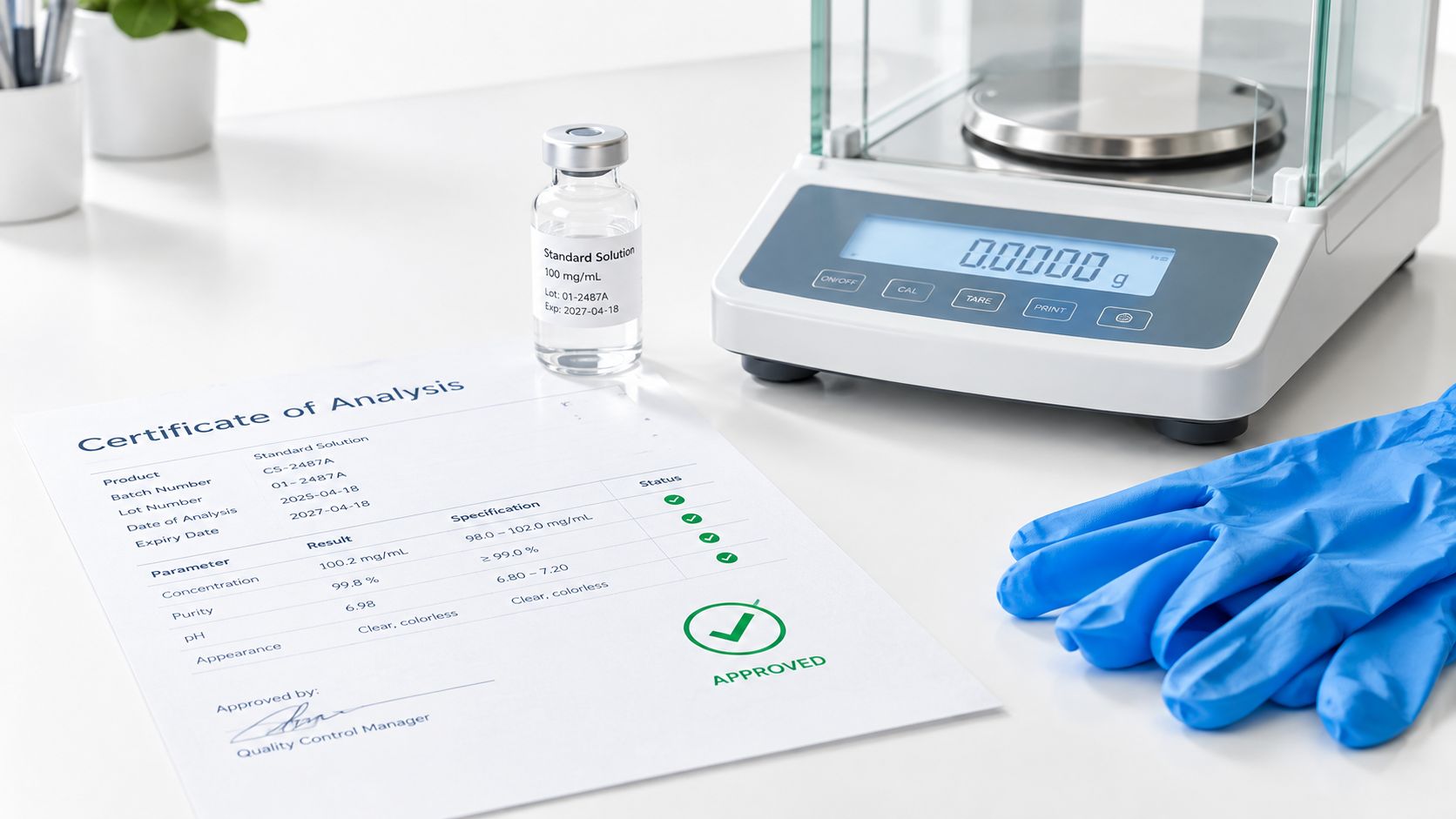
Patients can ask three direct questions:
- Which USP chapter governs this formulation?
- Can the pharmacy provide the potency result for the relevant lot?
- Can the pharmacy provide the sterility and endotoxin testing information?
A “yes” to these questions doesn't replace medical screening or correct administration. It does give the patient a more meaningful view of product controls than a vague claim that the medication is “pharmacy compounded.”
Accredited Pharmacies and What Accreditation Actually Means
Accreditation is a credibility signal, not a blanket safety guarantee. A patient should treat it as one layer in a verification process that also includes state licensure, compounding pathway, testing records, labeling, and clinical support.
NABP Pharmacy Compounding Accreditation is a voluntary program with sterile and non-sterile tiers. LegitScript certification can provide a compliance signal for certain online pharmacy and telehealth operations. State board licensure confirms that the pharmacy is authorized within its jurisdiction, but it doesn't by itself prove that the vial has the correct concentration or that the patient received effective injection training.
Compounding-Pharmacy Credentials at a Glance
| Credential | What It Covers | What It Does Not Cover | How to Verify |
|---|---|---|---|
| NABP compounding accreditation | Review of selected compounding processes and pharmacy practices | It doesn't guarantee every prescription, lot, or patient measurement will be error-free | Check the pharmacy's current accreditation listing and scope |
| LegitScript certification | Compliance features relevant to eligible online healthcare and pharmacy operations | It doesn't replace sterile testing, prescriber assessment, or FDA approval | Verify the organization's certification status and covered entity |
| State board license | Legal authorization and regulatory standing in the relevant state | It doesn't establish therapeutic equivalence or confirm a specific vial's potency | Use the applicable state board's license lookup |
| 503A status | Patient-specific compounding after a prescription | It doesn't mean the preparation is FDA-approved or suitable without counseling | Ask the pharmacy to identify its operating pathway |
| 503B status | Outsourcing-facility production under a separate regulatory framework | It doesn't eliminate the need for patient-specific clinical oversight | Confirm registration and the facility's current status |
The strongest process combines several signals. The absence of all verifiable credentials, reluctance to identify the dispensing pharmacy, or vague answers about concentration and testing should prompt caution before payment or injection.
Accreditation can support trust in a process, but only a complete medication-use system supports safe administration.
Patient Safety Checklist Before the First Dose
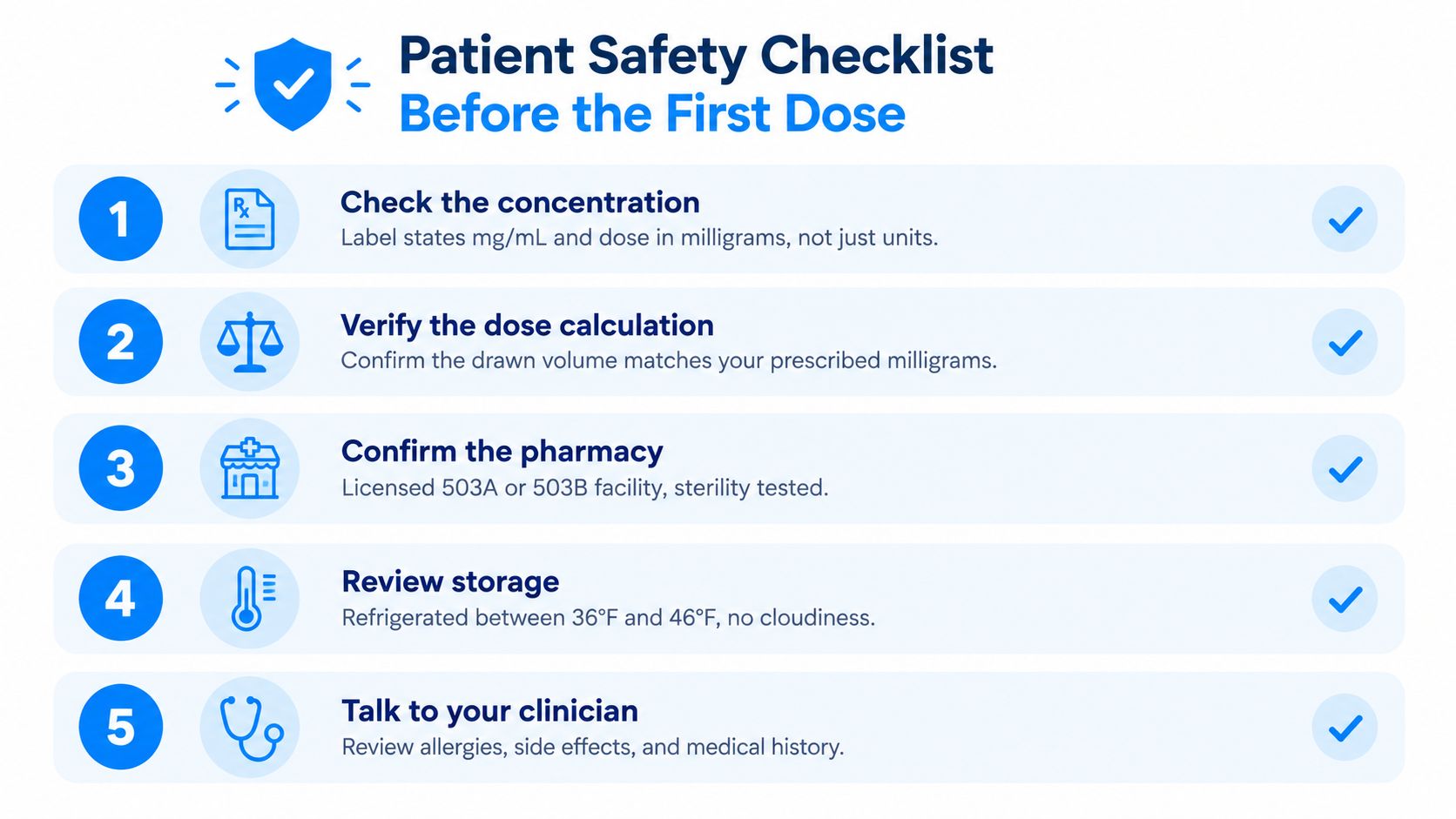
A safe first dose depends on two separate checks: product safety, meaning what is in the vial, and dose-delivery safety, meaning whether the patient can measure and inject the intended amount. A pharmacy process cannot correct a calculation error at home, just as a correctly measured dose cannot make an unidentified or damaged product safe.
Use this checklist during a telehealth consultation, pharmacy call, or first-dose teaching session.
Five guardrails before injection
Confirm the concentration. The prescription and vial should list the concentration in mg/mL and the prescribed amount in milligrams. “Units” alone do not identify the semaglutide dose. Syringe units show volume markings, so the concentration must be known before converting the prescription into a syringe measurement.
Match the syringe to the volume. The syringe should make the prescribed volume easy to measure. A low-volume insulin syringe may suit a small volume, but the prescriber or pharmacist should confirm the device, scale, and exact marking.
Perform teach-back. Before injecting, use water to demonstrate where the plunger will stop. The pharmacist or clinician should check the calculation and watch the demonstration. Asking whether the patient understands does not reveal whether the measurement is correct.
Get titration instructions in writing. The plan should state when the dose may increase, how to respond if nausea continues, and whom to contact after a missed or excessive dose. Gradual escalation gives the body time to adjust. Self-directed increases remove that safeguard.
Confirm storage and shipping. Follow the pharmacy's instructions for temperature, light, and handling. Inspect the vial before use. If a temperature-sensitive shipment arrives warm, damaged, cloudy, or inconsistent with its label, contact the pharmacy before injecting.
Symptoms also need a response plan. In the STEP 1 trial, serious adverse events occurred in 9.8% of semaglutide participants compared with 6.4% receiving placebo. The published trial supports gradual escalation and active counseling, rather than treating new symptoms as irrelevant.
Contact a clinician promptly for persistent vomiting, severe abdominal pain, dehydration, fainting, possible pancreatitis or gallbladder symptoms, or vision changes. Severe or rapidly worsening symptoms may require same-day evaluation.
What the Post-Shortage Regulatory Shift Means for You
Access rules can change while a patient is already taking a medication. FDA determined that the semaglutide injection shortage was resolved and provided temporary enforcement-discretion periods ending April 22, 2025, for 503A compounders and May 22, 2025, for 503B outsourcing facilities. The FDA policy clarification explains those deadlines.
That transition doesn't answer whether a specific patient should continue, switch, or stop. It means the dispensing pathway, refill availability, formulation, and legal basis for compounding may need to be reassessed. Regulatory eligibility also isn't the same as clinical safety, FDA approval, or therapeutic equivalence.
A continuity-of-care decision path
- If the pharmacy can no longer fill the prescription: The patient should contact the prescriber before the next dose, confirm available alternatives, and request an updated medication and concentration plan.
- If the formulation changes: The patient shouldn't assume that the old syringe marking applies to the new vial. The concentration and volume must be recalculated and taught again.
- If switching to an FDA-approved product: The prescriber should provide a deliberate transition plan. Patients shouldn't combine products or independently match doses by memory.
- If telehealth care crosses state lines: The patient should verify that the prescriber and dispensing pharmacy can legally provide care and delivery in the patient's location.
- If a program encourages faster escalation: Larger doses, more frequent dosing, or rapid titration should be treated as warning signs requiring clarification, not as shortcuts to better results.
The safest response to a disrupted refill is a pause for verification, not improvisation. The patient needs a current prescription, an identified pharmacy, a documented concentration, and a clinician who can explain the next dose.
Hair Shedding, Dose Signals, and Integrated Safety Principles
Hair shedding can alarm patients, but it doesn't prove that semaglutide has directly damaged hair follicles. A meta-analysis of nine interventional studies found a higher risk of reported hair loss among GLP-1 receptor agonist users than placebo users, with a pooled risk ratio of 3.252 and a 95% confidence interval of 1.437 to 7.358. The meta-analysis supports counseling and evaluation, not a simple causal conclusion.
Rapid weight loss, inadequate calorie or protein intake, illness, iron deficiency, and thyroid disease can shift follicles into a temporary resting phase called telogen effluvium. A clinician evaluating new diffuse shedding should review the timing of the loss, dietary intake, weight trajectory, medication dose, thyroid status, and iron status.
Dose signals deserve careful interpretation
A separate pharmacovigilance analysis identified a stronger observed hair-loss signal with semaglutide and tirzepatide than with other evaluated GLP-1 therapies. Reports appeared more frequent at higher obesity-treatment doses, but spontaneous reports are vulnerable to reporting bias, confounding from rapid weight loss, and differences among patient populations. A signal doesn't prove direct follicular toxicity.
The modifiable safety principle is controlled escalation. If shedding begins after a dose increase, the prescriber can document the timing, review nutrition, assess the pace of weight reduction, and consider holding escalation while intake and symptoms are reassessed. Persistent, patterned, patchy, or scarring loss isn't typical uncomplicated telogen shedding and warrants dermatologic assessment.
A compounded semaglutide program is reasonably safe only when the whole system works together: the pharmacy follows appropriate USP processes, testing supports the preparation, the prescriber calculates the dose correctly, the patient demonstrates measurement, titration follows a clinician-directed schedule, and red-flag symptoms receive prompt evaluation.
The sentence worth remembering is simple: safe compounded semaglutide depends as much on how the dose is prepared and delivered as on the molecule written on the prescription.
Vials + Vitals provides physician-directed telehealth assessments, individualized GLP-1 and semaglutide titration plans, pharmacy coordination, dose education, and follow-up focused on formulation and administration safety. Patients seeking structured evaluation and supervised metabolic care can visit Vials + Vitals to review available care pathways.
Ready to see if this protocol fits your biology?
A licensed provider reviews every request before anything is prescribed.
Calibrate your metabolic protocol →