How to Travel with Semaglutide: Storage and Packing Rules
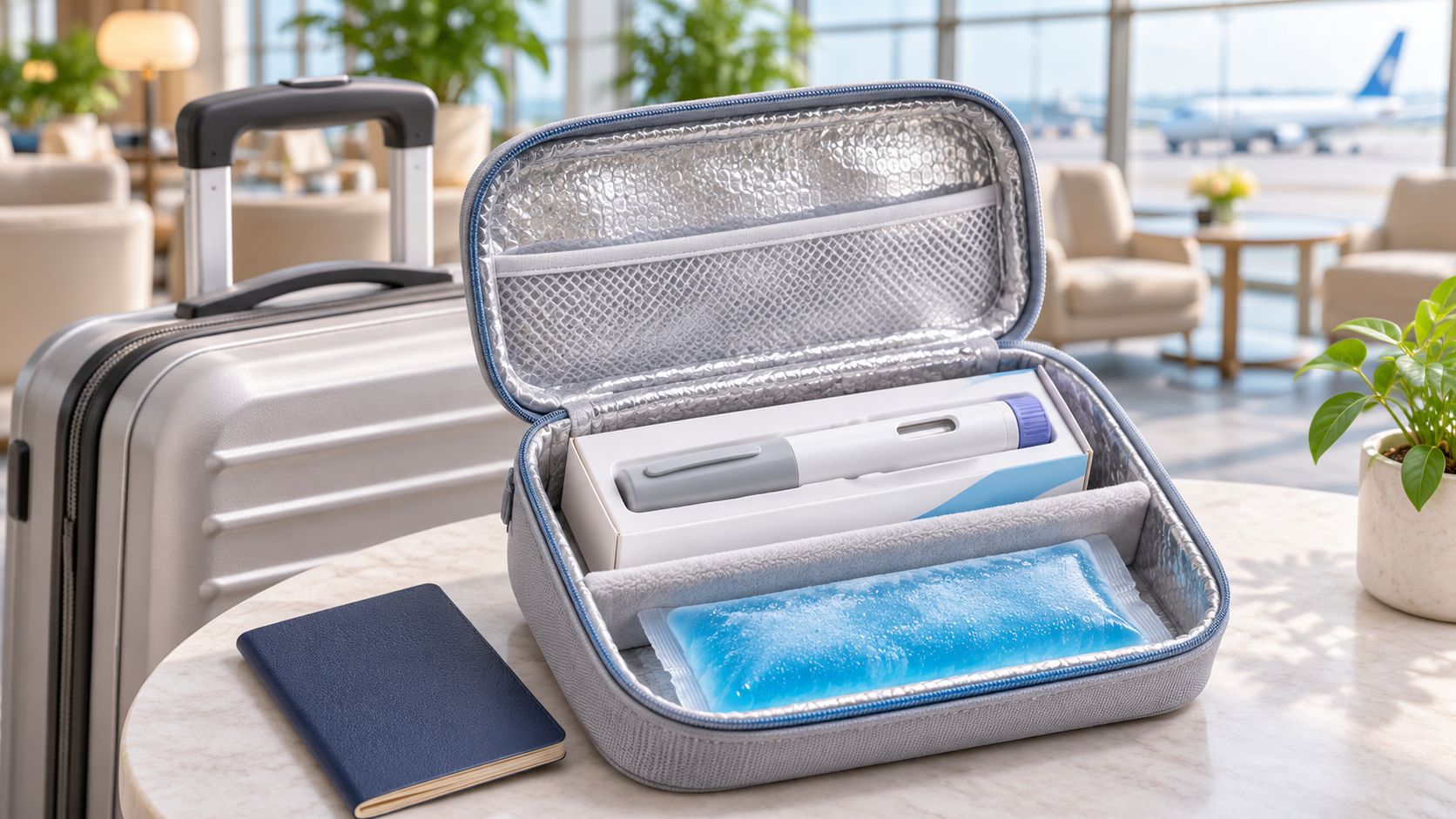
Learn how to travel with semaglutide safely, including storage limits, carry-on packing, airport screening, heat exposure and dose timing across time zones.
Is a cooling case enough to keep semaglutide safe during a trip? Not by itself. Knowing how to travel with semaglutide starts with the exact product label, because a branded pen and a compounded vial may have different storage and handling rules.
A practical plan connects temperature control, carry-on packing, and the prescribed injection schedule. The dispensing pharmacy can clarify storage limits and questionable temperature exposure, while the prescribing clinician can assess dose timing, missed doses, and symptoms that might complicate travel.
Table of Contents
- Semaglutide Storage Limits Before You Travel
- Packing and Clearing Airport Screening
- Compounded Vials and Branded Pens Need Different Checks
- What to Do After Heat or Freezing Exposure
- Dose Timing Across Time Zones and Borders
- Confirm Your Plan Before You Leave
Semaglutide Storage Limits Before You Travel
Keep injectable semaglutide within its labeled temperature range, protected from light and extreme heat, and never let it freeze. Cold storage isn't the same as maximum cooling. A pen pressed against a frozen pack can become too cold even when the surrounding bag feels comfortable.
The FDA-approved Wegovy prescribing information gives the following limits for the unopened single-dose pens described below. These are Wegovy-specific instructions, not a universal storage allowance for every semaglutide product.
Storage limits for a Wegovy-labeled semaglutide pen
| Situation | Storage requirement | Time limit | Discard if |
|---|---|---|---|
| Unopened pen with refrigeration available | Refrigerate at 36°F–46°F (2°C–8°C), protected from light, in original carton | Keep refrigerated | Frozen or above 86°F (30°C) |
| Pen before cap removal, no refrigerator | Store at 46°F–86°F (8°C–30°C) | Up to 28 days | Frozen, above 86°F (30°C), or unrefrigerated for 28 days or longer |
| Pen that may have frozen | Do not use; discard per Wegovy prescribing information | Not applicable | Any freezing |
| Compounded multidose vial | Follow the dispensing pharmacy label | Per dispensing label | Per dispensing label |
The room-temperature allowance isn't permission to leave medication anywhere outside a refrigerator. A parked car, sunlight through an airplane window, and a hotel room with unreliable air conditioning can expose a pen to conditions outside its permitted range. Checked baggage also leaves the traveler unable to monitor or protect the medication.
Plan for the whole journey
Storage planning should include the ride to the airport, time in transit, and the final destination. For example, a hotel refrigerator doesn't solve the problem of a medication case left in a hot rental car during lunch. Likewise, a refrigerator that freezes items near its cooling plate isn't automatically suitable for medication.
An insulated medication case can help, but its usefulness depends on the packing arrangement and surrounding conditions. A thermometer can help check the case rather than relying entirely on touch. Cooling packs should maintain the permitted range, not turn the compartment into a freezer.
Practical rule: The aim is controlled temperature, not the coldest possible temperature.
The distinction between delivery conditions and ongoing storage is also relevant to cold-chain shipping. Receiving medication in insulated packaging doesn't establish how long that packaging will protect it during another journey.
Before packing, the traveler should locate the storage instructions on the dispensing label, write them down, and resolve unclear wording with the pharmacy. Compounded vials require their own product-specific instructions.
Packing and Clearing Airport Screening
Medication belongs in the carry-on, and it stays easier to protect when its identifying information travels with it. The CDC Yellow Book guidance on traveling with medicines recommends carry-on storage and enough medication for the trip plus extra for delays, because checked bags can be delayed, lost, or exposed to unsuitable conditions.
A full bag creates a predictable failure. The traveler packs the medication pouch last, runs out of room, and checks the very supplies that need to stay within reach. Packing the pouch first removes that decision entirely.
A departure-night packing routine
- Read the dispensing label. Record the permitted storage range and any handling restrictions. The label on the actual pen or vial outranks any general online recommendation.
- Keep the original packaging. The carton protects the product and keeps identifying details together. Throwing it away to save space can make both storage and documentation harder.
- Count the trip supply and contingency. Include the prescribed medication needed during the itinerary and an appropriate reserve, while respecting destination import rules.
- Prepare the insulated case. Select cooling supplies that can maintain the product's permitted conditions. A case advertised for medication still needs a suitable packing arrangement.
- Separate medication from frozen packs. A thin protective barrier or the case's designated compartment can prevent direct contact. More ice isn't necessarily better.
- Gather administration and disposal supplies. Pack the needles or syringes required for the prescribed formulation and a suitable travel sharps container. Loose used needles don't belong in luggage.
- Add the paperwork. Keep a prescription copy or pharmacy label with the medicine. A clinician's note can help explain injectable medication and associated supplies.
- Set the agreed reminder. Enter the clinician-approved dose timing for the destination, rather than relying on memory during an overnight flight.
The CDC guidance on traveling abroad with medicine recommends original labeled containers and suggests a clinician's note for injectable medicines. Documentation should identify the traveler and medication clearly, including the prescribed dosage.
At the security checkpoint
Before screening begins, the traveler should tell the officer about medically necessary medication and present it for separate inspection. Keeping the pouch near the top of the carry-on avoids unpacking the entire bag in the security line.
TSA guidance for medication and medical supplies permits medically necessary liquids above the usual 100 mL limit and allows medication-related cooling packs and supplies to undergo screening, including when cooling packs are frozen, partially frozen, or melted. TSA allows a frozen cooling pack to be screened, but the medication itself must stay above freezing. Those are two separate rules, and the dispensing label decides the second one.
After inspection, the medication should go back into its protective arrangement. If an airline requires a carry-on to be gate-checked, the medication pouch should be removed first and kept with the traveler.
Common packing slips
- A full carry-on: Medication gets moved into checked luggage because it was packed last.
- Direct ice contact: A frozen pack presses against the pen during transit.
- A discarded carton: The pharmacy label and light-protective packaging are left behind.
- An unattended case: Medication stays in a hot car while the traveler checks in.
- An unexplained exposure: A product gets used because it looks normal, despite uncertain storage.
On arrival, the traveler should check that the case still feels appropriately cool and that the label remains legible. Touch is only an initial check, not proof that storage stayed within range. Any uncertainty needs a pharmacy assessment before the next injection.
Compounded Vials and Branded Pens Need Different Checks
A semaglutide pen and a compounded vial can have different storage instructions, even when they contain the same active ingredient. Branded products differ from each other as well, so follow the instructions for the specific product and device you have.
Compare the instructions, not just the ingredient
Branded pens come with manufacturer labeling for the particular product and device. Check the supplied labeling rather than relying on storage rules for another brand or presentation.
Compounded multidose vials may have pharmacy-specific concentrations, beyond-use dates, and handling instructions. The beyond-use date describes one limit; it does not establish how long a vial can be kept outside its stated storage conditions.
The differences between vials and pens show why travel checks need to match the container dispensed. For a compounded product, the dispensing label and pharmacy instructions should guide questions about storage, vial handling, and supplies.
Before leaving, photograph the label so you can refer to the medication name, concentration, storage directions, and beyond-use information. Ask the dispensing pharmacy about the permitted temperature range and time outside refrigeration for that specific preparation. Confirm how to handle a punctured vial, and ask the prescribing clinician what to do about a delayed or missed dose.
A cooling pack cannot replace product-specific storage directions. If any instruction is unclear, check with the dispensing pharmacy before travel. For Vials + Vitals patients, independent licensed clinicians assess suitability and decide whether to prescribe; licensed U.S. pharmacy partners fill valid prescriptions and provide directions.
What to Do After Heat or Freezing Exposure
A pen that froze shouldn't be used. A medication that later thaws or cools down hasn't necessarily become suitable again. When exposure is suspected rather than confirmed, the traveler should separate the medication from usable supplies and contact the dispensing pharmacy before injecting it.
The following lookup distinguishes the Wegovy pen rules described earlier from compounded-vial decisions. The branded thresholds aren't universal limits for every semaglutide preparation.
Heat and freezing exposure: first action and who to contact
| Situation | First action | Who to contact |
|---|---|---|
| Pen froze | Discard per Wegovy label; do not use | Dispensing pharmacy or prescribing clinician |
| Pen exposed above 86°F (30°C) | Discard per Wegovy label; do not use | Dispensing pharmacy |
| Compounded vial froze or overheated | Do not use until the pharmacy confirms, following its label | Dispensing pharmacy |
| Cloudy or discolored medication | Isolate it and check the label; don't inject pending advice | Dispensing pharmacy or clinician |
| Pen unrefrigerated for 28 days or longer | Discard as the label directs | Dispensing pharmacy |
Give the pharmacist a usable exposure history
A precise account is more helpful than saying the medication became warm. The pharmacy needs the product identity, its handling history, and the best available description of the incident.
- Record the circumstances: Note the estimated exposure duration, available temperature readings, and whether the medication touched a frozen pack.
- Photograph the details: Capture the packaging, dispensing label, and any visible change before disposal, when practical.
For example, a vial left in a hotel refrigerator during a power outage raises a different question from a pen found against a frozen gel pack. If the temperature wasn't measured, that uncertainty should be stated rather than replaced with a guess.
The dispensing pharmacy handles product-specific storage questions. The prescribing clinician handles the treatment plan, including whether a delayed dose should be taken or the schedule reconsidered. Discarding an unusable product doesn't authorize an extra injection from another supply.
Before departure, the pharmacy's phone number should be saved in the traveler's phone and kept with the medication paperwork.
Dose Timing Across Time Zones and Borders
A dose schedule has to follow the prescribed interval across time zones, not the local weekday. A calendar reminder can shift when a phone changes time zones, while the clinically relevant question concerns how much time has passed since the last injection and what the product label says.
U.S. screening permission also doesn't establish permission to enter another country. Airport screening rules and destination import rules are separate systems. Destination and transit countries can restrict specific medications, dosage forms, quantities, needles, and compounded preparations, so official government and customs authorities for each stop on the itinerary must confirm what may be brought in.
Build a plan around elapsed time
The injectable regimen addressed here is weekly, but crossing time zones can complicate how that schedule appears on a calendar. The clinician should review the itinerary, product label, prescribed regimen, and likely delays. The traveler shouldn't independently change the amount, shorten the interval, or double a dose.
A semaglutide dose calculator guide explains the arithmetic behind dosing intervals, but instructions from the prescriber determine what is appropriate after a missed injection or treatment interruption.
Travel planning should address distinct situations:
- A flight delay overlaps an injection: The clinician can establish how to handle the interruption without an improvised extra dose.
- A pen or vial is lost abroad: Replacement may require local evaluation; an overseas pharmacy can't be assumed to fill a U.S. prescription.
- Nausea, vomiting, or dehydration develops: The clinician can assess whether symptoms affect treatment or require care before further travel.
- Home delivery overlaps departure: The patient should confirm fulfillment timing and realistic replacement options before leaving.
Border clearance, medication supply, and dose timing are separate problems. A workable plan addresses each.
Vials + Vitals requires complete health disclosure: withholding a medication, condition, or prior reaction can make a protocol unsafe and is grounds for declining or terminating care. Travel-related symptoms and changes in other medicines belong in that clinical conversation, not just the packing checklist.
Confirm Your Plan Before You Leave
Before departure, confirm the itinerary with the prescribing clinician. Trip length, time-zone changes, and destination entry rules may affect the plan. Check official requirements for every destination and transit point, since rules can differ between countries.
Keep the final review focused on decisions that depend on your specific trip:
- Confirm the itinerary and any timing questions with the clinician.
- Check official medication-entry requirements for destinations and transit points.
- Make sure you know whom to contact if the plan needs reassessment while you are away.
Vials + Vitals provides marketing, management, and access to patient intake. Independent licensed clinicians evaluate patients and decide whether care or a prescription is appropriate. Completing an assessment does not guarantee a prescription. If prescribed, medication is filled by a licensed U.S. pharmacy.
Adults considering GLP-1 care can explore metabolic health and weight management care. Medication use and travel plans should follow the prescribing clinician's guidance and the dispensing pharmacy's instructions.
For adults considering treatment before travel, visit Vials + Vitals to explore the care pathway and prepare questions about medication supply, storage, and continuity.
Optional journal measurement
May we count eligible search visits and whether the session reaches a care page or a confirmed new email signup? These first-party counts do not record page addresses, searches or contact details. A random session code prevents repeat counting for up to 30 minutes. This choice lasts for this tab; marketing email consent is separate. You can withdraw here.
Nothing is counted before you choose Allow.