GLP-1 Titration Schedule Guide to Safe Escalation
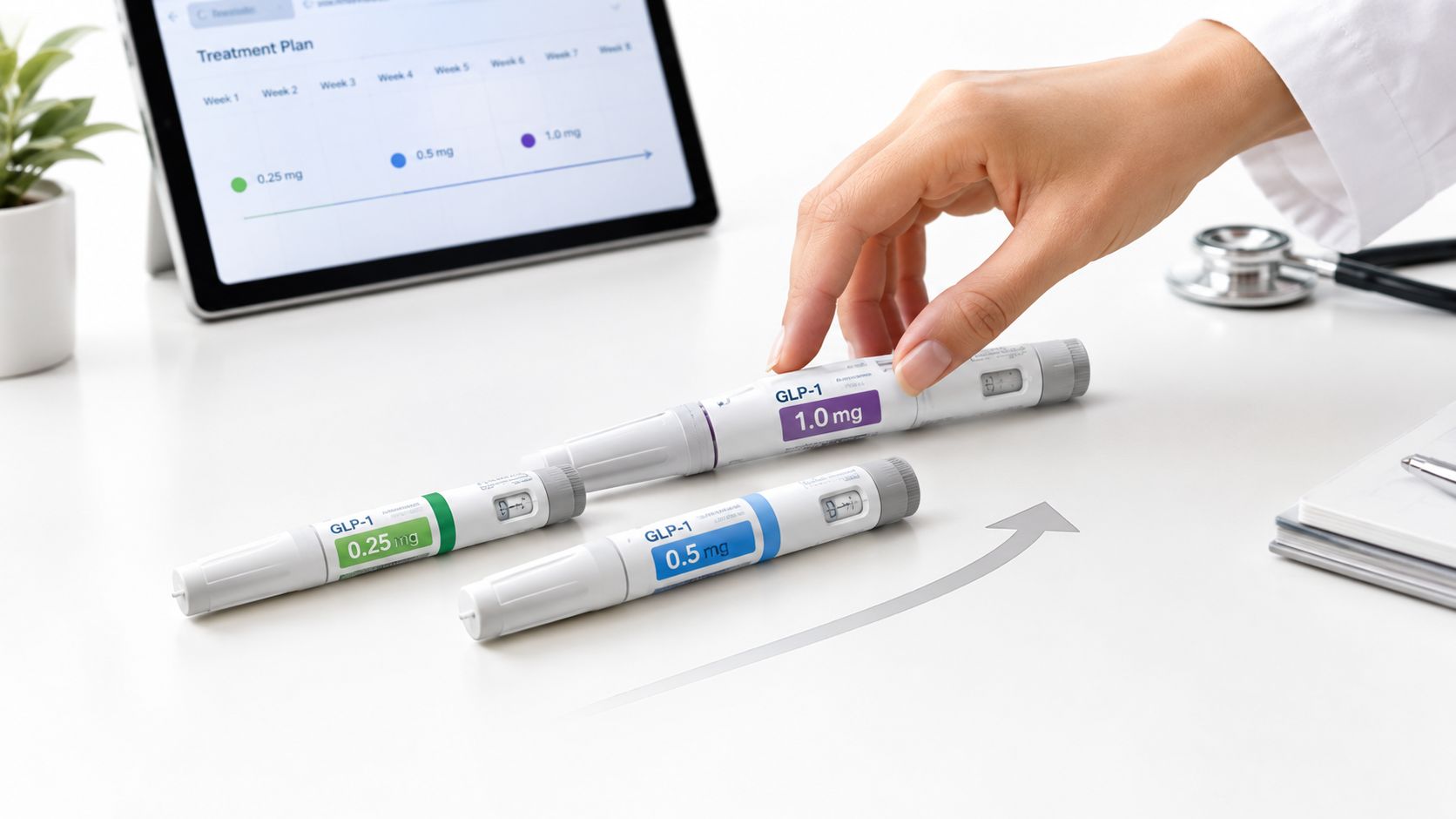
Learn the GLP-1 titration schedule for semaglutide and tirzepatide, with stepwise dosing, monitoring tips, and how to handle side effects safely.
A person starts a weekly GLP-1 injection, feels a little nausea after the first dose, then wonders whether the next increase should happen on schedule or wait another week. That question is common because a GLP-1 titration schedule is not just a dosing chart, it's the part of treatment that helps the body adapt safely while the prescriber watches for tolerance, appetite changes, and adherence.
The timing matters because the labeled approach is built around predictable checkpoints. Semaglutide's obesity labeling uses a stepped pattern that begins at 0.25 mg weekly for 4 weeks and increases only after at least 4 weeks at each lower dose, with the maintenance dose reached later in the sequence (FDA semaglutide label). That same logic shows up in real-world titration workflows, where the prescriber is not trying to force rapid weight loss on day one, but to create a tolerable path to a dose the patient can stay on.
A practical way to read the schedule is simple. Each dose is a short trial period, and each increase is a decision point. If nausea stays mild, appetite is moving in the right direction, and daily routines still hold together, the next step may be reasonable. If side effects are getting in the way, a hold or step-back can be safer than pushing ahead.
Clinical takeaway: Successful early titration looks like steady progress over roughly 12 to 20 weeks, with enough time at each dose for the patient and prescriber to judge tolerability before the next increase.
Table of Contents
- Introduction to GLP-1 Titration and Why Timing Matters
- How Semaglutide and Tirzepatide Titration Schedules Compare
- Following a Stepwise Escalation With Clinical Checkpoints
- Monitoring Progress and Managing Common Side Effects
- When to Hold Adjust or Restart Your Titration Plan
- Building a Safe Personalized Titration Path Forward
Introduction to GLP-1 Titration and Why Timing Matters
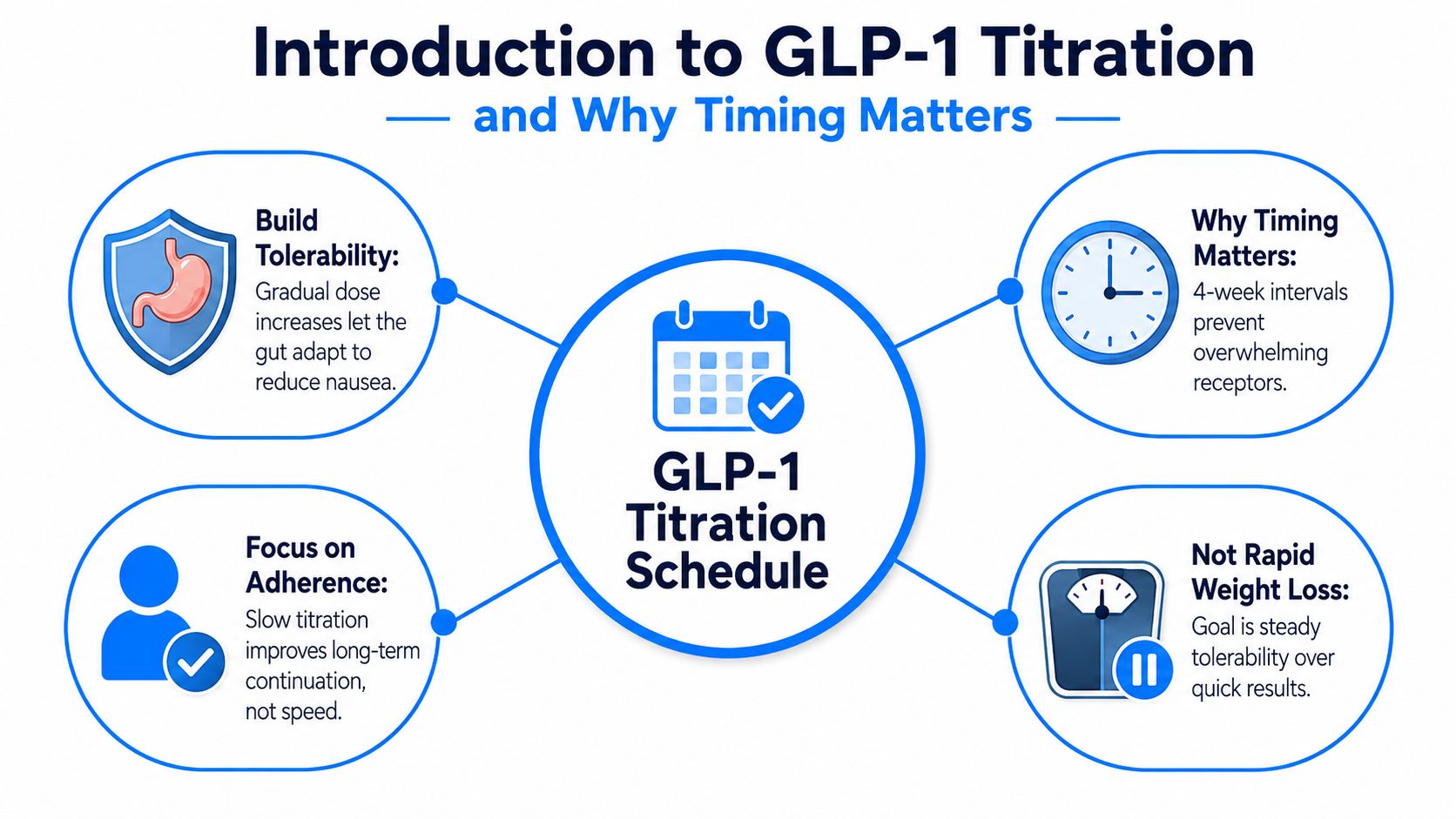
A new patient often expects the medication to “work” immediately, then gets surprised when the first month feels more like adjustment than transformation. That reaction makes sense. The purpose of titration is to help the gastrointestinal system adapt, not to chase full effect on day one, and the schedule is embedded in labeling for that reason (FDA semaglutide label).
Why the first dose is intentionally low
Semaglutide's obesity labeling starts at 0.25 mg weekly for weeks 1 to 4, then increases in 4-week steps to 0.5 mg, 1.0 mg, 1.7 mg, and finally 2.4 mg weekly from week 17 onward as maintenance (FDA semaglutide label). That slow climb is safety-first design, especially for gastrointestinal tolerability. It gives the prescriber time to assess nausea, appetite suppression, and whether the patient is taking the medication on schedule.
The same structure is used in obesity-focused references that describe semaglutide's labeled titration as deliberately slow and tracked against the 4-week step pattern (NCBI semaglutide dosing table). In plain terms, the first month is a test of how the body responds, not a race toward the endpoint.
A useful way to think about it is this. The dose is being increased because the treatment plan needs time to find the lowest effective and tolerable point, not because higher doses are automatically better. That is why clinicians often treat the titration calendar as part of the therapy itself.
The schedule is not a nuisance. It's the part that keeps patients on treatment long enough to benefit from it.
What timing lets a prescriber see
The strongest clinical value of a GLP-1 titration schedule is that it creates recurring checkpoints. At each one, the prescriber can ask whether hunger is dropping, whether nausea is manageable, and whether the patient can continue the same habits until the next adjustment. That is especially important because many side effects appear after starting or after an increase, not all at once.
Liraglutide shows the older, faster version of this logic. Its obesity escalation moved from 0.6 mg daily in week 1 to 3.0 mg daily by week 5. Semaglutide lengthened those steps because its dosing model reflects a different pharmacologic profile and a stronger emphasis on gradual adaptation.
How Semaglutide and Tirzepatide Titration Schedules Compare
The two most common modern weekly incretin schedules look similar on the surface, but they solve the same problem in slightly different ways. Both begin low, both move in fixed intervals, and both care more about tolerance than speed. The differences matter because patients often compare them as if they should behave the same.
The modern weekly pattern
Semaglutide's obesity titration is the most familiar weekly ladder. It begins at 0.25 mg once weekly, then increases every 4 weeks to 0.5 mg, 1.0 mg, 1.7 mg, and 2.4 mg from week 17 onward (FDA semaglutide label). In a key obesity trial, the same stepwise schedule was used for 16 weeks before the 2.4 mg maintenance dose continued for the rest of the study (STEP-1 trial framework).
Tirzepatide's standard obesity escalation starts at 2.5 mg weekly for 4 weeks, then increases by 2.5 mg every 4 weeks until maintenance is reached (FDA tirzepatide summary review). In the FDA-reviewed phase 3 obesity program, the 4-week stepwise approach was used across trials to improve gastrointestinal tolerability (tirzepatide program summary).
Why the older daily model still matters
Liraglutide remains useful as a historical contrast because it escalated much faster. The daily ramp moved from 0.6 mg to 1.2 mg, 1.8 mg, 2.4 mg, and 3.0 mg in 5 weeks total. That older pattern shows how GLP-1 titration evolved from a compressed daily ramp to longer weekly ramps as newer agents entered practice.
| Agent | Starting Dose and Interval | Escalation Pattern | Maintenance Dose |
|---|---|---|---|
| Semaglutide | 0.25 mg once weekly for 4 weeks | Increase every 4 weeks through 0.5 mg, 1.0 mg, and 1.7 mg | 2.4 mg weekly from week 17 onward |
| Tirzepatide | 2.5 mg once weekly for 4 weeks | Increase by 2.5 mg every 4 weeks | Maintenance reached after stepwise escalation |
| Liraglutide | 0.6 mg daily in week 1 | Daily ramp through 1.2 mg, 1.8 mg, and 2.4 mg | 3.0 mg daily from week 5 onward |
Practical rule: When patients ask which schedule is “faster,” the better question is which one they can tolerate long enough to reach maintenance.
Why the difference changes clinical counseling
Semaglutide and tirzepatide both use fixed-duration steps, but the weekly interval gives clinicians more time to observe day-to-day tolerance before the next increase. Tirzepatide's development program also shows that dose-escalation algorithms can vary within a protocol. A randomized 12-week study used one path to 15 mg that moved through 2.5 mg for 2 weeks, then 5 mg for 2 weeks, then 10 mg for 4 weeks, while another path used 2.5 mg followed by 7.5 mg, each for 4 weeks (tirzepatide titration study).
That flexibility matters because the field has moved away from a one-size-fits-all mindset. The schedule is still structured, but it isn't blind to patient response.
Following a Stepwise Escalation With Clinical Checkpoints
A sensible titration plan works like a series of short clinical reassessments. The point is not just to reach the next dose, it's to decide whether the current dose is still doing its job without creating avoidable side effects.
What happens during each 4-week window
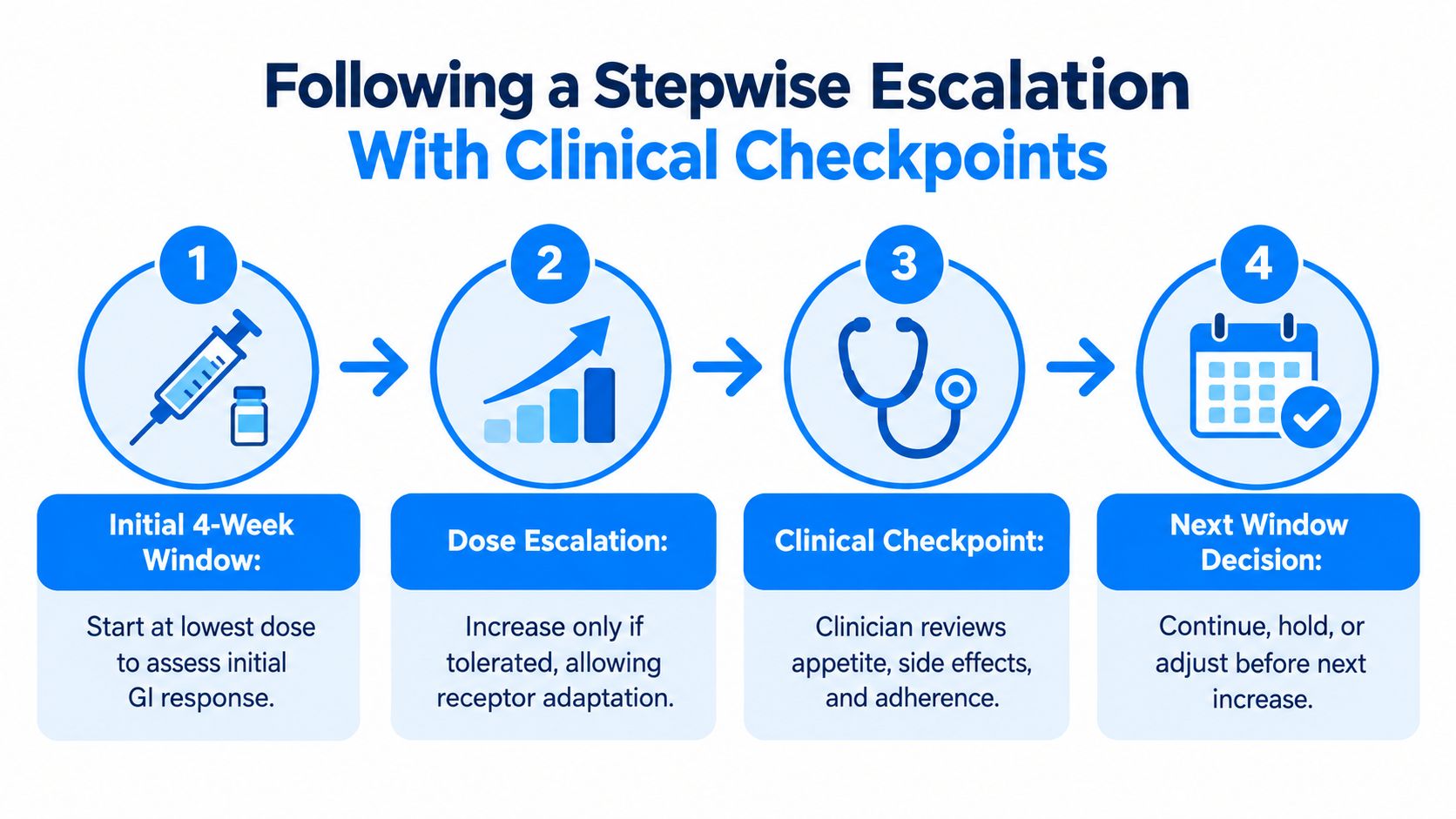
The first 4 weeks at a low dose are a trial period. If the medication is being used as intended, the patient and prescriber are watching for early nausea, appetite change, and whether daily routines stay intact. Semaglutide labeling requires at least 4 weeks at each lower dose before increasing, which is why the schedule is treated as a safety checkpoint rather than a flexible suggestion (FDA semaglutide label).
That same 4-week rhythm appears in real-world obesity care as a quality marker for whether titration is being followed appropriately (NCBI semaglutide dosing table). A clinician looking at a patient's chart wants to see more than the dose. They want to see whether the patient stayed on it, whether symptoms settled, and whether the next step looks reasonable.
What gets checked before increasing
The most useful checkpoint is not a lab number alone. It's the combination of tolerability, appetite suppression, and adherence. If nausea is fading, meals are more manageable, and the patient has been taking each dose on time, the next increase may be appropriate. If symptoms are still disruptive, holding the dose longer is often the safer move.
Practical rule: A patient doesn't “fail” titration by staying at one dose longer. Sometimes the hold is what allows treatment to continue at all.
The Vials + Vitals clinical model uses individualized guardrails over about 12 weeks, which fits the broader reality that many patients spend a meaningful stretch in intermediate doses before reaching maintenance. That kind of oversight matters most when symptoms are uneven, because the clinician can decide whether to continue, hold, or adjust rather than forcing a rigid calendar.
When a patient needs an extended hold
A patient may tolerate the first dose but struggle after the first increase. Another may do well for two months, then develop nausea that makes the next step a bad idea. In both cases, the right decision may be to stay where the body is comfortable for another cycle, then reassess.
The important point is that the schedule serves the patient. It doesn't require speed for its own sake.
Monitoring Progress and Managing Common Side Effects
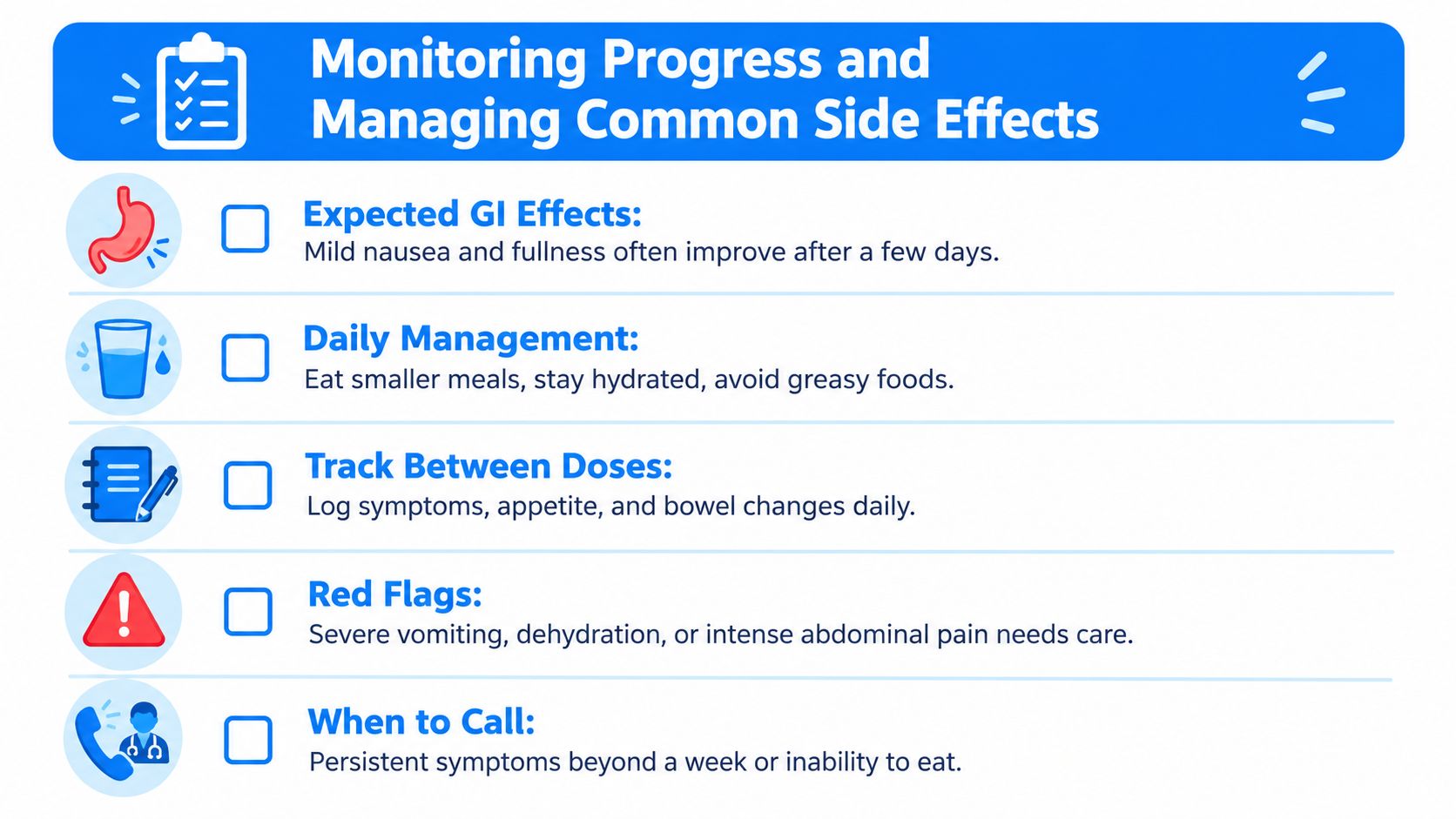
Mild nausea, fullness, constipation, or looser stools can happen when a GLP-1 dose changes, and those symptoms often settle with time. The goal between doses is to keep daily life stable enough that the patient can judge whether the current dose is still tolerable.
What to track each week
A simple symptom log is usually more useful than memory. The patient should note nausea, appetite, bowel changes, hydration, and whether meals are getting skipped because of discomfort. Semaglutide references also note that GI effects are most common at initiation and after dose increases, and that they often improve within a few weeks at each dose level.
A weekly check-in can be very plain:
- Meals and intake: Are smaller meals working, or is eating becoming difficult?
- Hydration: Is fluid intake staying steady, or is nausea cutting it down?
- Bowel pattern: Is constipation building, or are stools becoming loose enough to be concerning?
- Energy and function: Is the patient able to work, exercise lightly, and sleep normally?
- Dose timing: Was the medication taken on schedule without confusion?
When symptoms are no longer routine
Persistent vomiting, severe bloating, inability to pass stool, or strong abdominal pain are not routine adjustment symptoms and need prompt medical attention. Dehydration is especially important to watch because nausea and vomiting can stress kidney function.
Hair retention deserves a careful, honest conversation too. A 2026 review of GLP-1 receptor agonist users reported that the available evidence most often links these drugs with telogen effluvium and worsening androgenetic alopecia, while also emphasizing that the literature is limited and no confirmed causal mechanism has been established. That means shedding complaints should be taken seriously, but they should also be framed cautiously, especially when rapid weight change, reduced intake, and stress can all affect hair cycling.
If hair shedding appears during metabolic treatment, the safest response is documentation, nutrition review, and clinician follow-up, not automatic blame on the medication.
What helps between increases
Smaller meals, slower eating, and careful hydration are the most practical habits to reinforce when symptoms start. If a dose change has made the stomach feel unsettled, that doesn't automatically mean the medication is wrong. It may mean the body needs more time at the current level before the next step.
When to Hold Adjust or Restart Your Titration Plan
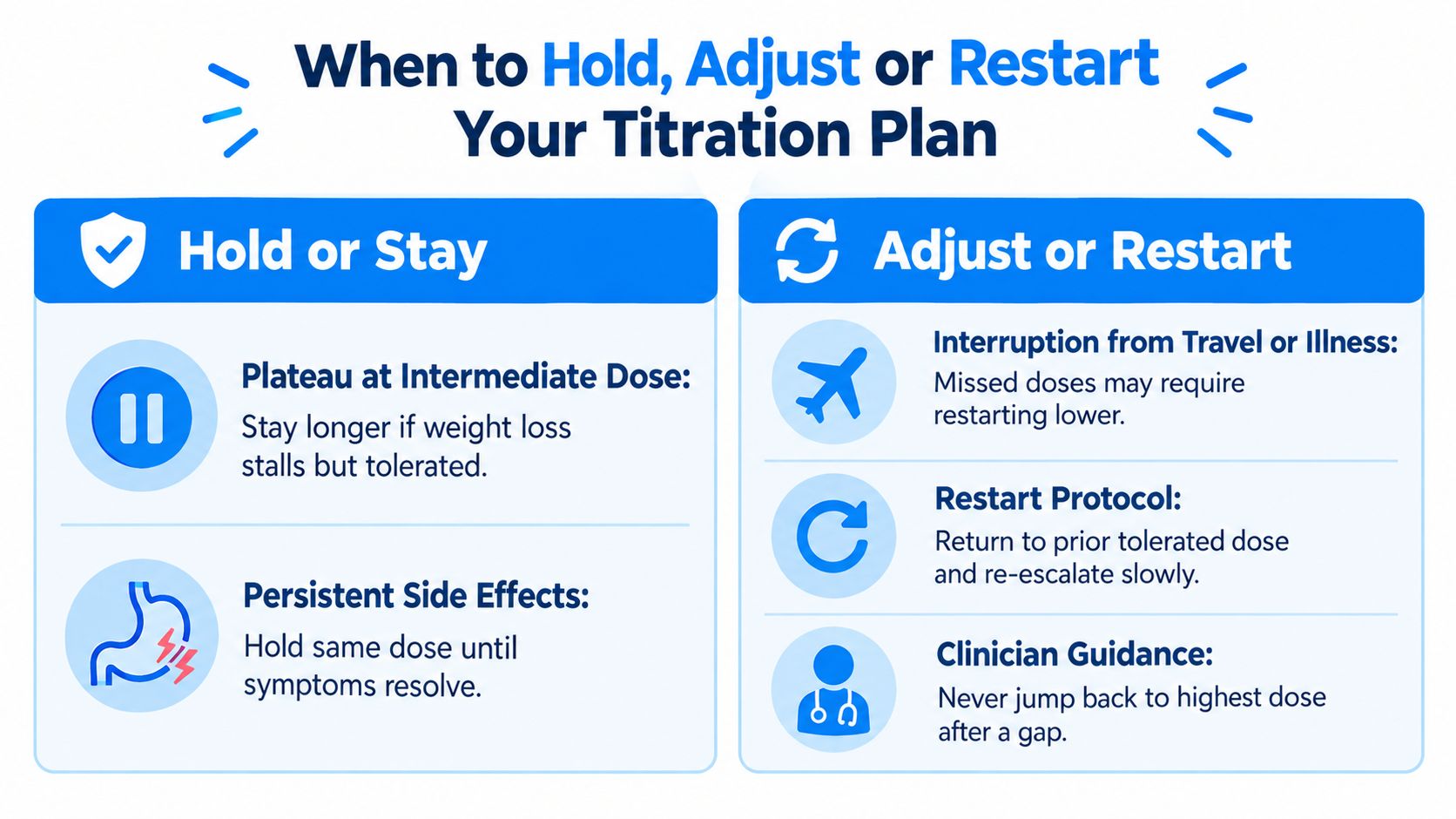
The ideal schedule breaks down in real life more often than most guides admit. A patient may plateau at an intermediate dose, get side effects that don't settle, or miss doses because of travel, illness, or supply disruption. The right response is not always to keep climbing.
When holding is the safer choice
If the current dose is helping but the patient still has side effects, the most conservative move is to stay put. A newer hospital and pharmacy discussion notes that many patients spend a long time in intermediate doses, and that reaching maximum dose often takes 12 to 20 weeks. That longer pathway leaves room for tolerability-based decisions.
Holding can also make sense when weight loss stalls but the medication is still tolerable. A plateau at one dose does not automatically mean the dose failed. It may mean the patient needs more time, better adherence, or a different discussion about whether a higher step is worth the tradeoff.
When stepping back is more sensible than pushing forward
The literature on GLP-1 initiation gaps emphasizes that titration schedules differ by agent and that many real-world patients need a “hold or step back” approach when side effects flare (GLP-1 medication gaps review). That is the key clinical idea. If symptoms become more than tolerable, the previous dose may be the right place to return before attempting another rise.
Clinical rule: Partial-dose maintenance can be reasonable when full escalation keeps causing dropout, as long as the prescriber is actively weighing benefit, tolerance, and safety.
Restarting after a gap
Missed-dose and restart rules matter because interruptions are common, and they can change how the body responds when treatment resumes. A review of GLP-1 receptor agonist medication gaps highlights that missed doses and interruptions can contribute to readmissions and poor outcomes, which is why restart guidance matters in practice (GLP-1 medication gaps review). After a 1 to 3 week gap, many clinicians reassess whether the patient should resume at the prior tolerated dose or step down first rather than jumping straight back.
That approach is more resilient than a rigid calendar. The safest restart is the one that respects how long the gap lasted, how much tolerance may have been lost, and whether the patient had side effects before the interruption. For semaglutide specifically, patient-facing dosing guidance also warns against doubling up after a missed dose, and advises contacting the prescriber when the restart plan is unclear.
Building a Safe Personalized Titration Path Forward
A durable GLP-1 plan is not the fastest route to a maintenance dose, it's the one that stays safe through dose changes, interruptions, and tolerance resets. That is why physician-directed titration, pharmacy quality checks, and regular follow-up matter as much as the medication choice itself.
One option in that kind of framework is Vials + Vitals, which uses physician review, individualized titration oversight, and clinical tools such as a GLP-1 Titration Calculator to help map the schedule to the patient's current dose and tolerability. The right tool only works when the clinical review is real, because the schedule still has to reflect symptoms, gaps, and whether the current step is sustainable.
Bottom line: The safest GLP-1 schedule is the one that matches biology, not impatience.
For long-term metabolic care, the most useful next step is a licensed evaluation, not self-directed dose changes. A patient who understands the titration logic is better prepared to report side effects early, pause when needed, and restart without guesswork.
If a GLP-1 titration schedule feels confusing, Vials + Vitals can help translate the label into a plan that fits the patient's tolerance, access, and treatment goals. Visit Vials + Vitals to review physician-guided options and see how a supervised titration pathway can be built around safe escalation, holds, and restart planning.
Ready to see if this protocol fits your biology?
A licensed provider reviews every request before anything is prescribed.
Calibrate your metabolic protocol →