GLP-1 Cost Without Insurance: Complete Guide
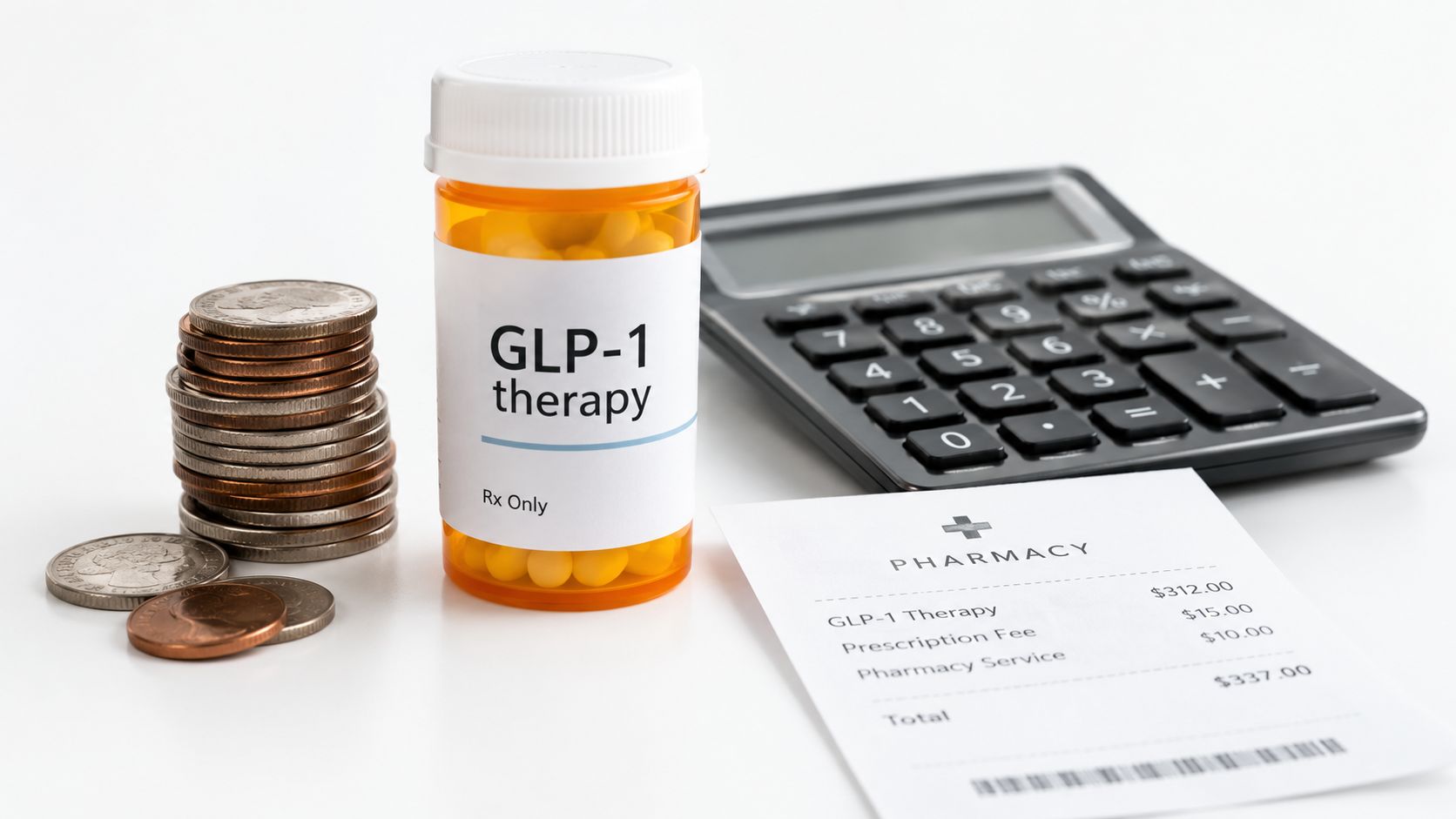
Understand GLP-1 cost without insurance. Compare brand, compounded, and manufacturer prices. Learn strategies to reduce out-of-pocket expenses
A four-week supply of a branded GLP-1 medication without insurance typically costs $1,100 to $1,300, or approximately $13,200 to $15,600 over twelve months. Manufacturer cash-pay programs can reduce that amount substantially, but eligibility, dose, timing, and availability determine whether a patient can obtain the lower price.
That range describes the historical list price of FDA-approved anti-obesity medicines, not the final amount every uninsured patient pays. A pharmacy discount, manufacturer program, negotiated cash channel, or changing dose can produce a very different bill. The opposite is also true. A patient whose health plan excludes weight-loss treatment may face much of the pharmacy price without benefiting from insurer rebates or negotiated net pricing.
The clinically relevant question is not, “What does a GLP-1 cost per month?” It is, “What will the full treatment pathway cost when the prescription, titration schedule, clinical review, dispensing, supplies, shipping, and maintenance dose are included?” The Vials + Vitals Medical Board addresses that question from a cash-price perspective, with attention to both metabolic treatment and the biology of hair retention.
Table of Contents
- Understanding GLP-1 Pricing Without Insurance
- Comparing Brand versus Compounded GLP-1 Therapies
- Breaking Down Total Treatment Expenses
- The Impact of Dose Escalation on Your Budget
- Identifying Manufacturer Savings and Cash Programs
- Evaluating Clinical Quality versus Low Pricing
Understanding GLP-1 Pricing Without Insurance
The most useful starting point is the distinction between list price, net price, and cash price. The Congressional Budget Office reported that, as of October 2024, a four-week supply of a GLP-1 anti-obesity medication generally cost about $1,100 to $1,300 before insurance discounts or other concessions. Continued for twelve months, that equals approximately $13,200 to $15,600, before physician visits, laboratory monitoring, or related care, as detailed in the Congressional Budget Office analysis of obesity medications.
That figure can mislead in both directions. It may overstate what a patient pays through an eligible manufacturer cash program, but it can understate the financial exposure of an uninsured patient using ordinary pharmacy pricing. The CBO explains that manufacturers commonly receive a reduced price after discounts paid to insurance plans and other payers. Those reductions mean a list price shouldn't be treated as the average net price across the health system, and an uninsured patient generally shouldn't assume that payer-level discounts will lower the pharmacy bill.
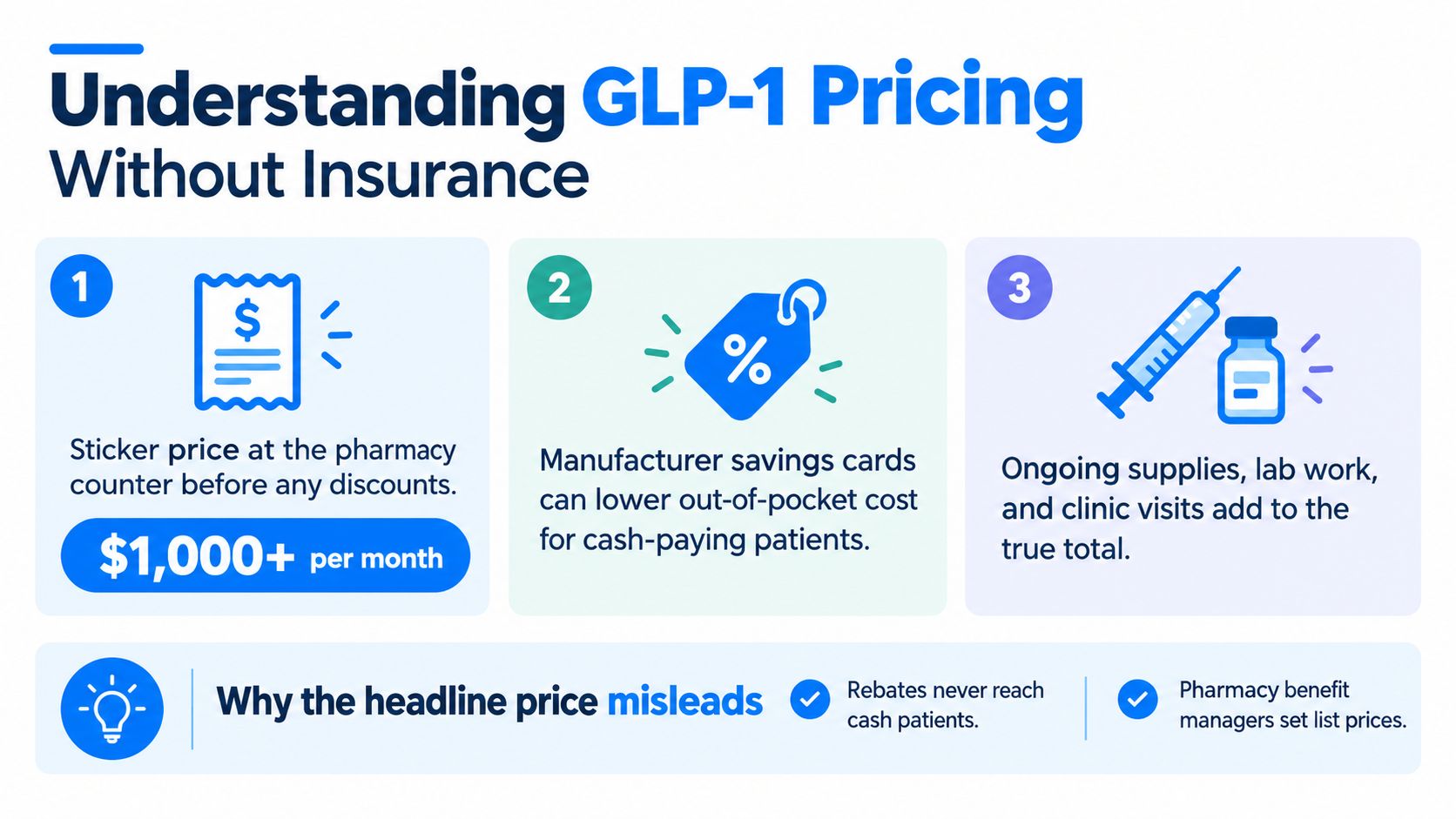
The price on the receipt is only one layer
A cash-paying patient may encounter several separate charges:
- Medication: The branded product or compounded prescription represents the largest recurring expense in most treatment plans.
- Clinical access: A physician evaluation, follow-up review, or titration assessment may be billed separately or included in a program fee.
- Dispensing and delivery: Shipping, temperature-controlled handling, syringes, and other supplies may or may not appear in the advertised medication price.
- Monitoring: Laboratory work and clinical review can create costs outside the prescription transaction.
A low advertised monthly number is therefore incomplete unless it identifies the dose, formulation, treatment period, and included services. A starter-dose price might not describe the maintenance dose. A subscription price might include clinical oversight but exclude laboratory testing or supplies. A pharmacy price might cover only the medication.
Practical rule: A reliable cash estimate names every recurring charge and separates one-time intake costs from expenses that continue during maintenance treatment.
The gap between ordinary retail pricing and direct-purchase programs has widened the range of possible self-pay outcomes. The National Consumers League reported average list prices of approximately $936 to $1,349 per month for uninsured or otherwise self-paying patients, while cited manufacturer programs advertised lower prices for selected products and doses. Those offers demonstrate why the phrase GLP-1 cost without insurance doesn't identify one universal number. It identifies a pricing problem that requires dose-specific and channel-specific analysis.
Comparing Brand versus Compounded GLP-1 Therapies
A branded, FDA-approved medication and a compounded preparation shouldn't be evaluated as interchangeable products just because both involve a GLP-1 pathway. The price difference may reflect more than the active ingredient. It can also reflect the product's approval status, manufacturing process, delivery format, pharmacy relationship, clinical supervision, and the amount of service bundled with dispensing.
For uninsured patients, branded products have historically carried retail list prices near the upper end of the self-pay market. The CBO's four-week estimate of $1,100 to $1,300 applies to FDA-approved anti-obesity medicines before insurance discounts or other concessions. Separate manufacturer cash channels can be lower, but those prices may apply only to certain doses, patients, pharmacies, or time periods.
Compounded formulations can appear less expensive because they may be dispensed through a different supply and service model. That lower price doesn't, by itself, establish equivalent quality, potency, sterility, stability, or clinical outcomes. A patient considering a compounded product should identify the dispensing pharmacy, the prescribing clinician, the formulation, the testing process, and the remedy available if the product arrives damaged, unusable, or clinically inappropriate.
GLP-1 treatment cost comparison
| Therapy Type | Average Monthly Cost Range | Formulation Options |
|---|---|---|
| FDA-approved branded anti-obesity medication at ordinary retail pricing | Approximately $1,100 to $1,300 for four weeks | Product-specific injectable pen or other approved delivery format |
| FDA-approved branded medication through an eligible manufacturer cash program | Potentially substantially below ordinary list pricing, depending on dose and program | Product-specific approved formulation |
| Compounded semaglutide or tirzepatide | Varies by pharmacy, dose, formulation, and clinical service model | Pharmacy-dispensed formulation, with the exact presentation determined by the prescriber and pharmacy |
The table's most important limitation is that the categories aren't economically equivalent. A branded list price is not the same as a manufacturer cash price, and neither is the same as a compounded program that may bundle consultation, dispensing, and shipping. Comparing only the medication line can make the cheaper option appear more attractive than it is after clinical and operational charges are included.
Quality questions belong beside price questions
Patients should ask whether the formulation is FDA-approved for the intended indication, whether the prescription comes from a licensed clinician, and whether the pharmacy provides clear information about potency, sterility, storage, labeling, and adverse-event support. Compounding can serve a legitimate clinical role in appropriate circumstances, but the decision requires medical judgment rather than a price comparison alone.
The clinically responsible comparison is therefore not “brand versus compounded” in the abstract. It is approved product versus a specific compounded product from a specific pharmacy under a specific treatment plan. Without those details, a quoted monthly price doesn't reveal what the patient is purchasing.
Breaking Down Total Treatment Expenses
A twelve-week budget should be built as a treatment ledger, not as a single monthly medication figure. The first line is the medication cost for each planned period. The remaining lines account for clinical access, dispensing, supplies, shipping, and any monitoring required by the prescribing clinician.
The calculation can be written as:
Total twelve-week cost = medication charges + consultation charges + titration or follow-up charges + supplies + shipping + laboratory or monitoring charges
No universal total can be stated responsibly because consultation fees, shipping policies, supply requirements, and laboratory arrangements differ by provider and patient. A medically supervised program may bundle some items, while another service may bill each item separately. The budget must therefore use the actual fee schedule attached to the prescription.

A practical twelve-week method
Record the initial clinical charge. The patient should identify whether the intake assessment is separate, refundable when treatment isn't appropriate, or included in the first treatment period.
List every medication stage. If the plan uses different doses during the twelve weeks, each stage should receive its own line rather than being averaged from the lowest advertised price.
Add recurring service charges. A membership, follow-up assessment, or titration review belongs in the month in which it is billed. A plan that includes physician oversight should state what that oversight covers.
Add operational costs. Shipping, cold-chain delivery when required, syringes, containers, and other supplies can alter the true cash obligation.
Separate known costs from uncertain costs. Laboratory testing or additional clinical visits may depend on the patient's history and the prescriber's assessment. Those costs should be marked as variable rather than silently omitted.
A twelve-month estimate uses the same method. The first twelve weeks should reflect the actual titration plan, while the remaining period should use the expected maintenance cost only if the clinician has established that dose and the pharmacy has confirmed its price.
A promotional first month is not a treatment budget. It is one input in a treatment budget.
Patients should also calculate a continuation scenario and a stop-treatment scenario. The continuation scenario asks whether the maintenance price remains affordable after an introductory offer ends. The stop-treatment scenario asks whether unused medication, prepaid services, or subscription charges create a financial loss if a clinician recommends discontinuation or the patient cannot tolerate treatment.
The Impact of Dose Escalation on Your Budget
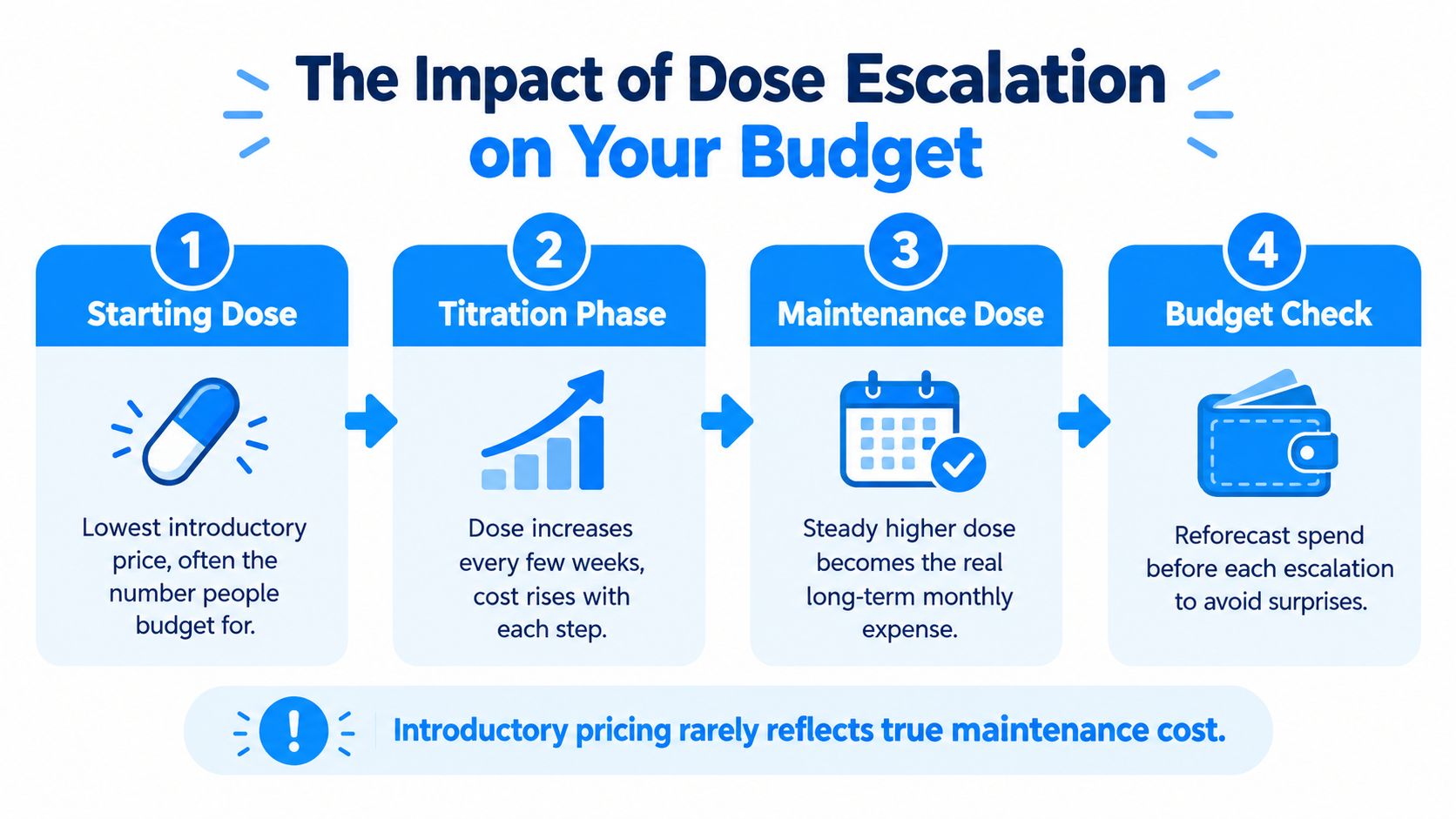
Dose escalation changes the financial shape of treatment. The starting dose may be the least expensive point in the schedule, while the maintenance dose can carry a higher monthly charge because the strength, quantity, delivery format, or manufacturer program changes.
A representative self-pay scenario illustrates the problem without predicting a particular patient's treatment. During the first stage, a patient sees a low introductory price and assumes that amount represents the ongoing cost. During titration, the prescribed dose increases, and the monthly medication charge rises. By maintenance, the patient discovers that the original budget covered the entry point rather than the cost of continuing therapy.
Manufacturer-direct pricing reported for selected cash-pay Zepbound dose levels has ranged from roughly $299 to $449, while standard retail pricing has been reported near $1,060 per month. Wegovy list pricing has been reported around $1,350 per month. These figures come from different pricing channels and aren't interchangeable. The dose, eligibility rules, product availability, pharmacy participation, and program terms can change the amount due, as summarized in the reported GLP-1 cash-price comparison.
The twelve-week calculation
A patient can reduce budget error by calculating each stage separately:
- Starting stage: Record the actual introductory medication price and its duration.
- Titration stage: Add the price for each prescribed strength rather than assuming the initial price persists.
- Maintenance stage: Use the confirmed maintenance price, including any change after a promotion ends.
- Clinical stage: Add the consultation, follow-up, supply, and delivery charges attached to each period.
The result is the total for the planned twelve weeks. Dividing that total by three produces an average monthly figure for that specific protocol, but the average shouldn't replace the stage-by-stage ledger. A patient could have an affordable average while still facing a higher payment in the maintenance month.
A longer budget should then multiply the confirmed maintenance expense across the remaining treatment months and preserve a separate allowance for clinical review and supplies. The calculation should be revised before each dose increase, not after the new charge appears.
Why the cheapest first month can distort decisions
A lower starting price can encourage a patient to begin treatment without confirming whether the later dose is financially sustainable. That creates an adherence risk unrelated to pharmacology. If a patient stops because the maintenance price becomes unmanageable, the clinical plan and the financial plan have failed together.
The responsible question is not whether a patient can afford the introductory period. It is whether the patient can afford the expected treatment trajectory, including the point at which the prescribed dose stabilizes.
Identifying Manufacturer Savings and Cash Programs
Manufacturer cash programs have fragmented the self-pay market. A patient may encounter an ordinary pharmacy list price, a direct-purchase offer, or a dose-specific promotion, and each channel can produce a different bill. The lower figure should be treated as a conditional offer, not as a permanent market price.
The National Consumers League reported several examples of advertised manufacturer pricing. Wegovy self-pay pricing was listed at $149 per month for certain lower doses through April 15, 2026, with the 4 mg dose increasing to $199 after that date. Reported Zepbound cash prices included $299 for four 2.5 mg vials, $399 for four 5 mg vials, and up to $499 for the highest dose. The figures and eligibility conditions are summarized in the KFF report on GLP-1 use and prescription drug costs.
The terms matter more than the headline
A cash program should be evaluated against five questions:
- Which dose qualifies? A price for a starter dose may not apply to the prescribed maintenance dose.
- How long does the offer last? An introductory amount can change on a stated date or after a defined treatment period.
- Who qualifies? Eligibility can depend on insurance status, prescription requirements, product availability, and other program rules.
- What does the amount include? The advertised medication price may exclude consultation, dispensing, supplies, shipping, or monitoring.
- Where can the prescription be filled? A direct channel may not be available through every pharmacy or in every jurisdiction.
A patient should preserve the program's terms at the time of enrollment and verify them before each refill. Manufacturer programs can change, and a quoted price from an earlier search may not apply when the next prescription is due.
The economic advantage can be substantial. A patient who qualifies for a lower cash channel may avoid hundreds of dollars in monthly list-price exposure. That difference doesn't prove that the program will remain the least expensive choice, because a compounded option, a different dose, or a bundled clinical service may produce another total. It does show why uninsured patients shouldn't use a single retail list price as the only benchmark.
Net price isn't the same as cash price
A 2025 economic model in JAMA Health Forum estimated annual net prices of $8,412 for semaglutide and $6,236 for tirzepatide, figures that reflect commercial discounts and not necessarily the cash amount paid by an uninsured patient. The same model estimated incremental cost-effectiveness ratios of $467,676 per quality-adjusted life-year for semaglutide and $197,023 for tirzepatide, with modeled additional price reductions of 81.9% and 30.5%, respectively, needed to reach a $100,000-per-quality-adjusted-life-year threshold, as reported in the JAMA Health Forum economic analysis.
Those results don't tell an uninsured patient what a pharmacy will charge. They demonstrate a different point: health-system net prices and patient-facing cash prices answer different economic questions. A sound household budget uses the latter.
Evaluating Clinical Quality versus Low Pricing
The lowest monthly price can be clinically misleading when it omits the information needed to judge treatment integrity. A lower quote may reflect a different dose, a short introductory period, a bundled service model, or a formulation that requires more scrutiny. Price alone can't establish that two preparations have equivalent potency, sterility, stability, or suitability for a particular patient.
Patients considering compounded therapy should request specific, verifiable information about the dispensing pharmacy and prescription. The clinician should explain why the selected formulation is appropriate, how the dose will be titrated, what adverse effects require contact, and how the practice will respond if the patient experiences persistent or unexpected symptoms.
Hair shedding requires biological interpretation
Hair loss deserves careful counseling because the phrase can describe different disorders. A systematic review of randomized clinical-trial data reported alopecia at 6.0 cases per 1,000 patient-years among GLP-1 receptor agonist users, compared with 0.8 cases per 1,000 patient-years in placebo groups. The pooled risk ratio was 3.40, with a 95% confidence interval of 1.18 to 9.81, and semaglutide and tirzepatide produced the strongest signals in the available evidence. The review identified telogen effluvium and androgenetic alopecia as predominant reported patterns and discussed rapid or substantial weight loss as a plausible contributor, as described in the systematic review of GLP-1 therapy and alopecia.
The findings don't establish that either medication directly causes alopecia. Rapid caloric or metabolic change can move follicles prematurely from the anagen growth phase into telogen, producing diffuse shedding that differs from permanent follicle destruction. Nutritional intake, iron status, thyroid disease, medication timing, and pre-existing patterned hair loss should therefore be assessed before treatment is stopped automatically.
Evidence remains mixed
A 2025 systematic review examined five studies involving 2,905 adults treated primarily with weekly subcutaneous tirzepatide. Reported diagnoses included telogen effluvium, androgenetic alopecia, alopecia areata, central centrifugal cicatricial alopecia, and folliculitis decalvans. The review described the association between tirzepatide and telogen effluvium as weak, with a reported p value of 0.054, which doesn't meet the conventional statistical-significance threshold of 0.05. It also reported that some studies described hair loss as an adverse event, while others described improvement or regrowth among patients receiving tirzepatide beginning at 2.5 mg weekly and titrating to 7.5 mg, as detailed in the tirzepatide-specific systematic review.
Another review found that no prospective controlled study had specifically evaluated GLP-1-related hair loss and concluded that causality hasn't been established. A retrospective dermatology-clinic cohort of 283 GLP-1 receptor agonist recipients found no statistically significant association between a specific drug and androgenetic alopecia or telogen effluvium. A nationally representative U.S. database analysis did associate any GLP-1 receptor agonist use with higher odds of any alopecia, with an odds ratio of 1.18, and androgenetic alopecia, with an odds ratio of 1.80, while not finding the same association for alopecia areata or telogen effluvium, according to the review of causality and conflicting alopecia evidence.
Persistent diffuse shedding warrants clinical assessment. Patchy, scarring, inflammatory, or rapidly progressive loss shouldn't be attributed to routine telogen effluvium without examination. The financial plan should include the possibility of follow-up care, because choosing an inexpensive medication doesn't eliminate the cost of evaluating an unexpected clinical response.
A physician-directed telehealth option such as Vials + Vitals can combine an online clinical assessment, U.S.-licensed provider review, individualized titration, pharmacy dispensing, and delivery, with the applicable formulation and treatment plan determined by clinical eligibility. Patients should still compare the complete cash obligation, confirm pharmacy and testing details, and ask what happens financially if treatment isn't clinically appropriate or must be discontinued.
Vials + Vitals provides physician-directed telehealth evaluation and protocol-based GLP-1 care, including semaglutide and tirzepatide options, individualized titration, and fulfillment through accredited U.S. pharmacy partners. Patients seeking a transparent assessment of medication, clinical, and delivery costs can review the service at Vials + Vitals and compare the proposed plan with the full twelve-week and twelve-month budget described above.
Ready to see if this protocol fits your biology?
A licensed provider reviews every request before anything is prescribed.
Calibrate your metabolic protocol →