Compounding Pharmacy Online: Safety and Verification
Learn how a compounding pharmacy online operates, verify USP and NABP accreditations, and ensure safe fulfillment for GLP-1 and peptide therapies.
The most popular advice about a compounding pharmacy online is usually too simple. If the pharmacy has a polished website and ships fast, many people assume the medicine is legitimate, but digital convenience says almost nothing about licensure, sterile handling, or whether the formulation is even allowed.
That gap matters most for metabolic care and hair-related protocols, where patients are often shopping for GLP-1s, tirzepatide, semaglutide, or adjunctive therapies through telehealth. The question is not whether a pharmacy can take an order online, it's whether the entire workflow, from clinical assessment to cold-chain delivery, is controlled tightly enough to protect the patient.
Table of Contents
- The Evolution of Digital Compounding Pharmacies
- Navigating the Regulatory Framework and Shortage Delistings
- Verifying Accreditation and Digital Pharmacy Legitimacy
- Quality Controls for Sterile Injectables and Cold-Chain Logistics
- Evaluating Formulation Claims and Adverse Event Risks
- The Role of Physician Oversight in Telehealth Compounding
- Clinical Takeaways and Patient Safety Parameters
The Evolution of Digital Compounding Pharmacies
Compounding used to sit at the center of American dispensing, then receded into a specialized role as manufactured drugs became dominant. A peer-reviewed historical review reports that about 75% of U.S. prescriptions required in-pharmacy compounding in the 1930s, then the share fell to 25% by the 1950s, less than 5% by 1960, and about 1% by 1970. That decline is the key to understanding the modern compounding pharmacy online model, because today's digital pharmacies are not trying to replace retail pharmacy at scale, they're answering a narrower clinical need.
Why specialization changed the delivery model
The older model depended on a patient standing in front of the counter and waiting for a custom preparation. The modern model routes the same kind of individualized work through online intake, remote prescribing, and home delivery, which makes sense only when the therapy truly needs customization. That's why online compounding works best for patient-specific formulations, not for routine substitution of standard retail products. A peer-reviewed historical review shows how far the field moved from mass dispensing toward niche, medically directed preparation.
Practical rule: online access should make compounding more precise, not more casual.
This shift also changed patient expectations. People now expect speed, discreet fulfillment, and a clear line from evaluation to dispensing, but the medicine still has to respect the same old principles, correct prescription, appropriate formulation, and verified pharmacy controls. A digital storefront can improve access, but it can't relax the standards that make compounding defensible in the first place.
Navigating the Regulatory Framework and Shortage Delistings
The first legal question in online compounding is whether the product belongs under Section 503A or Section 503B. Under FDA guidance, 503A compounding is tied to an individual patient prescription in a state-licensed pharmacy or by a licensed physician, while 503B outsourcing facilities are FDA-registered, inspected on a risk-based schedule, and held to a more formal quality-system burden. That split determines whether the pharmacy can prepare office-use quantities, how the product is labeled, and how much documentation surrounds release and quality assurance. FDA compounding provisions
What changed after the GLP-1 shortage
The regulatory picture tightened again once the shortage-based pathway began closing. FDA said enforcement discretion for semaglutide compounding tied to the shortage ended in April–May 2025 for most 503A and 503B pathways, which created confusion because some consumer pages still implied broad online availability. FDA policy update
That matters because convenience and cost savings are not clinical reasons by themselves. Once shortage-based copying is no longer available, legitimate access depends on whether a patient-specific prescription is indicated and whether the pharmacy is operating within the current legal boundary. Tirzepatide came off the FDA shortage list in December 2024 and semaglutide followed in February 2025, which removed the routine copying pathway for compounders. Stanford Medicine summary
A pharmacy can look “online-ready” and still be out of bounds for the product it's advertising.
For patients, that means the legal test is not “can it ship nationwide,” it's “is this exact therapy legally compoundable for this exact patient under the current rules.” For clinics, it means telehealth workflows need prescriber review, not automated checkout language that treats a prescription drug like retail skincare.
Verifying Accreditation and Digital Pharmacy Legitimacy
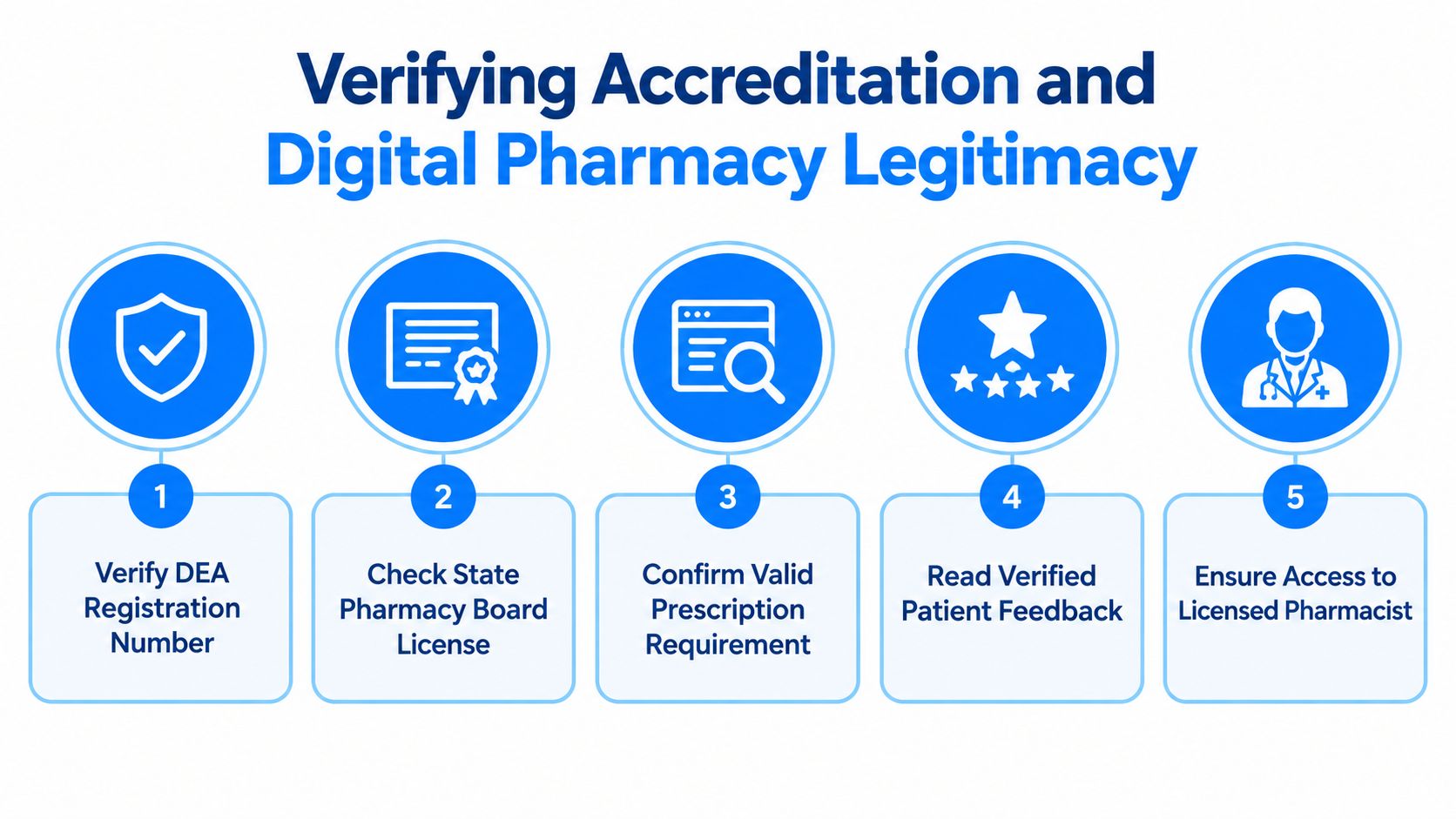
A legitimate online pharmacy makes verification easy. The patient should be able to confirm state licensure, inspect the prescribing requirement, and see some evidence of third-party oversight or pharmacy-board status before payment happens. If those details are hidden, buried, or vague, the safest assumption is that the operation is not built for medical accountability.
A simple verification sequence that works
Start with the pharmacy license. Every U.S. state maintains a board database, and a valid license should match the pharmacy's legal name and address. Then confirm that the site requires a real prescription, because any source willing to sell compounded medication without a valid prescription is treating regulation as optional.
Next, look for accreditation language that can be independently checked, plus access to a pharmacist for questions about formulation, storage, and refills. Patients should also ask how the pharmacy handles temperature-sensitive products and what happens if a package arrives compromised.
Clinical takeaway: if the pharmacy can't explain its controls in plain language, it probably doesn't have enough of them.
Online ads are often the weakest part of the patient journey. Recent independent coverage notes gaps in advertisements for non-FDA-approved treatments, including limited disclosure of contraindications, adverse-event reporting, and other safety information, and that matters because the shopper rarely sees the pharmacy's accreditation, potency testing, or cold-chain handling before buying. Independent coverage on online ads
The cleanest rule is this, if the marketing sounds more confident than the documentation, the documentation is probably incomplete.
Quality Controls for Sterile Injectables and Cold-Chain Logistics
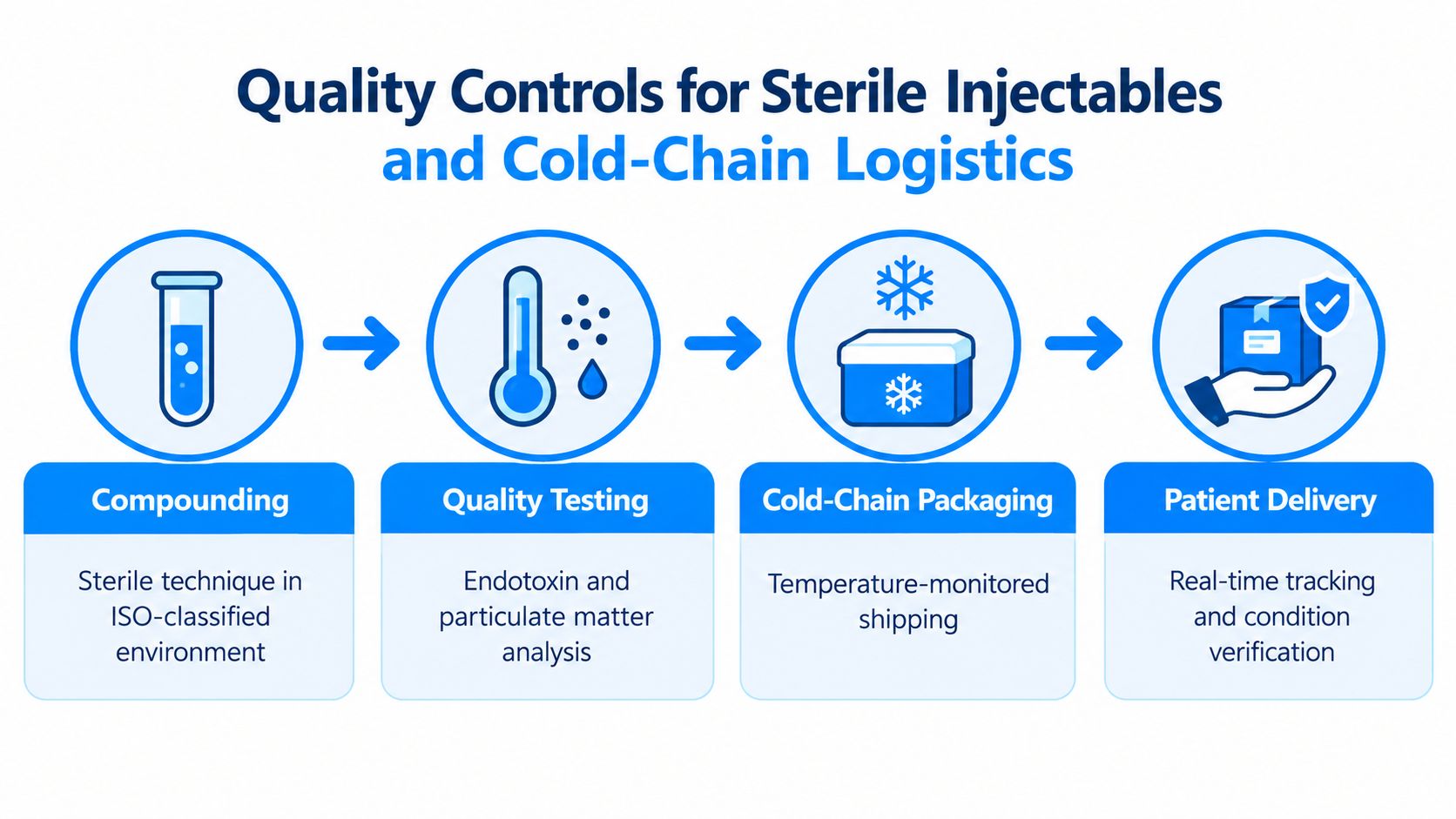
Sterile compounding is not a packaging problem. It's a microbiology and logistics problem that happens to end in a box at the door. For injectable therapies used in metabolic care, the pharmacy has to prove that the batch was prepared under control and that shipment did not compromise the drug before it reached the patient.
What sterility testing actually requires
USP Chapter 71 sterility testing uses a 14-day incubation window, split into 7 days at 20–25°C and 7 days at 30–35°C, to detect mold, yeast, and bacteria. A batch passes only if no growth appears after the full incubation period. That makes sterility release a real testing event, not a label applied at the last minute. USP Chapter 71 summary
The pharmacy also has to manage beyond-use dating carefully. A drug that sits outside its validated range, or one that is shipped without the right insulation and temperature controls, may degrade before it's used. In practice, cold-chain packaging and documented release criteria are not logistics extras, they're part of whether the dose remains fit for use.
What patients should ask before ordering
- How is the batch released? Ask whether the pharmacy performs sterility-related release checks before shipment.
- How is temperature preserved? Confirm insulated packaging and temperature-monitored shipping for products that require it.
- What happens on arrival? The pharmacy should explain what to do if a package arrives warm, damaged, or delayed.
- Is the storage range documented? The patient should receive clear instructions for refrigeration or room-temperature storage, depending on the formulation.
Those questions matter because cold-chain failure can turn a legitimate prescription into a compromised product. For any injectable therapy sent through a compounding pharmacy online workflow, the burden is on the pharmacy to show that the medicine left the facility intact and arrived intact.
Evaluating Formulation Claims and Adverse Event Risks
Marketing in this space often leans on delivery formats that sound convenient but haven't been clinically validated. FDA-approved semaglutide exists as an injectable and as an oral tablet, while sublingual drops or dissolving-tablet versions sold by some compounders have not been studied in clinical trials. When a product promises a different absorption route without real clinical evidence, the claim should be treated as a formulation hypothesis, not as established therapy. Stanford Medicine summary
FDA-approved and compounded GLP-1 formulations
| Formulation Type | Clinical Validation | Absorption Profile | Safety Status |
|---|---|---|---|
| FDA-approved semaglutide injectable | Established | Known and studied | Regulated approved product |
| FDA-approved semaglutide oral tablet | Established | Known and studied | Regulated approved product |
| Compounded sublingual or dissolving formulations | Not established in clinical trials | Variable and unverified | Higher uncertainty |
The safety signal around compounded incretin drugs also matters. A recent review reported that, as of November 30, 2024, the FDA had received 392 adverse-event reports for compounded semaglutide and 215 for compounded tirzepatide. Those reports do not prove causality by themselves, but they do show why compounded GLP-1 products deserve stricter scrutiny than casual online retail products. Adverse-event review
That's the central issue with online advertising for these therapies. A website can present a smooth checkout flow while leaving out the details that determine whether the medicine is clinically aligned, legally permissible, and absorbed the way the prescriber expects.
The Role of Physician Oversight in Telehealth Compounding
A legitimate online compounding pathway starts with a clinician, not a cart. The strongest telehealth models use an intake review, a prescription decision, and a titration schedule that is adjusted over time, because metabolic therapy often needs guardrails rather than a one-time order. Without that structure, online access turns into self-directed dosing, which is the wrong model for injectable weight-management drugs and for any therapy that needs ongoing reassessment.
What structured oversight changes
Physician oversight reduces guesswork in three ways. First, it screens for exclusions before treatment begins. Second, it sets a dose progression that matches the patient's tolerance and response. Third, it creates a stop point when the therapy is no longer clinically justified.
That matters in telehealth because the convenience of home delivery can hide a familiar failure mode, patients keep requesting a product long after the reason for treatment has changed. A structured pathway keeps the pharmacy linked to an actual medical decision rather than a recurring shipment.
For patients comparing options, the useful distinction is between a physician-directed service and a storefront that merely forwards an order. Vials + Vitals is one physician-directed telehealth option that uses online assessment, prescriber review, and fulfillment through licensed partner pharmacies, which is the kind of model that aligns with the clinical controls described above.
Practical rule: if the dose plan never changes, nobody is really managing the therapy.
The same logic applies to hair-related or metabolic regimens. The pharmacy can only compound what the prescriber can justify, and the prescriber can only justify what the patient's biology and response support over time.
Clinical Takeaways and Patient Safety Parameters
A safe online compounding decision starts with one question, not three, and that question is whether the treatment is clinically indicated and legally compoundable right now. If the answer is unclear, the patient should not be pushed into checkout mode. The safest workflows treat the pharmacy as the end of a medical process, not the beginning of a shopping experience.
The patient checklist
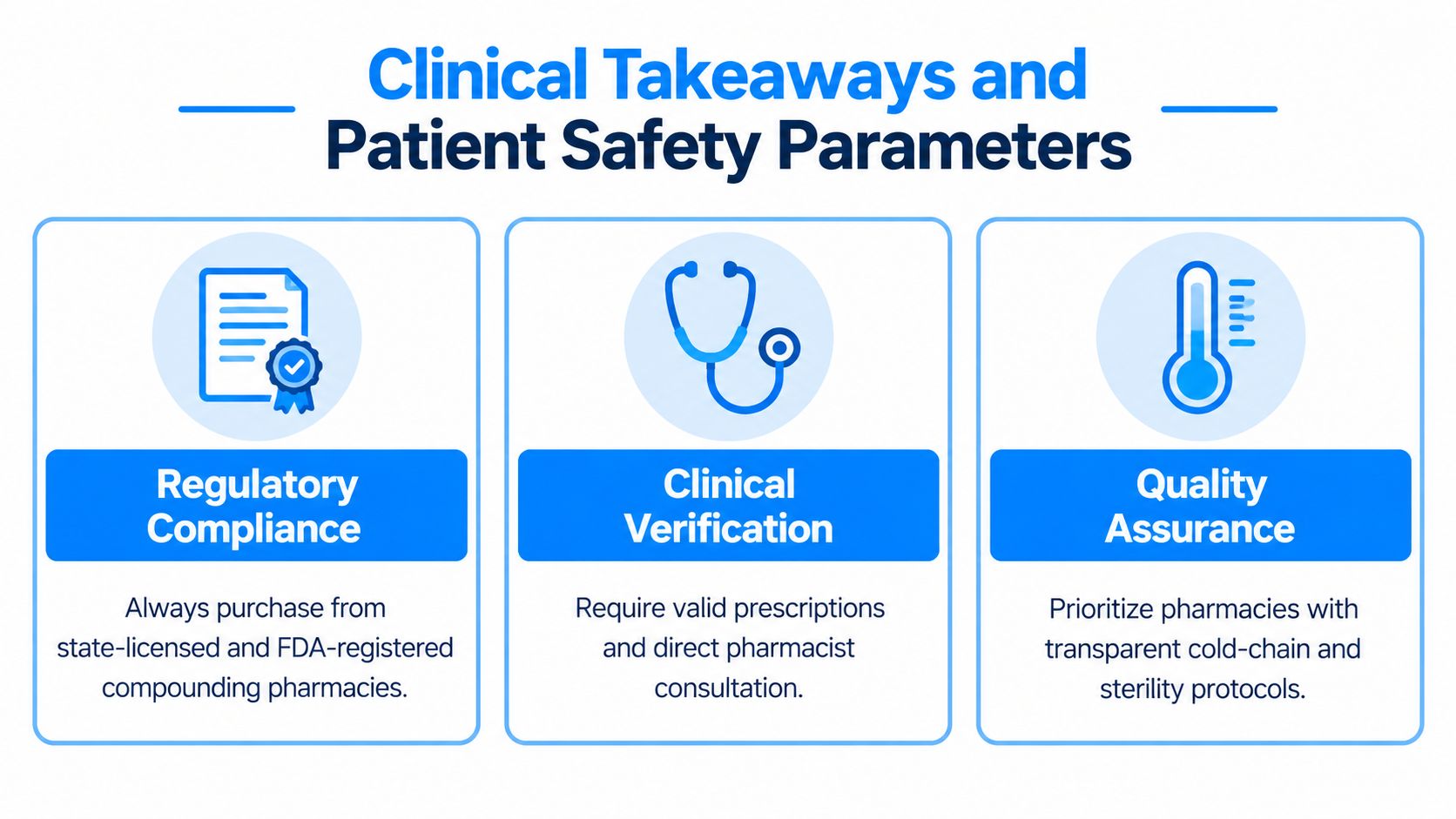
- Confirm the legal pathway: verify whether the drug is being handled under an appropriate patient-specific prescription and not routine copying after shortage delisting.
- Verify licensure and accreditation: match the pharmacy against state records and look for transparent quality credentials.
- Require pharmacist access: a patient should be able to ask how the drug was compounded, tested, stored, and shipped.
- Check the delivery controls: cold-chain shipping should be explained clearly for any temperature-sensitive injectable.
- Read the formulation label carefully: the route of administration should match what has been studied or prescribed.
The easiest mistake is assuming that all online compounding sites are interchangeable. They aren't. Some are clinical workflows with pharmacy fulfillment attached, while others are just marketing pages with a payment button.
For patients focusing on metabolic health, hair retention biology, or other protocol-driven care, the right standard is simple, verified medicine, verified pharmacy, verified oversight. If any one of those pieces is missing, the safer move is to walk away and ask for documentation before anything ships.
Vials + Vitals provides physician-directed telehealth, clinical assessment, and fulfillment through licensed U.S. pharmacy partners, which fits the same safety standards outlined here. For patients comparing online compounded therapies for metabolic health or hair-related protocols, visit Vials + Vitals to review how a prescriber-led workflow and accredited pharmacy fulfillment are structured.
Ready to see if this protocol fits your biology?
A licensed provider reviews every request before anything is prescribed.
Calibrate your metabolic protocol →