Compounded Semaglutide: Safety, Regulations, and Quality
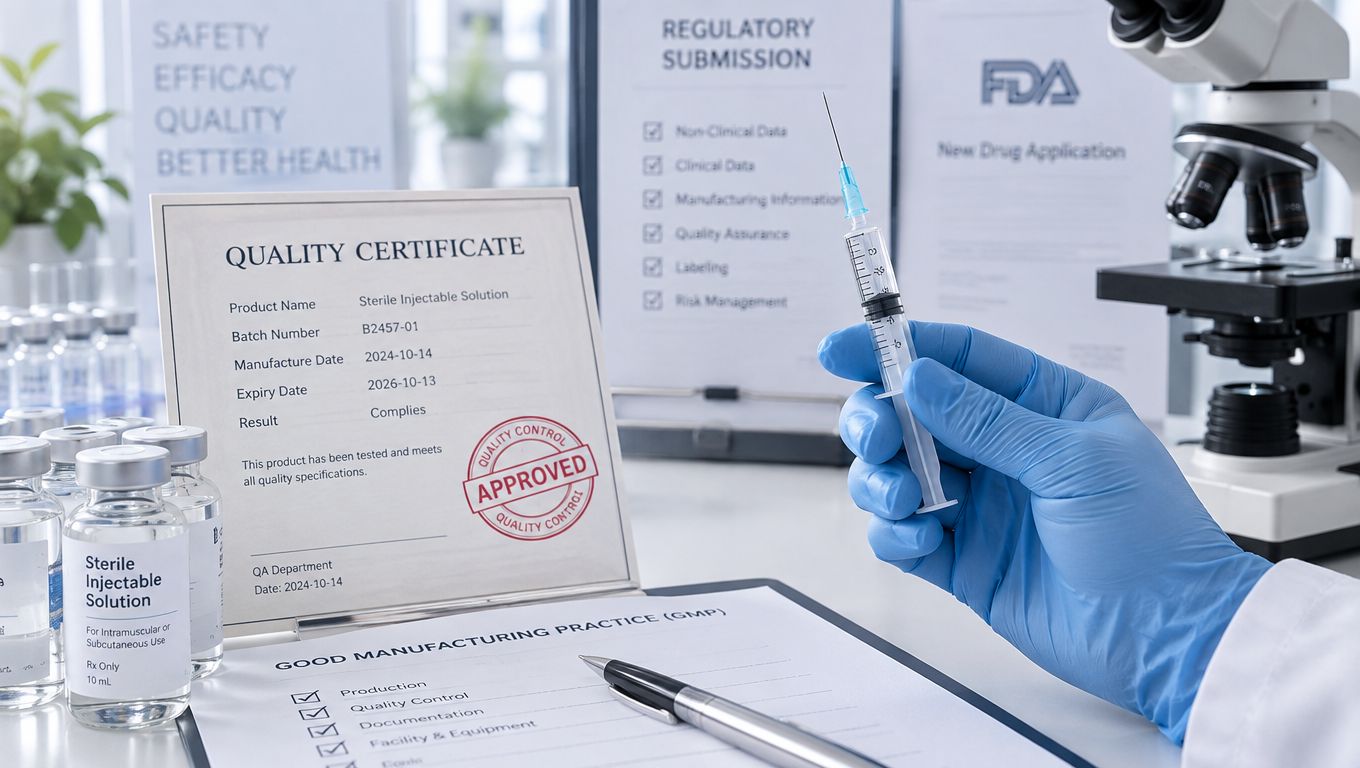
Understand compounded semaglutide: regulatory status, FDA shortages, safety risks, and how to verify compounding pharmacy quality for metabolic health.
Compounded semaglutide is not FDA-approved, has been linked to documented dosing errors, and expanded during a temporary regulatory window created by the 2022 to 2025 GLP-1 shortage. That window may limit future access as regulators restrict large-scale compounding.
But what happens when a medication that helped a patient becomes difficult to obtain, and the alternative was never reviewed by the FDA for safety, effectiveness, or quality before marketing? That question matters more than whether compounded semaglutide is “available.” Patients and clinicians need to understand why it emerged, what risks accompany it, and how to plan if its supply narrows.
The practical position is measured rather than absolute. Compounding can serve a legitimate clinical purpose when a patient has a specific need that an available product cannot meet. Compounded semaglutide became much more common for a different reason, access during a national shortage. It should therefore be viewed as a transitional clinical tool, not as an automatically interchangeable version of an FDA-approved medication.
Table of Contents
- Why Compounded Semaglutide Exists
- Understanding the Regulatory Rules for Compounded Semaglutide
- Safety Risks and Dosing Concerns
- Efficacy Context From Clinical Trials
- How to Verify Compounding Pharmacy Quality
- Common Misconceptions About Compounded GLP-1s
- Planning for Treatment Continuity
- Key Takeaways for Informed Decisions
Why Compounded Semaglutide Exists
What does a patient do when an FDA-approved GLP-1 medication is prescribed, but the local pharmacy cannot fill it? The prescriber may look for another source, while the patient searches online and finds a compounding pharmacy offering a vial. During a shortage, that option can appear to be the only practical way to avoid an interruption in treatment.
That shortage-driven reality explains the rise of compounded semaglutide. The FDA added semaglutide injection products to the drug shortage list in March 2022 for Wegovy and August 2022 for Ozempic. Those designations created a temporary pathway for 503A pharmacies and 503B outsourcing facilities to compound semaglutide for patients with prescriptions, as described in the FDA's clarification of policies for compounders.
The access problem that drove demand
A 503A pharmacy generally prepares medication for an individual prescription and a patient-specific need. A 503B outsourcing facility operates on a larger scale and distributes compounded medication under a different regulatory framework. Both entered the semaglutide access discussion while the shortage pathway was available, although their operating models and oversight requirements differ.
Patients sought compounded products for practical reasons:
- Availability: A local or online pharmacy might have compounded semaglutide when an approved product could not be obtained.
- Formulation flexibility: Compounding can sometimes address a patient-specific formulation issue, but the resulting medication is still not FDA-approved.
- Continuity: A patient responding to semaglutide may prefer to avoid an interruption while supply conditions remain uncertain.
The distinction from Wegovy and Ozempic matters because compounded semaglutide is not the FDA-approved medication in a different package. It is produced through a compounding process and does not carry the same premarket review status for safety, effectiveness, and quality.
The FDA determined that the semaglutide shortage was resolved in February 2025. Wind-down deadlines followed, with April 22, 2025 for 503A pharmacies and May 22, 2025 for 503B outsourcing facilities. These dates ended the shortage-based expansion period, but they did not eliminate every possible compounding pathway. They created a period of regulatory uncertainty for patients who had come to rely on these products. Compounded semaglutide is therefore best considered a transitional clinical tool, with a treatment-continuity plan, rather than an automatically interchangeable alternative to an approved medication.
Understanding the Regulatory Rules for Compounded Semaglutide
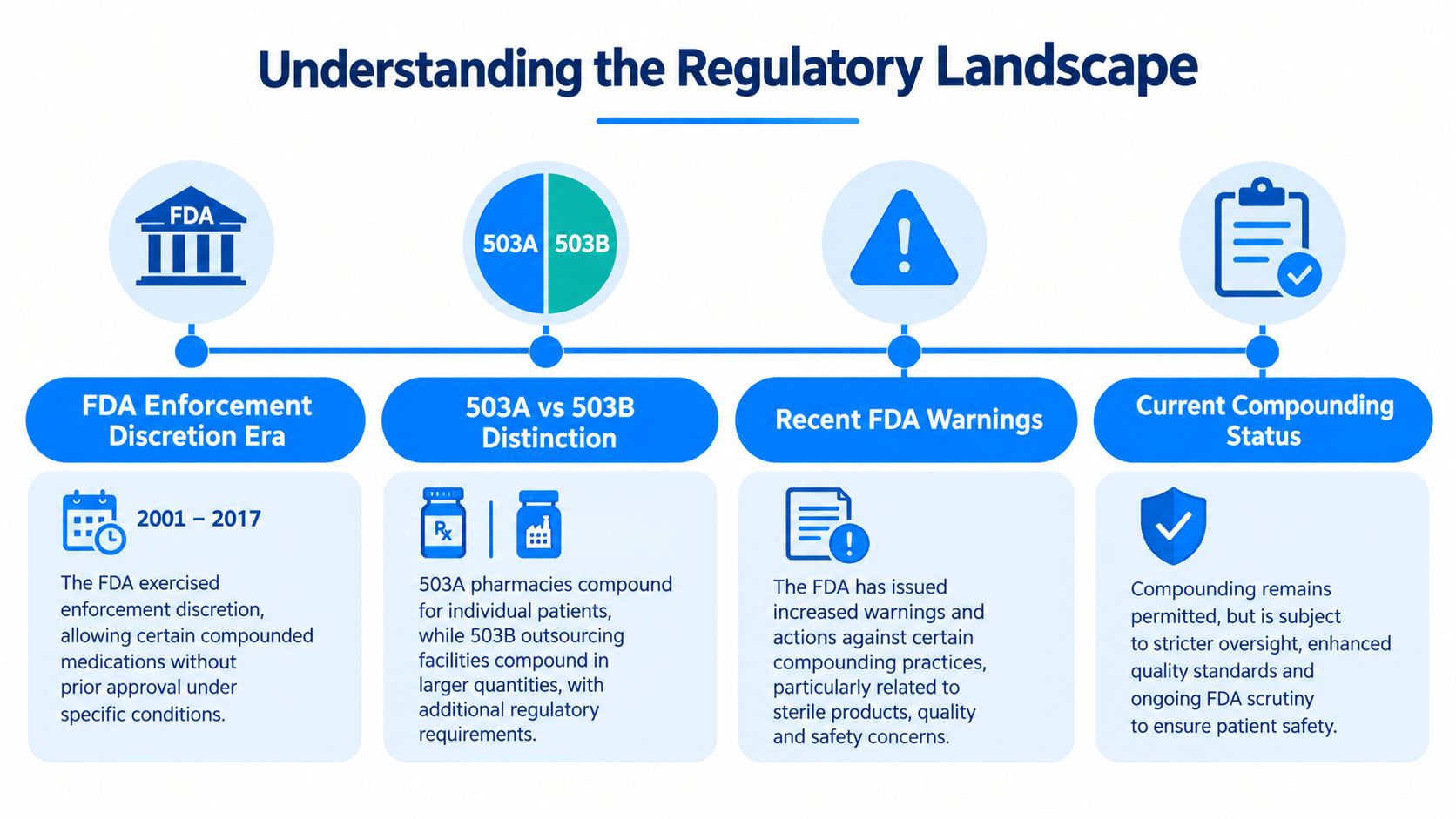
Which rules govern compounded semaglutide after the shortage period? The answer depends on the pharmacy's legal pathway, the patient-specific basis for the prescription, and how the medication is prepared, distributed, and marketed under federal and state requirements.
The FDA shortage designation changed the practical rules. While semaglutide appeared on the shortage list, 503A pharmacies and 503B outsourcing facilities had a temporary basis for compounding it for prescribed patients. After the FDA determined the shortage was resolved in February 2025, that basis narrowed, with separate wind-down deadlines for the two facility types. The FDA shortage-policy notice explains the regulatory significance of those deadlines.
503A and 503B are not interchangeable labels
These designations describe different operating models, not two forms of FDA approval. A 503A pharmacy generally compounds for a specific patient and prescription. A 503B outsourcing facility is intended for larger-scale preparation and must meet additional federal oversight requirements, including current good manufacturing practice requirements.
The designation alone does not establish that a product is safe, effective, or suitable for a particular patient. Patients should identify the facility preparing the medication and the pathway under which it operates.
| Question | Why it matters |
|---|---|
| Who compounded the medication? | A telehealth brand may not be the facility that prepared the vial. |
| Which regulatory pathway applies? | The answer affects production scale, oversight, and permissible sourcing. |
| What happens after the shortage pathway ends? | A supplier that depended on bulk production may face a different continuity problem from a traditional pharmacy. |
Post-shortage availability can therefore outlast the regulatory rationale that supported it. In April 2026, the FDA proposed excluding semaglutide, tirzepatide, and liraglutide from the 503B bulks list. The FDA announcement concerning the proposed 503B exclusions describes that proposal. The result is a gap between what patients can obtain and which supply models may remain durable.
Practical rule: Availability today does not prove that a compounded semaglutide supply will remain legally or commercially stable.
Safety Risks and Dosing Concerns
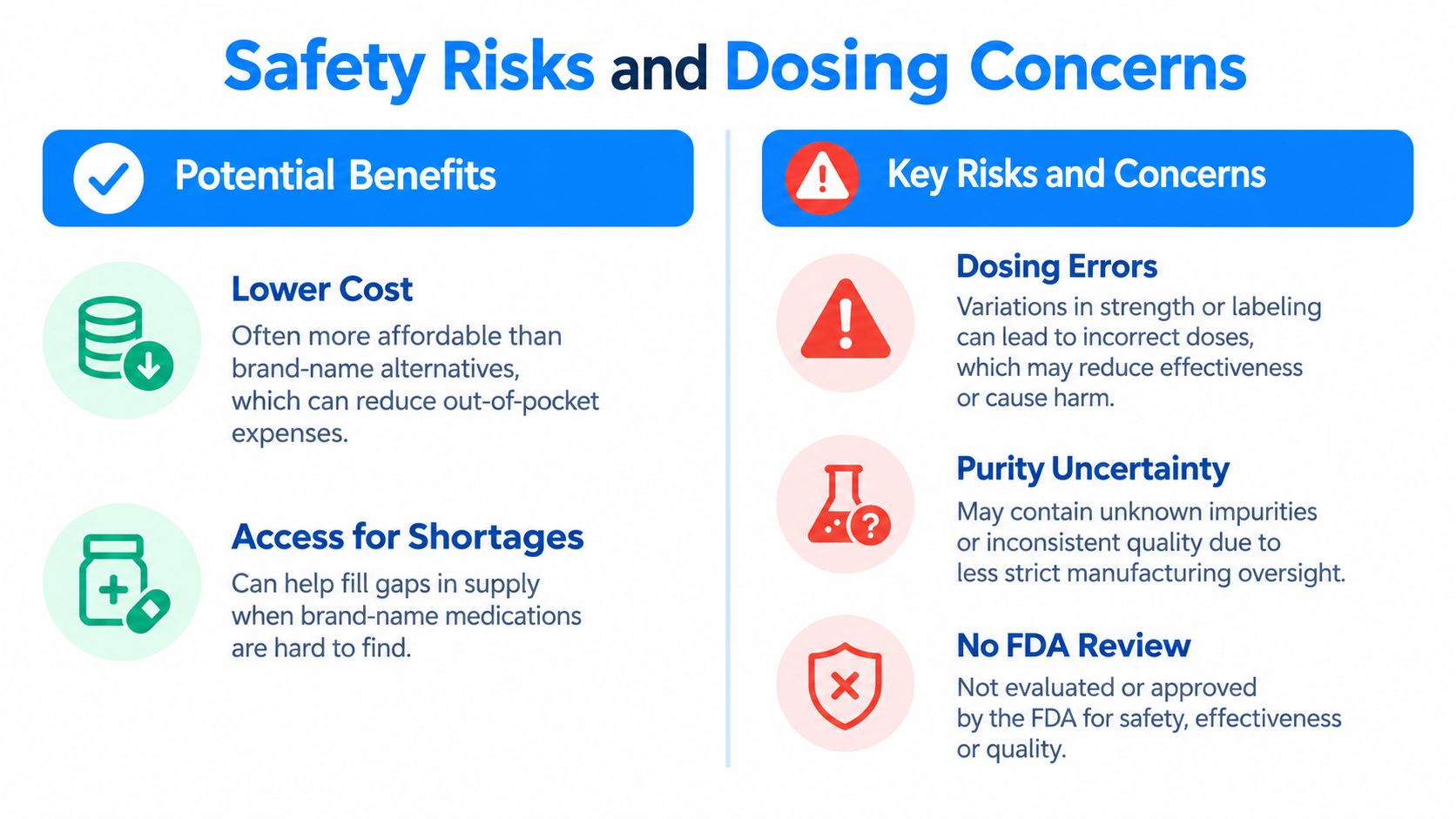
The central safety issue isn't that every compounded semaglutide dose will cause harm. The issue is that compounded products don't undergo FDA premarket review for safety, effectiveness, or quality, and the delivery system can place more responsibility on the patient.
The FDA has reported dosing errors involving compounded injectable semaglutide. Patients and caregivers have confused milligrams with milliliters, used incorrect syringe markings, or misinterpreted concentration instructions. Those mistakes can result in substantial overdoses or underdoses, particularly when a multidose vial requires the patient to calculate and draw a volume rather than use a fixed-dose delivery system.
Where the risk enters the process
Several failure points can produce an incorrect dose:
- Concentration confusion: The label may express the medication strength in a way that differs from the patient's instructions.
- Unit conversion: A patient may mistake a volume measurement for the amount of active ingredient.
- Syringe selection: Syringes with different markings can make the same volume look different.
- Instruction gaps: A telehealth patient may receive a vial without adequate live education or follow-up.
- Product variability: The compounded formulation isn't subject to the same premarket consistency review as an FDA-approved product.
These risks can overlap. A correctly compounded medication can still be used incorrectly, while a clear instruction sheet can't compensate for uncertain product quality. The FDA has received adverse-event reports, including reports tied to compounded injectable semaglutide that required hospitalization, as described in the FDA safety alert on dosing errors.
A safer clinical process
Patients shouldn't calculate a new volume from memory or copy a dose from another person's vial. The prescribing clinician or pharmacist should provide the concentration, the dose in the appropriate unit, the exact volume to draw, the syringe type, and instructions for what to do after a dosing mistake.
Urgent medical evaluation is appropriate after a suspected overdose or serious symptoms. Severe or persistent vomiting, inability to keep fluids down, marked weakness, fainting, confusion, or other acute changes deserve prompt clinical attention rather than an attempt to manage the error alone.
The FDA also warns that compounded semaglutide products aren't FDA-approved and that multiple adverse-event reports have been associated with dosing errors, as explained in the agency's concerns about unapproved GLP-1 drugs used for weight loss. Access can be valuable, but access without dose verification and clinical monitoring is an incomplete treatment model.
Efficacy Context From Clinical Trials
The strongest efficacy evidence for semaglutide comes from trials of a specific, studied product and dosing protocol. That evidence helps patients understand what semaglutide can achieve when the medication is manufactured, dosed, and monitored as intended. It doesn't establish that a compounded vial is equivalent to the trial product.
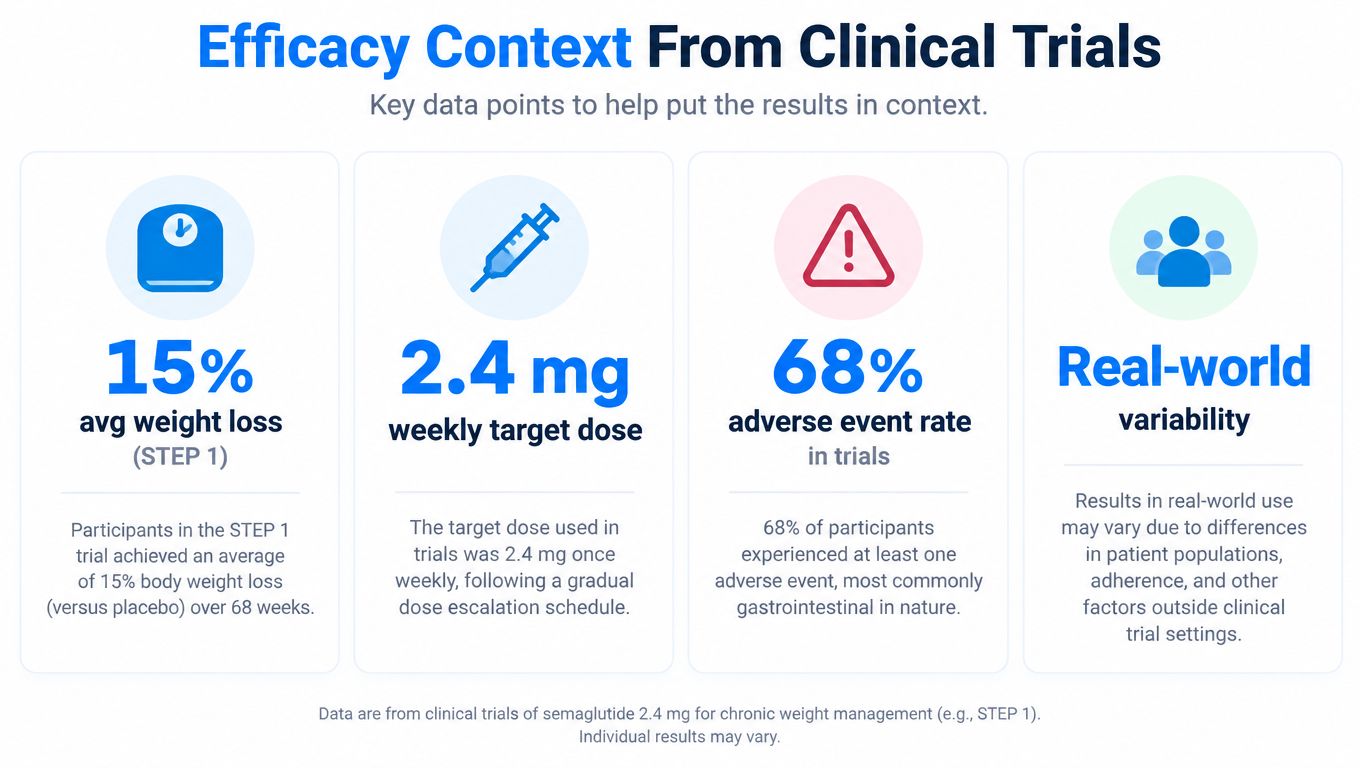
In the STEP 1 trial, adults with obesity receiving once-weekly semaglutide 2.4 mg lost 14.9% of body weight at 68 weeks, compared with placebo. The published STEP 1 trial provides the relevant clinical context for that result.
What the STEP findings do and don't prove
STEP 2 offers another useful comparison. Among participants receiving semaglutide 2.4 mg, 69% achieved at least 5% weight loss, compared with 57% receiving 1.0 mg and 29% receiving placebo. Those figures show a dose-related efficacy pattern within the trial, not a guarantee for an individual patient or a validation of compounded formulations.
The evidence supports several practical conclusions:
- A response is not defined by one early weigh-in. Treatment response develops over time and depends on dose escalation, adherence, health status, and tolerability.
- A trial result is not a product equivalence claim. The study evaluated a defined semaglutide intervention, not every preparation sold by a compounding pharmacy.
- Dose accuracy matters. A product that is underdosed may fail to provide the expected effect, while an overdosed product may increase adverse effects without improving the clinical strategy.
- Weight is only one outcome. Appetite control, glycemic measures, body composition, symptoms, and treatment tolerability all belong in follow-up.
Compounded semaglutide may produce GLP-1 effects when it contains the intended active ingredient at the intended concentration. That conditional statement is narrower than saying it is interchangeable with an FDA-approved medication. Patients should separate the efficacy of semaglutide as studied from the quality and reliability of a particular compounded product.
How to Verify Compounding Pharmacy Quality
Patients can't determine medication quality from a polished website, a low price, or a vial that looks professional. Verification begins with identifying the actual pharmacy, not merely the telehealth company or membership program that arranged the prescription.
A clinician should be able to name the compounding pharmacy and explain which regulatory pathway applies. If the supplier won't disclose who prepared the medication, the patient lacks the information needed to evaluate licensing, oversight, testing, storage, and recall communication.
A practical verification sequence
Start with the facility. Confirm the pharmacy's state license and physical identity. The name on the prescription, shipping label, and patient communication should be consistent. A third-party seller that cannot identify its dispensing pharmacy should not receive automatic trust.
Ask about sterile preparation. Injectable semaglutide requires sterile handling. Patients should ask what procedures govern sterile preparation, environmental monitoring, personnel training, beyond-use dating, and shipping conditions. General assurances aren't a substitute for a clear answer.
Request testing documentation. Ask whether the batch undergoes potency, identity, sterility, and endotoxin testing, and whether the pharmacy can provide a certificate of analysis for the relevant lot. A document should identify the lot and test rather than state that the product is “tested.”
Check recognized quality markers. NABP accreditation, LegitScript approval, and documented USP-compliant processes can provide useful signals. None of these labels alone guarantees that a particular vial is correctly prepared, appropriately labeled, or suitable for an individual patient.
Questions for the prescribing team
Patients should ask:
- What is the exact concentration in the vial?
- What dose is prescribed, and what volume corresponds to that dose?
- Which syringe should be used?
- How will the pharmacy handle a recall or quality concern?
- How often will the clinician review response, adverse effects, and the medication source?
- What is the plan if this pharmacy can no longer supply the product?
A quality-conscious process welcomes these questions. Evasive answers, unclear labels, unexplained concentration changes, and instructions that rely on the patient to perform complex calculations are reasons to pause before using the medication.
Common Misconceptions About Compounded GLP-1s
The most persistent misconception is that compounded semaglutide is just a lower-cost version of an FDA-approved product. Price and appearance don't establish equivalence. A compounded drug may contain the intended active ingredient, but the FDA hasn't reviewed that specific product for safety, effectiveness, or quality before it reaches patients.
A second misconception treats compounding as the same thing as generic manufacturing. A generic medication is an FDA-approved product that must meet the applicable requirements for its category, including evidence supporting therapeutic equivalence. A compounded preparation follows a different pathway and doesn't become a generic because it uses the same active ingredient.
Four assumptions that deserve scrutiny
“The label says semaglutide, so the product is the same.” The ingredient name doesn't answer questions about concentration, formulation, sterility, potency, packaging, or manufacturing controls.
“A pharmacy is a pharmacy.” Facilities differ in scale, oversight, sterile procedures, documentation, and communication. The patient's responsibility is to identify the actual facility and understand its process.
“More medication will work faster.” Dose escalation should follow a clinician-directed plan. Increasing the dose independently can increase risk, especially when the patient is using a vial and syringe.
“The shortage ended, so every compounded product is illegal.” The regulatory picture is more specific. The shortage-based pathway ended after the FDA determined the shortage was resolved, while other compounding questions depend on the facility, prescription, formulation, and applicable rules. Patients shouldn't rely on a blanket claim from either a seller or a headline.
The useful question isn't whether a compounded product looks like an approved product. It's whether the patient can verify what was made, how it was made, how it should be measured, and who will manage the treatment.
Compounding has a legitimate place in medicine when it addresses a defined patient need. That principle doesn't justify presenting a mass-produced copy as interchangeable with an FDA-approved therapy. Marketing language that erases the distinction makes informed consent harder.
Planning for Treatment Continuity
Patients using compounded semaglutide should plan for continuity before a supply interruption forces a rushed decision. A treatment plan that depends on one pharmacy, one vial concentration, or one subscription channel is fragile, especially while regulators continue to narrow large-scale compounding options.
The first step is a direct conversation with the prescribing clinician. The patient should share the current vial label, concentration, dose, injection schedule, adverse effects, and recent clinical results. The next medication choice may be an FDA-approved semaglutide product, another clinically appropriate therapy, or a monitored pause, but the decision depends on the patient's health status rather than a simple dose conversion.
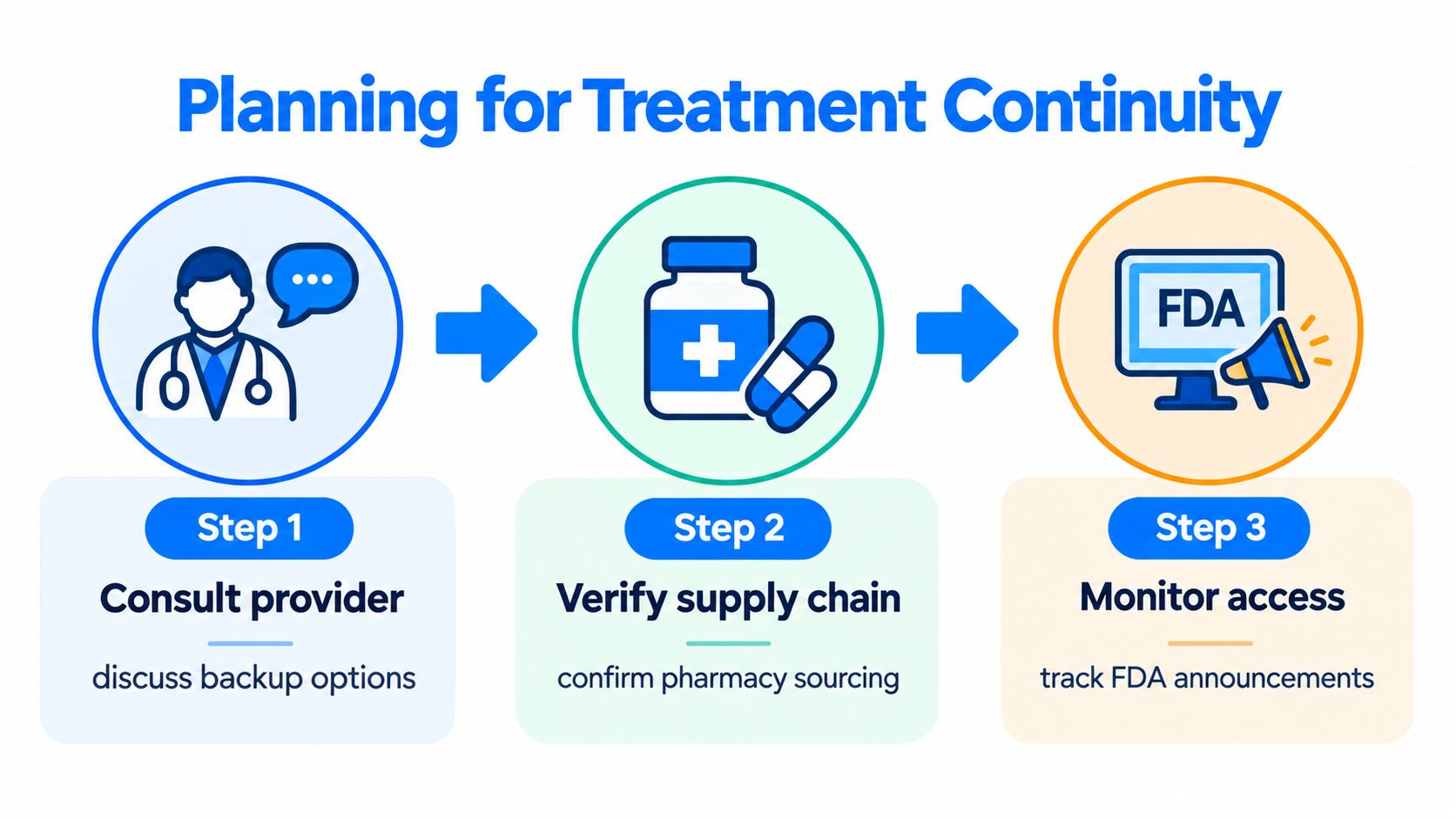
Build a written backup plan
A useful continuity plan should answer three questions:
- Who will prescribe the next treatment? The clinician should be identified before the current supply runs out.
- What clinical information is needed? Medication history, response, tolerability, relevant laboratory data, and the actual vial concentration may affect the transition.
- How will monitoring continue? Follow-up should assess appetite, weight trajectory, glycemic status when relevant, gastrointestinal symptoms, hydration, and other patient-specific risks.
Patients shouldn't stockpile multidose vials or change dosing to stretch a supply. Storage conditions, beyond-use dates, changing concentrations, and unsupervised dose calculations can create additional hazards. A short gap may be safer than an improvised regimen, but the clinician should provide that guidance.
The regulatory uncertainty also changes the timing of the conversation. The FDA's shortage-based pathway ended after the shortage resolution, and the agency proposed further restrictions affecting semaglutide, tirzepatide, and liraglutide in 2026. That doesn't mean every patient must stop immediately, but it does mean that waiting for a supplier to announce a disruption leaves fewer choices.
Continuity planning is clinical care, not panic buying. The goal is a documented transition pathway with verified medication, appropriate dosing, and a clinician who remains responsible for follow-up.
Key Takeaways for Informed Decisions
Compounded semaglutide emerged from a genuine access problem. The FDA shortage designations for Wegovy and Ozempic created a temporary pathway that allowed 503A pharmacies and 503B outsourcing facilities to compound semaglutide for prescribed patients. That pathway expanded access during an unstable period, but it didn't convert compounded semaglutide into an FDA-approved medication.
The distinction between access and equivalence should guide every decision:
- Regulatory status matters. Compounded semaglutide isn't FDA-approved and hasn't undergone FDA premarket review for safety, effectiveness, or quality.
- Dose measurement matters. Confusion between milligrams, milliliters, and syringe markings has produced documented dosing errors, including overdoses and underdoses.
- Product identity matters. Patients should know which pharmacy prepared the medication, which oversight applies, and what testing supports the relevant lot.
- Clinical evidence needs context. STEP trial results describe semaglutide used in a defined clinical research setting. They don't guarantee that every compounded product has the same quality or performance.
- Supply planning matters. The shortage-based pathway ended after the FDA determined the shortage was resolved, and later regulatory proposals may further restrict large-scale production.
The most defensible approach is neither automatic acceptance nor automatic fear. A patient who uses compounded semaglutide should have a named prescriber, a clearly documented dose, pharmacy-level transparency, instructions that eliminate measurement ambiguity, and a fallback plan. If those conditions aren't present, the convenience of access may not justify the uncertainty.
Metabolic treatment also requires more than a vial. Clinicians should monitor treatment response, adverse effects, relevant metabolic health measures, nutrition, physical activity, and body composition when clinically appropriate. A medication source can change, but the standard of clinical oversight shouldn't.
Vials + Vitals provides physician-directed telehealth assessment, individualized semaglutide and tirzepatide treatment pathways, prescription review, titration oversight, and fulfillment through U.S.-licensed pharmacy partners. Patients considering compounded semaglutide or planning a supervised transition can review the available care model and begin an assessment at Vials + Vitals.
Ready to see if this protocol fits your biology?
A licensed provider reviews every request before anything is prescribed.
Calibrate your metabolic protocol →