Best Online Weight Loss Program: A Clinical Comparison
Compare the best online weight loss program options for 2026, evaluated on clinical supervision, GLP-1 access, adherence, and safety.
You've probably already lived the cycle. A promising app, a few upbeat messages, an early burst of motivation, then a stall, a side effect, or a prescription process that feels detached from the actual work of losing weight. The best online weight loss program is not the one with the slickest interface, it's the one that gives a real clinician enough information, time, and follow-up to adjust treatment safely when your body changes.
At that point, the question isn't whether telehealth can work. The better question is whether the program has clinical depth, lean-mass safeguards, and a plan for continuity of care when weight loss slows, medication tolerance changes, or access becomes uneven. Those are the features that separate a convenience layer from a medically credible program.
| Clinical feature | What strong programs do | What weak programs usually miss |
|---|---|---|
| Prescriber oversight | A licensed clinician reviews eligibility and adjusts treatment | Intake feels automated or purely scripted |
| Diagnostic screening | Baseline labs and medical history shape treatment | Self-report replaces objective screening |
| Medication titration | Doses change by protocol, not guesswork | Patients stay on a fixed plan too long |
| Lifestyle support | Nutrition, activity, and behavior coaching are built in | Coaching exists in name only |
| Continuity | Follow-up and escalation pathways are defined | Care disappears after the first prescription |
Table of Contents
- What Makes an Online Weight Loss Program Clinically Credible
- Evidence Base for Online and Telehealth Weight Management
- Comparing Online Weight Loss Program Archetypes
- GLP-1 Therapy, Lean Mass, and Hair Retention Considerations
- Matching Online Programs to Real-World Use Cases
- Evaluating Clinical Supervision and Continuity of Care
- Choosing the Right Online Weight Loss Program for You
What Makes an Online Weight Loss Program Clinically Credible
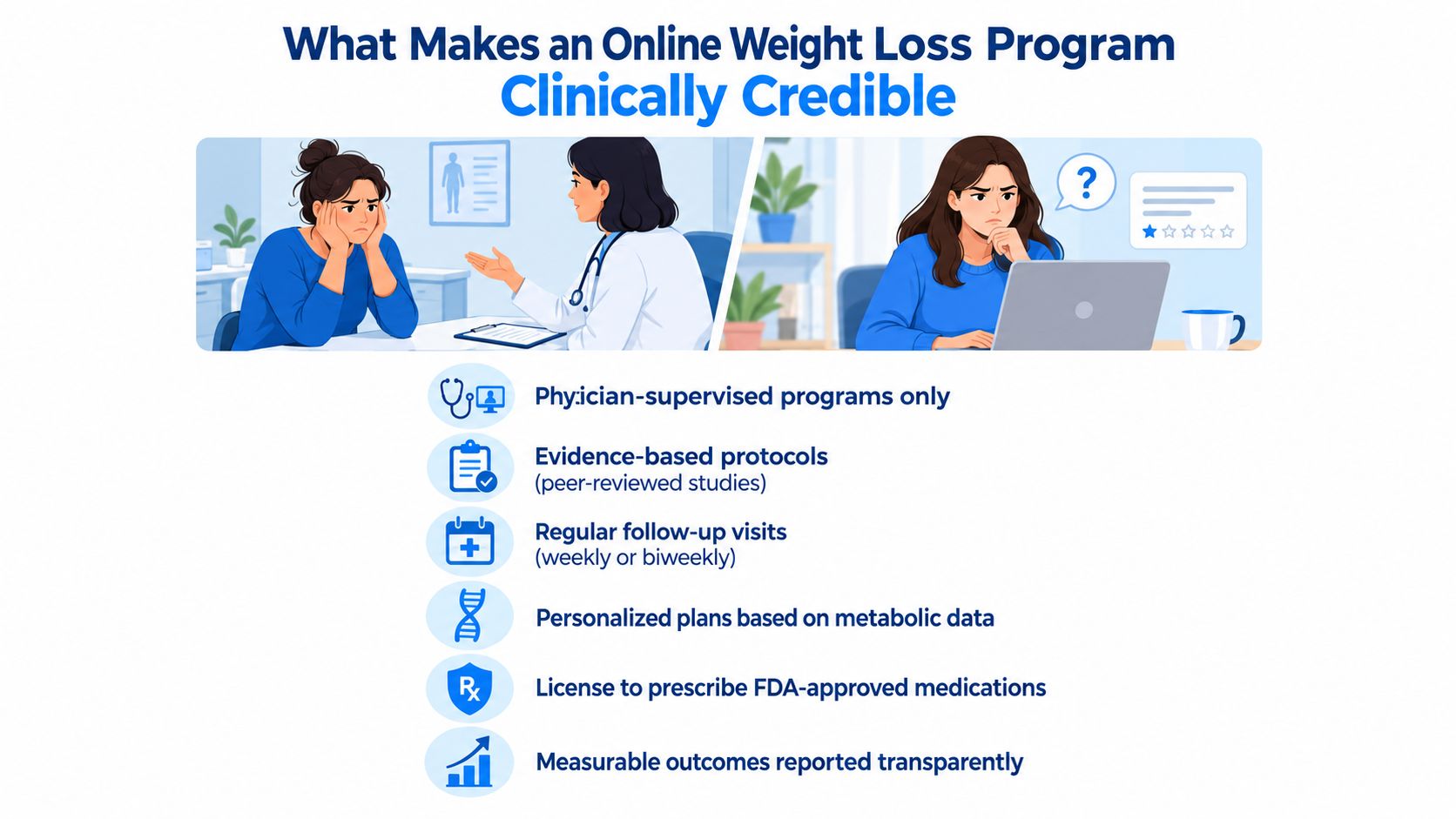
A patient comparing digital options after a frustrating in-person experience usually wants one question answered clearly, does a screen-based clinic mean real oversight? It does only if the program treats obesity as a medical condition, not a marketing funnel. Clinical credibility starts with supervision, then shows up in screening, titration, and follow-up.
The four pillars that matter
First, the program needs licensed physician involvement with authority to prescribe and reassess treatment. Second, eligibility should rest on medical history and labs, not only a questionnaire about motivation. Third, any medication plan should follow a structured titration protocol, because GLP-1 and dual incretin therapy is not a set-it-and-forget-it intervention. Fourth, the program needs an escalation pathway for stalled loss, side effects, or medication shortages, because those are normal inflection points in treatment.
The practical benchmark is whether the program can explain how it decides who qualifies, how often it checks progress, and what happens when the first plan is no longer enough. That matters because real-world digital weight-loss care has shown measurable outcomes at scale, including a mean loss of 4.3 kg after about 120 days in a program that studied 251,718 adults (PubMed). If a program cannot describe its medical workflow, it should not present itself as clinically dependable.
Practical rule: if the intake feels faster than a routine primary-care workup, the supervision is probably thinner than it should be.
A credible program also makes the trade-offs visible. Tight medication access without monitoring can miss side effects, and aggressive loss without attention to lean-mass preservation can leave patients lighter but less well supported. Continuity matters too, because weight loss slows, tolerance changes, and care gaps happen.
Readers can score a program against five questions before signing up. Who is prescribing, what diagnostic data are reviewed, how are medications adjusted, what lifestyle structure is included, and how does the team handle continuity when care gets complicated? Those criteria tell you more than app ratings or before-and-after galleries ever will.
Evidence Base for Online and Telehealth Weight Management
A telehealth program can work well only if the care model matches the treatment. Behavioral counseling, medication management, and scheduled follow-up do not perform the same way, and they should not be judged as if they do. Programs with the strongest clinical footing combine those pieces instead of offering one without the others.
What controlled studies and real-world data show
Telehealth often improves attendance because care is easier to keep. In one comparative study, 97% of telehealth patients attended versus 75% in person, and dropout was 13% versus 21% (PubMed). The same study found that 49% of telehealth patients lost more than 5% of initial body weight, close to 45% in person. For weight management, access and continuity matter as much as the visit format.
Modern obesity pharmacotherapy shows similar patterns when follow-up is built in. In the STEP semaglutide trials, once-weekly semaglutide 2.4 mg produced mean weight loss of 14.9% to 17.4% at 68 weeks, and 86% to 89% of participants achieved at least 5% weight loss versus 29% to 48% with placebo (PMC). In the 2-year STEP 5 trial, semaglutide maintained a mean loss of 15.2% at week 104 versus 2.6% with placebo (Nature). In SURMOUNT-1, once-weekly tirzepatide at 5 mg, 10 mg, and 15 mg produced substantial and sustained reductions compared with placebo (NEJM).
Why the evidence still has limits
The literature is still uneven. Programs vary in coaching intensity, medication access, and monitoring frequency, so a favorable headline does not reveal the actual care model. A telehealth system that sends a prescription without ongoing review is not the same as one that adjusts dose, tracks nutrition, manages adverse effects, and watches for relapse over time.
Controlled efficacy matters, but day-to-day follow-up is what determines whether that efficacy survives real life.
The better question is not whether a program can prescribe. It is whether the team can keep patients engaged long enough to turn early loss into durable treatment. In a 2024 telehealth comparison, 87% of telehealth participants said the program was helpful for losing weight versus 76% in the in-person group, while overall satisfaction stayed above 95% in both arms (PMC).
Comparing Online Weight Loss Program Archetypes
A patient comparing online weight-loss programs usually faces the same question in different packaging. Who is supervising care, and what happens after the first prescription or coaching call? The label matters less than the workflow underneath it, especially when weight loss has to account for lean mass, medication tolerance, and ongoing follow-up.
Five program types and the trade-offs they carry
Physician-led medical programs center on clinician oversight, eligibility review, medication titration, and follow-up. They fit best when labs, side effects, or obesity-related comorbidities need active management. The trade-off is time and participation, because the process is built to function like medical care rather than a quick transaction.
GLP-1 cash-pay clinics usually prioritize speed and access. That can work well for straightforward pharmacotherapy, but screening may be compressed and longitudinal support may be thinner. Those limits matter when a patient needs dose adjustment, continuity, or broader metabolic review instead of a one-time prescription.
Coaching-only platforms help with structure, accountability, and meal planning. Their weakness is clear when medication oversight is needed or when a patient has already cycled through repeated lifestyle-only attempts. They can support habits, but their ceiling is lower for people who need active clinical management.
Compounded-medication marketplaces raise harder questions about formulation consistency, pharmacy sourcing, and follow-up structure. Those questions are not abstract. The clinical value of a compounded regimen depends on who supervises it, how the formulation is prepared, and how reliably the patient is monitored.
Hybrid lifestyle-plus-medication services sit between those models. Their quality varies widely, because one service may have physician coverage while another mainly adds coaching to a thin prescribing workflow.
How to place a program on the map
A practical screen is simple. Ask whether a clinician reviews eligibility directly, whether the program supports lifestyle change alongside medication, and whether patients have a clear line of communication when treatment needs to change. If the answers are vague, the model is probably more consumer-facing than medically integrated.
The strongest programs make the medical part visible. The weakest ones hide it behind automation and branding.
One physician-directed model is Vials + Vitals, which uses online clinical assessment and provider review to determine eligibility and titration schedules. That structure is different from a simple medication storefront, because the prescribing step stays tied to medical review.
GLP-1 Therapy, Lean Mass, and Hair Retention Considerations
A patient can lose weight on GLP-1 therapy and still miss the larger clinical target if the program does not protect muscle, nutrition, and follow-up. The body does not give away fat alone. Some of the loss comes from lean tissue, and that trade-off matters when the goal is better metabolic health, not just a lower scale reading. Strong online programs treat that as a supervision problem, not a cosmetic one.
The semaglutide and tirzepatide trials already showed that GLP-1 therapy can produce substantial weight reduction, so the question in practice is how to keep the loss clinically clean. That means watching protein intake, strength work, GI side effects, and rate of loss together. When those pieces are ignored, patients can end up lighter but weaker, or more likely to abandon treatment because nausea and low intake were never addressed.
A recent review of telehealth-based GLP-1 care found that lean tissue made up a meaningful share of total loss, and only a small number of studies involved a registered dietitian (JMIR). That finding does not argue against medication. It argues for programs that pair prescribing with nutrition guidance and body-composition awareness.
Hair loss signals deserve careful interpretation
Hair shedding during treatment is often blamed on the medication, but the more likely explanation is the stress of rapid weight loss, reduced intake, or micronutrient gaps. A 2026 PubMed review notes that no prospective, controlled studies have specifically evaluated hair loss with GLP-1 receptor agonists, that the strongest evidence is for semaglutide and tirzepatide, and that rapid weight loss can plausibly trigger telogen effluvium (PubMed). In practice, that means new shedding should prompt a review of diet, pace of loss, and nutrient status before treatment is blamed outright.
What good programs should coach
- Protein first: enough intake to slow lean-mass loss during active weight reduction.
- Resistance training: regular strength work to help preserve muscle during calorie deficits.
- Symptom review: nausea, constipation, reduced intake, and fatigue should be checked early.
- Hair and nutrient monitoring: sudden shedding, brittle nails, or tight dietary restriction should trigger review.
A program that skips these steps is treating the scale, not the patient. The better model keeps medication management and body-composition support in the same plan, because long-term success depends on both.
Matching Online Programs to Real-World Use Cases
The right program depends on the job that needs doing. A plateau breaker needs a different structure than a person who just needs habit scaffolding, and neither should be forced into the same template. Matching the program to the use case keeps patients from overbuying intensity they don't need or underbuying care they do.
When escalation, simplicity, or behavior support is the priority
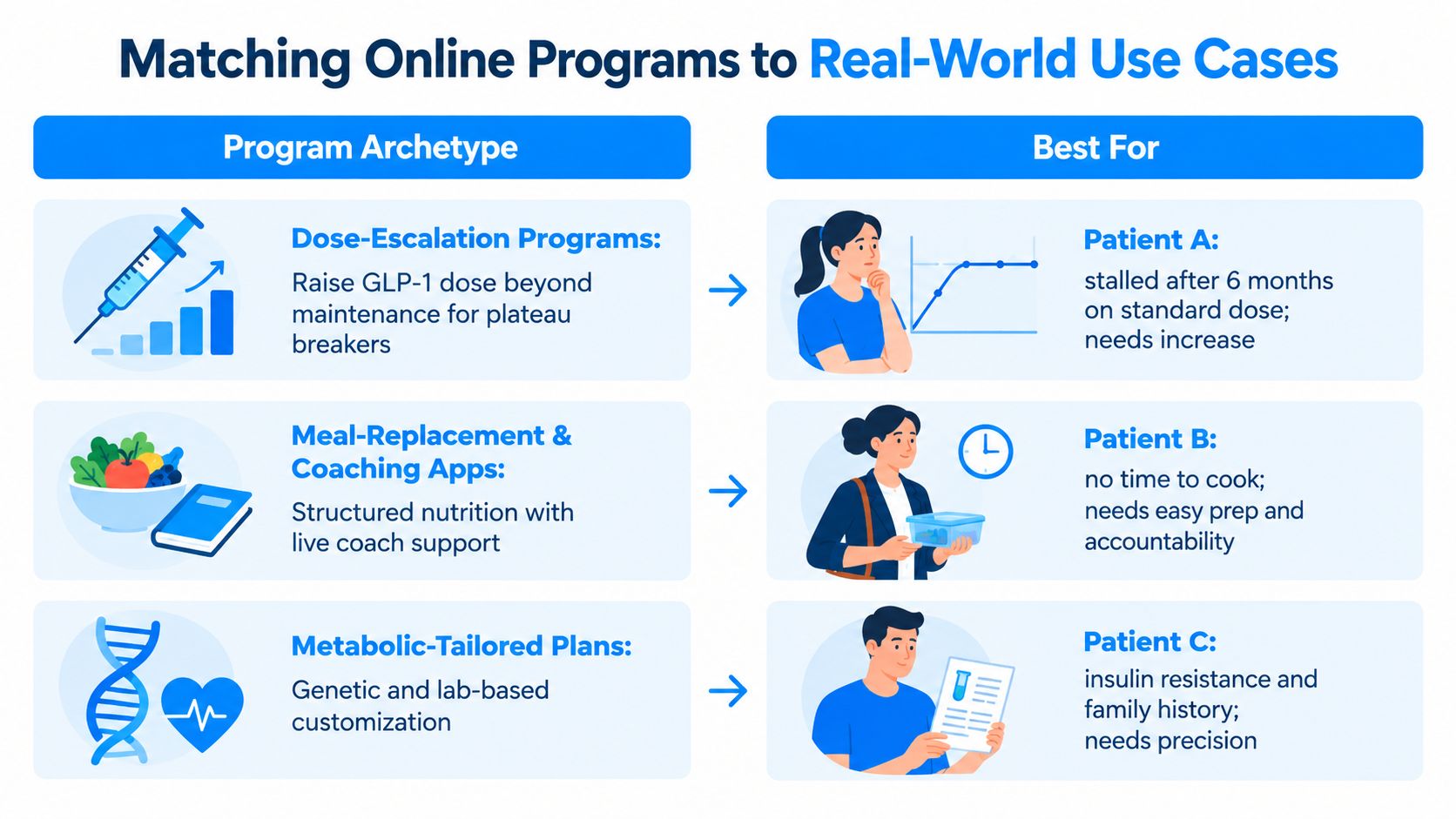
A patient stuck after months on a standard dose usually needs a program with real escalation pathways. That means a clinician who can review tolerability, labs, and response, then adjust therapy instead of leaving the patient frozen at a maintenance setting. The best fit is a physician-led or hybrid medical program with active titration rather than coaching alone.
Needle-averse patients need a different conversation. Programs that offer oral options or other non-injectable pathways can reduce friction, though oral semaglutide access can be constrained and should be verified directly before enrollment. For some patients, a behavioral-first platform is enough, but only if the weight-loss target is modest and the person doesn't need medication-level support.
Lifestyle-only candidates are usually looking for structure, not prescriptions. They benefit most from coaching-led programs that include meal planning, sleep routines, stress modules, and resistance-training guidance. That model can work well when the patient's biggest barrier is consistency, but its ceiling is lower when obesity is more advanced or when prior attempts have already failed.
How continuity changes the experience
Continuity matters more than many buyers realize. A program that checks in once and disappears after the first refill leaves the patient on their own when travel, illness, holidays, or side effects interrupt the routine. A continuous-care model can adjust labs, pace titration, and respond to relapse faster, which is often what determines whether the next month becomes a rebound or a restart.
The program that handles interruptions well is usually the one that handles treatment well.
For readers who want medication, coaching, and follow-up in one place, the best fit is often the model that keeps prescriber access and support tied together, not split across separate vendors or anonymous messages. That structure is especially relevant when a patient's goals extend beyond short-term appetite suppression and into durable metabolic change.
Evaluating Clinical Supervision and Continuity of Care
The most useful screening tool is a checklist that goes beyond marketing. If a program won't show how it evaluates risk, prescribes medication, and follows up after initiation, that's a sign the clinical layer may be too thin for long-term use. Patients should ask those questions before paying, not after the first adverse effect.
What to verify before enrollment
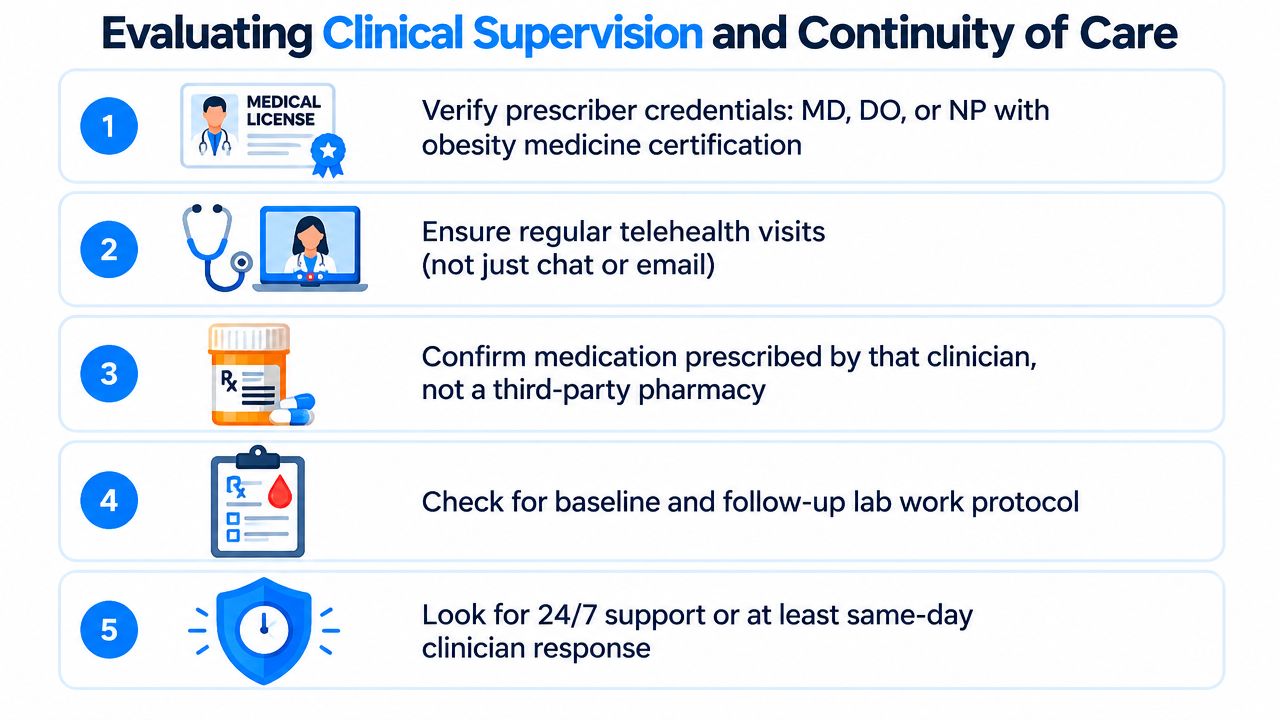
A credible prescriber should be a board-certified physician in internal medicine, family medicine, endocrinology, or obesity medicine, with nurse practitioners working under appropriate physician oversight where required. The initial workup should include baseline metabolic screening, and the program should say how it repeats testing once treatment is underway. For GLP-1 therapy, readers should expect a defined plan for labs and symptom review rather than vague reassurance.
Key items to confirm:
- Prescriber identity: who is responsible for decisions, not just intake.
- Medication source: whether the drug is FDA-approved or compounded, and how pharmacy quality is controlled.
- Follow-up schedule: how often the patient is seen, and whether those visits are video, not just chat.
- Adverse-event response: what happens if nausea, dehydration, or medication intolerance appears.
- Exit planning: how the program handles tapering, interruption, or transition off treatment.
Why pharmacy and follow-up details matter
Medication quality and continuity are tied together. A patient who can't get the same formulation consistently is not in a stable treatment pathway, even if the first prescription arrives quickly. The same is true if follow-up is limited to automated check-ins, because dose changes and side effects need real clinical judgment.
A program should also track more than the scale. Body composition, symptom burden, and adherence patterns matter because the goal is not just weight loss, it's better weight loss. That's where continuity shows up in practice, through scheduled follow-ups and a plan for adjustments when the first approach isn't enough.
Choosing the Right Online Weight Loss Program for You
A patient with multiple metabolic risks needs a different program than someone who mainly wants accountability. A plateau case also needs more clinical flexibility than someone beginning treatment for the first time. The right choice follows the medical problem, not the marketing.
Match the program to the patient profile
A high-BMI patient needing intensive medical oversight should favor a physician-led program with labs, titration, and regular follow-up. That setup is better suited to side effects, continuity gaps, and dose changes. Convenience matters, but it should not override whether the clinician can see the full clinical picture.
A mid-range patient prioritizing adherence coaching may fit a hybrid model if prescriber access is real, not symbolic. The stronger versions pair nutrition structure with medical supervision that can respond when progress slows. If a program cannot explain how those pieces work together, it is probably a weak fit.
A plateau case requiring escalation pathways needs a program that can adjust dose, consider another therapy, or revisit the broader metabolic plan. Structured titration and ongoing review matter here. A fixed subscription model does poorly with a changing clinical problem.
A lifestyle-only user seeking behavioral structure can choose a coaching-led program if expectations stay realistic. These models work best when the main need is accountability, meal planning, and habit building. They are a poor fit when medication-level treatment may be needed later.
The practical question is not whether a program sounds personalized. It is whether the supervision matches the patient's complexity and keeps working after the first prescription or coaching plan.
| Reader profile | Clinical priority | Recommended archetype | Key evaluation factor |
|---|---|---|---|
| High-BMI patient | Medical oversight | Physician-led medical program | Prescriber access and labs |
| Mid-range patient | Adherence support | Hybrid lifestyle-plus-medication service | Follow-up cadence |
| Plateau case | Escalation | Continuous-care medical program | Titration flexibility |
| Lifestyle-only user | Behavior structure | Coaching-led platform | Coaching depth |
The clinical bottom line is straightforward. The best online weight loss program is the one whose supervision intensity fits the patient's medical complexity, whose nutrition support helps preserve lean tissue, and whose continuity plan still works when treatment becomes messy. Anything less is a digital front end on incomplete care.
If the goal is medically supervised weight loss with real titration oversight, Vials + Vitals provides telehealth assessment, clinician review, and protocol-driven GLP-1 and dual-incretin care with pharmacy fulfillment when treatment is appropriate. Readers who want a physician-directed option can review how online evaluation and ongoing supervision fit this topic.
Ready to see if this protocol fits your biology?
A licensed provider reviews every request before anything is prescribed.
Calibrate your metabolic protocol →